Organic Chemistry PYQ — Page 12
JEE Main Chemistry — Organic Chemistry previous year questions with solutions.
All Organic Chemistry Questions (1783)
The alkane from below having two secondary hydrogens is :
In the sulphur estimation, 0.20 g of a pure organic compound gave 0.40 g of barium sulphate. The percentage of sulphur in the compound is ______ $\times 10^{-1} \%$. (Molar mass : $\mathrm{O}=16, \mathrm{~S}=32, \mathrm{Ba}=137$ in $\mathrm{g} \mathrm{mol}^{-1}$ )
Match the Compounds (List - I) with the appropriate Catalyst/Reagents (List - II) for their reduction into corresponding amines. 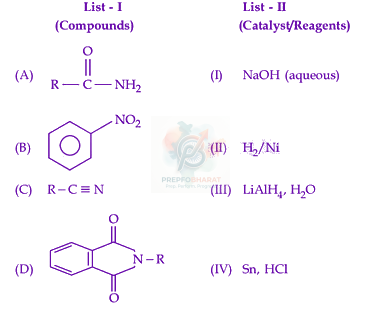 Choose the correct answer from the options given below :
A compound ' $\mathrm{X}^{\prime}$ absorbs 2 moles of hydrogen and ' $\mathrm{X}^{\prime}$ upon oxidation with $\mathrm{KMnO}_4 \mid \mathrm{H}^{+}$gives  The total number of $\sigma$ bonds present in the compound ' $\mathrm{X}^{\prime}$ is______
The structure of the major product formed in the following reaction is : 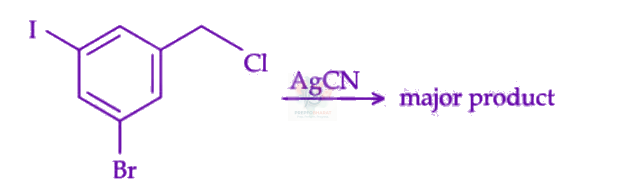
In Dumas' method for estimation of nitrogen, 0.5 gram of an organic compound gave 60 mL of nitrogen collected at 300 K temperature and 715 mm Hg pressure. The percentage composition of nitrogen in the compound (Aqueous tension at $300 \mathrm{~K}=15 \mathrm{~mm} \mathrm{Hg})$ is
Following are the four molecules "P", "Q", "R" and "S". Which one among the four molecules will react with $\mathrm{H}-\mathrm{Br}_{(\mathrm{aq})}$ at the fastest rate? 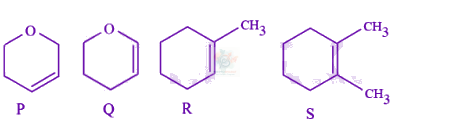
Which of the following arrangements with respect to their reactivity in nucleophilic addition reaction is correct?
In Dumas' method 292 mg of an organic compound released 50 mL of nitrogen gas $\left(\mathrm{N}_2\right)$ at 300 K temperature and 715 mm Hg pressure. The percentage composition of ' N ' in the organic compound is ________ % (Nearest integer) (Aqueous tension at $300 \mathrm{~K}=15 \mathrm{~mm} \mathrm{Hg}$)
An organic compound (X) with molecular formula $\mathrm{C}_3 \mathrm{H}_6 \mathrm{O}$ is not readily oxidised. On reduction it gives $\mathrm{C}_3 \mathrm{H}_8 \mathrm{O}(\mathrm{Y})$ which reacts with HBr to give a bromide (Z) which is converted to Grignard reagent. This Grignard reagent on reaction with (X) followed by hydrolysis give 2,3-dimethylbutan-2-ol. Compounds $(\mathrm{X}),(\mathrm{Y})$ and $(\mathrm{Z})$ respectively are :
The correct stability order of the following species/molecules is: 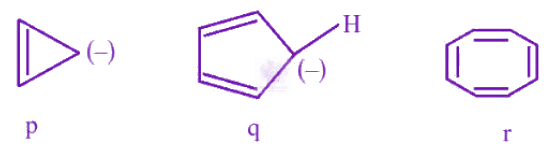
In Carius method of estimation of halogen, 0.25 g of an organic compound gave 0.15 g of silver bromide $(\mathrm{AgBr})$. The percentage of Bromine in the organic compound is $\ldots\ldots$ $\times 10^{-1 \%}$ (Nearest integer). (Given : Molar mass of Ag is 108 and Br is $80 \mathrm{~g} \mathrm{~mol}^{-1}$ )
Match List-I with List-II - $\begin{array}{|l|l|l|l|}<br />\hline & \begin{array}{l}<br />\text { List-I } \\ \text { (Separation of) }<br />\end{array} & & \begin{array}{l}<br />\text { List-II } \\ \text { (Separation } \\ \text { Technique) }<br />\end{array} \\ \hline \text { (A) } & \begin{array}{l}<br />\text { Aniline from } \\ \text { aniline-water } \\ \text { mixture }<br />\end{array} & \text { (I) } & \begin{array}{l}<br />\text { Simple } \\ \text { distillation }<br />\end{array} \\ \hline \text { (B) } & \begin{array}{l}<br />\text { Glycerol from } \\ \text { spent-lye in soap } \\ \text { industry }<br />\end{array} & \text { (II) } & \begin{array}{l}<br />\text { Fractional } \\ \text { distillation }<br />\end{array} \\ \hline \text { (C) } & \begin{array}{l}<br />\text { Different } \\ \text { fractions of crude } \\ \text { oil in petroleum } \\ \text { industry }<br />\end{array} & \text { (III) } & \begin{array}{l}<br />\text { Distillation } \\ \text { at reduced } \\ \text { pressure }<br />\end{array} \\ \hline \text { (D) } & \begin{array}{l}<br />\text { Chloroform- } \\ \text { Aniline mixture }<br />\end{array} & \text { (IV) } & \begin{array}{l}<br />\text { Steam } \\ \text { distillation }<br />\end{array} \\ \hline<br />\end{array}$ Choose the correct answer from the options given below :
In the following series of reactions identify the major products A \& B respectively. 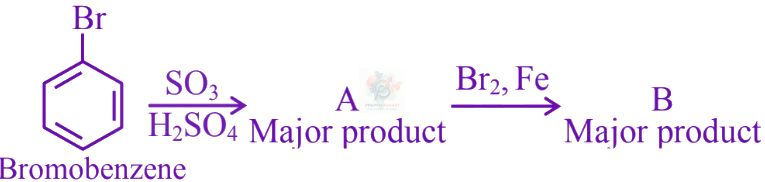
Identify correct conversion during acidic hydrolysis from the following : (A) starch gives galactose. (B) cane sugar gives equal amount of glucose and fructose. (C) milk sugar gives glucose and galactose. (D) amylopectin gives glucose and fructose. (E) amylose gives only glucose. Choose the correct answer from the options given below :
Given below are two statements : Statement (I) : On nitration of m-xylene with $\mathrm{HNO}_3, \mathrm{H}_2 \mathrm{SO}_4$ followed by oxidation, 4-nitrobenzene-1,3-dicarboxylic acid is obtained as the major product. Statement (II) : $-\mathrm{CH}_3$ group is o/p-directing while $-\mathrm{NO}_2$ group is m-directing group. In the light of the above statements, choose the correct answer from the options given below :
What is the correct IUPAC name of 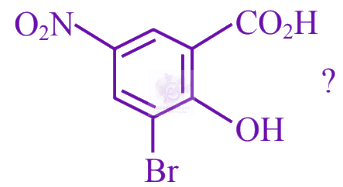
Which of the following is the correct IUPAC name of given organic compound $(\mathrm{X})$ ? 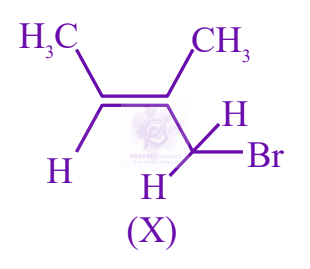
Identify the correct statements from the following 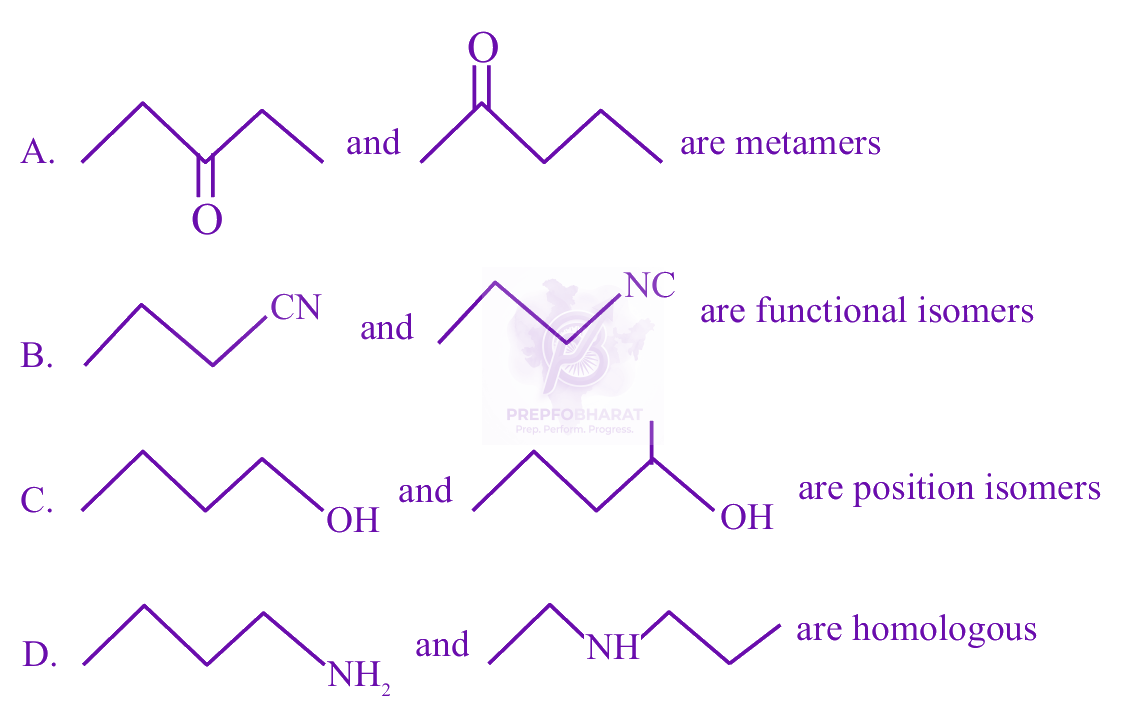 Choose the correct answer from the options given below
Given below are two statements: Statement I: In Lassaigne's test, the covalent organic molecules are transformed into ionic compounds. Statement II: The sodium fusion extract of an organic compound having N and S gives prussian blue colour with $\mathrm{FeSO}_4$ and $\mathrm{Na}_4\left[\mathrm{Fe}(\mathrm{CN})_6\right]$ In the light of the above statements, choose the correct answer from the options given below.
During estimation of nitrogen by Dumas' method of compound $\mathrm{X}(0.42 \mathrm{~g})$ : 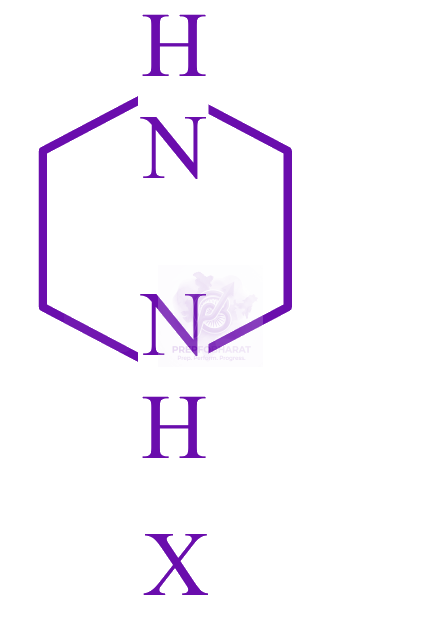 _____ mL of $\mathrm{N}_2$ gas will be liberated at STP. (nearest integer) (Given molar mass in $\mathrm{g} \mathrm{mol}^{-1}: \mathrm{C}: 12, \mathrm{H}: 1$, $\mathrm{N}: 14)$
Fat soluble vitamins are : A. Vitamin $B_1$ B. Vitamin C C. Vitamin E D. Vitamin $\mathrm{B}_{12}$ E. Vitamin K Choose the correct answer from the options given below :
The purification method based on the following physical transformation is : 
Benzene is treated with oleum to produce compound (X) which when further heated with molten sodium hydroxide followed by acidification produces compound (Y).The compound Y is treated with zinc metal to produce compound $(\mathrm{Z})$. Identify the structure of compound $(\mathrm{Z})$ from the following option.