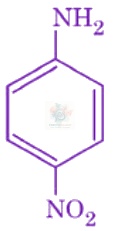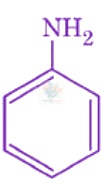
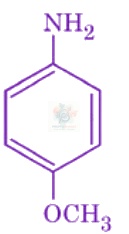
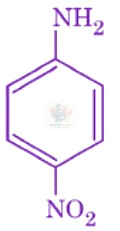
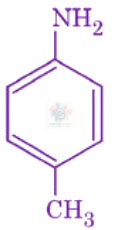
The strength of a conjugate acid is inversely proportional to the basic strength of its corresponding base. Thus, the weakest base will form the strongest conjugate acid.
The basicity of anilines depends on the availability of the lone pair on the nitrogen atom. Electron-withdrawing groups decrease basicity by withdrawing electron density, while electron-donating groups increase basicity.
In 4-nitroaniline, the −NO2 group is a strong electron-withdrawing group due to its −R and −I effects. This strongly delocalizes the lone pair of electrons on the nitrogen atom, making 4-nitroaniline the weakest base among the given options.
In contrast, −OCH3 (+R effect) and −CH3 (+I and hyperconjugation) are electron-donating groups that increase basicity, making 4-methoxyaniline and 4-methylaniline stronger bases than aniline.
Since 4-nitroaniline is the weakest base, its conjugate acid is the strongest.
Answer: 4-nitroaniline