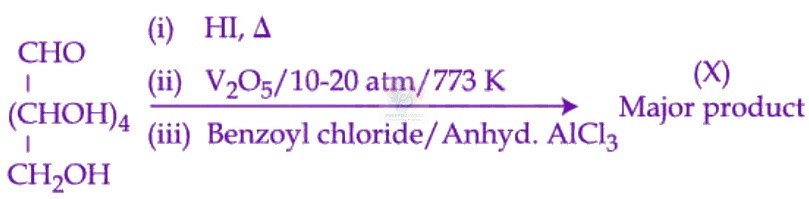
Step 1: The starting material is an aldohexose (like D-glucose). On prolonged heating with HI, it undergoes reduction to form n-hexane. This indicates that all six carbon atoms are linked in a straight chain.
CHO−(CHOH)4−CH2OHHI, ΔCH3−CH2−CH2−CH2−CH2−CH3 (n-hexane)
Step 2: n-Hexane, when passed over heated V2O5 at 773 K and 10−20 atm pressure, undergoes aromatization (dehydrogenation and cyclization) to form benzene.
n-hexaneV2O5, 773 K, 10-20 atmC6H6 (Benzene)
Step 3: Benzene reacts with benzoyl chloride (C6H5COCl) in the presence of anhydrous AlCl3 to form benzophenone. This is a Friedel-Crafts acylation reaction.
C6H6+C6H5COClAnhyd. AlCl3C6H5−CO−C6H5 (Benzophenone)
Step 4: Analyze the product (X), which is benzophenone.
The structure of benzophenone consists of two phenyl rings attached to a carbonyl group.
Each phenyl ring contains 3 π bonds, so two rings have 6 π bonds.
The carbonyl group (C=O) contains 1 π bond.
Total number of π bonds = 6+1=7.
Total number of π electrons = 7×2=14.
The oxygen atom in the carbonyl group has 2 lone pairs of electrons.
Total number of lone pair electrons = 2×2=4.
Total number of electrons in the π bonds and lone pairs = 14+4=18.
Answer: 18