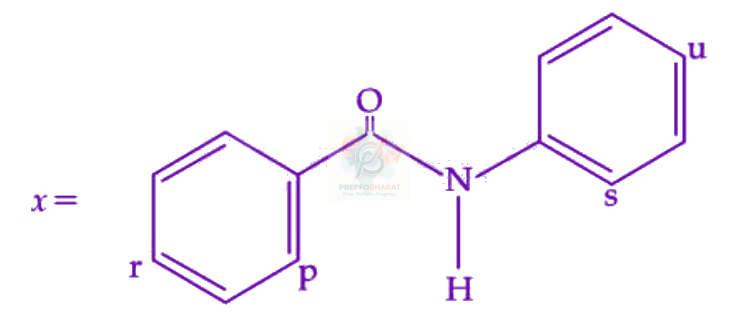
The given molecule, benzanilide, contains two phenyl rings with different reactivities towards electrophilic aromatic substitution.
The left phenyl ring is attached to the carbonyl carbon of the amide group (−C(=O)NHPh). The carbonyl group is electron-withdrawing due to its −M and −I effects, which deactivates this ring towards electrophilic attack.
The right phenyl ring is attached to the nitrogen atom of the amide group (−NHC(=O)Ph). The nitrogen atom possesses a lone pair of electrons that can delocalize into the ring via resonance (+M effect). This electron donation activates the right ring, making it significantly more reactive than the left ring.
The −NHC(=O)Ph group is an ortho/para directing group. The possible sites for electrophilic attack on the activated ring are the ortho position ('s') and the para position ('u').
Due to the large steric bulk of the −NHC(=O)Ph group, the ortho position ('s') experiences significant steric hindrance. Therefore, the electrophile will preferentially attack the less hindered para position.
Thus, the preferred site for the attack of the electrophile is predominantly at 'u'.
Answer: Predominantly at "u"