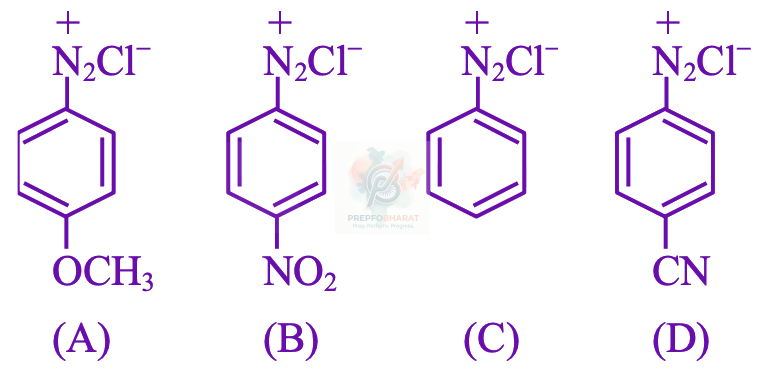
The stability of benzenediazonium salts is governed by the electronic effects of the substituents present on the benzene ring.
The diazonium group −N2+ is strongly electron-withdrawing. Electron-donating groups (EDG) stabilize the diazonium cation by dispersing the positive charge through resonance or inductive effects, whereas electron-withdrawing groups (EWG) destabilize it by increasing the positive charge density.
In (A), the −OCH3 group at the para position is a strong electron-donating group via the +M effect, which significantly stabilizes the diazonium ion.
In (C), there is no substituent (hydrogen), providing a baseline stability.
In (D), the −CN group is an electron-withdrawing group via −M and −I effects, which destabilizes the cation.
In (B), the −NO2 group is a very strong electron-withdrawing group via −M and −I effects, even stronger than −CN, leading to the least stability.
Comparing the effects: +M of −OCH3 (A) > H (C) > −M of −CN (D) > −M of −NO2 (B).
Therefore, the correct stability order is A>C>D>B.