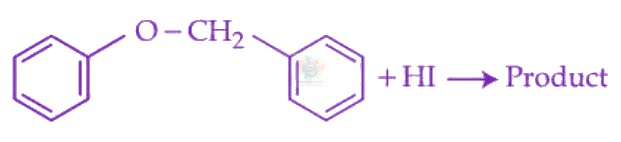
The given reactant is phenyl benzyl ether (C6H5−O−CH2−C6H5).
When it reacts with HI, the ether oxygen is first protonated to form an oxonium ion. The cleavage of the ether linkage then takes place.
The C6H5−O bond has partial double bond character due to the resonance of the oxygen's lone pair with the benzene ring, making it strong and difficult to break. On the other hand, the O−CH2 bond is a weaker single bond. Moreover, cleavage of the O−CH2 bond can proceed via a highly stable benzyl carbocation (in an SN1 mechanism) or undergo facile SN2 attack by the iodide ion (I−) at the less sterically hindered and activated benzylic carbon.
Therefore, the I− ion attacks the CH2 group, cleaving the O−CH2 bond. The products formed are phenol (C6H5OH) and benzyl iodide (C6H5CH2I).
Statement I claims the products are benzyl alcohol and iodobenzene, which is incorrect. Thus, Statement I is false.
Statement II claims that the −O−CH2− bond is cleaved to give the product, which is correct. Thus, Statement II is true.
Answer: Statement I is false but Statement II is true