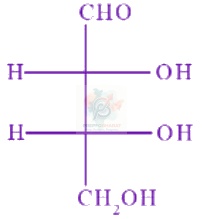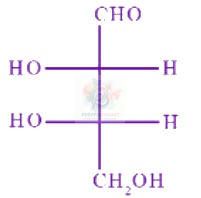
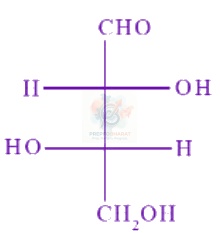
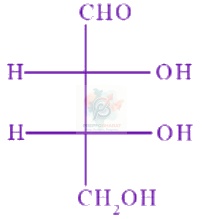
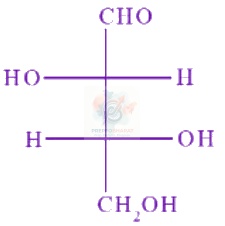
For a carbohydrate to be classified as a D-sugar, the hydroxyl (−OH) group on the lowest chiral carbon (C3 in the case of an aldotetrose) must be on the right side in its Fischer projection. This eliminates options (A) and (B), which are L-sugars.
Oxidation of an aldotetrose with concentrated HNO3 converts both the aldehyde (−CHO) group at C1 and the primary alcohol (−CH2OH) group at C4 into carboxylic acid (−COOH) groups, yielding a dicarboxylic acid (tartaric acid).
The problem states that the resulting dicarboxylic acid is optically inactive. This implies that the product must be a meso compound, which requires a plane of symmetry. For the dicarboxylic acid to possess a plane of symmetry, the −OH groups on C2 and C3 must be on the same side in the Fischer projection.
Looking at the D-sugars:
Option (C) is D-erythrose. Upon oxidation, it forms meso-tartaric acid, which has a plane of symmetry and is optically inactive.
Option (D) is D-threose. Upon oxidation, it forms an optically active tartaric acid because it lacks a plane of symmetry.
Therefore, the correct structure of the D-aldotetrose is given in option (C).
Answer: