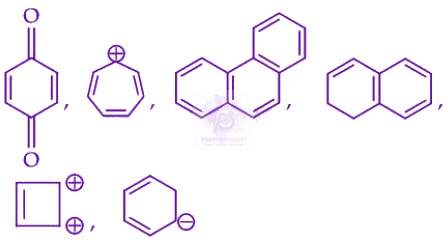
A species is aromatic if it is cyclic, planar, fully conjugated (continuous cyclic overlap of p-orbitals) and contains (4n+2)π electrons (Huckel's rule). Let us analyse each species.
1,4-Benzoquinone:
The six-membered ring has only 4π electrons (from the two C=C bonds); the two C=O groups are cross-conjugated and do not contribute to a continuous (4n+2)π ring system. Hence, it is non-aromatic.
Tropylium cation:
A planar, cyclic, fully conjugated seven-membered system with three C=C bonds and a positive charge (empty p-orbital). It has 6π electrons, satisfying Huckel's rule with n=1. It is aromatic.
Phenanthrene:
A fused tricyclic, planar, fully conjugated hydrocarbon with 14π electrons. It obeys Huckel's rule with n=3. It is aromatic.
1,2-Dihydronaphthalene:
It contains an intact benzene ring fused to a partially saturated six-membered ring. Because of the benzene ring, the molecule as a whole is classified as aromatic.
Cyclobutadiene dication:
A planar, four-membered ring with one C=C bond and two positive charges (two empty p-orbitals), giving 2π electrons. It satisfies Huckel's rule with n=0. It is aromatic.
Cyclohexadienyl anion (as drawn with a −CH2− group):
The sp3 −CH2− carbon breaks the continuous cyclic conjugation, so the ring is not fully conjugated. Hence, it is non-aromatic.
Counting the aromatic species: tropylium cation, phenanthrene, 1,2-dihydronaphthalene and cyclobutadiene dication give a total of 4 aromatic species.
Hence, the correct option is (2) 4.