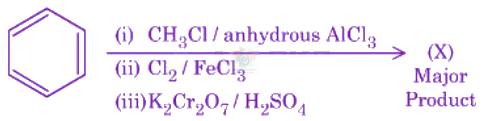
Step 1: The first reaction is a Friedel-Crafts alkylation. Benzene reacts with CH3Cl in the presence of anhydrous AlCl3 to form toluene.
Step 2: The second reaction is electrophilic aromatic substitution. Toluene reacts with Cl2 in the presence of FeCl3 to form a mixture of o-chlorotoluene and p-chlorotoluene. Due to steric hindrance at the ortho position, the major product is p-chlorotoluene.
Step 3: The third reaction is the oxidation of the alkyl side chain. p-chlorotoluene is oxidized by K2Cr2O7/H2SO4 to form p-chlorobenzoic acid, which is the major product (X).
The molecular formula of p-chlorobenzoic acid is C7H5ClO2.
Molar mass of (X)=(7×12)+(5×1)+35.5+(2×16)=84+5+35.5+32=156.5 g mol−1.
Step 4: Reaction of p-chlorobenzoic acid with NaHCO3 liberates CO2 gas:
C6H4ClCOOH+NaHCO3→C6H4ClCOONa+H2O+CO2↑
From the stoichiometry, 1 mole of p-chlorobenzoic acid produces 1 mole of CO2 gas.
Volume of CO2 liberated at STP = 11.2 dm3.
Moles of CO2 liberated = 22.411.2=0.5 mol.
Therefore, moles of p-chlorobenzoic acid reacted = 0.5 mol.
Mass of (X) reacted, P=0.5 mol×156.5 g mol−1=78.25 g.
Answer: 78.25