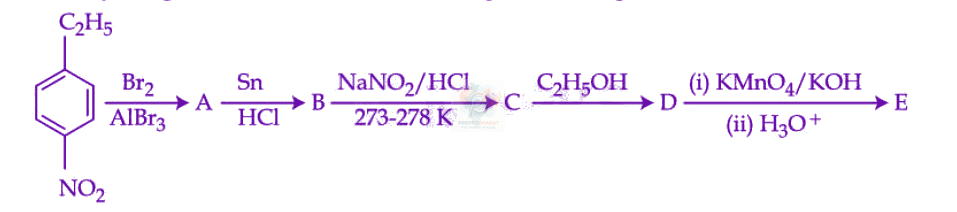
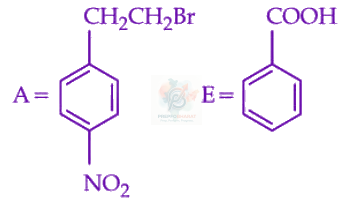
The starting compound is 1-ethyl-4-nitrobenzene.
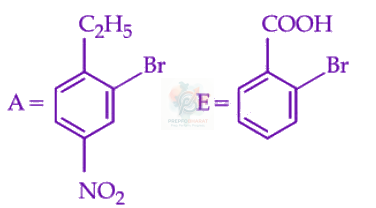
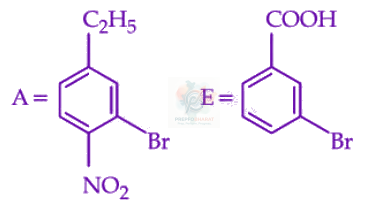
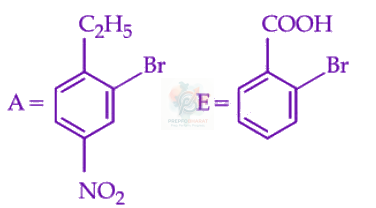
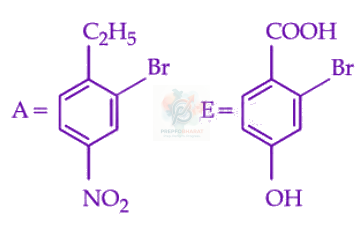
Reaction with Br2/AlBr3 is an electrophilic aromatic substitution. The −C2H5 group is activating and ortho/para-directing, while the −NO2 group is deactivating and meta-directing. Both groups direct the incoming electrophile (Br+) to the position ortho to the −C2H5 group. Thus, compound A is 2-bromo-1-ethyl-4-nitrobenzene.
Reaction with Sn/HCl reduces the −NO2 group to an −NH2 group, forming compound B (4-amino-2-bromo-1-ethylbenzene).
Reaction with NaNO2/HCl at 273−278 K converts the −NH2 group into a diazonium salt, forming compound C (3-bromo-4-ethylbenzenediazonium chloride).
Reaction with ethanol (C2H5OH) reduces the diazonium group, replacing it with a hydrogen atom. This forms compound D (1-bromo-2-ethylbenzene).
Reaction with alkaline KMnO4 followed by acidic hydrolysis oxidizes the ethyl side chain (−C2H5) to a carboxylic acid group (−COOH). The bromine atom remains unaffected. This forms compound E (2-bromobenzoic acid).
Answer: