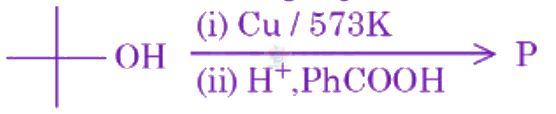
Step 1: The first reagent is Cu at 573 K. When a tertiary alcohol like tert-butyl alcohol is passed over heated copper at 573 K, it undergoes dehydration rather than dehydrogenation to form an alkene.
(CH3)3C−OHCu/573 KCH2=C(CH3)2+H2O
The intermediate product is isobutylene (2-methylpropene).
Step 2: The second set of reagents is H+ and PhCOOH (benzoic acid). This is an acid-catalyzed addition of a carboxylic acid to an alkene, which is a standard method for synthesizing tert-butyl esters.
First, the alkene is protonated by the acid to form the most stable carbocation, which is the tertiary butyl carbocation:
CH2=C(CH3)2+H+⇌(CH3)3C+
Next, the carboxylic acid acts as a nucleophile and attacks the carbocation. The oxygen atom of the benzoic acid attacks the tert-butyl carbocation, followed by deprotonation:
PhCOOH+(CH3)3C+⇌Ph−CO−O+(H)−C(CH3)3⇌Ph−CO−O−C(CH3)3+H+
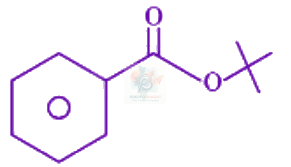
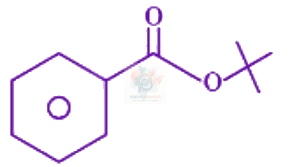
The final major product is tert-butyl benzoate. Electrophilic aromatic substitution (Friedel-Crafts alkylation) on the benzene ring does not occur here because the −COOH group is strongly deactivating, making O-alkylation (ester formation) the highly preferred pathway.
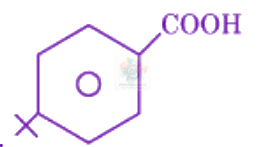
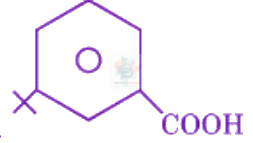
Comparing this with the given options, Option (C) represents the structure of tert-butyl benzoate.
Answer: