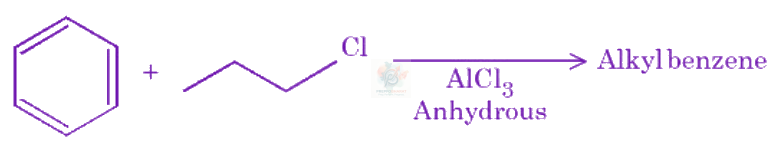
In the given Friedel-Crafts alkylation reaction, 1-chloropropane reacts with anhydrous AlCl3 to initially form a primary carbocation, the n-propyl carbocation (CH3−CH2−CH2+).
This primary carbocation is less stable and undergoes a 1,2-hydride shift to form a more stable secondary carbocation, the iso-propyl carbocation (CH3−CH+−CH3). Therefore, statement B is correct.
The iso-propyl carbocation then acts as an electrophile and attacks the benzene ring, yielding iso-propylbenzene (cumene) as the major product. Thus, statement A is incorrect.
Once an alkyl group is introduced to the benzene ring, it acts as an electron-donating group (via hyperconjugation and inductive effect), which activates the ring. This makes the newly formed alkylbenzene more reactive towards electrophilic aromatic substitution than the original benzene molecule, leading to polyalkylation. Hence, multiple substitution is a common and inevitable drawback. Therefore, statement C is correct.
Introducing an electron-donating substituent on benzene generally activates the ring and facilitates Friedel-Crafts alkylation (except for strong Lewis bases like −NH2 which complex with AlCl3). Thus, statement D is incorrect.
Therefore, only statements B and C are correct.
Answer: B and C only