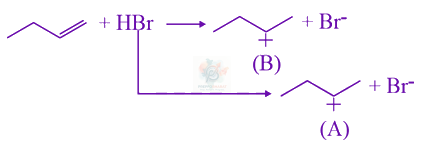
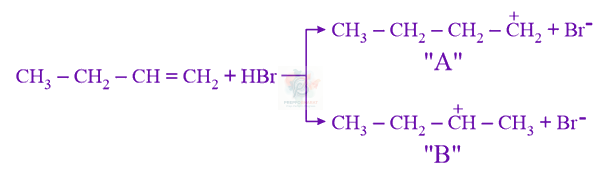
This is more stable due to secondary cation formation and formed with faster rate due to low activation energy.
JEE Main 2021 — Chemistry Organic Chemistry
Choose the correct statement regarding the formation of carbocations A and B given :-
Held on 17 Mar 2021 · Verified 6 Jul 2026.
Carbocation B is more stable and formed relatively at faster rate
Carbocation A is more stable and formed relatively at slow rate
Carbocation B is more stable and formed relatively at slow rate
Carbocation A is more stable and formed relatively at faster rate
Sign in to track your attempts and accuracy.
Sign in to keep a private note on this question. Nothing you write is ever public.
A hydroxy compound $(\mathrm{X})$ with molar mass $122 \mathrm{~g} \mathrm{~mol}^{-1}$ is acetylated with acetic anhydride, using a large excess of the reagent ensuring complete acetylation of all hydroxyl groups. The product obtained has a molar mass of $290 \mathrm{~g} \mathrm{~mol}^{-1}$. The number of hydroxyl groups present in compound (X) is:
Given below are two statements: Statement I: Benzene is nitrated to give nitrobenzene, which on further treatment with $\mathrm{CH}_{3} \mathrm{COCl} / \mathrm{AlCl}_{3}$ will give 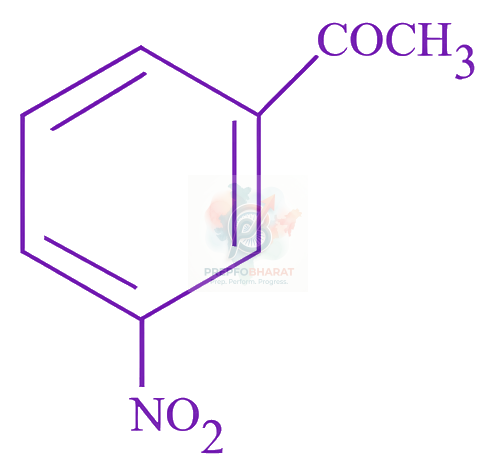 Statement II: $-\mathrm{NO}_{2}$ group is a $m$-directing, and deactivating group. In the light of the above statements, choose the most appropriate answer from the options given below
Given below are two statements: Statement I: $\left(\mathrm{CH}_{3}\right)_{3} \stackrel{\oplus}{\mathrm{C}}$ is more stable than $\stackrel{\oplus}{\mathrm{C}} \mathrm{H}_{3}$ as nine hyperconjugation interactions are possible in $\left(\mathrm{CH}_{3}\right)_{3} \stackrel{\oplus}{\mathrm{C}}$. Statement II: $\stackrel{\oplus}{\mathrm{C}} \mathrm{H}_{3}$ is less stable than $\left(\mathrm{CH}_{3}\right)_{3} \stackrel{\oplus}{\mathrm{C}}$ as only three hyperconjugation interactions are possible in $\stackrel{\oplus}{\mathrm{C}} \mathrm{H}_{3}$. In the light of the above statements, choose the correct answer from the options given below
Sucrose hydrolyses in acidic medium into glucose and fructose by first order rate law with $t_{1/2} = 3$ hour. The percentage of sucrose remaining after $6$ hours is _______. (Nearest integer) (Given: $\log 2 = 0.3010$ and $\log 3 = 0.4771$)
Consider the following reaction sequence 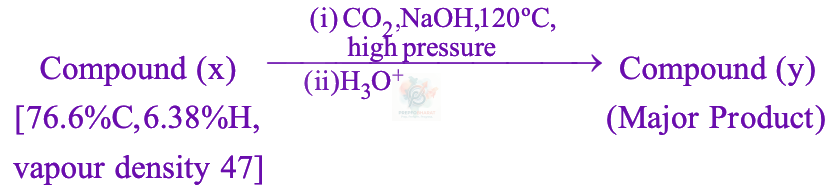 Compound $(\mathrm{y})$ develops characteristic colour with neutral $\mathrm{FeCl}_{3}$ solution. Identify the INCORRECT statement from the following for the above sequence.
Work through every JEE Main Organic Chemistry PYQ, year by year.