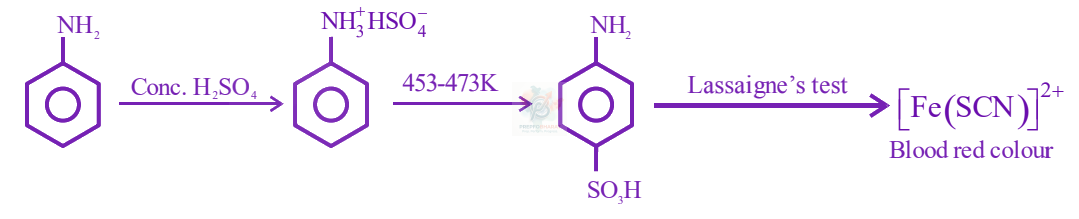
Aniline reacts with conc.H2SO4followed by heating at 453−473Kgives p-aminobenzene sulphonic acid, which gives blood red colour in the 'Lassaigne's test'Nitrogen, sulphur, and halogens present in organic compounds are detected by Lassaigne's test. Here, a small piece of Na metal is heated in a fusion tube with the organic compound. The principle is that, in doing so, Na converts all the elements present into ionic form.
Aniline does not undergo Friedel-Crafts reaction (alkylation and acetylation) due to salt formation with aluminium chloride, the Lewis acid, which is used as a catalyst. Due to this, nitrogen of aniline acquires positive charge and hence acts as a strong deactivating group for further reaction.