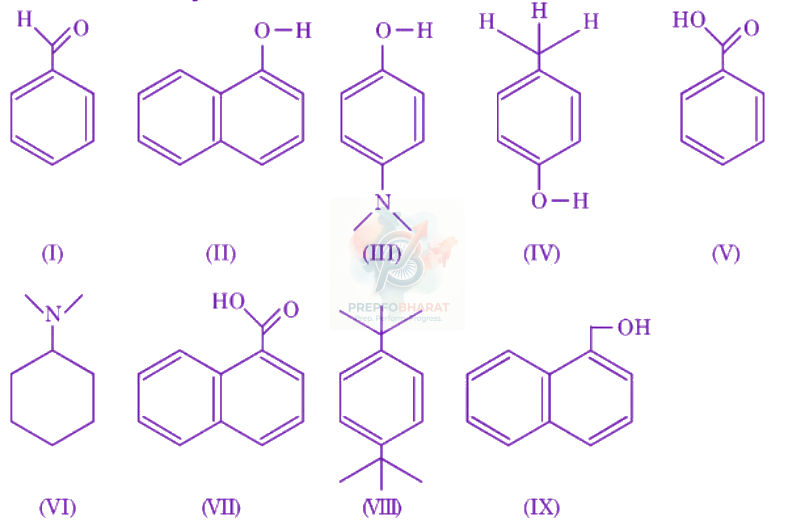
To determine which compounds are soluble in aqueous NaOH, we need to identify the compounds that are sufficiently acidic to react with NaOH (a strong base) to form water-soluble sodium salts. Generally, carboxylic acids and phenols are acidic enough to dissolve in aqueous NaOH, whereas alcohols, aldehydes, amines, and hydrocarbons are not.
Let us analyze each compound:
(I) Benzaldehyde: It is an aldehyde. It does not have an acidic proton and is insoluble in aqueous NaOH.
(II) 1-Naphthol: It is a phenol derivative. Phenols are acidic and react with NaOH to form soluble phenoxide salts. (Soluble)
(III) 4-(Dimethylamino)phenol: It contains a phenolic −OH group. Despite the basic amino group, the acidic phenol group will react with NaOH to form a soluble salt. (Soluble)
(IV) p-Cresol: It is a phenol derivative. It reacts with NaOH to form a soluble sodium salt. (Soluble)
(V) Benzoic acid: It is a carboxylic acid, which is highly acidic and readily dissolves in aqueous NaOH. (Soluble)
(VI) N,N-Dimethylcyclohexanamine: It is an aliphatic amine. It is basic in nature and insoluble in aqueous NaOH.
(VII) 1-Naphthoic acid: It is a carboxylic acid and will dissolve in aqueous NaOH. (Soluble)
(VIII) 1,4-Di-tert-butylbenzene: It is a hydrocarbon. It is neutral and insoluble in aqueous NaOH.
(IX) 1-Naphthalenemethanol: It is an alcohol (benzyl-type). Alcohols are generally not acidic enough to react with aqueous NaOH. (Insoluble)
The compounds soluble in aqueous NaOH are (II), (III), (IV), (V), and (VII).
Total number of soluble compounds = 5.
Answer: 5