JEE Main 2025 — Algebra
Mathematics Algebra questions from JEE Main 2025.
Other Years
187 Algebra Questions from 2025
Consider the equation $\mathrm{x}^2+4 \mathrm{x}-\mathrm{n}=0$, where $\mathrm{n} \in[20,100]$ is a natural number. Then the number of all distinct values of $n$, for which the given equation has integral roots, is equal to
If α and β are roots of x² - 5x + 6 = 0, then α³ + β³ equals:
Let $A=\left[\begin{array}{ccc}\cos \theta & 0 & -\sin \theta \\ 0 & 1 & 0 \\ \sin \theta & 0 & \cos \theta\end{array}\right]$. If for some $\theta \in(0, \pi)$, $A^2=A^T$, then the sum of the diagonal elements of the matrix $(\mathrm{A}+\mathrm{I})^3+(\mathrm{A}-\mathrm{I})^3-6 \mathrm{~A}$ is equal to _____ .
Define a relation R on the interval \(\left[0, \frac{\pi}{2}\right)\) by \(x \mathrm{R} y\) if and only if \(\sec ^2 x-\tan ^2 y=1\). Then R is :
If $\alpha$ is a root of the equation $x^2+x+1=0$ and $\sum_{\mathrm{k}=1}^{\mathrm{n}}\left(\alpha^{\mathrm{k}}+\frac{1}{\alpha^{\mathrm{k}}}\right)^2=20$, then n is equal to
For the quadratic equation ax² + bx + c = 0 to have two distinct real roots, the discriminant must satisfy:
Let $\alpha, \beta, \gamma$ and $\delta$ be the coefficients of $x^7, x^5, x^3$ and $x$ respectively in the expansion of $\left(x+\sqrt{x^3-1}\right)^5+\left(x-\sqrt{x^3-1}\right)^5, x\gt1$. If u and v satisfy the equations $\begin{aligned} & \alpha u+\beta v=18 \\ & \gamma u+\delta v=20 \end{aligned}$ then $u+v$ equals :
Let $A=\{1,2,3, \ldots, 10\}$ and $B=\left\{\frac{m}{n}: m, n \in A, m \lt n\right.$ and $\left.\operatorname{gcd}(m, n)=1\right\}$. Then $n(B)$ is equal to :
If the system of linear equations : $\begin{aligned} & x+y+2 z=6 \\ & 2 x+3 y+\mathrm{a} z=\mathrm{a}+1 \\ & -x-3 y+\mathrm{b} z=2 \mathrm{~b} \end{aligned}$ where $a, b \in \mathbf{R}$, has infinitely many solutions, then $7 a+3 b$ is equal to :
$\begin{aligned}<br/>& \text { If } \frac{1}{1^4}+\frac{1}{2^4}+\frac{1}{3^4}+\ldots . . \infty=\frac{\pi^4}{90}, \\ & \frac{1}{1^4}+\frac{1}{3^4}+\frac{1}{5^4}+\ldots . . \infty=\alpha, \\ & \frac{1}{2^4}+\frac{1}{4^4}+\frac{1}{6^4}+\ldots . \infty=\beta,<br/>\end{aligned}$ then $\frac{\alpha}{\beta}$ is equal to
Let the system of equations : $\begin{aligned}<br/>& 2 x+3 y+5 z=9 \\ & 7 x+3 y-2 z=8 \\ & 12 x+3 y-(4+\lambda) z=16-\mu<br/>\end{aligned}$ have infinitely many solutions. Then the radius of the circle centred at $(\lambda, \mu)$ and touching the line $4 x=3 y$ is
The system of equations $\begin{aligned} & x+y+z=6 \\ & x+2 y+5 z=9, \\ & x+5 y+\lambda z=\mu, \end{aligned}$ has no solution if
If the system of equations $\begin{aligned} & 2 x-y+z=4 \\ & 5 x+\lambda y+3 z=12 \\ & 100 x-47 y+\mu z=212 \end{aligned}$ has infinitely many solutions, then $\mu-2 \lambda$ is equal to
If the system of equations $\begin{aligned} & x+2 y-3 z=2 \\ & 2 x+\lambda y+5 z=5 \\ & 14 x+3 y+\mu z=33 \end{aligned}$ has infinitely many solutions, then $\lambda+\mu$ is equal to :
Let the coefficients of three consecutive terms $T_r, T_{r+1}$ and $T_{r+2}$ in the binomial expansion of $(a+b)^{12}$ be in a G.P. and let $p$ be the number of all possible values of $r$. Let $q$ be the sum of all rational terms in the binomial expansion of $(\sqrt[4]{3}+\sqrt[3]{4})^{12}$. Then $\mathrm{p}+\mathrm{q}$ is equal to :
Let $\mathrm{a} \in \mathbf{R}$ and A be a matrix of order $3 \times 3$ such that $\operatorname{det}(A)=-4$ and $A+I=\left[\begin{array}{lll}1 & a & 1 \\ 2 & 1 & 0 \\ a & 1 & 2\end{array}\right]$, where $I$ is the identity matrix of order $3 \times 3$. If $\operatorname{det}((a+1) \operatorname{adj}((a-1) A))$ is $2^m 3^n, m, n \in$ $\{0,1,2, \ldots .20\}$, then $\mathrm{m}+\mathrm{n}$ is equal to :
Let $A=\left[\begin{array}{cc}\frac{1}{\sqrt{2}} & -2 \\ 0 & 1\end{array}\right]$ and $P=\left[\begin{array}{cc}\cos \theta & -\sin \theta \\ \sin \theta & \cos \theta\end{array}\right], \theta\gt0$. If $\mathrm{B}=\mathrm{PAP}^{\mathrm{T}}, \mathrm{C}=\mathrm{P}^{\mathrm{T}} \mathrm{B}^{10} \mathrm{P}$ and the sum of the diagonal elements of $C$ is $\frac{\mathrm{m}}{\mathrm{n}}$, where $\operatorname{gcd}(\mathrm{m}, \mathrm{n})=1$, then $\mathrm{m}+\mathrm{n}$ is :
If $\sum_{\mathrm{r}=1}^9\left(\frac{\mathrm{r}+3}{2^{\mathrm{r}}}\right) .{ }^9 \mathrm{C}_{\mathrm{r}}=\alpha\left(\frac{3}{2}\right)^9-\beta, \quad \alpha, \beta \in \mathrm{N}, \quad$ then $(\alpha+\beta)^2$ is equal to
Let $A$ be a $3 \times 3$ real matrix such that $A^2(A-2 I)-$ $4(\mathrm{~A}-\mathrm{I})=\mathrm{O}$, where I and O are the identity and null matrices, respectively. If $A^5=\alpha A^2+\beta A+\gamma I$, where $\alpha, \beta$ and $\gamma$ are real constants, then $\alpha+\beta+\gamma$ is equal to:
If the domain of the function $f(x)=\log _7\left(1-\log _4\left(x^2-9 x+18\right)\right)$ is $(\alpha, \beta) \cup(\gamma, \delta)$, then $\alpha+\beta+\gamma+\delta$ is equal to
If $f(x)=\frac{2^x}{2^x+\sqrt{2}}, \mathrm{x} \in \mathbb{R}$, then $\sum_{\mathrm{k}=1}^{81} f\left(\frac{\mathrm{k}}{82}\right)$ is equal to
For some $n \neq 10$, let the coefficients of the 5 th, 6 th and 7 th terms in the binomial expansion of $(1+\mathrm{x})^{\mathrm{n}+4}$ be in A.P. Then the largest coefficient in the expansion of $(1+\mathrm{x})^{\mathrm{n}+4}$ is:
The number of natural numbers, between 212 and 999 , such that the sum of their digits is 15 , is
$1+3+5^2+7+9^2+\ldots$ upto 40 terms is equal to
Let $A=\{-2,-1,0,1,2,3\}$. let R be a relation on A defined by $x R y$ if and only if $y=\max \{x, 1\}$. Let $l$ be the number of elements in R. Let m and n be the minimum number of elements required to be added in R to make it reflexive and symmetric relations, respectively. Then $l+\mathrm{m}+\mathrm{n}$ is equal to
If the system of linear equations $\begin{aligned} & 3 x+y+\beta z=3 \\ & 2 x+\alpha y-z=-3 \\ & x+2 y+z=4\end{aligned}$ has infinitely many solutions, then the value of $22 \beta-9 \alpha$ is :
The interior angles of a polygon with n sides, are in an A.P. with common difference $6^{\circ}$. If the largest interior angle of the polygon is $219^{\circ}$, then n is equal to
Let $\alpha, \beta$ be the roots of the equation $x^2-a x-b=0$ with $\operatorname{Im}(\alpha) \lt \operatorname{Im}(\beta)$. Let $P_n=\alpha^n-\beta^n$. If $\mathrm{P}_3=-5 \sqrt{7} i, \mathrm{P}_4=-3 \sqrt{7} i, \mathrm{P}_5=11 \sqrt{7} i$ and $\mathrm{P}_6=45 \sqrt{7} i$, then $\left|\alpha^4+\beta^4\right|$ is equal to $\qquad$ .
Among the statements (S1) : The set $\left\{\mathrm{z} \in \mathbb{C}-\{-\mathrm{i}\}:|\mathrm{z}|=1\right.$ and $\frac{\mathrm{z}-\mathrm{i}}{\mathrm{z}+\mathrm{i}}$ is purely real} contains exactly two elements, and (S2) : The set $\left\{\mathrm{z} \in \mathbb{C}-\{-1\}:|\mathrm{z}|=1\right.$ and $\frac{\mathrm{z}-1}{\mathrm{z}+1}$ is purely imaginary contains infinitely many elements.
The sum $1+3+11+25+45+71+.$. upto 20 terms, is equal to
Let $\mathrm{T}_{\mathrm{r}}$ be the $\mathrm{r}^{\text {th }}$ term of an A.P. If for some $\mathrm{m}, \mathrm{T}_{\mathrm{m}}=\frac{1}{25}, \mathrm{~T}_{25}=\frac{1}{20}$, and $20 \sum_{\mathrm{r}=1}^{25} \mathrm{~T}_{\mathrm{r}}=13$, then $5 \mathrm{~m} \sum_{\mathrm{r}=\mathrm{m}}^{2 \mathrm{~m}} \mathrm{~T}_{\mathrm{r}}$ is equal to
Let $\mathrm{R}=\{(1,2),(2,3),(3,3)\}$ be a relation defined on the set $\{1,2,3,4\}$. Then the minimum number of elements, needed to be added in R so that R becomes an equivalence relation, is:
Let $I$ be the identity matrix of order $3 \times 3$ and for the matrix $\mathrm{A}=\left[\begin{array}{ccc}\lambda & 2 & 3 \\ 4 & 5 & 6 \\ 7 & -1 & 2\end{array}\right],|\mathrm{A}|=-1$. Let B be the inverse of the matrix $\operatorname{adj}\left(\mathrm{A} \operatorname{adj}\left(\mathrm{A}^2\right)\right)$. Then $|(\lambda B+1)|$ is equal to _____
Let $A=\left[\begin{array}{cc}\alpha & -1 \\ 6 & \beta\end{array}\right], \alpha \gt 0$, such that $\operatorname{det}(A)=0$ and $\alpha+\beta=1$. If I denotes $2 \times 2$ identity matrix, then the matrix $(1+\mathrm{A})^8$ is:
From all the English alphabets, five letters are chosen and are arranged in alphabetical order. The total number of ways, in which the middle letter is ' M ', is :
Let $A=\left[a_{i j}\right]$ be $3 \times 3$ matrix such that $A\left[\begin{array}{l}0 \\ 1 \\ 0\end{array}\right]=\left[\begin{array}{l}0 \\ 0 \\ 1\end{array}\right], A\left[\begin{array}{l}4 \\ 1 \\ 3\end{array}\right]=\left[\begin{array}{l}0 \\ 1 \\ 0\end{array}\right]$ and $A\left[\begin{array}{l}2 \\ 1 \\ 2\end{array}\right]=\left[\begin{array}{l}1 \\ 0 \\ 0\end{array}\right]$, then $a_{23}$ equals :
Let $A=\{1,2,3\}$. The number of relations on $A$, containing $(1,2)$ and $(2,3)$, which are reflexive and transitive but not symmetric, is ______ -
Let M denote the set of all real matrices of order $3 \times 3$ and let $\mathrm{S}=\{-3,-2,-1,1,2\}$. Let $$ \begin{aligned} & \mathrm{S}_1=\left\{\mathrm{A}=\left[a_{\mathrm{ij}}\right] \in \mathrm{M}: \mathrm{A}=\mathrm{A}^{\mathrm{T}} \text { and } a_{\mathrm{ij}} \in \mathrm{~S}, \forall \mathrm{i}, \mathrm{j}\right\}, \\ & \mathrm{S}_2=\left\{\mathrm{A}=\left[a_{\mathrm{ij}}\right] \in \mathrm{M}: \mathrm{A}=-\mathrm{A}^{\mathrm{T}} \text { and } a_{\mathrm{ij}} \in \mathrm{~S}, \forall \mathrm{i}, \mathrm{j}\right\}, \\ & \mathrm{S}_3=\left\{\mathrm{A}=\left[a_{\mathrm{ij}}\right] \in \mathrm{M}: a_{11}+a_{22}+a_{33}=0 \text { and } a_{\mathrm{ij}} \in \mathrm{~S}, \forall \mathrm{i}, \mathrm{j}\right\} . \end{aligned} $$ If $n\left(\mathrm{~S}_1 \cup_2 \mathrm{US}_3\right)=125 \alpha$, then $\alpha$ equals _______
Let the matrix $A=\left[\begin{array}{lll}1 & 0 & 0 \\ 1 & 0 & 1 \\ 0 & 1 & 0\end{array}\right]$ satisfy $A^n=A^{n-2}+A^2-I$ for $\mathrm{n} \geq 3$. Then the sum of all the elements of $\mathrm{A}^{50}$ is :-
The remainder when $\left((64)^{(64)}\right)^{(64)}$ is divided by 7 is equal to
Consider the sets $\mathrm{A}=\left\{(\mathrm{x}, \mathrm{y}) \in \mathbb{R} \times \mathbb{R}: \mathrm{x}^2+\mathrm{y}^2=25\right\}$, $\mathrm{B}=\left\{(\mathrm{x}, \mathrm{y}) \in \mathbb{R} \times \mathbb{R}: \mathrm{x}^2+9 \mathrm{y}^2=144\right\}, \mathrm{C}=\{(\mathrm{x}, \mathrm{y})$ $\left.\in \mathbb{Z} \times \mathbb{Z}: x^2+y^2 \leq 4\right\}$, and $D=A \cap B$. The total number of one-one functions from the set D to the set C is:
Let $X=\mathbf{R} \times \mathbf{R}$. Define a relation $R$ on $X$ as : $\left(a_1, b_1\right) R\left(a_2, b_2\right) \Leftrightarrow b_1=b_2$ Statement I : $\quad \mathrm{R}$ is an equivalence relation. Statement II : For some $(a, b) \in X$, the set $S=\{(x, y) \in X:(x, y) R(a, b)\}$ represents a line parallel to $y=x$. In the light of the above statements, choose the correct answer from the options given below :
The number of sequences of ten terms, whose terms are either 0 or 1 or 2 , that contain exactly five 1 s and exactly three 2 s , is equal to
The number of words, which can be formed using all the letters of the word "DAUGHTER", so that all the vowels never come together, is
Let $\left(1+x+x^2\right)^{10}=a_0+a_1 x+a_2 x^2+\ldots .+a_{20} x^{20}$. If $\left(a_1+a_3+a_5+\ldots .+a_{19}\right)-11 \mathrm{a}_2=121 \mathrm{k}$, then k is equal to $\qquad$ .
For an integer $\mathrm{n} \geq 2$, if the arithmetic mean of all coefficients in the binomial expansion of $(x+y)^{2 n-3}$ is 16 , then the distance of the point $P\left(2 n-1, n^2-4 n\right)$ from the line $x+y=8$ is:
Let $f(x)+2 f\left(\frac{1}{x}\right)=x^2+5$ and $2 g(x)-3 g\left(\frac{1}{2}\right)=x, x \gt 0$. If $\alpha=\int_1^2 f(x) d x$, and $\beta=\int_1^2 g(x) d x$, then the value of $9 \alpha+\beta$ is:
If the domain of the function $f(x)=\log _e\left(\frac{2 x-3}{5+4 x}\right)+\sin ^{-1}\left(\frac{4+3 x}{2-x}\right) \quad \text { is } \quad[\alpha, \beta)$ then $\alpha^2+4 \beta$ is equal to
If the domain of the function $f(x)=\frac{1}{\sqrt{10+3 x-x^2}}+\frac{1}{\sqrt{x+|x|}}$ is $(a, b)$, then $(1+a)^2+b^2$ is equal to :
If the domain of the function $\log _5\left(18 x-x^2-77\right)$ is $(\alpha, \beta)$ and the domain of the function $\log _{(x-1)}\left(\frac{2 x^2+3 x-2}{x^2-3 x-4}\right)$ is $(\gamma, \delta)$, then $\alpha^2+\beta^2+\gamma^2$ is equal to :
$\text { The number of real solution(s) of the equation } x^2+3 x+2=\min \{|x-3|,|x+2|\} \text { is : }$
Let A be the set of all functions $f: \mathbf{Z} \rightarrow \mathbf{Z}$ and R be a relation on A such that $\mathrm{R}=\{(\mathrm{f}, \mathrm{g}): f(0)=\mathrm{g}(1)$ and $f(1)=\mathrm{g}(0)\}$. Then R is:
Let $O$ be the origin, the point $A$ be $z_1=\sqrt{3}+2 \sqrt{2} i$, the point $B\left(z_2\right)$ be such that $\sqrt{3}\left|z_2\right|=\left|z_1\right|$ and $\arg \left(z_2\right)=\arg \left(z_1\right)+\frac{\pi}{6}$. Then
Let $A$ be a matrix of order $3 \times 3$ and $|A|=5$. If $|2 \operatorname{adj}(3 \mathrm{~A} \operatorname{adj}(2 \mathrm{~A}))|=2^\alpha \cdot 3^\beta \cdot 5^\gamma \alpha, \beta, \gamma \in \mathrm{N}$ then $\alpha+\beta+\gamma$ is equal to
Let $\alpha$ and $\beta$ be the roots of $x^2+\sqrt{3 x}-16=0$, and $\gamma$ and $\delta$ be the roots of $x^2+3 x-1=0$. If $P_n=\alpha^n+\beta^n$ and $Q_n=\gamma^n+\delta^n$, then $\frac{\mathrm{P}_{25}+\sqrt{3 \mathrm{P}_{24}}}{2 \mathrm{P}_{23}}+\frac{\mathrm{Q}_{25}-\mathrm{Q}_{23}}{\mathrm{Q}_{24}}$ is equal to
The number of different 5 digit numbers greater than 50000 that can be formed using the digits 0 , $1,2,3,4,5,6,7$, such that the sum of their first and last digits should not be more than 8 , is
Let the domain of the function $f(x)=\cos ^{-1}\left(\frac{4 x+5}{3 x-7}\right)$ be $[\alpha, \beta]$ and the domain of $\mathrm{g}(\mathrm{x})=\log _2\left(2-6 \log _{27}(2 \mathrm{x}+5)\right)$ be $(\gamma, \delta)$. Then $|7(\alpha+\beta)+4(\gamma+\delta)|$ is equal to ________
The sum of all rational terms in the expansion of $\left(1+2^{1 / 3}+3^{1 / 2}\right)^6$ is equal to
For $t \gt -1$, let $\alpha_t$ and $\beta_t$ be the roots of the equation $\left((t+2)^{\frac{1}{7}}-1\right) x^2+\left((t+2)^{\frac{1}{6}}-1\right)$ $x+\left((t+2)^{\frac{1}{21}}-1\right)=0$ If $\lim _{t \rightarrow-1^{+}} \alpha_t=a$ and $\lim _{t \rightarrow-1^{+}} \beta_t=b$, then $72(a+b)^2$ is equal to ________.
Let $A=\left[a_{i j}\right]$ be a matrix of order $3 \times 3$, with $a_{i j}=(\sqrt{2})^{i+j}$. If the sum of all the elements in the third row of $A^2$ is $\alpha+\beta \sqrt{2}, \alpha, \beta \in \mathbf{Z}$, then $\alpha+\beta$ is equal to :
If $\sum_{r=0}^5 \frac{{ }^{11} C_{2r+1}}{2 r+2}=\frac{\mathrm{m}}{\mathrm{n}}, \operatorname{gcd}(\mathrm{m}, \mathrm{n})=1$, then $\mathrm{m}-\mathrm{n}$ is equal to _______
Let $A=\{0,1,2,3,4,5\}$. Let $R$ be a relation on A defined by $(x, y) \in R$ if and only if max $\{x, y\} \in\{3,4\}$. Then among the statements $\left(\mathrm{S}_1\right)$ : The number of elements in R is 18 , and $\left(\mathrm{S}_2\right)$ : The relation R is symmetric but neither reflexive nor transitive
Consider two sets $A$ and $B$, each containing three numbers in A.P. Let the sum and the product of the elements of A be 36 and p respectively and the sum and the product of the elements of B be 36 and q respectively. Let d and D be the common differences of AP's in A and B respectively such that $D=d+3, d \gt 0$. If $\frac{p+q}{p-q}=\frac{19}{5}$, then $p-q$ is equal to
The product of all solutions of the equation $\mathrm{e}^{5\left(\log _{\mathrm{e}} x\right)^2+3}=x^8, x\gt0$, is :
Let \(\mathrm{S}=\left\{\mathrm{m} \in \mathbf{Z}: \mathrm{A}^{\mathrm{m}^2}+\mathrm{A}^{\mathrm{m}}=3 \mathrm{I}-\mathrm{A}^{-6}\right\}\), where \(\mathrm{A}=\left[\begin{array}{cc}2 & -1 \\ 1 & 0\end{array}\right]\). Then \(\mathrm{n}(\mathrm{S})\) is equal to ______.
If $\alpha$ and $\beta$ are the roots of the equation $2 z^2-3 z-2 \mathrm{i}=0$, where $\mathrm{i}=\sqrt{-1}$, then $16 \cdot \operatorname{Re}\left(\frac{\alpha^{19}+\beta^{19}+\alpha^{11}+\beta^{11}}{\alpha^{15}+\beta^{15}}\right) \cdot \operatorname{lm}\left(\frac{\alpha^{19}+\beta^{19}+\alpha^{11}+\beta^{11}}{\alpha^{15}+\beta^{15}}\right)$ is equal to
The least value of n for which the number of integral terms in the Binomial expansion of \((\sqrt[3]{7}+\sqrt[12]{11})^{\mathrm{n}}\) is 183, is :
Let $A=\{1,6,11,16, \ldots\}$ and $B=\{9,16,23,30, \ldots\}$ be the sets consisting of the first 2025 terms of two arithmetic progressions. Then $n(A \cup B)$ is
Let $\mathrm{A}=\{1,2,3,4\}$ and $\mathrm{B}=\{1,4,9,16\}$. Then the number of many-one functions $f: \mathrm{A} \rightarrow \mathrm{B}$ such that $1 \in f(\mathrm{~A})$ is equal to :
The largest $\mathrm{n} \in \mathrm{N}$ such that $3^{\mathrm{n}}$ divides 50 ! is:
Let $A$ be a $3 \times 3$ matrix such that $\begin{aligned}<br/>& |\operatorname{adj}(\operatorname{adj}(\operatorname{adj} \mathrm{A}))|=81 . \text { If } \\ & \mathrm{S}=\left\{\mathrm{n} \in \mathbb{Z}:(|\operatorname{adj}(\operatorname{adj} A)|)^{\frac{(n-1)^2}{2}}=|A|^{\left(3 n^2-5 n-4\right)}\right\}<br/>\end{aligned}$ , then $\sum_{n \in S}\left|A^{\left(n^2+n\right)}\right|$ is equal to
Let the range of the function $f(x)=6+16 \cos x \cdot \cos \left(\frac{\pi}{3}-x\right) \cdot \cos \left(\frac{\pi}{3}+x\right) \cdot \sin 3 x \cdot \cos 6 x, x \in \mathbf{R}$ be $[\alpha, \beta]$. Then the distance of the point $(\alpha, \beta)$ from the line $3 x+4 y+12=0$ is :
If $z_1, z_2, z_3 \in C$ are the vertices of an equilateral triangle, whose centroid is $\mathrm{z}_0$, then $\sum_{\mathrm{k}=1}^3\left(\mathrm{z}_{\mathrm{k}}-\mathrm{z}_0\right)^2$ is equal to
Let the set of all values of $\mathrm{p} \in \mathbb{R}$, for which both the roots of the equation $x^2-(p+2) x+(2 p+9)=0$ are negative real numbers, be the interval $(\alpha, \beta]$. Then $\beta-2 \alpha$ is equal to
The product of all the rational roots of the equation $\left(x^2-9 x+11\right)^2-(x-4)(x-5)=3$, is equal to
The remainder, when $7^{103}$ is divided by 23 , is equal to :
Let $f$ be a function such that $f(x)+3 f\left(\frac{24}{x}\right)$ $=4 x, x \neq 0$. Then $f(3)+f(8)$ is equal to
From a group of 7 batsmen and 6 bowlers, 10 players are to be chosen for a team, which should include atleast 4 batsmen and atleast 4 bowlers. One batsmen and one bowler who are captain and vice-captain respectively of the team should be included. Then the total number of ways such a selection can be made, is
The relation $R=\{(x, y): x, y \in \mathbb{Z}$ and $x+y$ is even $\}$ is:
In the expansion of $\left(\sqrt[3]{2}+\frac{1}{\sqrt[3]{3}}\right)^n, \mathrm{n} \in \mathrm{N}$, if the ratio of $15^{\text {at }}$ term from the beginning to the $15^{\text {th }}$ term from the end is $\frac{1}{6}$, then the value of ${ }^n C_3$ is:
Let $A$ be a $3 \times 3$ matrix such that $X^T A X=O$ for all nonzero $3 \times 1$ matrices $X=\left[\begin{array}{l}x \\ y \\ z\end{array}\right]$. If $\mathbf{A}\left[\begin{array}{l}1 \\ 1 \\ 1\end{array}\right]=\left[\begin{array}{c}1 \\ 4 \\ -5\end{array}\right], \mathbf{A}\left[\begin{array}{l}1 \\ 2 \\ 1\end{array}\right]=\left[\begin{array}{c}0 \\ 4 \\ -8\end{array}\right]$, and $\operatorname{det}(\operatorname{adj}(2(\mathbf{A}+\mathbf{1})))-2^\alpha 3^\beta 5^\gamma, \alpha, \beta, \gamma \in N$, then $\alpha^2+\beta^2+\gamma^2$ is_____.
Let $f(x)=\log _{\mathrm{e}} x$ and $g(x)=\frac{x^4-2 x^3+3 x^2-2 x+2}{2 x^2-2 x+1}$. Then the domain of $f \circ g$ is
The number of 3 -digit numbers, that are divisible by 2 and 3 , but not divisible by 4 and 9 , is______.
For a $3 \times 3$ matrix $M$, let trace $(M)$ denote the sum of all the diagonal elements of $M$. Let $A$ be a $3 \times 3$ matrix such that $|A|=\frac{1}{2}$ and trace $(A)=3$. If $B=\operatorname{adj}(\operatorname{adj}(2 A))$, then the value of $|B|+$ trace (B) equals :
Let $f: \mathbf{R}-\{0\} \rightarrow(-\infty, 1)$ be a polynomial of degree 2, satisfying $f(x) f\left(\frac{1}{x}\right)=f(x)+f\left(\frac{1}{x}\right)$. If $f(K)=-2 K$, then the sum of squares of all possible values of $K$ is :
The number of real roots of the equation $\mathrm{x}|\mathrm{x}-2|+3|\mathrm{x}-3|+1=0$ is :
Let P be the set of seven digit numbers with sum of their digits equal to 11 . If the numbers in P are formed by using the digits 1,2 and 3 only, then the number of elements in the set \(P\) is :
If $\sum_{r=1}^n T_r=\frac{(2 n-1)(2 n+1)(2 n+3)(2 n+5)}{64}$, then $\lim _{n \rightarrow \infty} \sum_{r=1}^n\left(\frac{1}{T_r}\right)$ is equal to :
Suppose that the number of terms in an A.P. is $2 k, k \in N$. If the sum of all odd terms of the A.P. is 40 , the sum of all even terms is 55 and the last term of the A.P. exceeds the first term by 27, then k is equal to :
There are 12 points in a plane, no three of which are in the same straight line, except 5 points which are collinear. Then the total number of triangles that can be formed with the vertices at any three of these 12 points is
Let $S=\mathbf{N} \cup\{0\}$. Define a relation $R$ from $S$ to $\mathbf{R}$ by : $\mathrm{R}=\left\{(x, y): \log _{\mathrm{e}} y=x \log _{\mathrm{e}}\left(\frac{2}{5}\right), x \in \mathrm{~S}, y \in \mathbf{R}\right\}$ Then, the sum of all the elements in the range of $R$ is equal to :
Let $[x]$ denote the greatest integer less than or equal to $x$. Then the domain of $f(x)=\sec ^{-1}(2[x]+1)$ is :
In a group of 3 girls and 4 boys, there are two boys $B_1$ and $B_2$. The number of ways, in which these girls and boys can stand in a queue such that all the girls stand together, all the boys stand together, but $B_1$ and $B_2$ are not adjacent to each other, is :
If the set of all $\mathrm{a} \in \mathbf{R}$, for which the equation $2 x^2+(a-5) x+15=3 \mathrm{a}$ has no real root, is the interval $(\alpha, \beta)$, and $X=\{x \in Z: \alpha \lt x \lt \beta\}$, then $\sum_{x \in X} x^2$ is equal to :
Let $\mathrm{A}=\{1,2,3, \ldots, 10\}$ and R be a relation on A such that $\mathrm{R}=\{(\mathrm{a}, \mathrm{b}): \mathrm{a}=2 \mathrm{~b}+1\}$. Let $\left(\mathrm{a}_1, \mathrm{a}_2\right)$, $\left(a_2, a_3\right),\left(a_3, a_4\right), \ldots .,\left(a_k, a_{k+1}\right)$ be a sequence of $k$ elements of R such that the second entry of an ordered pair is equal to the first entry of the next ordered pair. Then the largest integer k , for which such a sequence exists, is equal to :
If the system of equations $\begin{aligned} & (\lambda-1) x+(\lambda-4) y+\lambda z=5 \\ & \lambda x+(\lambda-1) y+(\lambda-4) z=7 \\ & (\lambda+1) x+(\lambda+2) y-(\lambda+2) z=9\end{aligned}$ has infinitely many solutions, then $\lambda^2+\lambda$ is equal to
Let $\mathrm{A}=$ $\left\{\theta \in[0,2 \pi]: 1+10 \operatorname{Re}\left(\frac{2 \cos \theta+i \sin \theta}{\cos \theta-3 i \sin \theta}\right)=0\right\} .$ Then $\sum_{\theta \in A} \theta^2$ is equal to
The sum $1+\frac{1+3}{2!}+\frac{1+3+5}{3!}+\frac{1+3+5+7}{4!}+\ldots$ upto $\infty$ terms, is equal to
If the set of all $\mathrm{a} \in \mathrm{R}-\{1\}$, for which the roots of the equation $(1-a) x^2+2(a-3) x+9=0$ are positive is $(-\infty,-\alpha] \cup[\beta, \gamma)$, then $2 \alpha+\beta+\gamma$ is equal to _______ .
The number of solutions of the equation \(\left(\frac{9}{x}-\frac{9}{\sqrt{x}}+2\right)\left(\frac{2}{x}-\frac{7}{\sqrt{x}}+3\right)=0\) is:
Let the system of equations $\begin{aligned}<br/>& x+5 y-z=1 \\ & 4 x+3 y-3 z=7 \\ & 24 x+y+\lambda z=\mu<br/>\end{aligned}$ $\lambda, \mu \in \mathrm{R}$, have infinitely many solutions. Then the number of the solutions of this system, If $x, y, z$ are integers and satisfy $7 \leq x+y+z \leq 77$, is
Let the product of $\omega_1=(8+i) \sin \theta+(7+4 i) \cos \theta$ and $\omega_2=(1+8 i) \sin \theta+(4+7 i) \cos \theta$ be $\alpha+i \beta$, $\mathrm{i}=\sqrt{-1}$. Let p and q be the maximum and the minimum values of $\alpha+\beta$ respectively.
The number of integral terms in the expansion of $\left(5^{\frac{1}{2}}+7^{\frac{1}{8}}\right)^{1016}$ is
If the locus of $z \in \mathrm{C}$, such that $\operatorname{Re}\left(\frac{z-1}{2 z+\mathrm{i}}\right)+\operatorname{Re}\left(\frac{\bar{z}-1}{2 \bar{z}-\mathrm{i}}\right)=2$ is a circle of radius $r$ and center $(a, b)$ then $\frac{15 a b}{r^2}$ is equal to :
Let \(\left|z_1-8-2 i\right| \leq 1\) and \(\left|z_2-2+6 i\right| \leq 2, z_1, z_2 \in \mathbf{C}\). Then the minimum value of \(\left|z_1-z_2\right|\) is :
If $\alpha+i \beta$ and $\gamma+i \delta$ are the roots of $x^2-(3-2 i) x-(2 i-2)=0, i=\sqrt{-1}$, then $\alpha \gamma+\beta \delta$ is equal to :
For $\mathrm{n} \geq 2$, let $S_n$ denote the set of all subsets of $\{1,2 \ldots . . ., n\}$ with no two consecutive numbers. For example $\{1,3,5\} \in \mathrm{S}_6$, but $\{1,2,4\} \notin \mathrm{S}_6$. Then $n\left(\mathrm{~S}_5\right)$ is equal to ________
Let p be the number of all triangles that can be formed by joining the vertices of a regular polygon P of n sides and q be the number of all quadrilaterals that can be formed by joining the vertices of $P$. If $p+q=126$, then the eccentricity of the ellipse $\frac{x^2}{16}+\frac{y^2}{n}=1$ is :
If all the words with or without meaning made using all the letters of the word "KANPUR" are arranged as in a dictionary, then the word at $440^{\text {th }}$ position in this arrangement, is :
The number of 6-letter words, with or without meaning, that can be formed using the letters of the word MATHS such that any letter that appears in the word must appear at least twice, is _______.
Let $\mathrm{x}_1, \mathrm{x}_2, \mathrm{x}_3, \mathrm{x}_4$ be in a geometric progression. $2,7,9,5$ are subtracted respectively from $x_1, x_2, x_3$ $x_4$ then the resulting numbers are in an arithmetic progression. Then the value of $\frac{1}{24}\left(x_1 x_2 x_3 x_4\right)$ is :
For positive integers $n$, if $4 a_n=\left(n^2+5 n+6\right)$ and $S_n=\sum_{k=1}^n\left(\frac{1}{a_k}\right)$, then the value of $507 S_{2025}$ is :
Let $a_1, a_2, a_3 \ldots$ be in an A.P. such that $\sum_{\mathrm{k}=1}^{12} \mathrm{a}_{2 \mathrm{k}-1}=-\frac{72}{5} \mathrm{a}_1, \mathrm{a}_1 \neq 0$. If $\sum_{\mathrm{k}=1}^{\mathrm{n}} \mathrm{a}_{\mathrm{k}}=0$, then n is:
Let $a_1, a_2, \ldots, a_{2024}$ be an Arithmetic Progression such that $a_1+\left(a_5+a_{10}+a_{15}+\ldots+a_{2020}\right)+a_{2024}=2233$. Then $a_1+a_2+a_3+\ldots+a_{2024}$ is equal to _______
Let $S_n=\frac{1}{2}+\frac{1}{6}+\frac{1}{12}+\frac{1}{20}+\ldots$ upto $n$ terms. If the sum of the first six terms of an A.P. with first term -p and common difference p is $\sqrt{2026 \mathrm{~S}_{2025}}$, then the absolute difference betwen $20^{\text {th }}$ and $15^{\text {th }}$ terms of the A.P. is
The sum of the series $2 \times 1 \times{ }^{20} \mathrm{C}_4-3 \times 2 \times{ }^{20} \mathrm{C}_5+4 \times 3 \times{ }^{20} \mathrm{C}_6-5 \times 4$ $\times { }^{20} \mathrm{C}_7+\ldots+18 \times 17 \times{ }^{20} \mathrm{C}_{20}$, is equal to
If the sum of the second, fourth and sixth terms of a G.P. of positive terms is 21 and the sum of its eighth, tenth and twelfth terms is 15309 , then the sum of its first nine terms is :
Let M and m respectively be the maximum and the minimum values of \(f(x)=\left|\begin{array}{ccc} 1+\sin ^2 x & \cos ^2 x & 4 \sin 4 x \\ \sin ^2 x & 1+\cos ^2 x & 4 \sin 4 x \\ \sin ^2 x & \cos ^2 x & 1+4 \sin 4 x \end{array}\right|, x \in \mathrm{R}\) Then \(M^4-m^4\) is equal to :
Let $z_1, z_2$ and $z_3$ be three complex numbers on the circle $|z|=1$ with $\arg \left(z_1\right)=\frac{-\pi}{4}, \arg \left(z_2\right)=0$ and $\arg \left(z_3\right)=\frac{\pi}{4}$. If $\left|z_1 \bar{z}_2+z_2 \bar{z}_3+z_3 \bar{z}_1\right|^2=\alpha+\beta \sqrt{2}, \alpha, \beta \in \mathbf{Z}$, then the value of $\alpha^2+\beta^2$ is :
$\text { The function } f:(-\infty, \infty) \rightarrow(-\infty, 1) \text {, defined by } f(x)=\frac{2^x-2^{-x}}{2^x+2^{-x}} \text { is : }$
Let $\alpha$ be a solution of $x^2+x+1=0$, and for some $a$ and $b$ in $\mathbb{R},\left[\begin{array}{lll}4 & \mathrm{a} & \mathrm{b}\end{array}\right]\left[\begin{array}{ccc}1 & 16 & 13 \\ -1 & -1 & 2 \\ -2 & -14 & -8\end{array}\right]=\left[\begin{array}{ccc}0 & 0 & 0\end{array}\right]$. If $\frac{4}{\alpha^4}$ $+\frac{\mathrm{m}}{\alpha^{\mathrm{a}}}+\frac{\mathrm{n}}{\alpha^{\mathrm{b}}}=3$, then $\mathrm{m}+\mathrm{n}$ is equal to
Let $\mathrm{A}=\{(x, y) \in \mathbf{R} \times \mathbf{R}:|x+y| \geqslant 3\}$ and $\mathrm{B}=\{(x, y) \in \mathbf{R} \times \mathbf{R}:|x|+|y| \leq 3\}$. If $\mathrm{C}=\{(x, y) \in \mathrm{A} \cap \mathrm{B}: x=0$ or $y=0\}$, then $\sum_{(x, y) \in \mathrm{C}}|x+y|$ is :
If the equation $\mathrm{a}(\mathrm{b}-\mathrm{c}) \mathrm{x}^2+\mathrm{b}(\mathrm{c}-\mathrm{a}) \mathrm{x}+\mathrm{c}(\mathrm{a}-\mathrm{b})=0$ has equal roots, where $\mathrm{a}+\mathrm{c}=15$ and $\mathrm{b}=\frac{36}{5}$, then $a^2+c^2$ is equal to
Let the domains of the functions $\mathrm{f}(\mathrm{x})=\log _4 \log _3 \log _7\left(8-\log _2\left(\mathrm{x}^2+4 \mathrm{x}+5\right)\right)$ and $g(x)=\sin ^{-1}\left(\frac{7 x+10}{x-2}\right)$ be $(\alpha, \beta)$ and $[\gamma, \delta]$, respectively. Then $\alpha^2+\beta^2+\gamma^2+\delta^2$ is equal to :-
The product of all solutions of the equation $\mathrm{e}^{5\left(\log _{\mathrm{e}} x\right)^2+3}=x^8, x\gt0$, is :
For some $\mathrm{a}, \mathrm{b}$, let $f(x)=\left|\begin{array}{ccc}\mathrm{a}+\frac{\sin x}{x} & 1 & \mathrm{~b} \\ \mathrm{a} & 1+\frac{\sin x}{x} & \mathrm{~b} \\ \mathrm{a} & 1 & \mathrm{~b}+\frac{\sin x}{x}\end{array}\right|, x \neq 0, \lim _{x \rightarrow 0} f(x)=\lambda+\mu \mathrm{a}+\nu \mathrm{b}$. Then $(\lambda+\mu+\nu)^2$ is equal to :
Let $P_n=\alpha^n+\beta^n, n \in \mathbf{N}$. If $P_{10}=123, P_9=76$, $P_8=47$ and $P_1=1$, then the quadratic equation having roots $\frac{1}{\alpha}$ and $\frac{1}{\beta}$ is :
If in the expansion of $(1+x)^{\mathrm{p}}(1-x)^{\mathrm{q}}$, the coefficients of $x$ and $x^2$ are 1 and -2 , respectively, then $\mathrm{p}^2+\mathrm{q}^2$ is equal to :
Let $z$ be a complex number such that $|z|=1$. If $\frac{2+\mathrm{k}^2 \mathrm{z}}{\mathrm{k}+\overline{\mathrm{z}}}=\mathrm{kz}, \mathrm{k} \in \mathbf{R}$, then the maximum distance of $\mathrm{k}+\mathrm{ik}^2$ from the circle $|\mathrm{z}-(1+2 \mathrm{i})|=1$ is:
${ }^{\text { } }$ If $\alpha=1+\sum_{r=1}^6(-3)^{r-1} \quad{ }^{12} \mathrm{C}_{2 r-1}$, then the distance of the point $(12, \sqrt{3})$ from the line $\alpha x-\sqrt{3} y+1=0$ is _________.
Let $A$ be a square matrix of order 3 such that $\operatorname{det}(A)=-2$ and $\operatorname{det}(3 \operatorname{adj}(-6 \operatorname{adj}(3 A)))=2^{\mathrm{m}+\mathrm{n}} \cdot 3^{\mathrm{mn}}, \mathrm{m}\gt\mathrm{n}$. Then $4 \mathrm{~m}+2 \mathrm{n}$ is equal to _______
The sum of the squares of the roots of $|\mathrm{x}+2|^2+|\mathrm{x}-2|-2=0$ and the squares of the roots of $x^2-2|x-3|-5=0$, is
Let $f: \mathbb{R} \rightarrow \mathbb{R}$ be a function defined by $f(x)=(2+3 a) x^2+\left(\frac{a+2}{a-1}\right) x+b, a \neq 1 . \text { If }$ $f(x+\mathrm{y})=f(x)+f(\mathrm{y})+1-\frac{2}{7} x \mathrm{y}$, then the value of $28 \sum_{i=1}^5|f(i)|$ is
Let $A=\{z \in C:|z-2-i|=3\}$, $B=\{z \in C: \operatorname{Re}(z-i z)=2\}$ and $S=A \cap B$. Then $\sum_{z \in S}|z|^2$ is equal to ________ .
If $\sum_{r=1}^{30} \frac{r^2\left({ }^{30} C_r\right)^2}{{ }^{30} C_{r-1}}=\alpha \times 2^{29}$, then $\alpha$ is equal to ______
If the sum of the first 10 terms of the series $\frac{4.1}{1+4.1^4}+\frac{4.2}{1+4.2^4}+\frac{4.3}{1+4.3^4}+\ldots$ is $\frac{m}{n}$, where $\operatorname{gcd}(m, n)=1$, then $m+n$ is equal to______
The roots of the quadratic equation $3 x^2-\mathrm{p} x+\mathrm{q}=0$ are $10^{\text {th }}$ and $11^{\text {th }}$ terms of an arithmetic progression with common difference $\frac{3}{2}$. If the sum of the first 11 terms of this arithmetic progression is 88 , then $q-2 p$ is equal to $\qquad$ -.
The term independent of $x$ in the expansion of $\left(\frac{(x+1)}{\left(x^{2 / 3}+1-x^{1 / 3}\right)}-\frac{(x+1)}{\left(x-x^{1 / 2}\right)}\right)^{10}, x\gt1$ is:
If the range of the function $f(x)=\frac{5-x}{x^2-3 x+2}$, $x \neq 1,2$, is $(-\infty, \alpha] \cup[\beta, \infty)$, then $\alpha^2+\beta^2$ is equal to :
The number of non-empty equivalence relations on the set $\{1,2,3\}$ is :
Let m and $\mathrm{n},(\mathrm{m} \lt \mathrm{n})$ be two 2-digit numbers. Then the total numbers of pairs $(m, n)$, such that $\operatorname{gcd}(m, n)=6$, is ________
If $7=5+\frac{1}{7}(5+\alpha)+\frac{1}{7^2}(5+2 \alpha)+\frac{1}{7^3}(5+3 \alpha)+\ldots \infty$, then the value of $\alpha$ is :
If the sum of the first 20 terms of the series $\frac{4.1}{4+3.1^2+1^4}+\frac{4.2}{4+3.2^2+2^4}+\frac{4.3}{4+3.3^2+3^4}+\frac{4.4}{4+3.4^2+4^4}+\ldots$ is $\frac{m}{n}$, where $m$ and $n$ are coprime, then $m+n$ is equal to :-
Let the curve $z(1+i)+\bar{z}(1-i)=4, z \in \mathrm{C}$, divide the region $|z-3| \leq 1$ into two parts of areas $\alpha$ and $\beta$. Then $|\alpha-\beta|$ equals :
Let $f, \mathrm{~g}:(1, \infty) \rightarrow \mathbb{R}$ be defined as $f(\mathrm{x})=\frac{2 x+3}{5 x+2}$ and $g(x)=\frac{2-3 x}{1-x}$. If the range of the function $f \circ g:[2,4] \rightarrow \mathbb{R}$ is $[\alpha, \beta]$, then $\frac{1}{\beta-\alpha}$ is equal to
Suppose A and B are the coefficients of $30^{\text {th }}$ and $12^{\text {th }}$ terms respectively in the binomial expansion of $(1+x)^{2 \mathrm{n}-1}$. If $2 \mathrm{~A}=5 \mathrm{~B}$, then n is equal to :
The sum, of the squares of all the roots of the equation $x^2+|2 x-3|-4=0$, is
Let $f(x)=\frac{2^{x+2}+16}{2^{2 x+1}+2^{x+4}+32}$. Then the value of $8\left(f\left(\frac{1}{15}\right)+f\left(\frac{2}{15}\right)+\ldots+f\left(\frac{59}{15}\right)\right)$ is equal to
Let $\mathrm{A}=\{-3,-2,-1,0,1,2,3\}$ and R be a relation on $A$ defined by $x R y$ if and only if $2 x-y \in\{0,1\}$. Let $l$ be the number of elements in R. Let $m$ and $n$ be the minimum number of elements required to be added in R to make it reflexive and symmetric relations, respectively. Then $l+\mathrm{m} \mathrm{n}$ is equal to :-
Let $\mathrm{A}=\left\{x \in(0, \pi)-\left\{\frac{\pi}{2}\right\}: \log _{(2 / \pi)}|\sin x|+\log _{(2 / \pi)}|\cos x|=2\right\}$ and $\mathrm{B}=\{x \geqslant 0: \sqrt{x}(\sqrt{x}-4)-3|\sqrt{x}-2|+6=0\}$. Then $\mathrm{n}(\mathrm{A} \cup \mathrm{B})$ is equal to :
Let $\left|\frac{\bar{z}-i}{2 \bar{z}+i}\right|=\frac{1}{3}, z \in C$, be the equation of a circle with center at $C$. If the area of the triangle, whose vertices are at the points $(0,0), \mathrm{C}$ and $(\alpha, 0)$ is 11 square units, then $\alpha^2$ equals:
The number of singular matrices of order 2 , whose elements are from the set $\{2,3,6,9\}$ is
The sum of all rational terms in the expansion of $(2+\sqrt{3})^8$ is
Let $\left\langle a_{\mathrm{n}}\right\rangle$ be a sequence such that $a_0=0, a_1=\frac{1}{2}$ and $2 a_{\mathrm{n}+2}=5 a_{\mathrm{n}+1}-3 a_{\mathrm{n}}, \mathrm{n}=0,1,2,3, \ldots$. Then $\sum_{\mathrm{k}=1}^{100} a_k$ is equal to
The number of ways, 5 boys and 4 girls can sit in a row so that either all the boys sit together or no two boys sit together, is $\qquad$ -
Let $S=\left\{p_1, p_2 \ldots ., p_{10}\right\}$ be the set of first ten prime numbers. Let $A=S \cup P$, where $P$ is the set of all possible products of distinct elements of $S$. Then the number of all ordered pairs ( $x, y$ ), $x \in S$, $y \in A$, such that $x$ divides $y$, is ______.
The number of terms of an A.P. is even; the sum of all the odd terms is 24 , the sum of all the even terms is 30 and the last term exceeds the first by $\frac{21}{2}$. Then the number of terms which are integers in the A.P. is :
Group A consists of 7 boys and 3 girls, while group B consists of 6 boys and 5 girls. The number of ways, 4 boys and 4 girls can be invited for a picnic if 5 of them must be from group $A$ and the remaining 3 from group $B$, is equal to :
If \(1^2 \cdot\left({ }^{15} C_1\right)+2^2 \cdot\left({ }^{15} C_2\right)+3^2 \cdot\left({ }^{15} C_3\right)+\ldots\) \(+15^2 \cdot\left({ }^{15} C_{15}\right)=2^m \cdot 3^n \cdot 5^k\), where \(m, n, k \in \mathbf{N}\), then \(\mathrm{m}+\mathrm{n}+\mathrm{k}\) is equal to :
Let $a_1, a_2, a_3, \ldots$ be a G. P. of increasing positive numbers. If $\mathrm{a}_3 \mathrm{a}_5=729$ and $\mathrm{a}_2+\mathrm{a}_4=\frac{111}{4}$, then $24\left(a_1+a_2+a_3\right)$ is equal to
The value of \(\lim _{n \rightarrow \infty}\left(\sum_{k=1}^n \frac{k^3+6 k^2+11 k+5}{(k+3)!}\right)\) is:
Line $L_1$ of slope 2 and line $L_2$ of slope $\frac{1}{2}$ intersect at the origin O . In the first quadrant, $\mathrm{P}_1, \mathrm{P}_2, \ldots . \mathrm{P}_{12}$ are 12 points on line $L_1$ and $Q_1, Q_2, \ldots . . Q_9$ are 9 points on line $L_2$. Then the total number of triangles, that can be formed having vertices at three of the 22 points $\mathrm{O}, \mathrm{P}_1, \mathrm{P}_2, \ldots \mathrm{P}_{12}$, $\mathrm{Q}_1, \mathrm{Q}_2, \ldots . \mathrm{Q}_9$, is:
If $\mathrm{A}, \mathrm{B}$, and $\left(\operatorname{adj}\left(\mathrm{A}^{-1}\right)+\operatorname{adj}\left(\mathrm{B}^{-1}\right)\right)$ are non-singular matrices of same order, then the inverse of $\mathrm{A}\left(\operatorname{adj}\left(\mathrm{A}^{-1}\right)+\operatorname{adj}\left(\mathrm{B}^{-1}\right)\right)^{-1} \mathrm{~B}$, is equal to
Number of functions $f:\{1,2, \ldots, 100\} \rightarrow\{0,1\}$, that assign 1 to exactly one of the positive integers less than or equal to 98 , is equal to ________.
The number of ways, in which the letters $\mathrm{A}, \mathrm{B}, \mathrm{C}$, D, E can be placed in the 8 boxes of the figure below so that no row remains empty and at most one letter can be placed in a box, is : 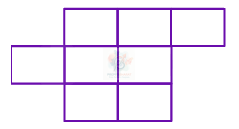
If the number of seven-digit numbers, such that the sum of their digits is even, is $m \cdot n \cdot 10^{\mathrm{n}}$; $m, n \in\{1,2,3, \ldots, 9\}$, then $m+n$ is equal to _______
The product of the last two digits of $(1919)^{1919}$ is $\qquad$
Let $f:[0,3] \rightarrow$ A be defined by $f(x)=2 x^3-15 x^2+36 x+7$ and $g:[0, \infty) \rightarrow B$ be defined by $\mathrm{g}(x)=\frac{x^{2025}}{x^{2025}+1}$. If both the functions are onto and $\mathrm{S}=\{x \in \mathbf{Z}: x \in \mathrm{~A}$ or $x \in \mathrm{~B}\}$, then $\mathrm{n}(\mathrm{S})$ is equal to :
Let $\alpha_\theta$ and $\beta_\theta$ be the distinct roots of $2 x^2+(\cos \theta) x-1=0, \theta \in(0,2 \pi)$. If m and M are the minimum and the maximum values of $\alpha_\theta^4+\beta_\theta^4$, then $16(M+m)$ equals :
Consider an A. P. of positive integers, whose sum of the first three terms is 54 and the sum of the first twenty terms lies between 1600 and 1800. Then its \(11^{\text {th }}\) term is :
The number of complex numbers $z$, satisfying $|z|=1$ and $\left|\frac{z}{\bar{z}}+\frac{\bar{z}}{z}\right|=1$, is :
Let $z \in C$ be such that $\frac{z^2+3 i}{z-2+i}=2+3 i$. Then the sum of all possible values of $z^2$ is
Let $a_1, a_2, a_3, \ldots$ be a G.P. of increasing positive terms. If $a_1 a_5=28$ and $a_2+a_4=29$, then $a_6$ is equal to:
Let \(\mathrm{A}=\left[\mathrm{a}_{i j}\right]=\left[\begin{array}{cc}\log _5 128 & \log _4 5 \\ \log _5 8 & \log _4 25\end{array}\right]\). If \(\mathrm{A}_{i j}\) is the cofactor of \(\mathrm{a}_{i j}, \mathrm{C}_{i j}=\sum_{\mathrm{k}=1}^2 \mathrm{a}_{i \mathrm{k}} \mathrm{A}_{j \mathrm{k}}, 1 \leq i, j \leq 2\), and \(\mathrm{C}=\left[\mathrm{C}_{i j}\right]\), then \(8|\mathrm{C}|\) is equal to :
Let $A=\left[\begin{array}{ccc}2 & 2+p & 2+p+q \\ 4 & 6+2 p & 8+3 p+2 q \\ 6 & 12+3 p & 20+6 p+3 q\end{array}\right]$. If $\operatorname{det}(\operatorname{adj}(\operatorname{adj}(3 \mathrm{~A})))=2^{\mathrm{m}} \cdot 3^{\mathrm{n}}, \mathrm{m}, \mathrm{n} \in \mathrm{N}$, then $\mathrm{m}+\mathrm{n}$ is equal to
If $\quad y(x)=\left|\begin{array}{ccc}\sin x & \cos x & \sin x+\cos x+1 \\ 27 & 28 & 27 \\ 1 & 1 & 1\end{array}\right|, x \in \mathbb{R}$, then $\frac{d^2 y}{d x^2}+y$ is equal to
If the first term of an A.P. is 3 and the sum of its first four terms is equal to one-fifth of the sum of the next four terms, then the sum of the first 20 terms is equal to
Let $f: \mathbb{R} \rightarrow \mathbb{R}$ be a continuous function satisfying $f(0)=1$ and $f(2 \mathrm{x})-f(\mathrm{x})=\mathrm{x}$ for all $\mathrm{x} \in \mathbb{R}$. If $\lim _{n \rightarrow \infty}\left\{f(x)-f\left(\frac{x}{2^n}\right)\right\}=G(x)$, then $\sum_{r=1}^{10} G\left(r^2\right)$ is equal to
Let integers $\mathrm{a}, \mathrm{b} \in[-3,3]$ be such that $\mathrm{a}+\mathrm{b} \neq 0$. Then the number of all possible ordered pairs (a, b), for which $\left|\frac{z-\mathrm{a}}{z+\mathrm{b}}\right|=1$ and $\left|\begin{array}{ccc}z+1 & \omega & \omega^2 \\ \omega & z+\omega^2 & 1 \\ \omega^2 & 1 & z+\omega\end{array}\right|=1, z \in \mathrm{C}$, where $\omega$ and $\omega^2$ are the roots of $x^2+x+1=0$, is equal to ________.
If $\sum_{\mathrm{r}=0}^{10}\left(\frac{10^{\mathrm{r}+1}-1}{10^{\mathrm{r}}}\right) \cdot{ }^{11} \mathrm{C}_{\mathrm{r}+1}=\frac{\alpha^{11}-11^{11}}{10^{10}}$, then $\alpha$ is equal to :
Let $\alpha, \beta(\alpha \neq \beta)$ be the values of m , for which the equations $x+y+z=1 ; x+2 y+4 z=\mathrm{m}$ and $x+4 y+10 z=m^2$ have infinitely many solutions. Then the value of $\sum_{n=1}^{10}\left(n^\alpha+n^\beta\right)$ is equal to :
Let $f: R-\{0\} \rightarrow R$ be a function such that $f(x)-6 f\left(\frac{1}{x}\right)=\frac{35}{3 x}-\frac{5}{2}$. If the $\lim _{x \rightarrow 0}\left(\frac{1}{\alpha x}+f(x)\right)=\beta ; \alpha, \beta \in R$, then $\alpha+2 \beta$ is equal to
If the system of equation $\begin{aligned}<br/>& 2 x+\lambda y+3 z=5 \\ & 3 x+2 y-z=7 \\ & 4 x+5 y+\mu z=9<br/>\end{aligned}$ has infinitely many solutions, then $\left(\lambda^2+\mu^2\right)$ is equal to :
$\text { In an arithmetic progression, if } S_{40}=1030 \text { and } S_{12}=57 \text {, then } S_{30}-S_{10} \text { is equal to : }$
The number of relations on the set $\mathrm{A}=\{1,2,3\}$ containing at most 6 elements including $(1,2)$, which are reflexive and transitive but not symmetric, is ________
Let $\mathrm{a}_{\mathrm{n}}$ be the $\mathrm{n}^{\text {th }}$ term of an A. P. If $S_n=a_1+a_2+a_3+\ldots+a_n=700, a_6=7$ and $S_7=7$, then $\mathrm{a}_{\mathrm{n}}$ is equal to :
Let $A=\{-3,-2,-1,0,1,2,3$,$\} . Let R$ be a relation on A defined by $x R y$ if and only if $0 \leq x^2+2 y \leq 4$. Let $l$ be the number of elements in R and $m$ be the minimum number of elements required to be added in R to make it a reflexive relation. then $l+m$ is equal to