JEE Main 2021 — Algebra
Mathematics Algebra questions from JEE Main 2021.
Other Years
239 Algebra Questions from 2021
A function $f(x)$ is given by $f(x)=\frac{{5}^{x}}{{5}^{x}+5}$, then the sum of the series $f(\frac{1}{20})+f(\frac{2}{20})+f(\frac{3}{20})+\ldots +f(\frac{39}{20})$ is equal to:
A man is walking on a straight line. The arithmetic mean of the reciprocals of the intercepts of this line on the coordinate axes is $\frac{1}{4}$. Three stones $A,B$ and $C$ are placed at the points $(1,1),(2,2)$ and $(4,4)$ respectively. Then which of these stones is$/$are on the path of the man?
A natural number has prime factorization given by $n={2}^{x}{3}^{y}{5}^{z}$, where $y$ and $z$ are such that $y+z=5$ and ${y}^{-1}+{z}^{-1}=\frac{5}{6},y>z$. Then the number of odd divisors of $n$, including $1$, is:
A number is called a palindrome if it reads the same backward as well as forward. For example $285582$ is a six digit palindrome. The number of six digit palindromes, which are divisible by $55,$ is ________.
A point $z$ moves in the complex plane such that $\mathrm{arg}(\frac{z-2}{z+2})=\frac{\pi }{4},$ then the minimum value of $|z-9\sqrt{2}-2i{|}^{2}$ is equal to
A possible value of $x,$ for which the ninth term in the expansion of ${{{3}^{{\mathrm{log}}_{3}\sqrt{{25}^{x-1}+7}}+{3}^{(-\frac{1}{8}){\mathrm{log}}_{3}({5}^{x-1}+1)}}}^{10}$ in the increasing powers of ${3}^{(-\frac{1}{8}){\mathrm{log}}_{3}({5}^{x-1}+1)}$ is equal to $180,$ is :
A scientific committee is to be formed from $6$ Indians and $8$ foreigners, which includes at least $2$ Indians and double the number of foreigners as Indians. Then the number of ways, the committee can be formed, is:
All the arrangements, with or without meaning, of the word $\mathrm{FARMER}$ are written excluding any word that has two $R$ appearing together. The arrangements are listed serially in the alphabetic order as in the English dictionary. Then the serial number of the word $\mathrm{FARMER}$ in this list is _____ .
If |z - 2| = |z + 2|, then z lies on:
Consider a rectangle $ABCD$ having $5,6,7,9$ points in the interior of the line segments $AB,BC,CD,DA$ respectively. Let $\alpha$ be the number of triangles having these points from different sides as vertices and $\beta$ be the number of quadrilaterals having these points from different sides as vertices. Then $(\beta -\alpha )$ is equal to
Consider an arithmetic series and a geometric series having four initial terms from the set ${11,8,21,16,26,32,4}$. If the last terms of these series are the maximum possible four digit numbers, then the number of common terms in these two series is equal to _______.
Consider function $f:A\rightarrow B$ and $g:B\rightarrow C(A,B,C\subseteq R)$ such that ${(gof)}^{-1}$ exists, then:
Consider the following system of equations: $x+2y-3z=a$ $2x+6y-11z=b$ $x-2y+7z=c$ where $a,b$ and $c$ are real constants. Then the system of equations :
Consider the system of linear equations $-x+y+2z=0$ $3x-ay+5z=1$ $2x-2y-az=7$ Let ${S}_{1}$ be the set of all $a\in R$ for which the system is inconsistent and ${S}_{2}$ be the set of all $a\in R$ for which the system has infinitely many solutions. If $n({S}_{1})$ and $n({S}_{2})$ denote the number of elements in ${S}_{1}$ and ${S}_{2}$ respectively, then
Define a relation $R$ over a class of $n\times n$ real matrices $A$ and $B$ as "$ARB$ iff there exists a non-singular matrix $P$ such that $PA{P}^{-1}=B$". Then which of the following is true ?
For real numbers $\alpha$ and $\beta ,$ consider the following system of linear equations: $x+y-z=2,x+2y+\alpha z=1$ and $2x-y+z=\beta .$ If the system has infinite solutions, then $\alpha +\beta$ is equal to ______.
For the natural numbers $m,n,$ if $(1-y{)}^{m}(1+y{)}^{n}=1+{a}_{1}y+{a}_{2}{y}^{2}+\ldots .+{a}_{m+n}{y}^{m+n}$ and ${a}_{1}={a}_{2}=10,$ then the value of $m+n,$ is equal to:
For the system of linear equations: $x-2y=1,x-y+kz=-2,ky+4z=6,k\in R$ Consider the following statements: (A) The system has unique solution if $k\neq 2,k\neq -2.$ (B) The system has unique solution if $k=-2.$ (C) The system has unique solution if $k=2.$ (D) The system has no-solution if $k=2.$ (E) The system has infinite number of solutions if $k\neq -2.$ Which of the following statements are correct?
If $1,{\mathrm{log}}_{10}({4}^{x}-2)$ and ${\mathrm{log}}_{10}({4}^{x}+\frac{18}{5})$ are in arithmetic progression for a real number $x$ then the value of the determinant $|\begin{matrix}2(x-\frac{1}{2}) & x-1 & {x}^{2} \\ 1 & 0 & x \\ x & 1 & 0\end{matrix}|$ is equal to:
If $\alpha$ and $\beta$ are the distinct roots of the equation ${x}^{2}+{(3)}^{\frac{1}{4}}x+{3}^{\frac{1}{2}}=0$, then the value of ${\alpha }^{96}({\alpha }^{12}-1)+{\beta }^{96}({\beta }^{12}-1)$ is equal to:
If $z$ and $\omega$ are two complex numbers such that $|z\omega |=1$ and $\mathrm{arg}(z)-\mathrm{arg}(\omega )=\frac{3\pi }{2}$, then $\mathrm{arg}(\frac{1-2\bar{z}\omega }{1+3\bar{z}\omega })$ is: (Here $\mathrm{arg}(z)$ denotes the principal argument of complex number $z$)
If $f(x)$ and $g(x)$ are two polynomials such that the polynomial $P(x)=f({x}^{3})+xg({x}^{3})$ is divisible by ${x}^{2}+x+1$, then $P(1)$ is equal to ___ .
If $A={x\in R:|x-2|>1},B={x\in R:\sqrt{{x}^{2}-3}>1},C={x\in R:|x-4|\geqslant 2}$ and $Z$ is the set of all integers, then the number of subsets of the set $(A\cap B\cap C{)}^{c}\cap Z$ is _________.
If $0<\theta ,\phi <\frac{\pi }{2},x=\sum _{n=0}^{\infty }{\mathrm{cos}}^{2n}\theta ,y=\sum _{n=0}^{\infty }{\mathrm{sin}}^{2n}\phi$ and $z=\sum _{n=0}^{\infty }{\mathrm{cos}}^{2n}\theta \cdot {\mathrm{sin}}^{2n}\phi$ then :
If $A=[\begin{matrix}0 & \mathrm{sin}\alpha \\ \mathrm{sin}\alpha & 0\end{matrix}]$ and $\mathrm{det}({A}^{2}-\frac{1}{2}I)=0,$ then a possible value of $\alpha$ is
If $A=[\begin{matrix}0 & -\mathrm{tan}(\frac{\theta }{2}) \\ \mathrm{tan}(\frac{\theta }{2}) & 0\end{matrix}]$ and $({I}_{2}+A){({I}_{2}-A)}^{-1}=[\begin{matrix}a & -b \\ b & a\end{matrix}],$ then $13({a}^{2}+{b}^{2})$ is equal to _____ .
If $A=[\begin{matrix}\frac{1}{\sqrt{5}} & \frac{2}{\sqrt{5}} \\ \frac{-2}{\sqrt{5}} & \frac{1}{\sqrt{5}}\end{matrix}],B=[\begin{matrix}1 & 0 \\ i & 1\end{matrix}],i=\sqrt{-1}$, and $Q={A}^{T}BA$, then the inverse of the matrix $A{Q}^{2021}{A}^{T}$ is equal to:
If $A=[\begin{matrix}1 & 1 & 1 \\ 0 & 1 & 1 \\ 0 & 0 & 1\end{matrix}]$ and $M=A+{A}^{2}+{A}^{3}+\ldots +{A}^{20},$ then the sum of all the elements of the matrix $M$ is equal to _______.
If $Prn=Pr+1n$ and $Crn=Cr-1n,$ then the value of $r$ is equal to:
If $a+b+c=1,ab+bc+ca=2$ and $abc=3,$ then the value of ${a}^{4}+{b}^{4}+{c}^{4}$ is equal to:
If $a+\alpha =1,b+\beta =2$ and $af(x)+\alpha f(\frac{1}{x})=bx+\frac{\beta }{x},x\neq 0,$ then the value of the expression $\frac{f(x)+f(\frac{1}{x})}{x+\frac{1}{x}}$ is ___________.
If ${\mathrm{log}}_{3}2,{\mathrm{log}}_{3}({2}^{x}-5),{\mathrm{log}}_{3}({2}^{x}-\frac{7}{2})$ are in an arithmetic progression, then the value of $x$ is equal to _____.
If $\mathrm{tan}(\frac{\pi }{9}),x,\mathrm{tan}(\frac{7\pi }{18})$ are in arithmetic progression and $\mathrm{tan}(\frac{\pi }{9}),y,\mathrm{tan}(\frac{5\pi }{18})$ are also in arithmetic progression, then $|x-2y|$ is equal to :
If $x,y,z$ are in arithmetic progression with common difference $d,x\neq 3d,$ and the determinant of the matrix $[\begin{matrix}3 & 4\sqrt{2} & x \\ 4 & 5\sqrt{2} & y \\ 5 & k & z\end{matrix}]$ is zero, then the value of ${k}^{2}$ is
If $\alpha ,\beta$ are natural numbers such that ${100}^{\alpha }-199\beta =(100)(100)+(99)(101)+(98)(102)+\ldots ..+(1)(199),$ then the slope of the line passing through $(\alpha ,\beta )$ and origin is:
If $\alpha ,\beta$ are roots of the equation ${x}^{2}+5(\sqrt{2})x+10=0,\alpha >\beta$ and ${P}_{n}={\alpha }^{n}-{\beta }^{n}$ for each positive integer $n,$ then the value of $(\frac{{P}_{17}{P}_{20}+5\sqrt{2}{P}_{17}{P}_{19}}{{P}_{18}{P}_{19}+5\sqrt{2}{P}_{18}^{2}})$ is equal to
If $\alpha ,\beta \in R$ are such that $1-2i$ (here ${i}^{2}=-1$) is a root of ${z}^{2}+\alpha z+\beta =0$, then $(\alpha -\beta )$ is equal to:
If $[x]$ be the greatest integer less than or equal to $x,$ then $\sum _{n=8}^{100}[\frac{{(-1)}^{n}n}{2}]$ is equal to:
If for $x\in (0,\frac{\pi }{2}),{\mathrm{log}}_{10}\mathrm{sin}x+{\mathrm{log}}_{10}\mathrm{cos}x=-1$ and ${\mathrm{log}}_{10}(\mathrm{sin}x+\mathrm{cos}x)=\frac{1}{2}({\mathrm{log}}_{10}n-1),n>0$, then the value of $n$ is equal to :
If for the complex numbers$z$ satisfying $|z-2-2i|\leq 1$, the maximum value of $|3iz+6|$ is attained at $a+ib$, then $a+b$ is equal to _____ .
If for the matrix, $A=[\begin{matrix}1 & -\alpha \\ \alpha & \beta \end{matrix}],A{A}^{T}={I}_{2}$, then the value of ${\alpha }^{4}+{\beta }^{4}$ is :
If for $x,y\in R,x>0,$ $y={\mathrm{log}}_{10}x+{\mathrm{log}}_{10}{x}^{1/3}+{\mathrm{log}}_{10}{x}^{1/9}+\ldots$upto $\infty$ terms and $\frac{2+4+6+\ldots +2y}{3+6+9+\ldots +3y}=\frac{4}{{\mathrm{log}}_{10}x},$ then the ordered pair $(x,y)$ is equal to
If $z$ is a complex number such that $\frac{z-i}{z-1}$ is purely imaginary, then the minimum value of $|z-(3+3i)|$ is :
If $(2021{)}^{3762}$ is divided by $17,$ then the remainder is _______.
If $n$ is the number of irrational terms in the expansion of ${({3}^{1/4}+{5}^{1/8})}^{60}$, then $(n-1)$ is divisible by :
If $(\frac{{3}^{6}}{{4}^{4}})k$ is the term, independent of $x,$ in the binomial expansion of ${(\frac{x}{4}-\frac{12}{{x}^{2}})}^{12},$ then $k$ is equal to
If $b$ is very small as compared to the value of $a$, so that the cube and other higher powers of $\frac{b}{a}$ can be neglected in the identity$\frac{1}{a-b}+\frac{1}{a-2b}+\frac{1}{a-3b}+\ldots .+\frac{1}{a-nb}=\alpha n+\beta {n}^{2}+\gamma {n}^{3}$ then the value of $\gamma$ is :
If ${e}^{({\mathrm{cos}}^{2}x+{\mathrm{cos}}^{4}x+{\mathrm{cos}}^{6}x+....\infty ){\mathrm{log}}_{e}2}$ satisfies the equation ${t}^{2}-9t+8=0$, then the value of $\frac{2\mathrm{sin}x}{\mathrm{sin}x+\sqrt{3}\mathrm{cos}x}$, where $0<x<\frac{\pi }{2}$, is equal to
If sum of the first $21$ terms of the series ${\mathrm{log}}_{{9}^{1/2}}x+{\mathrm{log}}_{{9}^{1/3}}x+{\mathrm{log}}_{{9}^{1/4}}x+\ldots ..$ where $x>0$ is $504,$ then $x$ is equal to
If the arithmetic mean and the geometric mean of the ${p}^{\mathrm{th}}$ and ${q}^{\mathrm{th}}$ terms of the sequence $-16,8,-4,2,\ldots$ satisfy the equation $4{x}^{2}-9x+5=0$, then $p+q$ is equal to _______.
If the co-efficient of ${x}^{7}$ and ${x}^{8}$ in the expansion of ${(2+\frac{x}{3})}^{n}$ are equal, then the value of $n$ is equal to :
If the coefficient of ${a}^{7}{b}^{8}$ in the expansion of $(a+2b+4ab{)}^{10}$ is $K\cdot {2}^{16},$ then $K$ is equal to
If the coefficients of ${x}^{7}$ in ${({x}^{2}+\frac{1}{bx})}^{11}$ and ${x}^{-7}$ in ${(x-\frac{1}{b{x}^{2}})}^{11},b\neq 0,$ are equal, then the value of $b$ is equal to:
If the constant term, in binomial expansion of ${(2{x}^{r}+\frac{1}{{x}^{2}})}^{10}$ is $180,$ then $r$ is equal to ____________.
If the digits are not allowed to repeat in any number formed by using the digits $0,2,4,6,8,$ then the number of all numbers greater than $10,000$ is equal to __________.
If the domain of the function $f(x)=\frac{{\mathrm{cos}}^{-1}\sqrt{{x}^{2}-x+1}}{\sqrt{{\mathrm{sin}}^{-1}(\frac{2x-1}{2})}}$ is the interval $(\alpha ,\beta ],$ then $\alpha +\beta$ is equal to:
If the equation $a|z{|}^{2}+\bar{\bar{\alpha }z+\alpha \bar{z}}+d=0$ represents a circle where $a,d$ are real constants then which of the following condition is correct?
If the following system of linear equations $2x+y+z=5$ $x-y+z=3$ $x+y+az=b$ has no solution, then :
If the fourth term in the expansion of ${(x+{x}^{{\mathrm{log}}_{2}x})}^{7}$ is $4480,$ then the value of $x$ where $x\in N$ is equal to:
If the functions are defined as $f(x)=\sqrt{x}$ and $g(x)=\sqrt{1-x},$ then what is the common domain of the following functions: $f+g,f-g,f/g,g/f,g-f$, where $(f\pm g)(x)=f(x)\pm g(x),(f/g)(x)=\frac{f(x)}{g(x)}$
If the greatest value of the term independent of $x$ in the expansion of ${(x\mathrm{sin}\alpha +a\frac{\mathrm{cos}\alpha }{x})}^{10}$ is $\frac{10!}{{(5!)}^{2}},$ then the value of $a$ is equal to:
If the least and the largest real values of $\alpha ,$ for which the equation $z+\alpha |z-1|+2i=0$ $(z\in C\text{and}i=\sqrt{-1})$ has a solution, are $p$ and $q$ respectively; then $4({p}^{2}+{q}^{2})$ is equal to_______.
If the matrix $A=[\begin{matrix}1 & 0 & 0 \\ 0 & 2 & 0 \\ 3 & 0 & -1\end{matrix}]$ satisfies the equation ${A}^{20}+\alpha {A}^{19}+\beta A=[\begin{matrix}1 & 0 & 0 \\ 0 & 4 & 0 \\ 0 & 0 & 1\end{matrix}]$ for some real numbers $\alpha$ and $\beta$, then $\beta -\alpha$ is equal to ______.
If the matrix $A=[\begin{matrix}0 & 2 \\ K & -1\end{matrix}]$ satisfies $A({A}^{3}+3I)=2I,$ then the value of $K$ is
If the real part of the complex number ${(1-\mathrm{cos}\theta +2i\mathrm{sin}\theta )}^{-1}$ is $\frac{1}{5}$ for $\theta \in (0,\pi ),$ then the value of the integral ${\int }_{0}^{\theta }\mathrm{sin}xdx$ is equal to:
If the real part of the complex number $z=\frac{3+2i\mathrm{cos}\theta }{1-3i\mathrm{cos}\theta },\theta \in (0,\frac{\pi }{2})$ is zero, then the value of ${\mathrm{sin}}^{2}3\theta +{\mathrm{cos}}^{2}\theta$ is equal to ______.
If the remainder when $x$ is divided by $4$ is $3$, then the remainder when ${(2020+x)}^{2022}$ is divided by $8$ is ___ .
If the sides $AB,BC$ and $CA$ of a triangle $ABC$ have $3,5$ and $6$ interior points respectively, then the total number of triangles that can be constructed using these points as vertices, is equal to:
If the sum of an infinite $\mathrm{GP}$, $a,ar,a{r}^{2},a{r}^{3},\ldots$ is $15$ and the sum of the squares of its each term is $150,$ then the sum of $ar,2a{r}^{4},a{r}^{6},\ldots$ is:
If the sum of the coefficients in the expansion of $(x+y{)}^{n}$ is $4096,$ then the greatest coefficient in the expansion is _____.
If the system of equations$kx+y+2z=1$ $3x-y-2z=2$ $-2x-2y-4z=3$ has infinitely many solutions, then $k$ is equal to ______ .
If the system of linear equations $2x+y-z=3$ $x-y-z=\alpha$ $3x+3y+\beta z=3$ has infinitely many solutions, then $|\alpha +\beta -\alpha \beta |$ is equal to __________.
If $S={z\in C:\frac{z-i}{z+2i}\in R}$, then
If $(\sqrt{3}+i{)}^{100}={2}^{99}(p+iq),$ then $p$ and $q$ are roots of the equation :
If ${x}^{2}+9{y}^{2}-4x+3=0,x,y\in R,$ then $x$ and $y$ respectively lie in the intervals
If $P=[\begin{matrix}1 & 0 \\ \frac{1}{2} & 1\end{matrix}],$ then ${P}^{50}$ is:
If ${a}_{r}=\mathrm{cos}\frac{2r\pi }{9}+i\mathrm{sin}\frac{2r\pi }{9},r=1,2,3,\ldots ,i=\sqrt{-1}$, then the determinant $|\begin{matrix}{a}_{1} & {a}_{2} & {a}_{3} \\ {a}_{4} & {a}_{5} & {a}_{6} \\ {a}_{7} & {a}_{8} & {a}_{9}\end{matrix}|$ is equal to :
If $\alpha +\beta +\gamma =2\pi ,$ then the system of equations $x+(\mathrm{cos}\gamma )y+(\mathrm{cos}\beta )z=0$ $(\mathrm{cos}\gamma )x+y+(\mathrm{cos}\alpha )z=0$ $(\mathrm{cos}\beta )x+(\mathrm{cos}\alpha )y+z=0$ has :
If $A=[\begin{matrix}2 & 3 \\ 0 & -1\end{matrix}],$ then the value of $det({A}^{4})+det({A}^{10}-(Adj(2A){)}^{10})$ is equal to ________.
In a school, there are three types of games to be played. Some of the students play two types of games, but none play all the three games. Which Venn diagrams can justify the above statement? 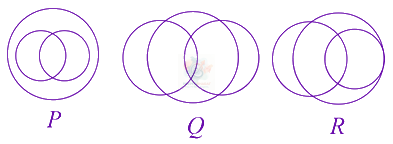
In an increasing geometric series, the sum of the second and the sixth term is $\frac{25}{2}$ and the product of the third and fifth term is $25.$ Then, the sum of ${4}^{th},{6}^{th}$ and ${8}^{th}$ terms is equal to:
$\frac{1}{{3}^{2}-1}+\frac{1}{{5}^{2}-1}+\frac{1}{{7}^{2}-1}+\ldots +\frac{1}{(201{)}^{2}-1}$ is equal to
Let a complex number be $w=1-\sqrt{3}i$. Let another complex number $z$ be such that $|zw|=1$ and $\mathrm{arg}(z)-\mathrm{arg}(w)=\frac{\pi }{2}$. Then the area of the triangle (in sq. units) with vertices origin, $z$ and $w$ is equal to
Let a complex number $z,|z|\neq 1$, satisfy ${\mathrm{log}}_{\frac{1}{\sqrt{2}}}(\frac{|z|+11}{{(|z|-1)}^{2}})\leq 2$. Then, the largest value of $|z|$ is equal to _________.
Let $R={(P,Q)|P$ and $Q$ are at the same distance from the origin$}$ be a relation, then the equivalence class of $(1,-1)$ is the set
Let $A={2,3,4,5,\ldots .,30}$ and $'\simeq '$ be an equivalence relation on $A\times A,$ defined by $(a,b)\simeq (c,d),$ if and only if $ad=bc$. Then the number of ordered pairs which satisfy this equivalence relation with ordered pair $(4,3)$ is equal to :
Let $A={1,2,3,\ldots ,10}$ and $f:A\rightarrow A$ be defined as $f(k)={\begin{matrix}k+1 & \mathrm{if}k\mathrm{is}odd \\ k & \mathrm{if}k\mathrm{is}even\end{matrix}$ Then the number of possible functions $g:A\rightarrow A$ such that $gof=f$ is:
Let $\frac{1}{16},a$ and $b$ be in G.P. and $\frac{1}{a},\frac{1}{b},6$ be in A.P., where $a,b>0$. Then $72(a+b)$ is equal to _______ .
Let $\alpha$ and $\beta$ be the roots of ${x}^{2}-6x-2=0$. If ${a}_{n}={\alpha }^{n}-{\beta }^{n}$ for $n\geqslant 1$, then the value of $\frac{{a}_{10}-2{a}_{8}}{3{a}_{9}}$ is:
Let ${S}_{1},{S}_{2}$ and ${S}_{3}$ be three sets defined as ${S}_{1}={z\in \mathbb{C}:|z-1|\leq \sqrt{2}},$ ${S}_{2}={z\in \mathbb{C}:Re((1-i)z)\geq 1}$ and ${S}_{3}={z\in \mathbb{C}:Im(z)\leq 1}.$ Then, the set ${S}_{1}\cap {S}_{2}\cap {S}_{3}$
Let ${z}_{1}$ and ${z}_{2}$ be two complex numbers such that $\mathrm{arg}({z}_{1}-{z}_{2})=\frac{\pi }{4}$ and ${z}_{1},{z}_{2}$ satisfy the equation $|z-3|=Re(z)$. Then the imaginary part ${z}_{1}+{z}_{2}$ is equal to
Let $z$ and $w$ be two complex numbers such that $w=z\bar{z}-2z+2,|\frac{z+i}{z-3i}|=1$ and $Re(w)$ has minimum value. Then, the minimum value of $n\in N$ for which ${w}^{n}$ is real, is equal to _______.
Let $A=[\begin{matrix}{a}_{1} \\ {a}_{2}\end{matrix}]$ and $B=[\begin{matrix}{b}_{1} \\ {b}_{2}\end{matrix}]$ be two $2\times 1$matrices with real entries such that $A=XB,$ where $X=\frac{1}{\sqrt{3}}[\begin{matrix}1 & -1 \\ 1 & k\end{matrix}],$ and $k\in R.$ If ${a}_{1}^{2}+{a}_{2}^{2}=\frac{2}{3}({b}_{1}^{2}+{b}_{2}^{2})$ and $({k}^{2}+1){b}_{2}^{2}\neq -2{b}_{1}{b}_{2}$, then the value of $k$ is __________.
Let $p$ and $q$ be two positive numbers such that $p+q=2$ and ${p}^{4}+{q}^{4}=272$. Then $p$ and $q$ are roots of the equation:
Let $A$ and $B$ be two $3\times 3$ real matrices such that $({A}^{2}-{B}^{2})$ is invertible matrix. If ${A}^{5}={B}^{5}$ and ${A}^{3}{B}^{2}={A}^{2}{B}^{3},$ then the value of the determinant of the matrix ${A}^{3}+{B}^{3}$ is equal to :
Let $\alpha$ and $\beta$ be two real numbers such that $\alpha +\beta =1$ and $\alpha \beta =-1$. Let ${p}_{n}={(\alpha )}^{n}+{(\beta )}^{n}$, ${p}_{n-1}=11$ and ${p}_{n+1}=29$ for some integer $n\geqslant 1$. Then, the value of ${p}_{n}^{2}$ is______.
Let $A+2B=[\begin{matrix}1 & 2 & 0 \\ 6 & -3 & 3 \\ -5 & 3 & 1\end{matrix}]$ and $2A-B=[\begin{matrix}2 & -1 & 5 \\ 2 & -1 & 6 \\ 0 & 1 & 2\end{matrix}].$ If $Tr(A)$ denotes the sum of all diagonal elements of the matrix $A,$ then $Tr(A)-Tr(B)$ has value equal to
Let $\alpha =\underset{x\in R}{\mathrm{max}}{{8}^{2\mathrm{sin}3x}\cdot {4}^{4\mathrm{cos}3x}}$ and $\beta =\underset{x\in R}{\mathrm{min}}{{8}^{2\mathrm{sin}3x}\cdot {4}^{4\mathrm{cos}3x}}.$ If $8{x}^{2}+bx+c=0$ is a quadratic equation whose roots are ${\alpha }^{1/5}$ and ${\beta }^{1/5},$ then the value of $c-b$ is equal to :
Let $f(x)={\mathrm{sin}}^{-1}x$ and $g(x)=\frac{{x}^{2}-x-2}{2{x}^{2}-x-6}$. If $g(2)=\underset{x\rightarrow 2}{\mathrm{lim}}g(x)$, then the domain of the function $fog$ is
Let $A=[\begin{matrix}a & b \\ c & d\end{matrix}]$ and $B=[\begin{matrix}\alpha \\ \beta \end{matrix}]\neq [\begin{matrix}0 \\ 0\end{matrix}]$ such that $AB=B$ and $a+d=2021,$ then the value of $ad-bc$ is equal to ______ .
Let $A={n\in N\mid {n}^{2}\leq n+10,000},B={3k+1\mid k\in N}$ and $C={2k\mid k\in N},$ then the sum of all the elements of the set $A\cap (B-C)$ is equal to ________.
Let $P=[\begin{matrix}-30 & 20 & 56 \\ 90 & 140 & 112 \\ 120 & 60 & 14\end{matrix}]$ and $A=[\begin{matrix}2 & 7 & {\omega }^{2} \\ -1 & -\omega & 1 \\ 0 & -\omega & -\omega +1\end{matrix}]$ where $\omega =\frac{-1+i\sqrt{3}}{2}$, and ${I}_{3}$ be the identity matrix of order $3$. If the determinant of the matrix ${({P}^{-1}AP-{I}_{3})}^{2}$ is $\alpha {\omega }^{2}$, then the value of $\alpha$ is equal to _________.
Let $A=[\begin{matrix}\begin{matrix}1 & -1 & 0 \\ 0 & 1 & -1 \\ 0 & 0 & 1\end{matrix}\end{matrix}]$ and $B=7{A}^{20}-20{A}^{7}+2I$, where $I$ is an identity matrix of order $3\times 3.$ If $B=[{b}_{ij}]$, then ${b}_{13}$ is equal to
Let $f:N\rightarrow N$ be a function such that $f(m+n)=f(m)+f(n)$ for every $m,n\in N.$ If $f(6)=18$ then $f(2)\cdot f(3)$ is equal to :
Let $A={{a}_{ij}}$ be a $3\times 3$ matrix, where ${a}_{ij}={\begin{matrix}{(-1)}^{j-i}\mathrm{if}i<j \\ 2\mathrm{if}i=j \\ {(-1)}^{i+j}\mathrm{if}i>j\end{matrix}$ then $\mathrm{det}(3Adj(2{A}^{-1}))$ is equal to ________.
Let $A$ be a $3\times 3$ matrix with $det(A)=4$. Let ${R}_{i}$ denote the ${i}^{th}$ row of $A$. If a matrix $B$ is obtained by performing the operation ${R}_{2}\rightarrow 2{R}_{2}+5{R}_{3}$ on $2A$, then $det(B)$ is equal to :
Let $n$ be a non-negative integer. Then the number of divisors of the form $4n+1$ of the number ${(10)}^{10}\cdot {(11)}^{11}\cdot {(13)}^{13}$ is equal to _____.
Let $f(x)$ be a polynomial of degree $3$ such that $f(k)=-\frac{2}{k}$ for $k=2,3,4,5.$ Then the value of $52-10f(10)$ is equal to _____ .
Let $n$ be a positive integer. Let $A=\sum _{k=0}^{n}{(-1)}^{k}\times Ckn[{(\frac{1}{2})}^{k}+{(\frac{3}{4})}^{k}+{(\frac{7}{8})}^{k}+{(\frac{15}{16})}^{k}+{(\frac{31}{32})}^{k}]$. If $63A=1-\frac{1}{{2}^{30}},$ then $n$ is equal to ______ .
Let $A$ be a $3\times 3$ real matrix. If $det(2Adj(2Adj(Adj(2A))))={2}^{41},$ then the value of $det({A}^{2})$ equals ______.
Let $A=[{a}_{ij}]$ be a real matrix of order $3\times 3,$ such that ${a}_{i1}+{a}_{i2}+{a}_{i3}=1,$ for $i=1,2,3.$ Then, the sum of all the entries of the matrix ${A}^{3}$ is equal to:
Let ${{{a}_{n}}}_{n=1}^{\infty }$ be a sequence such that ${a}_{1}=1,{a}_{2}=1$ and ${a}_{n+2}=2{a}_{n+1}+{a}_{n}$ for all $n\geq 1$. Then the value of $47\sum _{n=1}^{\infty }(\frac{{a}_{n}}{{2}^{3n}})$ is equal to ________.
Let $A$ be a symmetric matrix of order $2$ with integer entries. If the sum of the diagonal elements of ${A}^{2}$ is $1,$ then the possible number of such matrices is:
Let ${a}_{1},{a}_{2},{a}_{3},\ldots$ be an A.P. If $\frac{{a}_{1}+{a}_{2}+\ldots +{a}_{10}}{{a}_{1}+{a}_{2}+\ldots +{a}_{p}}=\frac{100}{{p}^{2}},p\neq 10,$ then $\frac{{a}_{11}}{{a}_{10}}$ is equal to :
Let $I$ be an identity matrix of order $2\times 2$ and $P=[\begin{matrix}2 & -1 \\ 5 & -3\end{matrix}]$. Then the value of $n\in N$ for which ${P}^{n}=5I-8P$ is equal to ___ .
Let ${a}_{1},{a}_{2},\ldots ,{a}_{21}$ be an $A.P.$ such that $\sum _{n=1}^{20}\frac{1}{{a}_{n}{a}_{n+1}}=\frac{4}{9}.$ If the sum of this $A.P.$ is $189,$ then ${a}_{6}{a}_{16}$ is equal to :
Let ${a}_{1},{a}_{2},\ldots ,{a}_{10}$ be an $A.P.$ with common difference $-3$ and ${b}_{1},{b}_{2},\ldots ,{b}_{10}$ be a $G.P.$ with common ratio $2.$ Let ${c}_{k}={a}_{k}+{b}_{k},k=1,2,\ldots ,10.$ If ${c}_{2}=12$ and ${c}_{3}=13,$ then $\sum _{k=1}^{10}{c}_{k}$ is equal to ______.
Let $M$ be any $3\times 3$ matrix with entries from the set ${0,1,2}$. The maximum number of such matrices, for which the sum of diagonal elements of ${M}^{T}M$ is seven, is______.
Let $f:R\rightarrow R$ be defined as $f(x)=2x-1$ and $g:R-{1}\rightarrow R$. be defined as $g(x)=\frac{x-\frac{1}{2}}{x-1}$. Then the composition function $f(g(x))$ is:
Let $g:N\rightarrow N$ be defined as $g(3n+1)=3n+2$ $g(3n+2)=3n+3$ $g(3n+3)=3n+1$, for all $n\geq 0$ Then which of the following statements is true ?
Let $f:R\rightarrow R$ be defined as $f(x+y)+f(x-y)=2f(x)f(y),f(\frac{1}{2})=-1.$ Then the value of $\sum _{k=1}^{20}\frac{1}{\mathrm{sin}(k)\mathrm{sin}(k+f(k))}$ is equal to :
Let $f:R-{3}\rightarrow R-{1}$ be defined by $f(x)=\frac{x-2}{x-3}$. Let $g:R\rightarrow R$ be given as $g(x)=2x-3$. Then, the sum of all the values of $x$ for which ${f}^{-1}(x)+{g}^{-1}(x)=\frac{13}{2}$ is equal to
Let $f:R-{\frac{\alpha }{6}}\rightarrow R$ be defined by $f(x)=(\frac{5x+3}{6x-\alpha })$. Then the value of $\alpha$ for which $(fof)(x)=x$, for all $x\in R-{\frac{\alpha }{6}},$ is
Let $a,b,c$ be in arithmetic progression. Let the centroid of the triangle with vertices $(a,c),(2,b)$ and $(a,b)$ be $(\frac{10}{3},\frac{7}{3}).$ If $\alpha ,\beta$ are the roots of the equation $a{x}^{2}+bx+1=0,$ then the value of ${\alpha }^{2}+{\beta }^{2}-\alpha \beta$ is:
Let $a,b,c,d$ be in arithmetic progression with common difference $\lambda$. If $|\begin{matrix}x+a-c & x+b & x+a \\ x-1 & x+c & x+b \\ x-b+d & x+d & x+c\end{matrix}|=2$, then value of ${\lambda }^{2}$ is equal to________.
Let $\lambda \neq 0$ be in $R.$ If $\alpha$ and $\beta$ are the roots of the equation ${x}^{2}-x+2\lambda =0,$ and $\alpha$ and $\gamma$ are the roots of the equation $3{x}^{2}-10x+27\lambda =0,$ then $\frac{\beta \gamma }{\lambda }$ is equal to ________.
Let ${P}_{1},{P}_{2}\ldots ,{P}_{15}$ be $15$ points on a circle. The number of distinct triangles formed by points ${P}_{i},{P}_{j},{P}_{k}$ such that $i+j+k\neq 15,$ is :
Let ${A}_{1},{A}_{2},{A}_{3},\ldots ..$ be squares such that for each $n\geqslant 1,$ the length of the side of ${A}_{n}$ equals the length of diagonal of ${A}_{n+1}$. If the length of ${A}_{1}$ is $12\mathrm{cm}$, then the smallest value of $n$ for which area of ${A}_{n}$ is less than one, is
Let $[\lambda ]$ be the greatest integer less than or equal to $\lambda$. The set of all values of $\lambda$ for which the system of linear equations $x+y+z=4,3x+2y+5z=3,9x+4y+(28+[\lambda ])z=[\lambda ]$ has a solution is:
Let $\alpha ,\beta ,\gamma$ be the real roots of the equation, ${x}^{3}+a{x}^{2}+bx+c=0,$ ($a,b,c\in R$ and $a,b\neq 0$). If the system of equations (in, $u,v,w$) given by $\alpha u+\beta v+\gamma w=0,\beta u+\gamma v+\alpha w=0,\gamma u+\alpha v+\beta w=0$ has non-trivial solution, then the value of $\frac{{a}^{2}}{b}$ is
Let ${z}_{1},{z}_{2}$ be the roots of the equation ${z}^{2}+az+12=0$ and ${z}_{1},{z}_{2}$ form an equilateral triangle with origin. Then, the value of $|a|$ is
Let $C$ be the set of all complex numbers. Let ${S}_{1}={z\in C|{|z–3–2i|}^{2}=8},$ ${S}_{2}=z\in C|\mathrm{Re}(z)\geq 5$ and ${S}_{3}={z\in C||z–\bar{z}|\geq 8}.$ Then the number of elements in ${S}_{1}\cap {S}_{2}\cap {S}_{3}$ is equal to
Let $\mathbb{C}$ be the set of all complex numbers. Let ${S}_{1}={z\in \mathbb{C}:|z-2|\leq 1}$ and ${S}_{2}={z\in \mathbb{C}:z(1+i)+\bar{z}(1-i)\geq 4}.$ Then, the maximum value of ${|z-\frac{5}{2}|}^{2}$ for $z\in {S}_{1}\cap {S}_{2}$ is equal to :
Let $Z$ be the set of all integers, $A={(x,y)\in Z\times Z:(x-2{)}^{2}+{y}^{2}\leq 4}$ $B={(x,y)\in Z\times Z:{x}^{2}+{y}^{2}\leq 4}\text{ and }$ $C={(x,y)\in Z\times Z:(x-2{)}^{2}+(y-2{)}^{2}\leq 4}$ If the total number of relations from $A\cap B$ to $A\cap C$ is ${2}^{p}$, then the value of $p$ is:
Let $N$ be the set of natural numbers and a relation $R$ on $N$ be defined by $R={(x,y)\in N\times N:{x}^{3}-3{x}^{2}y-x{y}^{2}+3{y}^{3}=0}$. Then the relation $R$ is
Let ${S}_{1}$ be the sum of first $2n$ terms of an arithmetic progression. Let ${S}_{2}$ be the sum of first $4n$ terms of the same arithmetic progression. If $({S}_{2}-{S}_{1})$ is $1000$, then the sum of the first $6n$ terms of the arithmetic progression is equal to:
Let ${S}_{n}$ be the sum of the first $n$ terms of an arithmetic progression. If ${S}_{3n}=3{S}_{2n}$, then the value of $\frac{{S}_{4n}}{{S}_{2n}}$ is :
Let $z$ be those complex numbers which satisfy $|z+5|\leq 4$ and $z(1+i)+\bar{z}(1-i)\geqslant -10,i=\sqrt{-1}$. If the maximum value of $|z+1{|}^{2}$ is $\alpha +\beta \sqrt{2}$, then the value of $(\alpha +\beta )$ is
Let $\alpha ,\beta$ be two roots of the equation ${x}^{2}+{(20)}^{1/4}x+{(5)}^{1/2}=0$. Then ${\alpha }^{8}+{\beta }^{8}$ is equal to
Let $A=[\begin{matrix}2 & 3 \\ a & 0\end{matrix}],a\in R$ be written as $P+Q$ where $P$ is a symmetric matrix and $Q$ is skew symmetric matrix. If $det(Q)=9$, then the modulus of the sum of all possible values of determinant of $P$ is equal to:
Let $M={A=[\begin{matrix}a & b \\ c & d\end{matrix}]:a,b,c,d\in (\pm 3,\pm 2,\pm 1,0)}$. Define $f:M\rightarrow Z,$ as $f(A)=det(A),$ for all $A\in M$ where $Z$ is set of all integers. Then the number of $A\in M$ such that $f(A)=15$ is equal to .
Let $[x]$ denote greatest integer less than or equal to $x$. If for $n\in N,{(1-x+{x}^{3})}^{n}=\sum _{j=0}^{3n}{a}_{j}{x}^{j}$, then $\sum _{j=0}^{[\frac{3n}{2}]}{a}_{2j}+4\sum _{j=0}^{[\frac{3n-1}{2}]}{a}_{2j+1}$ is equal to :
Let $[x]$ denote the greatest integer less than or equal to $x.$ Then, the values of $x\in R$ satisfying the equation ${[{e}^{x}]}^{2}+[{e}^{x}+1]-3=0$ lie in the interval:
Let $[x]$ denote the greatest integer $\leq x$, where $x\in R$. If the domain of the real valued function $f(x)=\sqrt{\frac{|[x]|-2}{|[x]|-3}}$ is $(-\infty ,a)\cup [b,c)\cup [4,\infty ),a<b<c$, then the value of $a+b+c$ is:
Let $n$ denote the number of solutions of the equation ${z}^{2}+3\bar{z}=0,$ where $z$ is a complex number. Then the value of $\sum _{k=0}^{\infty }\frac{1}{{n}^{k}}$ is equal to
Let ${S}_{n}$ denote the sum of first $n$-terms of an arithmetic progression. If ${S}_{10}=530,{S}_{5}=140,$ then ${S}_{20}-{S}_{6}$ is equal to:
Let $x$ denote the total number of one-one functions from a set $A$ with $3$ elements to a set $B$ with $5$ elements and $y$ denote the total number of one-one functions from the set $A$ to the set $A\times B$. Then :
Let $i=\sqrt{-1}.$ If $\frac{{(-1+i\sqrt{3})}^{21}}{{(1-i)}^{24}}+\frac{{(1+i\sqrt{3})}^{21}}{{(1+i)}^{24}}=k,$ and $n=[|k|]$ be the greatest integral part of $|k|.$ Then $\sum _{j=0}^{n+5}{(j+5)}^{2}-\sum _{j=0}^{n+5}(j+5)$ is equal to ________.
Let$A=[\begin{matrix}1 & 2 \\ -1 & 4\end{matrix}].$ If ${A}^{-1}=\alpha I+\beta A,\alpha ,\beta \in R,I$ is a $2\times 2$ identity matrix, then $4(\alpha -\beta )$ is equal to :
Let $\theta \in (0,\frac{\pi }{2})$. If the system of linear equations $(1+{\mathrm{cos}}^{2}\theta )x+{\mathrm{sin}}^{2}\theta y+4\mathrm{sin}3\theta z=0$ ${\mathrm{cos}}^{2}\theta x+(1+{\mathrm{sin}}^{2}\theta )y+4\mathrm{sin}3\theta z=0$ ${\mathrm{cos}}^{2}\theta x+{\mathrm{sin}}^{2}\theta y+(1+4\mathrm{sin}3\theta )z=0$ has a non-trivial solution, then the value of $\theta$ is:
Let $A={n\in N:n$ is a $3-$digit number$}$ $B={9k+2:k\in N}$ and $C={9k+l:k\in N}$ for some $l(0<l<9)$. If the sum of all the elements of the set $A\cap (B\cup C)$ is $274\times 400,$ then $l$ is equal to
Let $f,g:N\rightarrow N$ such that $f(n+1)=f(n)+f(1)\forall n\in N$ and $g$ be any arbitrary function. Which of the following statements is NOT true?
Let the coefficients of third, fourth and fifth terms in the expansion of ${(x+\frac{a}{{x}^{2}})}^{n},x\neq 0,$ be in the ratio $12:8:3.$ Then the term independent of $x$ in the expansion, is equal to _______.
Let the domain of the function $f(x)={\mathrm{log}}_{4}({\mathrm{log}}_{5}({\mathrm{log}}_{3}(18x-{x}^{2}-77)))$ be $(a,b)$. Then the value of the integral ${\int }_{a}^{b}\frac{{\mathrm{sin}}^{3}x}{({\mathrm{sin}}^{3}x+{\mathrm{sin}}^{3}(a+b-x))}$ is equal to _____.
Let the lines $(2-i)z=(2+i)\bar{z}$ and $(2+i)z+(i-2)\bar{z}-4i=0,$ (here ${i}^{2}=-1$) be normal to a circle $C$. If the line $iz+\bar{z}+1+i=0$ is tangent to this circle $C$, then its radius is :
Let the system of linear equations $4x+\lambda y+2z=0$ $2x-y+z=0$ $\mu x+2y+3z=0,\lambda ,\mu \in R$ has a non-trivial solution. Then which of the following is true?
Let ${(1+x+2{x}^{2})}^{20}={a}_{0}+{a}_{1}x+{a}_{2}{x}^{2}+\ldots +{a}_{40}{x}^{40},$ then ${a}_{1}+{a}_{3}+{a}_{5}+\ldots +{a}_{37}$ is equal to
Let $A=[\begin{matrix}1 & 0 & 0 \\ 0 & 1 & 1 \\ 1 & 0 & 0\end{matrix}].$ Then ${A}^{2025}-{A}^{2020}$ is equal to
Let $f(x)=|\begin{matrix}{\mathrm{sin}}^{2}x & -2+{\mathrm{cos}}^{2}x & \mathrm{cos}2x \\ 2+{\mathrm{sin}}^{2}x & {\mathrm{cos}}^{2}x & \mathrm{cos}2x \\ {\mathrm{sin}}^{2}x & {\mathrm{cos}}^{2}x & 1+\mathrm{cos}2x\end{matrix}|,x\in [0,\pi ].$ Then the maximum value of $f(x)$ is equal to
Let $A={0,1,2,3,4,5,6,7}.$ Then the number of bijective functions $f:A\rightarrow A$ such that $f(1)+f(2)=3-f(3)$ is equal to
Let $S={1,2,3,4,5,6,9}$. Then the number of elements in the set $T={A\subseteq S:A\neq \phi$ and the sum of all the elements of $A$ is not a multiple of $3}$ is
Let $A=[\begin{matrix}0 & 1 & 0 \\ 1 & 0 & 0 \\ 0 & 0 & 1\end{matrix}].$ Then the number of $3\times 3$ matrices $B$ with entries from the set ${1,2,3,4,5}$ and satisfying $AB=BA$ is ________.
Let $S={1,2,3,4,5,6,7}.$ Then the number of possible functions $f:S\rightarrow S$ such that $f(m\cdot n)=f(m)\cdot f(n)$ for every $m,n\in S$ and $m\cdot n\in S$, is equal to _____.
Let $A=[\begin{matrix}i & -i \\ -i & i\end{matrix}],i=\sqrt{-1}$. Then, the system of linear equations ${A}^{8}[\begin{matrix}x \\ y\end{matrix}]=[\begin{matrix}8 \\ 64\end{matrix}]$ has :
Let $z=\frac{1-i\sqrt{3}}{2},i=\sqrt{-1}$. Then the value of $21+{(z+\frac{1}{z})}^{3}+{({z}^{2}+\frac{1}{{z}^{2}})}^{3}+{({z}^{3}+\frac{1}{{z}^{3}})}^{3}+\ldots +{({z}^{21}+\frac{1}{{z}^{21}})}^{3}$ is______.
Let $A=[\begin{matrix}x & y & z \\ y & z & x \\ z & x & y\end{matrix}],$ where $x,y$ and $z$ are real numbers such that $x+y+z>0$ and $xyz=2$. If ${A}^{2}={I}_{3}$, then the value of ${x}^{3}+{y}^{3}+{z}^{3}$ is
Let $A=[\begin{matrix}[x+1] & [x+2] & [x+3] \\ [x] & [x+3] & [x+3] \\ [x] & [x+2] & [x+4]\end{matrix}]\begin{matrix} \\ \\ \end{matrix}$, where $[x]$ denotes the greatest integer less than or equal to $x$. If $det(A)$$=192$, then the set of values of $x$ is in the interval:
Let $P=[\begin{matrix}3 & -1 & -2 \\ 2 & 0 & \alpha \\ 3 & -5 & 0\end{matrix}],$ where $\alpha \in R.$ Suppose $Q=[{q}_{ij}]$ is a matrix satisfying $PQ=k{I}_{3}$ for some non-zero $k\in R.$ If ${q}_{23}=-\frac{k}{8}$ and $|Q|=\frac{{k}^{2}}{2}$, then ${\alpha }^{2}+{k}^{2}$ is equal to_________.
Let $S={n\in N,{(\begin{matrix}0 & i \\ 1 & 0\end{matrix})}^{n}(\begin{matrix}a & b \\ c & d\end{matrix})=(\begin{matrix}a & b \\ c & d\end{matrix})\forall a,b,c,d\in R},$ where $i=\sqrt{-1}.$ Then the number of $2-$ digit numbers in the set $S$ is
The number of solutions of the equation x² - 5|x| + 6 = 0 is:
Out of all the patients in a hospital $89%$ are found to be suffering from heart ailment and $98%$ are suffering from lungs infection. If $K%$ of them are suffering from both ailments, then $K$ can not belong to the set:
Team $A''$ consists of $7$ boys and $n$ girls and Team $B''$ has $4$ boys and $6$ girls. If a total of $52$ single matches can be arranged between these two teams when a boy plays against a boy and a girl plays against a girl, then $n$ is equal to:
The area of the triangle with vertices $P(z),Q(iz)$ and $R(z+iz)$ is
The coefficient of ${x}^{256}$ in the expansion of ${(1-x)}^{101}{({x}^{2}+x+1)}^{100}$ is:
The domain of the function, $f(x)={\mathrm{sin}}^{-1}(\frac{3{x}^{2}+x-1}{(x-1{)}^{2}})+{\mathrm{cos}}^{-1}(\frac{x-1}{x+1})$ is:
The domain of the function ${cosec}^{-1}(\frac{1+x}{x})$ is :
The equation of a circle is $Re({z}^{2})+2{(\mathrm{Im}(z))}^{2}+2Re(z)=0,$ where $z=x+iy.$ A line which passes through the centre of the given circle and the vertex of the parabola, ${x}^{2}-6x-y+13=0,$ has $y$-intercept equal to _________.
The equation $arg(\frac{z-1}{z+1})=\frac{\pi }{4}$ represents a circle with:
The following system of linear equations $2x+3y+2z=9$ $3x+2y+2z=9$ $x-y+4z=8$
The integer $k,$ for which the inequality ${x}^{2}-2(3k-1)x+8{k}^{2}-7>0$ is valid for every $x$ in $R$ is:
The inverse of $y={5}^{\mathrm{log}x}$ is:
The least positive integer $n$ such that $\frac{(2i{)}^{n}}{(1-i{)}^{n-2}},i=\sqrt{-1},$ is a positive integer, is ______.
The least value of $|z|$ where $z$ is complex number which satisfies the inequality ${e}^{(\frac{(|z|+3)(|z|-1)}{||z|+1|}{\mathrm{log}}_{e}2)}\geq {\mathrm{log}}_{\sqrt{2}}|5\sqrt{7}+9i|$, $i=\sqrt{-1},$ is equal to :
The lowest integer which is greater than ${(1+\frac{1}{{10}^{100}})}^{{10}^{100}}$ is
The maximum value of $f(x)=|\begin{matrix}{\mathrm{sin}}^{2}x & 1+{\mathrm{cos}}^{2}x & \mathrm{cos}2x \\ 1+{\mathrm{sin}}^{2}x & {\mathrm{cos}}^{2}x & \mathrm{cos}2x \\ {\mathrm{sin}}^{2}x & {\mathrm{cos}}^{2}x & \mathrm{sin}2x\end{matrix}|,x\in R$ is
The maximum value of the term independent of $t$ in the expansion of ${(t{x}^{\frac{1}{5}}+\frac{{(1-x)}^{\frac{1}{10}}}{t})}^{10}$where $x\in (0,1)$ is:
The minimum value of $f(x)={a}^{{a}^{x}}+{a}^{1-{a}^{x}}$, where $a,x\in R$ and $a>0$, is equal to:
The number of $4$-digit numbers which are neither multiple of $7$ nor multiple of $3$ is .
The number of elements in the set {$A=[\begin{matrix}a & b \\ 0 & d\end{matrix}]:a,b,d\in {-1,0,1}$ and $(I-A{)}^{3}=I-{A}^{3}$}, where $I$ is $2\times 2$ identity matrix, is .
The number of elements in the set ${x\in R:(|x|-3)|x+4|=6}$ is equal to
The number of elements in the set ${n\in {1,2,3,\ldots ,100}\mid (11{)}^{n}>(10{)}^{n}+(9{)}^{n}}$ is ___________.
The number of pairs $(a,b)$ of real numbers, such that whenever $\alpha$ is a root of the equation ${x}^{2}+ax+b=0,{\alpha }^{2}-2$ is also a root of this equation, is :
The number of rational terms in the binomial expansion of ${({4}^{\frac{1}{4}}+{5}^{\frac{1}{6}})}^{120}$is_______.
The number of real roots of the equation ${e}^{4x}-{e}^{3x}-4{e}^{2x}-{e}^{x}+1=0$ is equal to
The number of real solutions of the equation, ${x}^{2}-|x|-12=0$ is:
The number of seven digit integers with sum of the digits equal to $10$ and formed by using the digits $1,2$ and $3$ only is:
The number of six letter words (with or without meaning), formed using all the letters of the word 'VOWELS', so that all the consonants never come together, is
The number of solutions of the equation ${\mathrm{log}}_{(x+1)}(2{x}^{2}+7x+5)+{\mathrm{log}}_{(2x+5)}(x+1{)}^{2}-4=0,x>0,$ is
The number of solutions of the equation ${32}^{{\mathrm{tan}}^{2}x}+{32}^{{\mathrm{sec}}^{2}x}=81,0\leq x\leq \frac{\pi }{4}$ is :
The number of solutions of the equation ${\mathrm{log}}_{4}(x-1)={\mathrm{log}}_{2}(x-3)$ is ______.
The number of the real roots of the equation ${(x+1)}^{2}+|x-5|=\frac{27}{4}$ is ________.
The number of three-digit even numbers, formed by the digits $0,1,3,4,6,7$ if the repetition of digits is not allowed, is______.
The number of times the digit $3$ will be written when listing the integers from $1$ to $1000$ is
The probability of selecting integers $a\in [-5,30]$ such that ${x}^{2}+2(a+4)x-5a+64>0$, for all $x\in R$, is:
The range of the function $f(x)={\mathrm{log}}_{\sqrt{5}}(3+\mathrm{cos}(\frac{3\pi }{4}+x)+\mathrm{cos}(\frac{\pi }{4}+x)+\mathrm{cos}(\frac{\pi }{4}-x)-\mathrm{cos}(\frac{3\pi }{4}-x))$ is :
The ratio of the coefficient of the middle term in the expansion of $(1+x{)}^{20}$ and the sum of the coefficients of two middle terms in expansion of $(1+x{)}^{19}$ is .
The real valued function $f(x)=\frac{{cosec}^{-1}x}{\sqrt{x-[x]}},$ where $[x]$ denotes the greatest integer less than or equal to $x,$ is defined for all $x$ belonging to:
The set of all values of $k>-1$, for which the equation ${(3{x}^{2}+4x+3)}^{2}-(k+1)(3{x}^{2}+4x+3)(3{x}^{2}+4x+2)+$ $k{(3{x}^{2}+4x+2)}^{2}=0$ has real roots, is:
The students ${S}_{1},{S}_{2},\ldots ,{S}_{10}$ are to be divided into $3$ groups $A,B$ and $C$ such that each group has at least one student and the group $C$ has at most $3$ students. Then the total number of possibilities of forming such groups is __________.
The sum of all $3$-digit numbers less than or equal to $500,$ that are formed without using the digit $1$ and they all are multiple of $11,$ is ______.
The sum of all integral values of $k(k\neq 0)$ for which the equation $\frac{2}{x-1}-\frac{1}{x-2}=\frac{2}{k}$ in $x$ has no real roots, is_____.
The sum of all the $4$-digit distinct numbers that can be formed with the digits $1,2,2$ and $3$ is:
The sum of all the elements in the set ${n\in {1,2,\ldots \ldots ,100}\mid$ H.C.F. of $n$ and $2040$ is $1$} is equal to __________.
The sum of all those terms which are rational numbers in the expansion of ${({2}^{\frac{1}{3}}+{3}^{\frac{1}{4}})}^{12}$ is:
The sum of first four terms of a geometric progression $(G.P.)$ is $\frac{65}{12}$ and the sum of their respective reciprocals is $\frac{65}{18}.$ If the product of first three terms of the $G.P.$ is $1,$ and the third term is $\alpha ,$ then $2\alpha$ is _________.
The sum of ${162}^{th}$ power of the roots of the equation ${x}^{3}-2{x}^{2}+2x-1=0$ is ______.
The sum of the roots of the equation, $x+1-2{\mathrm{log}}_{2}(3+{2}^{x})+2{\mathrm{log}}_{4}(10-{2}^{-x})=0,$ is :
The sum of the roots of the equation, $x+1-2{\mathrm{log}}_{2}(3+{2}^{x})+2{\mathrm{log}}_{4}(10-{2}^{-x})=0,$ is :
The system of equations $kx+y+z=1,x+ky+z=k$ and $x+y+zk={k}^{2}$ has no solution if $k$ is equal to:
The system of linear equations$3x-2y-kz=10$ $2x-4y-2z=6$ $x+2y-z=5m$ is inconsistent if :
The term independent of $x$ in the expansion of ${(\frac{x+1}{{x}^{2/3}-{x}^{1/3}+1}-\frac{x-1}{x-{x}^{1/2}})}^{10},$ where $x\neq 0,1$ is equal to
The term independent of $x$ in the expansion of ${[\frac{x+1}{{x}^{2/3}-{x}^{1/3}+1}-\frac{x-1}{x-{x}^{1/2}}]}^{10},x\neq 1$, is equal to ___.
The total number of $4$-digit numbers whose greatest common divisor with $18$ is $3$ is _____.
The total number of $3\times 3$ matrices $A$ having enteries from the set $(0,1,2,3)$ such that the sum of all the diagonal entries of $A{A}^{T}$ is $9$, is equal to
The total number of numbers, lying between $100$ and $1000$ that can be formed with the digits $1,2,3,4,5,$ if the repetition of digits is not allowed and numbers are divisible by either $3$ or $5,$ is
The total number of positive integral solutions $(x,y,z)$ such that $xyz=24$ is :
The total number of two digit numbers $'n'$, such that ${3}^{n}+{7}^{n}$ is a multiple of $10$ , is ___ .
The value of $k\in R,$ for which the following system of linear equations $3x-y+4z=3$ $x+2y-3z=-2$ $6x+5y+kz=-3$ has infinitely many solutions, is:
The value of $|\begin{matrix}(a+1)(a+2) & a+2 & 1 \\ (a+2)(a+3) & a+3 & 1 \\ (a+3)(a+4) & a+4 & 1\end{matrix}|$ is
The value of $4+\frac{1}{5+\frac{1}{4+\frac{1}{5+\frac{1}{4+\ldots \ldots \infty }}}}$ is:
The value of $3+\frac{1}{4+\frac{1}{3+\frac{1}{4+\frac{1}{3+\ldots \infty }}}}$ is equal to
The values of $a$ and $b$, for which the system of equations $2x+3y+6z=8$ $x+2y+az=5$ $3x+5y+9z=b$ has no solution, are :
The values of $\lambda$ and $\mu$ such that the system of equations $x+y+z=6,3x+5y+5z=26$ and $x+2y+\lambda z=\mu$ has no solution, are:
There are $15$ players in a cricket team, out of which $6$ are bowlers, $7$ are batsmen and $2$ are wicketkeepers. The number of ways, a team of $11$ players be selected from them so as to include at least $4$ bowlers, $5$ batsmen and $1$ wicketkeeper, is
There are $5$ students in class $10,6$ students in class $11$ and $8$ students in class $12.$ If the number of ways, in which $10$ students can be selected from them so as to include at least $2$ students from each class and at most $5$ students from the total $11$ students of class $10$ and $11$ is $100k,$ then $k$ is equal to
Three numbers are in an increasing geometric progression with common ratio $r.$ If the middle number is doubled, then the new numbers are in an arithmetic progression with common difference $d.$ If the fourth term of GP is $3{r}^{2},$ then ${r}^{2}-d$ is equal to :
Two fair dice are thrown. The numbers on them are taken as $\lambda$ and $\mu ,$ and a system of linear equations $x+y+z=5$ $x+2y+3z=\mu$ $x+3y+\lambda z=1$ is constructed. If $p$ is the probability that the system has a unique solution and $q$ is the probability that the system has no solution, then:
$3\times {7}^{22}+2\times {10}^{22}-44$ when divided by $18$ leaves the remainder
Which of the following is not correct for relation $R$ on the set of real numbers?