We know that the complex number z satisfying ∣z−z0∣=r represents a circle with centre z0 and radius r units.
Hence, for S1=∣z−1∣≤2,z lies on and inside the circle
of radius 2 units and centre (1,0).
For S2, let z=x+iy
Now, (1−i)(z)=(1−i)(x+iy)
⇒(1−i)(z)=x+iy−ix−i2y
⇒(1−i)(z)=x+iy−ix+y
⇒Re((1−i)z)=x+y
⇒x+y≥1.
And, for S3, again let z=x+iy,
⇒y≤1.
Plotting all the inequalities on the graph, we get
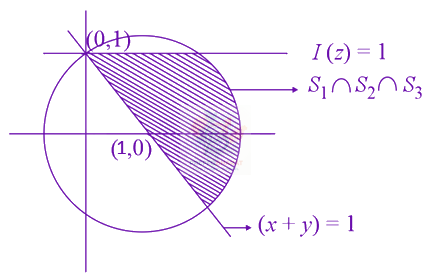
Now, the common part is shown in the shaded part, hence, we get infinite points in the shaded region.
⇒S1∩S2∩S3 has infinitely many elements.