$\begin{aligned}
& \mathrm{P}=\left[\begin{array}{cc}
\cos \theta & -\sin \theta \
\sin \theta & \cos \theta
\end{array}\right] \
& \because \mathrm{P}^{\mathrm{T}} \mathrm{P}=\mathrm{I} \
& \mathrm{B}=\mathrm{PAPT}
\end{aligned}Premultiplyby\mathrm{P}^{\mathrm{T}}(Given)\mathrm{P}^{\mathrm{T}} \mathrm{B}=\mathrm{P}^{\mathrm{T}} \mathrm{P} \mathrm{AP}^{\mathrm{T}}=\mathrm{AP}^{\mathrm{T}}NowpostmultiplybyP\mathrm{P}^{\mathrm{T}} \mathrm{BP}=\mathrm{AP}^{\mathrm{T}} \mathrm{P}=\mathrm{A}$ 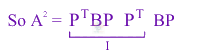
A2=PT B2P Similarly A10=PTB10P=C $\begin{aligned}
& A=\left[\begin{array}{cc}
\frac{1}{\sqrt{2}} & -2 \
0 & 1
\end{array}\right] \text { (Given) } \
& \Rightarrow A^2=\left[\begin{array}{cc}
\frac{1}{2} & -\sqrt{2}-2 \
0 & 1
\end{array}\right]
\end{aligned}SimilarlycheckA^3andsoonsinceC=A^{10}\RightarrowSumofdiagonalelementsofCis\left(\frac{1}{\sqrt{2}}\right)^{10}+1\begin{aligned} & =\frac{1}{32}+1=\frac{33}{32}=\frac{\mathrm{m}}{\mathrm{n}} \ & \operatorname{g~cd}(\mathrm{m}, \mathrm{n})=1(\text { Given }) \ & \Rightarrow \mathrm{m}+\mathrm{n}=65\end{aligned}$