JEE Main 2025 — Electromagnetism
Physics Electromagnetism questions from JEE Main 2025.
Other Years
129 Electromagnetism Questions from 2025
A particle of charge $q$, mass $m$ and kinetic energy E enters in magnetic field perpendicular to its velocity and undergoes a circular arc of radius( r). Which of the following curves represents the variation of $r$ with $E$ ?
A magnetic dipole experiences a torque of $80 \sqrt{3} \mathrm{~N} \mathrm{~m}$ when placed in uniform magnetic field in such a way that dipole moment makes angle of $60^{\circ}$ with magnetic field. The potential energy of the dipole is :
The net current flowing in the given circuit is_______ A. 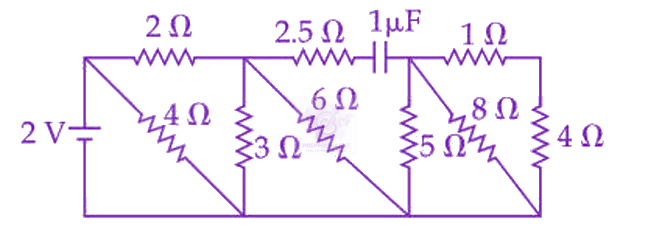
The magnitude of force on a charge q moving with velocity v in a magnetic field B at angle θ is:
A galvanometer having a coil of resistance $30 \Omega$ need 20 mA of current for full-scale deflection. If a maximum current of 3 A is to be measured using this galvanometer, the resistance of the shunt to be added to the galvanometer should be $\frac{30}{X} \Omega$, where $X$ is Options
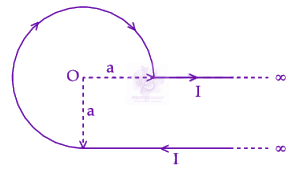 An infinite wire has a circular bend of radius a, and carrying a current I as shown in figure. The magnitude of magnetic field at the origin $O$ of the arc is given by :
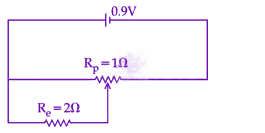 Sliding contact of a potentiometer is in the middle of the potentiometer wire having resistance $R_p=1 \Omega$ as shown in the figure. An external resistance of $R_e=2 \Omega$ is connected via the sliding contact. The electric current in the circuit is :
Two charges $\mathrm{q}_1$ and $\mathrm{q}_2$ are separated by a distance of 30 cm. A third charge $q_3$ initially at ' C ' as shown in the figure, is moved along the circular path of radius 40 cm from C to D. If the difference in potential energy due to movement of $q_3$ from $C$ to $D$ is given by $\frac{\mathrm{q}_3 \mathrm{~K}}{4 \pi \epsilon_0}$, the value of K is : 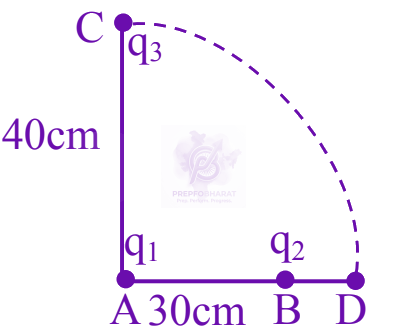
Conductor wire ABCDE with each $\operatorname{arm} 10 \mathrm{~cm}$ in length is placed in magnetic field of $\frac{1}{\sqrt{2}}$ Tesla, perpendicular to its plane. When conductor is pulled towards right with constant velocity of $10 \mathrm{~cm} / \mathrm{s}$, induced emf between points A and E is _____ mV. 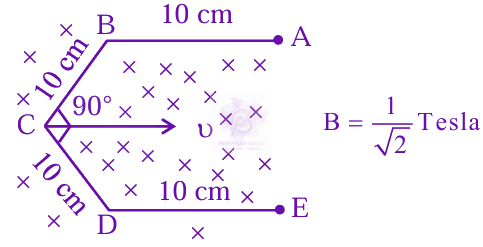
A rectangular metallic loop is moving out of a uniform magnetic field region to a field free region with a constant speed. When the loop is partially inside the magnate field, the plot of magnitude of induced emf $(\varepsilon)$ with time $(t)$ is given by
The electrostatic potential on the surface of uniformly charged spherical shell of radius $\mathrm{R}=10 \mathrm{~cm}$ is 120 V. The potential at the centre of shell, at a distance $\mathrm{r}=5 \mathrm{~cm}$ from centre, and at a distance $\mathrm{r}=15 \mathrm{~cm}$ from the centre of the shell respectively, are :
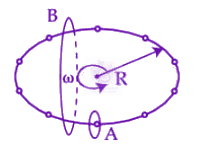 N equally spaced charges each of value q , are placed on a circle of radius R . The circle rotates about its axis with an angular velocity $\omega$ as shown in the figure. A bigger Amperian loop B encloses the whole circle where as a smaller Amperian loop A encloses a small segment. The difference between enclosed currents, $I_A-I_B$, for the given Amperian loops is
Uniform magnetic fields of different strengths $\left(B_1\right.$ and $B_2$), both normal to the plane of the paper exist as shown in the figure. A charged particle of mass m and charge q , at the interface at an instant, moves into the region 2 with velocity $v$ and returns to the interface. It continues to move into region 1 and finally reaches the interface. What is the displacement of the particle during this movement along the interface? 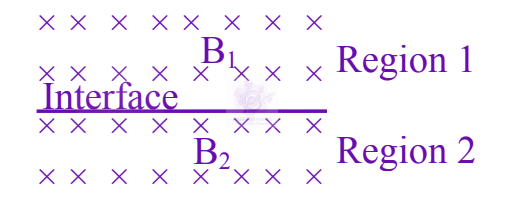 (Consider the velocity of the particle to be normal to the magnetic field and $B_2 \gt B_1$)
A parallel plate capacitor consisting of two circular plates of radius 10 cm is being charged by a constant current of 0.15 A . If the rate of change of potential difference between the plates is $7 \times 10^8 \mathrm{~V} / \mathrm{s}$ then the integer value of the distance between the parallel plates is $\left(\right.$ Take, $\left.\epsilon_0=9 \times 10^{-12} \frac{\mathrm{~F}}{\mathrm{~m}}, \pi=\frac{22}{7}\right)$ ________ $\mu \mathrm{m}$.
Two plane polarized light waves combine at a certain point whose electric field components are $\begin{aligned} & \mathrm{E}_1=\mathrm{E}_0 \sin \omega \mathrm{t} \\ & \mathrm{E}_2=\mathrm{E}_0 \sin \left(\omega \mathrm{t}+\frac{\pi}{3}\right)\end{aligned}$ Find the amplitude of the resultant wave.
Consider \(\mathrm{I}_1\) and \(\mathrm{I}_2\) are the currents flowing simultaneously in two nearby coils 1 & 2, respectively. If \(\mathrm{L}_1=\) self inductance of coil \(1, \mathrm{M}_{12}=\) mutual inductance of coil 1 with respect to coil 2, then the value of induced emf in coil 1 will be Options
In the figure shown below, a resistance of $150.4 \Omega$ is connected in series to an ammeter A of resistance $240 \Omega$. A shunt resistance of $10 \Omega$ is connected in parallel with the ammeter. The reading of the ammeter is _____ mA. 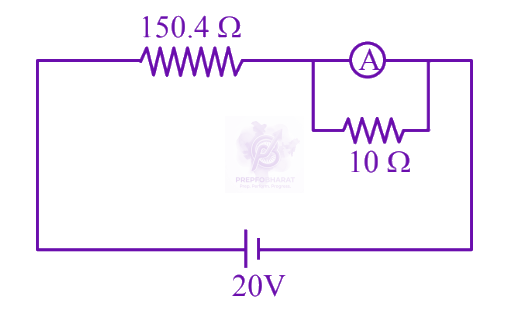
An alternating current is given by $\mathrm{I}=\mathrm{I}_{\mathrm{A}} \sin \omega \mathrm{t}+\mathrm{I}_{\mathrm{B}} \cos \omega \mathrm{t}$. The r.m.s current will be
Consider two infinitely large plane parallel conducting plates as shown below. The plates are uniformly charged with a surface charge density $+\sigma$ and $-2 \sigma$. The force experienced by a point charge +q placed at the mid point between two plates will be : 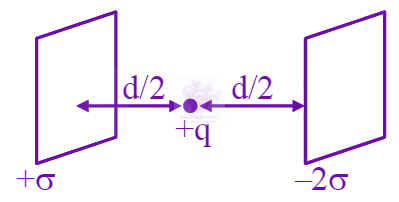
The relationship between the magnetic susceptibility $(\chi)$ and the magnetic permeability $(\mu)$ is given by : ($\mu_0$ is the permeability of free space and $\mu_{\mathrm{r}}$ is relative permeability)
Two capacitors $C_1$ and $C_2$ are connected in parallel to a battery. Charge-time graph is shown below for the two capacitors. The energy stored with them are $U_1$ and $U_2$, respectively. Which of the given statements is true? 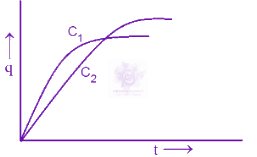
Three infinitely long wires with linear charge density $\lambda$ are placed along the $x-a x i s, y$-axis and $z-$ axis respectively. Which of the following denotes an equipotential surface?
An ac current is represented as $\mathrm{i}=5 \sqrt{2}+10 \cos \left(650 \pi \mathrm{t}+\frac{\pi}{6}\right) \mathrm{Amp}$ The r.m.s value of the current is
Given below are two statements: one is labelled as Assertion (A) and the other is labelled as Reason (R). Assertion (A) : The outer body of an air craft is made of metal which protects persons sitting inside from lightning-strikes. Reason (R) : The electric field inside the cavity enclosed by a conductor is zero. In the light of the above statements, chose the most appropriate answer from the options given below :
An inductor of self inductance 1 H connected in series with a resistor of $100 \pi \mathrm{ohm}$ and an ac supply of $100 \pi$ volt, 50 Hz. Maximum current flowing in the circuit is ________ A.
A series LCR circuit is connected to an alternating source of emf E. The current amplitude at resonant frequency is $I_0$. If the value of resistance R becomes twice of its initial value then amplitude of current at resonance will be
The magnetic field inside a 200 turns solenoid of radius 10 cm is $2.9 \times 10^{-4} \mathrm{Tesla}$. If the solenoid carries a current of 0.29 A , then the length of the solenoid is ________ $\pi \mathrm{cm}$.
Given below are two statements : Statement-I : The equivalent emf of two nonideal batteries connected in parallel is smaller than either of the two emfs. Statement-II : The equivalent internal resistance of two nonideal batteries connected in parallel is smaller than the internal resistance of either of the two batteries. In the light of the above statements, choose the correct answer from the options given below.
A square loop of sides $a=1 \mathrm{~m}$ is held normally in front of a point charge $\mathrm{q}=1 \mathrm{C}$. The flux of the electric field through the shaded region is $\frac{5}{\mathrm{p}} \times \frac{1}{\varepsilon_0} \frac{\mathrm{Nm}^2}{\mathrm{C}}$, where the value of p is _____. 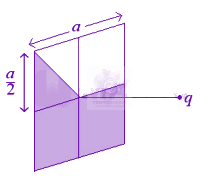
Given below are two statements : one is labelled as Assertion (A) and the other is labelled as Reason (R). Assertion (A) : Choke coil is simply a coil having a large inductance but a small resistance. Choke coils are used with fluorescent mercury-tube fittings. If household electric power is directly connected to a mercury tube, the tube will be damaged. Reason (R): By using the choke coil, the voltage across the tube is reduced by a factor \(\left(R / \sqrt{R^2+\omega^2 L^2}\right)\), where \(\omega\) is frequency of the supply across resistor \(R\) and inductor L . If the choke coil were not used, the voltage across the resistor would be the same as the applied voltage. In the light of the above statements, choose the most appropriate answer from the options given below :
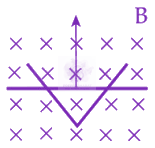 A conducting bar moves on two conducting rails as shown in the figure. A constant magnetic field B exists into the page. The bar starts to move from the vertex at time $t=0$ with a constant velocity. If the induced EMF is $\mathrm{E} \propto \mathrm{t}^{\mathrm{n}}$, then value of n is _.
Due to presence of an em-wave whose electric component is given by $\mathrm{E}=100 \sin (\omega \mathrm{t}-\mathrm{kx}) \mathrm{NC}^{-1}$, a cylinder of length 200 cm holds certain amount of em-energy inside it. If another cylinder of same length but half diameter than previous one holds same amount of em-energy, the magnitude of the electric field of the corresponding em-wave should be modified as
A wire of length 25 m and cross-sectional area $5 \mathrm{~mm}^2$ having resistivity of $2 \times 10^{-6} \Omega \mathrm{~m}$ is bent into a complete circle. The resistance between diametrically opposite points will be
A point charge causes an electric flux of $-2 \times 10^4 \mathrm{Nm}^2 \mathrm{C}^{-1}$ to pass through a spherical Gaussian surface of 8.0 cm radius, centred on the charge. The value of the point charge is : (Given $\epsilon_0=8.85 \times 10^{-12} \mathrm{C}^2 \mathrm{~N}^{-1} \mathrm{~m}^{-2}$ )
Given below are two statements : one is labelled as Assertion (A) and the other is labelled as Reason (R). Assertion (A) : Electromagnetic waves carry energy but not momentum. Reason (\(\mathbf{R}\)): Mass of a photon is zero. In the light of the above statements, choose the most appropriate answer from the options given below :
A parallel plate capacitor of capacitance $1 \mu \mathrm{~F}$ is charged to a potential difference of 20 V . The distance between plates is $1 \mu \mathrm{~m}$. The energy density between plates of capacitor is.
A plane electromagnetic wave propagates along the $+x$ direction in free space. The components of the electric field, $\vec{E}$ and magnetic field, $\vec{B}$ vectors associated with the wave in Cartesian frame are
An electron projected perpendicular to a uniform magnetic field B moves in a circle. If Bohr's quantization is applicable, then the radius of the electronic orbit in the first excited state is :
Which of the following resistivity ( $\rho$ ) $\mathrm{v} / \mathrm{s}$ temperature (T) curves is most suitable to be used in wire bound standard resistors?
A wire of resistance R is bent into an equilateral triangle and an identical wire is bent into $a$ square. The ratio of resistance between the two end points of an edge of the triangle to that of the square is Options
In a moving coil galvanometer, two moving coils $M_1$ and $M_2$ have the following particulars : $\begin{aligned}<br/>& \mathrm{R}_1=5 \Omega, \mathrm{~N}_1=15, \mathrm{~A}_1=3.6 \times 10^{-3} \mathrm{~m}^2, \mathrm{~B}_1=0.25 \mathrm{~T} \\ & \mathrm{R}_2=7 \Omega, \mathrm{~N}_2=21, \mathrm{~A}_2=1.8 \times 10^{-3} \mathrm{~m}^2, \mathrm{~B}_2=0.50 \mathrm{~T}<br/>\end{aligned}$ Assuming that torsional constant of the springs are same for both coils, what will be the ratio of voltage sensitivity of $M_1$ and $M_2$ ?
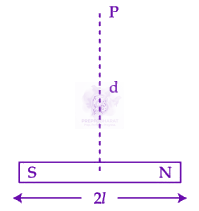 A bar magnet has total length $2 l=20$ units and the field point $P$ is at a distance $\mathrm{d}=10$ units from the centre of the magnet. If the relative uncertainty of length measurement is $1 \%$, then uncertainty of the magnetic field at point P is :
A time varying potential difference is applied between the plates of a parallel plate capacitor of capacitance $2.5 \mu \mathrm{~F}$. The dielectric constant of the medium between the capacitor plates is 1 . It produces an instantaneous displacement current of 0.25 mA in the intervening space between the capacitor plates, the magnitude of the rate of change of the potential difference will be _____ $\mathrm{Vs}^{-1}$.
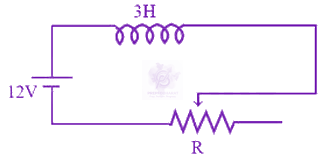 In the given circuit the sliding contact is pulled outwards such that electric current in the circuit changes at the rate of $8 \mathrm{~A} / \mathrm{s}$. At an instant when R is $12 \Omega$, the value of the current in the circuit will be ______ A.
A proton is moving undeflected in a region of crossed electric and magnetic fields at a constant speed of $2 \times 10^5 \mathrm{~ms}^{-1}$. When the electric field is switched off, the proton moves along a circular path of radius 2 cm . The magnitude of electric field is $x \times 10^4 \mathrm{~N} / \mathrm{C}$. The value of $x$ is _______ Take the mass of the proton $=1.6 \times 10^{-27} \mathrm{~kg}$.
A wire of resistance $R$ is bent into a triangular pyramid as shown in figure with each segment having same length. The resistance between points $A$ and $B$ is $R / n$. The value of $n$ is : 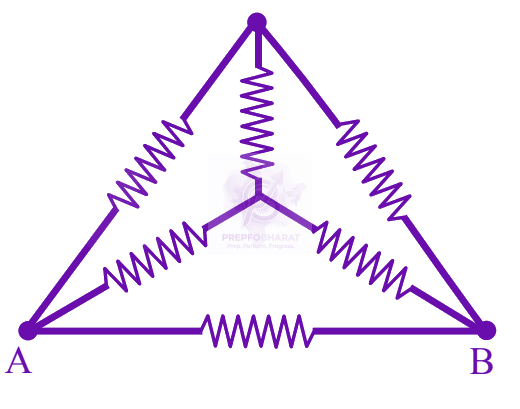
Two point charges $-4 \mu c$ and $4 \mu c$, constituting an electric dipole, are placed at $(-9,0,0) \mathrm{cm}$ and $(9,0,0) \mathrm{cm}$ in a uniform electric field of strength $10^4 \mathrm{NC}^{-1}$. The work done on the dipole in rotating it from the equilibrium through $180^{\circ}$ is :
Regarding self-inductance: A. The self-inductance of the coil depends on its geometry. B. Self-inductance does not depend on the permeability of the medium. C. Self-induced e.m.f. opposes any change in the current in a circuit. D. Self-inductance is electromagnetic analogue of mass in mechanics. E. Work needs to be done against self-induced e.m.f. in establishing the current. Choose the correct answer from the options given below:
Given below are two statements. One is labelled as Assertion (A) and the other is labelled as Reason (R). Assertion (A) : A electron in a certain region of uniform magnetic field is moving with constant velocity in a straight line path. Reason (R): The magnetic field in that region is along the direction of velocity of the electron. In the light of the above statements, choose the correct answer from the options given below :
Two small spherical balls of mass 10 g each with charges $-2 \mu \mathrm{C}$ and $2 \mu \mathrm{C}$, are attached to two ends of very light rigid rod of length 20 cm. The arrangement is now placed near an infinite nonconducting charge sheet with uniform charge density of $100 \mu \mathrm{C} / \mathrm{m}^2$ such that length of rod makes an angle of $30^{\circ}$ with electric field generated by charge sheet. Net torque acting on the rod is: (Take $\varepsilon_0: 8.85 \times 10^{-12} \mathrm{C}^2 / \mathrm{Nm}^2$)
Match List - I with List - II. \(\begin{array}{l|l} \text { List - I } & \text { List - II } \\ \hline \text { (A) }\begin{array}{l} \text { Electric field inside (distance } r>0 \text { from center) } \\ \text { of a uniformly charged spherical shell with } \\ \text { surface charge density } \sigma \text {, and radius R. } \end{array} & \text { (I) } \begin{array}{l} \sigma / \epsilon_0 \end{array} \\ \text { (B) } \begin{array}{l} \text { Electric field at distance r>0 from a uniformly } \\ \text { charged infinite plane sheet with surface } \\ \text { charge density } \sigma . \end{array} & \text { (II) } \sigma / 2 \epsilon_0 \\ \text { (C) } \begin{array}{l} \text { Electric field outside (distance r>0 from center) } \\ \text { of a uniformly charged spherical shell with } \\ \text { surface charge density } \sigma \text {, and radius R. } \end{array} & \text { (III) } 0 \\ \text { (D) } \begin{array}{l} \text { Electric field between } 2 \text { oppositely charged } \\ \text { infinite plane parallel sheets with uniform } \\ \text { surface charge density } \sigma . \end{array} & \text { (IV) } \frac{\sigma R^2}{\epsilon_0 r^2} \end{array}\) Choose the correct answer from the options given below :
The unit of $\sqrt{\frac{2 \mathrm{I}}{\epsilon_0 c}}$ is : (I = intensity of an electromagnetic wave, $\mathrm{c}:$ speed of light)
At steady state the charge on the capacitor, as shown in the circuit below, is $\qquad$ $\mu \mathrm{C}$. 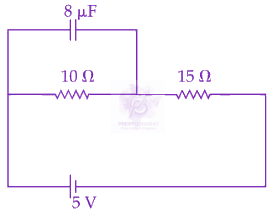
Three parallel plate capacitors $\mathrm{C}_1, \mathrm{C}_2$ and $\mathrm{C}_3$ each of capacitance $5 \mu \mathrm{~F}$ are connected as shown in figure. The effective capacitance between points A and B, when the space between the parallel plates of $C_1$ capacitor is filled with a dielectric medium having dielectric constant of 4, is : 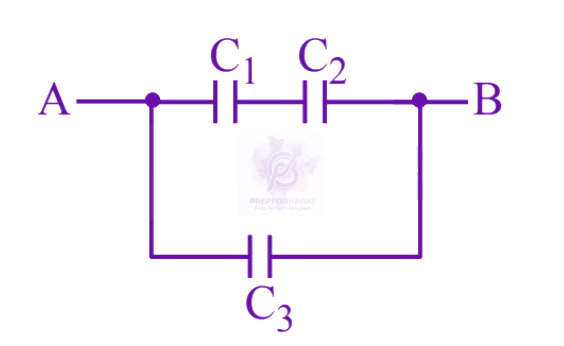
An inductor of reactance $100 \Omega$, a capacitor of reactance $50 \Omega$, and a resistor of resistance $50 \Omega$ are connected in series with an AC source of 10 V , 50 Hz. Average power dissipated by the circuit is ________ W.
Consider a parallel plate capacitor of area A (of each plate) and separation 'd' between the plates. If $E$ is the electric field and $\varepsilon_0$ is the permittivity of free space between the plates, then potential energy stored in the capacitor is
Given below are two statements : one is labelled as Assertion (A) and the other is labelled as Reason(R). Assertion (A) : Magnetic monopoles do not exist. Reason (R) : Magnetic field lines are continuous and form closed loops. In the light of the above statements, choose the most appropriate answer from the options given below :
Two long parallel wires $X$ and $Y$, separated by a distance of 6 cm , carry currents of 5A and 4A, respectively, in opposite directions as shown in the figure. Magnitude of the resultant magnetic field at point P at a distance of 4 cm from wire Y is $x \times 10^{-5} \mathrm{~T}$. The value of $x$ is__________ . Take permeability of free space as $\mu_0=4 \pi \times 10^{-7} \mathrm{SI}$ units. 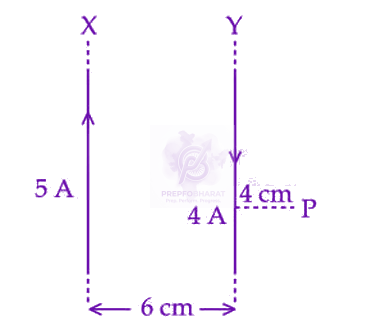
Current passing through a wire as function of time is given as $\mathrm{I}(\mathrm{t})=0.02 \mathrm{t}+0.01 \mathrm{~A}$. The charge that will flow through the wire from $t=1 s$ to $t=2 s$ is :
Two infinite identical charged sheets and a charged spherical body of charge density ' $\rho$ ' are arranged as shown in figure. Then the correct relation between the electrical fields at $\mathrm{A}, \mathrm{B}, \mathrm{C}$ and D points is : 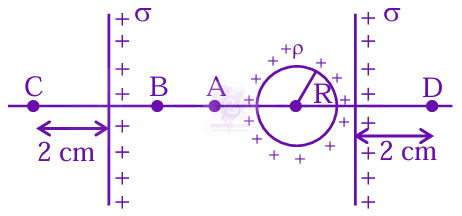
Given below are two statements : one is labelled as Assertion (A) and the other is labelled as Reason (R). Assertion (A) : Net dipole moment of a polar linear isotropic dielectric substance is not zero even in the absence of an external electric field. Reason (R) : In absence of an external electric field, the different permanent dipoles of a polar dielectric substance are oriented in random directions. In the light of the above statements, choose the most appropriate answer from the options given below :
A long straight wire of a circular cross-section with radius ' $a$ ' carries a steady current $I$. The current I is uniformly distributed across this cross-section. The plot of magnitude of magnetic field B with distance $r$ from the centre of the wire is given by
A dipole with two electric charges of $2 \mu \mathrm{C}$ magnitude each, with separation distance $0.5 \mu \mathrm{~m}$, is placed between the plates of a capacitor such that its axis is parallel to an electric field established between the plates when a potential difference of 5 V is applied. Separation between the plates is 0.5 mm. If the dipole is rotated by $30^{\circ}$ from the axis, it tends to realign in the direction due to a torque. The value of torque is :
The electric field in a region is given by $\overrightarrow{\mathrm{E}}=(2 \hat{\mathrm{i}}+4 \hat{\mathrm{j}}+6 \hat{\mathrm{k}}) \times 10^3 \mathrm{~N} / \mathrm{C}$. The flux of the field through a rectangular surface parallel to $x-z$ plane is $6.0 \mathrm{Nm}^2 \mathrm{C}^{-1}$. The area of the surface is ________ $\mathrm{cm}^2$.
Two large plane parallel conducting plates are kept 10 cm apart as shown in figure. The potential difference between them is $V$. The potential difference between the points A and B (shown in the figure) is : 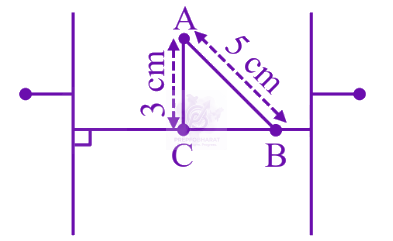
A positive ion $A$ and a negative ion $B$ has charges $6.67 \times 10^{-19} \mathrm{C}$ and $9.6 \times 10^{-10} \mathrm{C}$, and masses $19.2 \times 10^{-27} \mathrm{~kg}$ and $9 \times 10^{-27} \mathrm{~kg}$ respectively. At an instant, the ions are separated by a certain distance r. At that instant the ratio of the magnitudes of electrostatic force to gravitational force is $P \times 10^{45}$, where the value of 10$P$ is $\qquad$ (Take $\frac{1}{4 \pi \varepsilon_0}=9 \times 10^9 \mathrm{Nm}^2 \mathrm{C}^{-1}$ and universal gravitational constant as $6.67 \times 10^{-11} \mathrm{Nm}^2 \mathrm{~kg}^{-2}$ ) Assume that charge may not be an integral multiple of electrons.
A small uncharged conducting sphere is placed in contact with an identical sphere but having $4 \times 10^{-8} \mathrm{C}$ charge and then removed to a distance such that the force of repulsion between them is $9 \times 10^{-3} \mathrm{~N}$. The distance between them is (Take $\frac{1}{4 \pi \epsilon_{\mathrm{o}}}$ as $9 \times 10^9 \mathrm{in} \mathrm{SI}$ units)
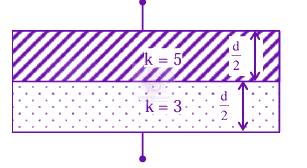 Space between the plates of a parallel plate capacitor of plate area $4 \mathrm{~cm}^2$ and separation of (d) 1.77 mm, is filled with uniform dielectric materials with dielectric constants (3 and 5) as shown in figure. Another capacitor of capacitance 7.5 pF is connected in parallel with it. The effective capacitance of this combination is ________ pF. $\left(\right.$ Given $\left.\varepsilon_0=8.85 \times 10^{-12} \mathrm{~F} / \mathrm{m}\right)$
A parallel plate capacitor has charge $5 \times 10^{-6} \mathrm{C}$. A dielectric slab is inserted between the plates and almost fills the space between the plates. If the induced charge on one face of the slab is $4 \times 10^{-6} \mathrm{C}$ then the dielectric constant of the slab is ________.
A parallel plate capacitor was made with two rectangular plates, each with a length of $l=3 \mathrm{~cm}$ and breath of $\mathrm{b}=1 \mathrm{~cm}$. The distance between the plates is $3 \mu \mathrm{~m}$. Out of the following, which are the ways to increase the capacitance by a factor of 10 ? A. $l=30 \mathrm{~cm}, \mathrm{~b}=1 \mathrm{~cm}, \mathrm{~d}=1 \mu \mathrm{~m}$ B. $l=3 \mathrm{~cm}, \mathrm{~b}=1 \mathrm{~cm}, \mathrm{~d}=30 \mu \mathrm{~m}$ C. $l=6 \mathrm{~cm}, \mathrm{~b}=5 \mathrm{~cm}, \mathrm{~d}=3 \mu \mathrm{~m}$ D. $l=1 \mathrm{~cm}, \mathrm{~b}=1 \mathrm{~cm}, \mathrm{~d}=10 \mu \mathrm{~m}$ E. $l=5 \mathrm{~cm}, \mathrm{~b}=2 \mathrm{~cm}, \mathrm{~d}=1 \mu \mathrm{~m}$ Choose the correct answer from the options given below:
Identify the valid statements relevant to the given circuit at the instant when the key is closed. 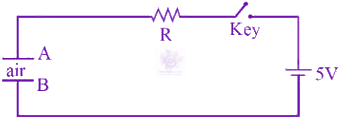 A. There will be no current through resistor $R$. B. There will be maximum current in the connecting wires. C. Potential difference between the capacitor plates A and B is minimum. D. Charge on the capacitor plates is minimum. Choose the correct answer from the options given below:
Two cells of emf 1 V and 2 V and internal resistance $2 \Omega$ and $1 \Omega$, respectively, are connected in series with an external resistance of $6 \Omega$. The total current in the circuit is $\mathrm{I}_1$. Now the same two cells in parallel configuration are connected to same external resistance. In this case, the total current drawn is $I_2$. The value of $\left(\frac{I_1}{I_2}\right)$ is $\frac{x}{3}$. The value of $x$ is _____.
The value of current I in the electrical circuit as given below, when potential at A is equal to the potential at B, will be ____ A. 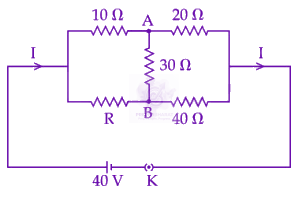
A solenoid having area $A$ and length ' $l$ ' is filled with a material having relative permeability 2. The magnetic energy stored in the solenoid is :
A parallel plate capacitor of area $A=16 \mathrm{~cm}^2$ and separation between the plates 10 cm , is charged by a DC current. Consider a hypothetical plane surface of area $\mathrm{A}_0=3.2 \mathrm{~cm}^2$ inside the capacitor and parallel to the plates. At an instant, the current through the circuit is 6A. At the same instant the displacement current through $\mathrm{A}_0$ is ________ mA .
From the combination of resistors with resistance values $R_1=R_2=R_3=5 \Omega$ and $R_4=10 \Omega$, which of the following combination is the best circuit to get an equivalent resistance of $6 \Omega$ ?
A particle of charge $1.6 \mu \mathrm{C}$ and mass $16 \mu \mathrm{~g}$ is present in a strong magnetic field of 6.28 T. The particle is then fired perpendicular to magnetic field. The time required for the particle to return to original location for the first time is ________ S. $(\pi=3.14)$
Consider a moving coil galvanomenter (MCG): A. The torsional constant in moving coil galvanometer has dimentions $\left[\mathrm{ML}^2 \mathrm{~T}^{-2}\right]$ B. Increasing the current sensitivity may not necessarily increase the voltage sensitivity. C. If we increase number of turns $(\mathrm{N})$ to its double $(2 \mathrm{~N})$, then the voltage sensitivity doubles. D. MCG can be converted into an ammeter by introducing a shunt resistance of large value in parallel with galvanometer. E. Current sensitivity of MCG depends inversely on number of turns of coil. Choose the correct answer from the options given below:
A tightly wound long solenoid carries a current of 1.5 A . An electron is executing uniform circular motion inside the solenoid with a time period of 75 ns . The number of turns per metre in the solenoid is $\ldots\ldots$ -. [Take mass of electron $\mathrm{m}_{\mathrm{e}}=9 \times 10^{-31} \mathrm{~kg}$, charge of electron $\left|\mathrm{q}_{\mathrm{e}}\right|=1.6 \times 10^{-19} \mathrm{C}$, $\left.\mu_0=4 \pi \times 10^{-7} \frac{\mathrm{~N}}{\mathrm{~A}^2}, 1 \mathrm{~ns}=10^{-9} \mathrm{~s}\right]$
Given below are two statements : one is labelled as Assertion A and the other is labelled as Reason $\mathrm{R}$ Assertion A : Work done in moving a test charge between two points inside a uniformly charged spherical shell is zero, no matter which path is chosen. Reason $\mathrm{R}$ : Electrostatic potential inside a uniformly charged spherical shell is constant and is same as that on the surface of the shell. In the light of the above statements, choose the correct answer from the options given below
A capacitor, $C_1=6 \mu \mathrm{~F}$ is charged to a potential difference of $\mathrm{V}_0=5 \mathrm{~V}$ using a 5 V battery. The battery is removed and another capacitor, $\mathrm{C}_2=12 \mu \mathrm{~F}$ is inserted in place of the battery. When the switch 'S' is closed, the charge flows between the capacitors for some time until equilibrium condition is reached. What are the charges $\left(q_1\right.$ and $\left.q_2\right)$ on the capacitors $C_1$ and $C_2$ when equilibrium condition is reached. 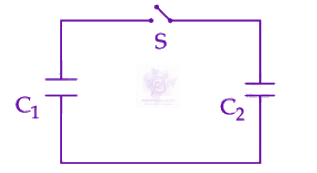
A point charge +q is placed at the origin. A second point charge +9 q is placed at $(\mathrm{d}, 0,0)$ in Cartesian coordinate system. The point in between them where the electric field vanishes is :
For ac circuit shown in figure, $\mathrm{R}=100 \mathrm{k} \Omega$ and $\mathrm{C}=100 \mathrm{pF}$ and the phase difference between $\mathrm{V}_{\text {in }}$ and $\left(V_B-V_A\right)$ is $90^{\circ}$. The input signal frequency is $10^x \mathrm{rad} / \mathrm{sec}$, where ' x ' is ______ 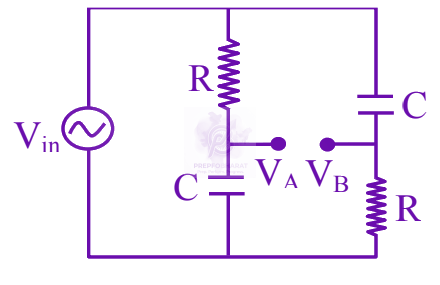
The magnetic field of an E.M. wave is given by $\overrightarrow{\mathrm{B}}=\left(\frac{\sqrt{3}}{2} \hat{i}+\frac{1}{2} \hat{j}\right) 30 \sin \left[\omega\left(\mathrm{t}-\frac{z}{\mathrm{c}}\right)\right]$ (S.I. Units). The corresponding electric field in S.I. units is :
There are ' $n$ ' number of identical electric bulbs, each is designed to draw a power $p$ independently from the mains supply. They are now joined in series across the main supply. The total power drawn by the combination is :
A wire of resistance $9 \Omega$ is bent to form an equilateral triangle. Then the equivalent resistance across any two vertices will be _____ ohm.
An electric dipole is placed at a distance of 2 cm from an infinite plane sheet having positive charge density $\sigma_{\mathrm{o}}$. Choose the correct option from the following. 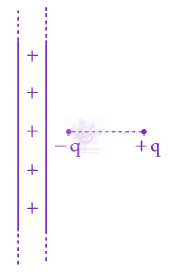
A coil of area A and N turns is rotating with angular velocity \(\omega\) in a uniform magnetic field \(\vec{B}\) about an axis perpendicular to \(\vec{B}\). Magnetic flux \(\varphi\) and induced \(\operatorname{emf} \varepsilon\) across it, at an instant when \(\vec{B}\) is parallel to the plane of coil, are :
Consider a circular loop that is uniformly charged and has a radius $\mathrm{a} \sqrt{2}$. Find the position along the positive z -axis of the cartesian coordinate system where the electric field is maximum if the ring was assumed to be placed in xy-plane at the origin :
Electric charge is transferred to an irregular metallic disk as shown in figure. If $\sigma_1, \sigma_2, \sigma_3$ and $\sigma_4$ are charge densities at given points then, choose the correct answer from the options given below: 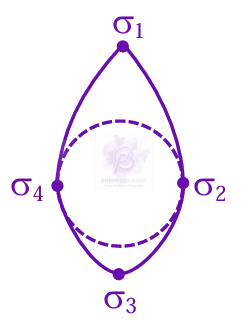 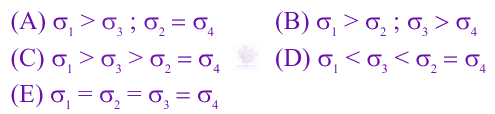
Consider a long straight wire of a circular cross-section (radius a) carrying a steady current I. The current is uniformly distributed across this cross-section. The distances from the centre of the wire's cross-section at which the magnetic field [inside the wire, outside the wire] is half of the maximum possible magnetic field, any where due to the wire, will be
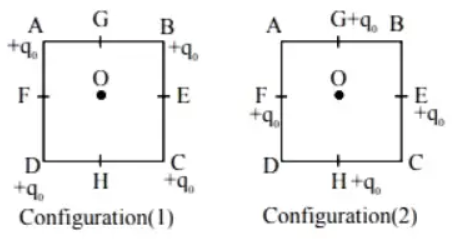 In the first configuration (1) as shown in the figure, four identical charges \(\left(q_0\right)\) are kept at the corners \(A, B, C\) and \(D\) of square of side length 'a'. In the second configuration (2), the same charges are shifted to mid points \(\mathrm{G}, \mathrm{E}, \mathrm{H}\) and F, of the square, If \(\mathrm{K}=\frac{1}{4 \pi \varepsilon_0}\), the difference between the potential energies of configuration (2) and (1) is given by :
Four capacitor each of capacitance $16 \mu \mathrm{~F}$ are connected as shown in the figure. The capacitance between points A and B is : ______ (in $\mu \mathrm{F}$). 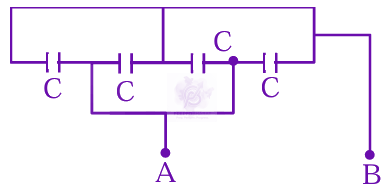
A small bob of mass 100 mg and charge $+10 \mu \mathrm{C}$ is connected to an insulating string of length 1 m. It is brought near to an infinitely long nonconducting sheet of charge density ' $\sigma$ ' as shown in figure. If string subtends an angle of $45^{\circ}$ with the sheet at equilibrium the charge density of sheet will be : (Given, $\varepsilon_0=8.85 \times 10^{-12} \frac{\mathrm{~F}}{\mathrm{~m}}$ and acceleration due to gravity, $g=10 \mathrm{~m} / \mathrm{s}^2$) 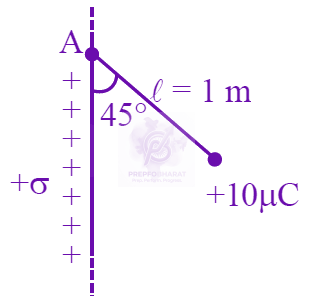
A parallel-plate capacitor of capacitance $40 \mu \mathrm{~F}$ is connected to a 100 V power supply. Now the intermediate space between the plates is filled with a dielectric material of dielectric constant $\mathrm{K}=2$. Due to the introduction of dielectric material, the extra charge and the change in the electrostatic energy in the capacitor, respectively, are
The battery of a mobile phone is rated as 4.2 V , 5800 mAh. How much energy is stored in it when fully charged ?
A 4.0 cm long straight wire carrying a current of 8A is placed perpendicular to an uniform magnetic field of strength 0.15 T. The magnetic force on the wire is ______ mN.
The electric field of an electromagnetic wave in free space is $\overrightarrow{\mathrm{E}}=57 \cos \left[7.5 \times 10^6 \mathrm{t}-5 \times 10^{-3}(3 x+4 y)\right](4 \hat{i}-3 \hat{j}) N / C$. The associated magnetic field in Tesla is
The difference of temperature in a material can convert heat energy into electrical energy. To harvest the heat energy, the material should have
A current of 5A exists in a square loop of side $\frac{1}{\sqrt{2}} \mathrm{~m}$. Then the magnitude of the magnetic field $B$ at the centre of the square loop will be $p \times 10^{-6} \mathrm{~T}$. where, value of p is _____ . $\left[\right.$ Take $\left.\mu_0=4 \pi \times 10^{-7} \mathrm{TmA}^{-1}\right]$.
A motor operating on 100 V draws a current of 1 A. If the efficiency of the motor is $91.6 \%$, then the loss of power in units of $\mathrm{cal} / \mathrm{s}$ is
What is the current through the battery in the circuit shown below 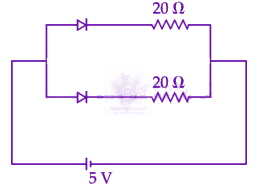
Let $B_1$ be the magnitude of magnetic field at center of a circular coil of radius $R$ carrying current $I$. Let $B_2$ be the magnitude of magnetic field at an axial distance ' $x$ ' from the center. For $x: R=3: 4, \frac{B_2}{B_1}$ is :
An alternating current is represented by the equation, $i=100 \sqrt{2} \sin (100 \pi t)$ ampere. The RMS value of current and the frequency of the given alternating current are
Using a battery, a 100 pF capacitor is charged to 60 V and then the battery is removed. After that, a second uncharged capacitor is connected to the first capacitor in parallel. If the final voltage across the second capacitor is 20 V, its capacitance is : (in pF)
For a short dipole placed at origin $O$, the dipole moment $P$ is along $x$-axis, as shown in the figure. If the electric potential and electric field at A are $\mathrm{V}_0$ and $\mathrm{E}_0$, respectively, then the correct combination of the electric potential and electric field, respectively, at point $B$ on the $y$-axis is given by 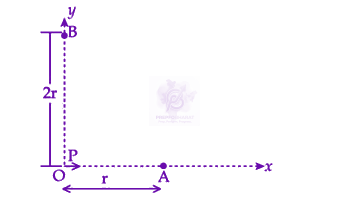
Given below are two statements: one is labelled as Assertion A and the other is labelled asReason R. Assertion A:. If oxygen ion $\left(\mathrm{O}^{-2}\right)$ and Hydrogen ion $\left(\mathrm{H}^{+}\right)$enter normal to the magnetic field with equal momentum, then the path of $\mathrm{O}^{-2}$ ion has a smaller curvature than that of $\mathrm{H}^{+}$. Reason R : A proton with same linear momentum as an electron will form a path of smaller radius of curvature on entering a uniform magnetic field perpendicularly. In the light of the above statements, choose the correct answer from the options given below :
If an optical medium possesses a relative permeability of $\frac{10}{\pi}$ and relative permittivity of $\frac{1}{0.0885}$, then the velocity of light is greater in vacuum than that in this medium by ________ times. $\left(\mu_0=4 \pi \times 10^{-7} \mathrm{H} / \mathrm{m}, \epsilon_0=8.85 \times 10^{-12} \mathrm{~F} / \mathrm{m}\right.$ $\left.\mathrm{c}=3 \times 10^8 \mathrm{~m} / \mathrm{s}\right)$
Two charges $7 \mu \mathrm{c}$ and $-4 \mu \mathrm{c}$ are placed at $(-7 \mathrm{~cm}, 0,0)$ and $(7 \mathrm{~cm}, 0,0)$ respectively. Given, $\epsilon_0=8.85 \times 10^{-12} \mathrm{C}^2 \mathrm{~N}^{-1} \mathrm{~m}^{-2}$, the electrostatic potential energy of the charge configuration is :
An electric dipole of mass m, charge q, and length \(l\) is placed in a uniform electric field \(\overrightarrow{\mathrm{E}}=\mathrm{E}_0 \hat{i}\). When the dipole is rotated slightly from its equilibrium position and released, the time period of its oscillations will be:
An electron is made to enter symmetrically between two parallel and equally but oppositely charged metal plates, each of 10 cm length. The electron emerges out of the electric field region with a horizontal component of velocity $10^6 \mathrm{~m} / \mathrm{s}$. If the magnitude of the electric field between the plates is $9.1 \mathrm{~V} / \mathrm{cm}$, then the vertical component of velocity of electron is (mass of electron $=9.1 \times 10^{-31} \mathrm{~kg}$ and charge of electron $=1.6 \times 10^{-19} \mathrm{C}$ )
Find the equivalent resistance between two ends of the following circuit 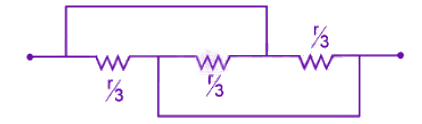
Consider a long thin conducting wire carrying a uniform current I. A particle having mass " M " and charge " $q$ " is released at a distance " $a$ " from the wire with a speed $v_0$ along the direction of current in the wire. The particle gets attracted to the wire due to magnetic force. The particle turns round when it is at distance $x$ from the wire. The value of $x$ is [ $\mu_0$ is vacuum permeability]
A metallic ring is uniformly charged as shown in figure. AC and BD are two mutually perpendicular diameters. Electric field due to $\operatorname{arc} \mathrm{AB}$ to ' O ' is ' E ' is magnitude. What would be the magnitude of electric field at ' O ' due to arc ABC ? 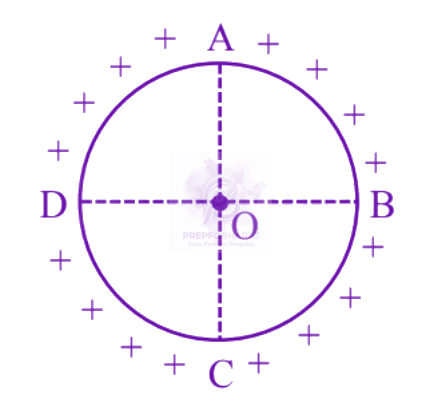
A plane electromagnetic wave of frequency 20 MHz travels in free space along the $+x$ direction. At a particular point in space and time, the electric field vector of the wave is $\mathrm{E}_y=9.3 \mathrm{Vm}^{-1}$. Then, the magnetic field vector of the wave at that point is
A particle of mass ' $m$ ' and charge ' $q$ ' is fastened to one end ' $A$ ' of a massless string having equilibrium length $l$, whose other end is fixed at point ' $O$ '. The whole system is placed on a frictionless horizontal plane and is initially at rest. If uniform electric field is switched on along the direction as shown in figure, then the speed of the particle when it crosses the x -axis is 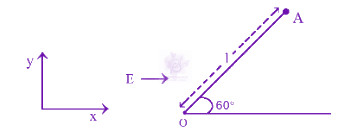
A point particle of charge $Q$ is located at $P$ along the axis of an electric dipole 1 at a distance $r$ as shown in the figure. The point P is also on the equatorial plane of a second electric dipole 2 at a distance r . The dipoles are made of opposite charge q separated by a distance $2 a$. For the charge particle at P not to experience any net force, which of the following correctly describes the situation? 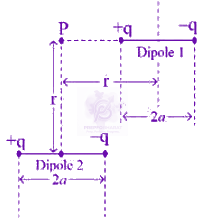
In a series LCR circuit, a resistor of $300 \Omega$, a capacitor of 25 nF and an inductor of 100 mH are used. For maximum current in the circuit, the angular frequency of the ac source is _____ $\times 10^4$ radians $\mathrm{s}^{-1}$.
Figure shows a current carrying square loop ABCD of edge length is ' $a$ ' lying in a plane. If the resistance of the $A B C$ part is $r$ and that of $A D C$ part is 2 r , then the magnitude of the resultant magnetic field at centre of the square loop is 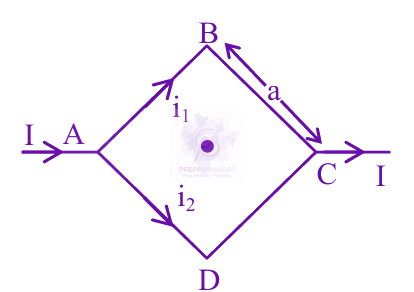
An electric bulb rated as $100 \mathrm{~W}-220 \mathrm{~V}$ is connected to an ac source of rms voltage 220 V. The peak value of current through the bulb is :
An electric dipole of dipole moment $6 \times 10^{-6} \mathrm{Cm}$ is placed in uniform electric field of magnitude $10^6 \mathrm{~V} / \mathrm{m}$. Initially, the dipole moment is parallel to electric field. The work that needs to be done on the dipole to make its dipole moment opposite to the field, will be ____ J.
The percentage increase in magnetic field (B) when space within a current carrying solenoid is filled with magnesium (magnetic susceptibility $\left.\chi_{\mathrm{mg}}=1.2 \times 10^{-5}\right)$ is :
An electron is released from rest near an infinite non-conducting sheet of uniform charge density ' $-\sigma$ '. The rate of change of de-Broglie wave length associated with the electron varies inversely as $\mathrm{n}^{\text {th }}$ power of time. The numerical value of $n$ is ________.
A parallel plate capacitor is filled equally (half) with two dielectrics of dielectric constant $\varepsilon_1$ and $\varepsilon_2$, as shown in figures. The distance between the plates is d and area of each plate is A. If capacitance in first configuration and second configuration are $C_1$ and $C_2$ respectively, then $\frac{C_1}{C_2}$ is : 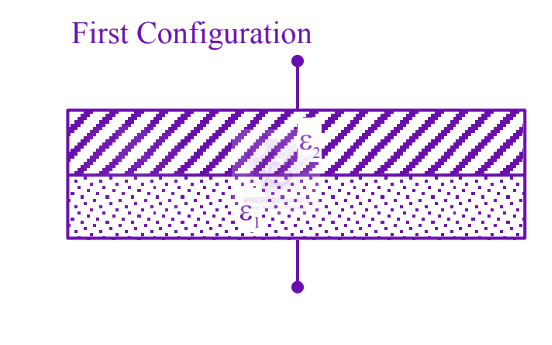 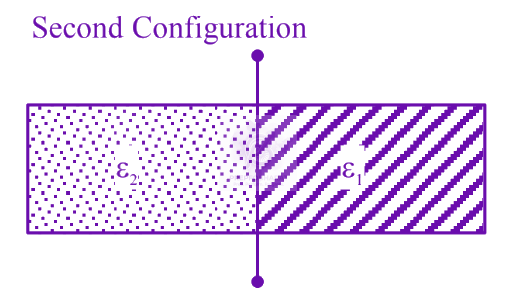
A line charge of length $\frac{\text { ' } a \text { ' }}{2}$ is kept at the center of an edge $B C$ of a cube $A B C D E F G H$ having edge length ' $a$ ' as shown in the figure. If the density of line charge is $\lambda$ C per unit length, then the total electric flux through all the faces of the cube will be _______. (Take, $\epsilon_0$ as the free space permittivity) 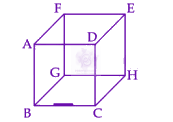
A loop ABCDA , carrying current $\mathrm{I}=12 \mathrm{~A}$, is placed in a plane, consists of two semi-circular segments of radius $R_1=6 \pi \mathrm{~m}$ and $\mathrm{R}_2=4 \pi \mathrm{~m}$. The magnitude of the resultant magnetic field at center O is $\mathrm{k} \times 10^{-7} \mathrm{~T}$. The value of k is ______ (Given $\mu_0=4 \pi \times 10^{-7} \mathrm{Tm} \mathrm{A}^{-1}$) 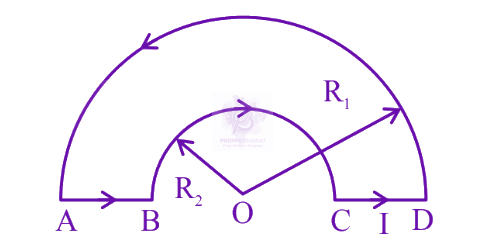
Two metal spheres of radius $R$ and $3 R$ have same surface charge density $\sigma$. If they are brought in contact and then separated, the surface charge density on smaller and bigger sphere becomes $\sigma_1$ and $\sigma_2$, respectively. The ratio $\frac{\sigma_1}{\sigma_2}$ is.
An infinitely long wire has uniform linear charge density $\lambda=2 \mathrm{nC} / \mathrm{m}$. The net flux through a Gaussian cube of side length $\sqrt{3} \mathrm{~cm}$, if the wire passes through any two corners of the cube, that are maximally displaced from each other, would be $\mathrm{xNm}^2 \mathrm{C}^{-1}$, where x is : [Neglect any edge effects and use $\frac{1}{4 \pi \varepsilon_0}=9 \times 10^9$ SI units]
A uniform magnetic field of 0.4 T acts perpendicular to a circular copper disc 20 cm in radius. The disc is having a uniform angular velocity of $10 \pi \mathrm{rad} \mathrm{s}^{-1}$ about an axis through its centre and perpendicular to the disc. What is the potential difference developed between the axis of the disc and the rim ? $(\pi=3.14)$