JEE Main 2018 — Electromagnetism
Physics Electromagnetism questions from JEE Main 2018.
Other Years
42 Electromagnetism Questions from 2018
A Helmholtz coil has a pair of loops, each with $N$ turns and radius $R$. They are placed coaxially at distance $R$ and the same current $I$ flows through the loops in the same direction. The magnitude of the magnetic field at $P,$ midway between the centres $A$ and $C,$ is given by [Refer to figure given below]: 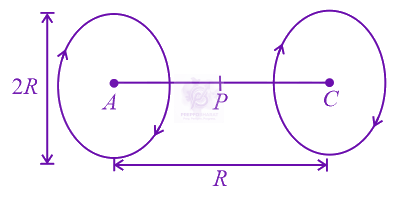
An ideal capacitor of capacitance $0.2\mu F$ is charged to a potential difference of $10V$. The charging battery is then disconnected. The capacitor is then connected to an ideal inductor of self inductance $0.5\mathrm{mH}$. The current at a time when the potential difference across the capacitor is $5V$ is:
A plane polarized monochromatic EM wave is travelling a vacuum along $z$ direction such that at $\mathrm{t}=\mathrm{t}_1$ it is found that the electric field is zero at a spatial point $z_1$. The next zero that occurs in its neighbourhood is at $z_2$. The frequency of the electromagnetic wave is:
A Helmholtz coil has pair of loops, each with $N$ turns and radius $R$. They are placed coaxially at distance $R$ and the same current $I$ flows through the loops in the same direction. The magnitude of magnetic field at $P$, midway between the centres $A$ and $C$, is given by (Refer to figure): 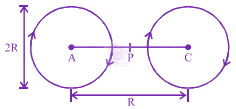
A power transmission line feeds input power at$2300V$ to a step-down transformer with its primary windings having $4000$turns giving the output power at $230V$. If the current in the primary coil of the transformer is $5A$ and its efficiency is $90%$, the output current would be:
The dipole moment of a circular loop carrying a current I, is m and the magnetic field at the centre of the loop is ${B}_{1}$ . When the dipole moment is doubled by keeping the current constant, the magnetic field at the centre of the loop is ${B}_{2}$ . The ratio $\frac{{B}_{1}}{{B}_{2}}$ is:
Two batteries with e.m.f. $12V$ and $13V$ are connected in parallel across a load resistor of $10\Omega$. The internal resistance of the two batteries are $1\Omega$ and $2\Omega$ respectively. The voltage across the load lies between,
A parallel plate capacitor of capacitance $90\mathrm{pF}$ is connected to a battery of EMF $20V$. If a dielectric material of dielectric constant $K=\frac{5}{3}$ is inserted between the plates, the magnitude of the induced charge will be:
A charge $Q$ is placed at a distance $\frac{a}{2}$ above the centre of a square surface of side length $a$. The electric flux through the square surface due to the charge would be? 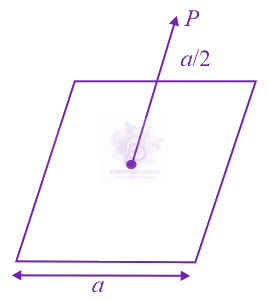
A monochromatic beam of light has a frequency $v=\frac{3}{2\pi }\times {10}^{12}$ $\mathrm{Hz}$ and is propagating along the direction $\frac{\hat{i}+\hat{j} }{\sqrt{2}}$ . It is polarized along the $\hat{k}$ direction. The acceptance form the magnetic field is:
A heating element has a resistance of $100 \Omega$ at room temperature. When it is connected to a supply of $220V$, a steady current of $2A$ passes in it and temperature is $500{}^{o}C$ more than the room temperature. The temperature coefficient of resistance of the heating element is
[12] A solid ball of radius $\mathrm{R}$ has a charge density $\rho$ given by $\rho=\rho_0\left(1-\frac{r}{R}\right)$ for $0 \leq r \leq R$. The electric field outside the ball is:
In the given circuit all resistances are of value $R$ ohm each. The equivalent resistance between $A$ and $B$ is: 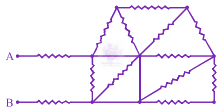
The $B-H$ curve for a ferromagnet is shown in the figure. The ferromagnet is placed inside a long solenoid with $1000\mathrm{turns}{\mathrm{cm}}^{-1}$. The current that should be passed in the solenoid to demagnetize the ferromagnet completely is, 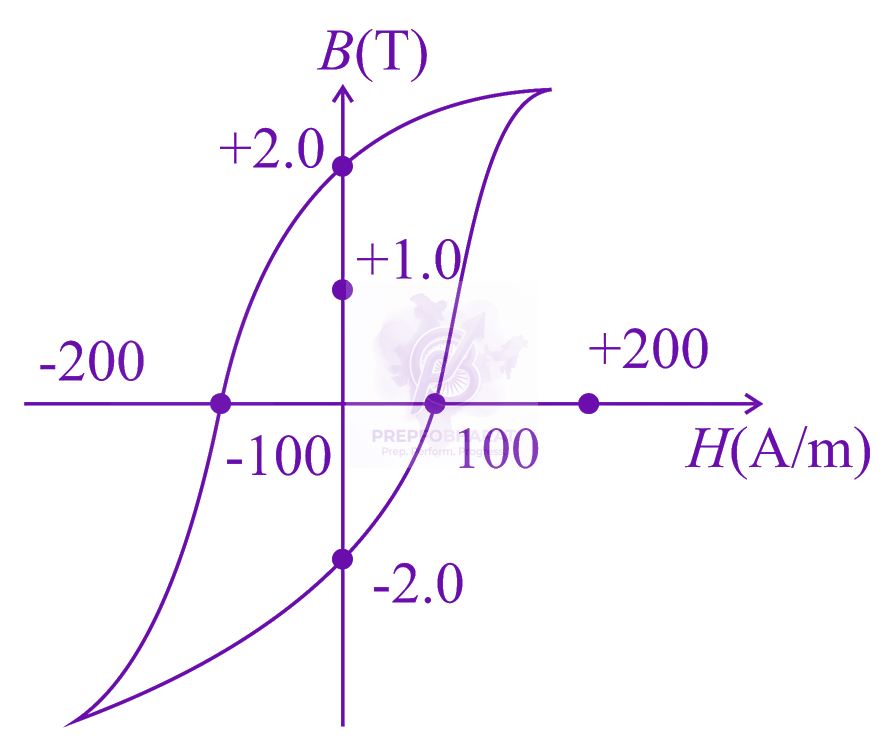
The equivalent capacitance between $A$ and $B$ in the circuit is given below. 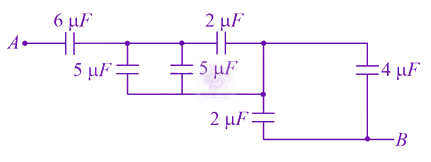
A body of mass $M$ and charge $q$ is connected to a spring of spring constant $k$. It is oscillating along $\mathrm{x}$-direction about its equilibrium position, taken to be at $x=0$, with an amplitude $A$. An electric field $E$ is applied along the $\mathrm{x}$-direction. Which of the following statements is correct?
An electron, a proton and an alpha particle having the same kinetic energy are moving in circular orbits of radii ${r}_{e}, {r}_{p}, {r}_{\alpha }$ respectively in a uniform magnetic field B. The relation between ${r}_{e}, {r}_{p}, {r}_{\alpha }$ is:
An EM wave from air enters a medium. The electric fields are ${\vec{E}}_{1}={E}_{01}\hat{x}\mathrm{cos}[2\pi v(\frac{z}{c}-t)]$ in air and ${\vec{E}}_{2}={E}_{02}\hat{x}\mathrm{cos}[k(2z-ct)]$in medium, where the wave number k and frequency $v$ refer to their values in the air. The medium is non-magnetic. If ${\epsilon }_{{r}_{1}}$ and ${\epsilon }_{{r}_{2}}$ refer to relative permittivities of air and medium respectively, which of the following options, is correct?
A parallel plate capacitor with area $200 \mathrm{~cm}^2$ and separation between the plates $1.5 \mathrm{~cm}$, is connected across a battery of emf V. If the force of attraction between the plates is $25 \times 10^{-6} \mathrm{~N}$, the value of $V$ is approximately: $$ \left.\left(\varepsilon_0=8.85 \times 10^{-12} \frac{\mathrm{C}^2}{\text { N.m }}\right)^2\right) $$
In a meter bridge, as shown in the figure, it is given that resistance $Y=12.5 \Omega$ and that the balance is obtained at a distance $39.5 \mathrm{~cm}$ from end $A$ (by jockey J). After interchanging the resistances $X$ and $Y$, a new balance point is found at a distance $l_2$ from end $A$. What are the values of $X$ and $l_2$ ? 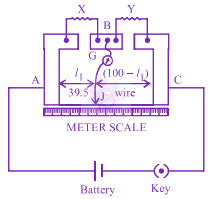
A plane electromagnetic wave of wavelength $\lambda$ has an intensity $I$. It is propagating along the positive $Y-$direction. The allowed expressions for the electric and magnetic fields are given by:
In the following circuit the switch $S$is closed at $t=0$. The charge on the capacitor ${C}_{1}$ as a function of time will be given by $({C}_{eq}= \frac{{C}_{1}{C}_{2}}{{C}_{1}+ {C}_{2}})$ 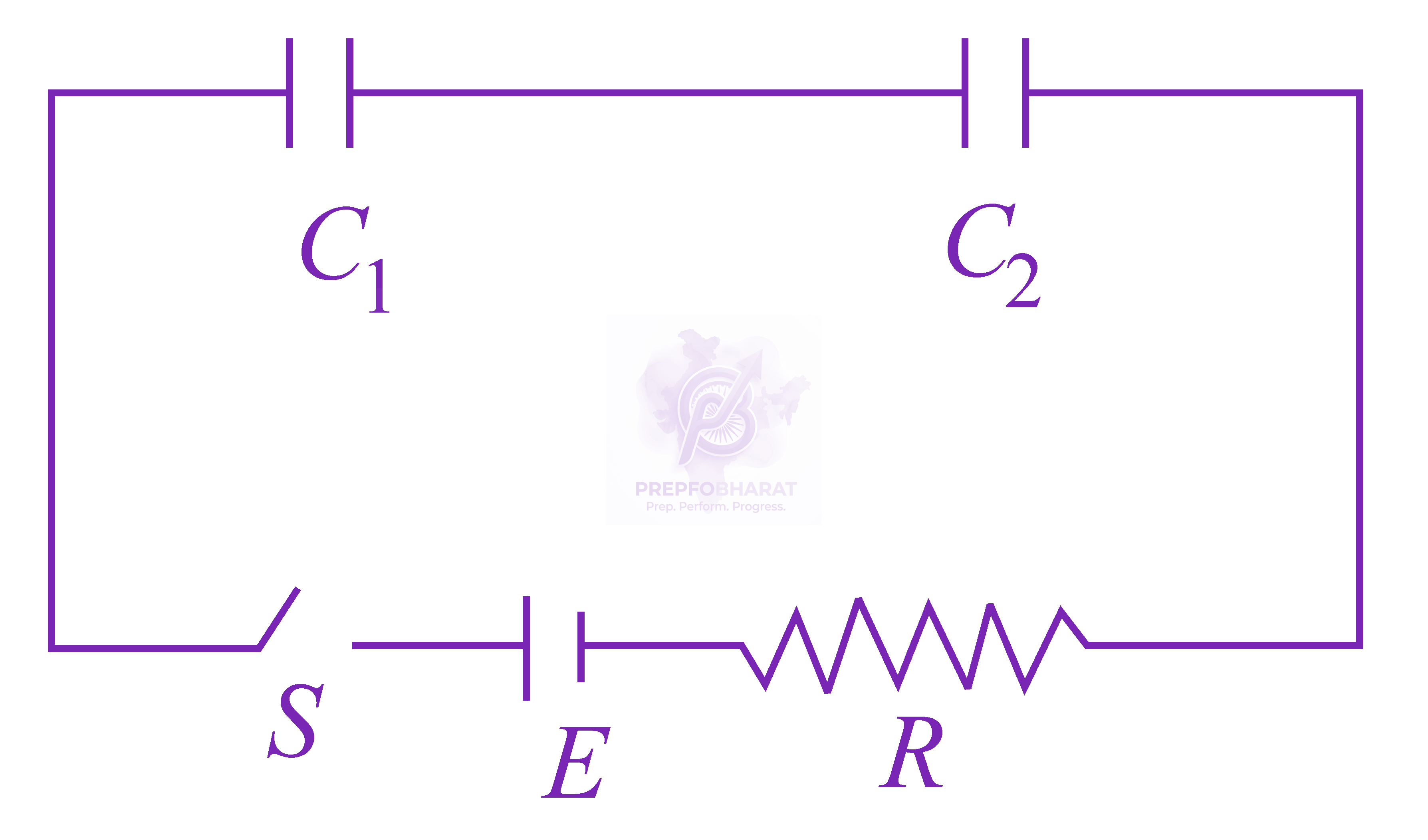
A capacitor $\mathrm{C}_1$ is charged up to a voltage $\mathrm{V}=$ $60 \mathrm{~V}$ by connecting it to battery $\mathrm{B}$ through switch (1), Now $\mathrm{C}_1$ is disconnected from battery and connected to a circuit consisting of two uncharged capacitors $\mathrm{C}_2=3.0 \mu \mathrm{F}$ and $\mathrm{C}_3=6.0 \mu \mathrm{F}$ through a switch $(2)$ as shown in the figure. The sum of final charges on $\mathrm{C}_2$ and $\mathrm{C}_3$ is: 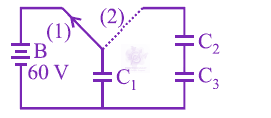
The equivalent capacitance between $A$ and $B$ in the circuit given below is: 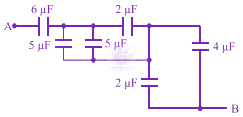
A constant voltage is applied between two ends of a metallic wire. If the length is halved and the radius of the wire is doubled, the rate of heat developed in the wire will be:
A galvanometer with its coil resistance $25 \Omega$ requires a current of $1\mathrm{mA}$ for its full deflection. In order to construct an ammeter to read up to a current of $2A$ the approximate value of the shunt resistance should be:
In an $\text{A.C.}$ circuit, the instantaneous e.m.f. and current are given by, $E=100\mathrm{sin}30t$$,I=20\mathrm{sin}(30t-\frac{\pi }{4})$. In one cycle of $\text{A.C.}$, the average power consumed by the circuit (in watt) and the watt-less current (in ampere) are, respectively:
In a circuit for finding the resistance of a galvanometer by half deflection method, a $6V$ battery and a high resistance of $11 k\Omega$ are used. The figure of merit of the galvanometer is $60 \mu A{\mathrm{division}}^{-1}$. In the absence of shunt resistance, the galvanometer produces a deflection of $\theta =9$ divisions when current flows in the circuit. The value of the shunt resistance that can cause the deflection of $\frac{\theta }{2}$, is closest to:
In the given circuit all resistance is of the value of $R$ ohm each. The equivalent resistance between $A$ and $B$ is: 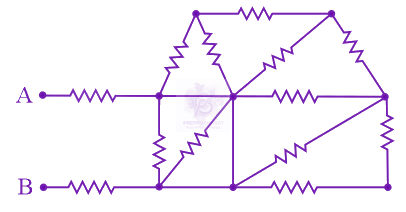
A coil of cross-sectional area $A$ having $n$ turns is placed in a uniform magnetic field $B$. When it is rotated with an angular velocity $\omega ,$ the maximum e.m.f. induced in the coil will be:
Three concentric metal shells $A,B$ and $C$ of respective radii $a,b$ and $c(a<b<c)$ have surface charge densities $+\sigma ,-\sigma$ and $+\sigma$ respectively. The potential of shell $B$ is:
A copper rod of mass $\mathrm{m}$ slides under gravity on two smooth parallel rails, with separation $l$ and set at an angle of $\theta$ with the horizontal. At the bottom, rails are joined by a resistance R. There is a uniform magnetic field $\mathrm{B}$ normal to the plane of the rails, as shown in the figure. The terminal speed of the copper rod is: 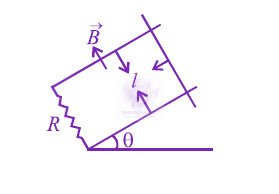
Two identical conducting spheres $A$ and $B$ carry an equal charges. They are separated by a distance much larger than their diameters, and the force between them is $F$. A third identical conducting sphere, $C$, is uncharged. Sphere $C$ is first touched to $A$, then to $B$, and then removed. As a result, the force between $A$ and $B$ would be equal to:
An ideal capacitor of capacitance $0.2 \mu \mathrm{F}$ is charged to a potential difference of $10 \mathrm{~V}$. The charging battery is then disconnected. The capacitor is then connected to an ideal inductor of self inductance $0.5 \mathrm{mH}$. The current at a time when the potential difference across the capacitor is $5 \mathrm{~V}$, is:
At the centre of a fixed large circular coil of radius $\mathrm{R}$, a much smaller circular coil of radius $r$ is placed. The two coils are concentric and are in the same plane. The larger coil carries a current I. The smaller coil is set to rotate with a constant angular velocity $\omega$ about an axis along their common diameter. Calculate the emf induced in the smaller coil after a time $t$ of its start of rotation.
On interchanging the resistances, the balance point of a meter bridge shifts to the left by $10\mathrm{cm}$. The resistance of their series combination is $1k\Omega$ . How much was the resistance on the left slot before interchanging the resistances?
A copper rod of cross-sectional area A carries a uniform current I through it. At temperature T, if the volume charge density of the rod is $\rho$, how long will the charges take to travel a distance $\mathrm{d}$ ?
A charge $q$ is spread uniformly over an insulated loop of radius $r$. If it is rotated with an angular velocity $\omega$ with respect to normal axis then magnetic moment of the loop is:
In a meter bridge as shown in the figure, it is given that resistance $Y=12.5\Omega$ and that the balance is obtained at a distance $39.5\mathrm{cm}$ from end $A$ (by jockey $J$). After interchanging the resistances $X$ and $Y$ a new balance point is found at a distance ${l}_{2}$ from end $A$. What are the values of $X$ (in $\Omega$) and ${l}_{2}$? 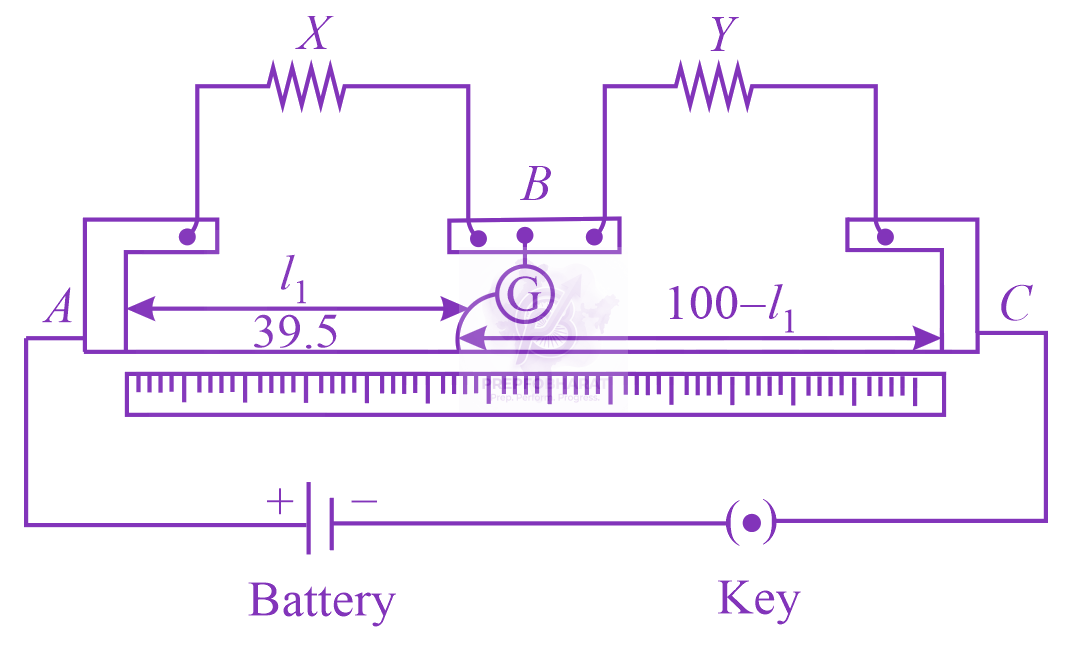
A charge $Q$ is placed at a distance $\mathrm{a} / 2$ above the centre of the square surface of edge a as shown in the figure. The electric flux through the square surface is: 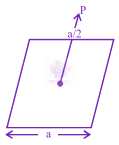
A monochromatic beam of light has a frequency $v=\frac{3}{2 \pi} \times 10^{12} \mathrm{~Hz}$ and is propagating along the direction $\frac{\hat{i}+\hat{j}}{\sqrt{2}}$. It is polarized along the $\hat{k}$ direction. The acceptable form for the magnetic field is:
A current of $1 \mathrm{~A}$ is flowing on the sides of an equilateral triangle of side $4.5 \times 10^{-2} \mathrm{~m}$. The magnetic field at the centre of the triangle will be: