JEE Main 2020 — Electromagnetism
Physics Electromagnetism questions from JEE Main 2020.
Other Years
120 Electromagnetism Questions from 2020
A wire of resistance R is bent to form a complete circle. The resistance between two diametrically opposite points is:
Consider two charged metallic spheres ${S}_{1}$ and ${S}_{2}$ of radii ${R}_{1}$ and ${R}_{2},$ respectively. The electric fields ${E}_{1}$ (on ${S}_{1}$ ) and ${E}_{2}$ (on ${S}_{2}$ ) on their surfaces are such that $\frac{{E}_{1}}{{E}_{2}}=\frac{{R}_{1}}{{R}_{2}}.$ Then the ratio ${V}_{1}$ (on ${S}_{1}$ )$/$${V}_{2}$ (on ${S}_{2}$ ) of the electrostatic potentials on each sphere is:
Proton with kinetic energy of $1MeV$ moves from south to north. It gets an acceleration of ${10}^{12}m/{s}^{2}$ by an applied magnetic field (west to east). The value of magnetic field: (Rest mass of proton is $1.6\times {10}^{-27}kg$ )
A part of a complete circuit is shown in the figure. At some instant, the value of current I is $1A$ and it is decreasing at a rate of ${10}^{2}{\mathrm{As}}^{-1}$. The value of the potential difference ${V}_{p}-{V}_{Q},$ (in volts) at that instant is- 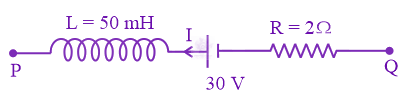
The magnetic field of a plane electromagnetic wave is $\vec{B}=3\times {10}^{-8}\mathrm{sin}[200\pi (y+ct)]\hat{i}T$ . Where, $c=3\times {10}^{8}m{s}^{-1}$ is the speed of light the corresponding electric filed is :
If the magnetic field in a plane electromagnetic wave is given by $\vec{B}=3\times {10}^{-8}\mathrm{sin}(1.6\times {10}^{3}x+48\times {10}^{10}t)\hat{j}T,$ then what will be expression for electric field ?
In a series $\mathrm{LR}$ circuit, power of $400W$ is dissipated from a source of $250V,50\mathrm{Hz}$. The power factor of the circuit is $0.8$. In order to bring the power factor to unity, a capacitor of value $C$ is added in series to the $L$ and $R$. Taking the value of $C$ as $(\frac{n}{3\pi })\mu F$, then value of $n$ is
An electron is constrained to move along the $y$-axis with a speed of $0.1c$ (c is the speed of light) in the presence of electromagnetic wave, whose electric field is $\vec{E}=30\hat{j}\mathrm{sin}(1.5\times {10}^{7}t-5\times {10}^{-2}x)V{m}^{-1}.$ where $t$ in in seconds and $x$ is im meters.The maximum magnetic force experienced by the electron will be: (given $c=3\times {10}^{8}m{s}^{-1}$ and electron charge $=1.6\times {10}^{-19}\mathrm{Coloumbs}$
Magnetic materials used for making permanent magnets $(P)$ and magnets in a transformer $(T)$ have different properties of the following, which property best matches for the type of magnet required?
Effective capacitance of parallel combination of two capacitors ${C}_{1}$ and ${C}_{2}$ is $10\mu F.$ When these capacitors are individually connected to a voltage source of $1V,$ the energy stored in the capacitor ${C}_{2}$ is $4$ times that of ${C}_{1}.$ If these capacitors are connected in series, their effective capacitance will be:
An electron gun is placed inside a long solenoid of radius $R$ on its axis. The solenoid has $n$ turns/length and carries a current $I.$ The electron gun shoots an electron along the radius of the solenoid with speed $v.$ If the electron does not hit the surface of the solenoid, maximum possible value of $v$ is (all symbols have their standard meaning): 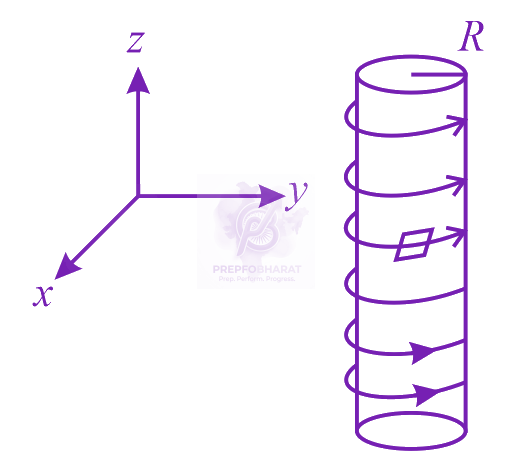
An electric dipole of moment $\vec{\text{p}}=(-\hat{i}-3\hat{j}+2\hat{k})\times {10}^{-29}\text{C m}$ at the origin $(0,0,0)$ . The electric field due to this dipole at $\vec{\text{r}}=+\hat{i}+3\hat{j}+5\hat{k}$ (note that $\vec{r}\cdot \vec{p}=0$ ) is parallel to:
Four resistance $40\Omega ,60\Omega ,90\Omega$ $110\Omega$ and make the arms of a quadrilateral $ABCD$. Across $AC$ is a battery of emf $40V$ and internal resistance negligible. The potential difference across $BD$ in $V$ is __________ 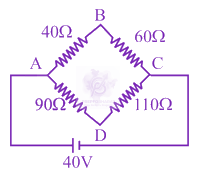
Radiation, with wavelength $6561Å$ falls on a metal surface to produce photoelectrons. The electrons are made to enter a uniform magnetic field of $3\times {10}^{-4}T$ . If the radius of the largest circular path followed by the electrons is $10mm$ , the work function of the metal is close to:
A long solenoid of radius $R$ carries a time $(t)$ dependent current $I(t)={I}_{0}t(1-t)$ . A ring of radius $2R$ is placed coaxially near its middle. During the time interval $0\leq t\leq 1,$ the induced current $({I}_{R})$ and the induced $EMF({V}_{R})$ in the ring change as:
In a fluorescent lamp choke (a small transformer) $100V$ of reverse voltage is produced when the choke current changes uniformly from $0.25A$ to $0$ in a duration of $0.025ms$ . The self-inductance of the choke (in $mH$ ) is estimated to be ________
A $LCR$ circuit behaves like a clamped harmonic oscillator. Comparing it with a physical spring-mass damped oscillator having damping constant $'{b}^{'},$ the correct equivalence would be:
An electric field $\vec{E}=4x\hat{i}-({y}^{2}+1)\hat{j}N/C$ passes through the box shown in figure. The flux of the electric field through surfaces $ABCD$ and $BCGF$ are marked as ${\phi }_{\text{I}}$ and ${\phi }_{\text{II}}$ respectively. The difference between $({\phi }_{I}-{\phi }_{II})$ is (in $N{m}^{2}/C$ ) ____________. 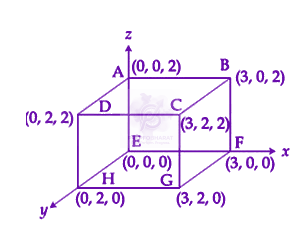
Consider the force $F$ on a charge '$q$' due to a uniformly charged spherical shell of radius $R$ carrying charge $Q$ distributed uniformly over it. Which one of the following statements is true for $F$, if '$q$' is placed at distance $r$ from the centre of the shell?
A charged particle of mass ‘ $m$ ’ and charge ‘ $q$ ’ moving under the influence of uniform electric field $\vec{\text{E}}\hat{i}$ and a uniform magnetic field $\vec{\text{B}}\hat{k}$ follows a trajectory from point P to Q as shown in figure. The velocities at P and Q are respectively, $v\vec{i}$ and $-2v\vec{j}$ . Then which of the following statements (A, B, C, D) are the correct? (Trajectory shown is schematic and not to scale) 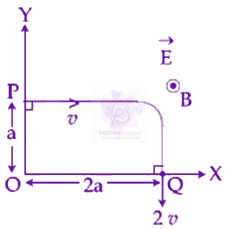 $(A)$ $E=\frac{3}{2}(\frac{m{v}^{2}}{qa})$ $(B)$ Rate of work done by the electric field at P is $\frac{3}{2}(\frac{m{v}^{3}}{a})$ $(C)$ Rate of work done by both the fields at Q is zero $(D)$ The difference between the magnitude of angular momentum of the particle at P and Q is $2mav$ .
A two point charges $4q$ and $–q$ are fixed on the $x$ -axis at $x=\frac{-d}{2}$ and $x=\frac{d}{2}$, respectively. If the third point charge ‘$q$ ’ is taken from the origin to $x=d$ along the semicircle as shown in the figure, the energy of the charge will: 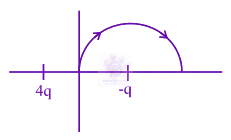
Two identical capacitors $A$ and $B,$ charged to the same potential $5V$ are connected in two different circuits as shown below at time $t=0.$ If the charge on capacitors $A$ and $B$ at time $t=CR$ is ${Q}_{A}$ and ${Q}_{B}$ respectively, then (Here $e$ is the base of natural logarithm) 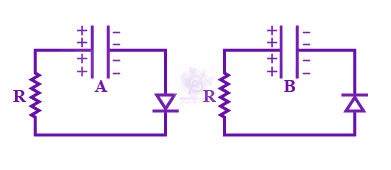
Four resistances of $15\Omega ,12\Omega ,4\Omega$ and $10\Omega$ respectively in cyclic order to form Wheatstone’s network. The resistance that is to be connected in parallel with the resistance of $10\Omega$ to balance the network is ______________ $\Omega .$
An iron rod of volume ${10}^{-3}{m}^{3}$ and relative permeability $1000$ is placed as core in a solenoid with$10\mathrm{turns}{\mathrm{cm}}^{-1}$ . If a current of $0.5A$ is passed through the solenoid, then the magnetic moment of the rod will be :
In the figure, potential difference between $A$ and $B$ is: 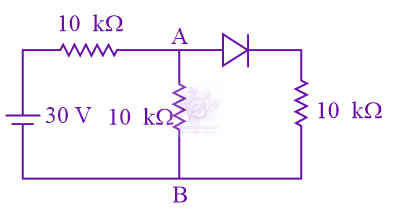
In the circuit shown in the figure, the total charge is $750\mu C$ and the voltage across capacitor ${C}_{2}$ is $20V$. Then the charge on capacitor ${C}_{2}$ is : 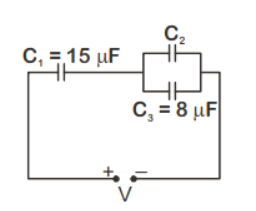
A plane electromagnetic wave, has frequency of $2.0\times {10}^{10}\mathrm{Hz}$ and its energy density is $1.02\times {10}^{-8}J{m}^{-3}$ in vacuum. The amplitude of the magnetic field of the wave is close to $(\frac{1}{4{\pi \epsilon }_{0}}=9\times {10}^{9}\frac{{\mathrm{Nm}}^{2}}{{C}^{2}})$ and speed of light $=3\times {10}^{8}m{s}^{-1}$.
A small circular loop of conducting wire has radius a and carries current $I.$ It is placed in a uniform magnetic field $B$ perpendicular to its plane such that when rotated slightly about its diameter and released, it starts performing simple harmonic motion of time period $T.$ The mass of the loop is $m$ then:
A very long wire ABDMNDC is shown in figure carrying current I. AB and BC parts are straight, long and at right angle. At D wire forms a circular turn DMND of radius R. AB, BC parts are tangential to circular turn at N and D. Magnetic filed at the center of circle is: 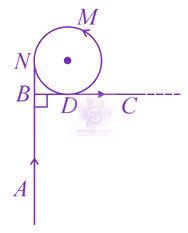
A plane electromagnetic wave of frequency $25GHz$ is propagating in vacuum along the z-direction. At a particular point in space and time, the magnetic filed is given by $\vec{B}=5\times {10}^{-8} \hat{j} T.$ The corresponding electric field $\vec{E}$ is (speed of light $=3\times {10}^{8} m{s}^{-1}$ )
In a building there are $15$ bulbs of $45W$ , $15$ bulbs of $100W,15$ small fans of $10W$ and $2$ heaters of $1kW$ . The voltage of electric main supply is $220V$ . The minimum fuse capacity (rated value) of the building will be:
A wire $A$, bent in the shape of an arc of a circle, carrying a current of $2A$ and having radius $2\mathrm{cm}$ and another wire $B$, also bent in the shape of an arc of a circle, carrying a current of $3A$ and having radius of $4\text{ cm}$, are placed as shown in the figure. The ratio of the magnetic fields due to the wires $\text{A}$ and $\text{B}$ at the common centre $\text{O}$ is: 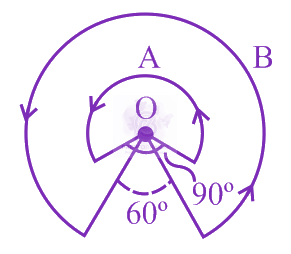
A loop $ABCDEFA$ of straight edges has six corner points $A(0,0,0),B(5,0,0),C(5,5,0),D(0,5,0),E(0,5,5)$ and $F(0,0,5)$ . The magnetic field in this region is $\vec{B}=(3\hat{i}+4\hat{k})T$ . The quantity of flux through the loop $ABCDEFA$ (in $Wb$ ) is _____________
An emf of $20V$ is applied at time $t=0$ to a circuit containing in series $10mH$ inductor and $5\text{Ω}$ resistor. The ratio of the currents at time $t=\infty$ and at $t=40\text{s}$ is close to: (Take ${e}^{2}=7.389$ )
The electric field of a plane electromagnetic wave is given by $\vec{E}={E}_{0}(\hat{x}+\hat{y})\mathrm{sin}(kz-\omega t)$. Its magnetic field will be given by
A small point mass carrying some positive charge on it, is released from the edge of a table. There is a uniform electric field in this region in the horizontal direction. Which of the following options then correctly describe the trajectory of the mass ? (Curves are drawn schematically and are not to scale)
A planar loop of wire rotates in a uniform magnetic field. Initially, at $t=0$ , the plane of the loop is perpendicular to the magnetic field. If it rotates with a period of $10s$ about an axis in its plane then the magnitude of induced emf will be maximum and minimum, respectively at:
An electromagnetic wave has electric field amplitude E₀ and magnetic field amplitude B₀. The ratio E₀/B₀ is equal to:
Three charged particles $\text{A}, \text{B}$ and $\text{C}$ with charges $-4q,2q$ and $-2q$ are present on the circumference of a circle of radius $d.$ The charged particles $\text{A}, \text{C}$ and centre $\text{O}$ of the circle formed an equilateral triangle as shown in the figure. The electric field at the point $\text{O}$ is 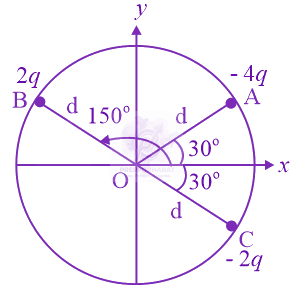
Concentric metallic hollow spheres of radii R and 4R hold charges ${Q}_{1}$ and ${Q}_{2}$ respectively. Given that surface charge densities of the concentric spheres are equal, the potential difference $V(R)-V(4R)$ is:
A small bar magnet is placed with its axis at ${30}^{o}$ with an external magnetic field of $0.06T$ experiences a torque of $0.018\mathrm{Nm}$. The minimum work required to rotate it from its stable to unstable equilibrium position is:
The electric field of a plane electromagnetic wave propagating along the x direction in vacuum is $\vec{E}={E}_{0}\mathrm{jcos}(\omega t-\mathrm{kx}).$ The magnetic field $\vec{B},$ at the moment $t=0$ is:
A $750\mathrm{Hz},20V(\mathrm{rms})$ source is connected to a resistance of $100\Omega ,$ an inductance of $0.1803H$ and a capacitance of $10\mu F$ all in series. The time in which the resistance (heat capacity $2J/^{\circ}C$ ) will get heated by $10^{\circ}C.$ (assume no loss of heat to the surroundings) is close to :
The correct match between the entries in column I and column II are : <table class="pyq-table"><tbody><tr><td></td><td>I</td><td></td><td>II</td></tr><tr><td></td><td>Radiation</td><td></td><td>Wavelength</td></tr><tr><td>a</td><td>Microwave</td><td>i</td><td>$100m$</td></tr><tr><td>b</td><td>Gamma rays</td><td>ii</td><td>${10}^{-15}m$</td></tr><tr><td>c</td><td>A.M. radio</td><td>iii</td><td>${10}^{-10}m$</td></tr><tr><td>d</td><td>X–rays</td><td>iv</td><td>${10}^{-3}m$</td></tr></tbody></table>
A plane electromagnetic wave is propagating along the direction $\frac{\hat{i}+\hat{j}}{\sqrt{2}},$ with its polarization along the direction $\hat{k.}$ The correct form of the magnetic field of the wave would be (here ${B}_{0}$ is an appropriate constant):
A capacitor $C$ is fully charged with voltage ${V}_{0}$. After disconnecting the voltage source, it is connected in parallel with another uncharged capacitor of capacitance $\frac{C}{2}$. The energy loss in the process after the charge is distributed between the two capacitors is :
In the circuit, given in the figure currents in different branches and value of one resistor are shown. Then potential at point $B$ with respect to the point $A$ is: 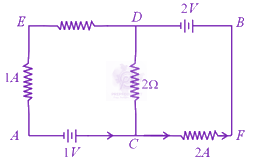
At time $t=0$ magnetic field of $1000Gauss$ is passing perpendicularly through the area defined by the closed loop shown in the figure. If the magnetic field reduces linearly to $500Gauss,$ in the next $5s,$ then induced $EMF$ in the loop is: 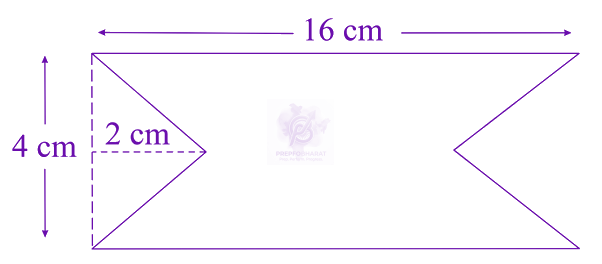
In $LC$ circuit the inductance $L=40\mathrm{mH}$ and capacitance $C=100\mu F.$ If a voltage $V(t)=10sin(314t)$ is applied to the circuit, the current in the circuit is given as:
A capacitor is made of two square plates each of side ‘ $a$ ’ making a very small angle $\alpha$ between them, as shown in figure. The capacitance will be close to: 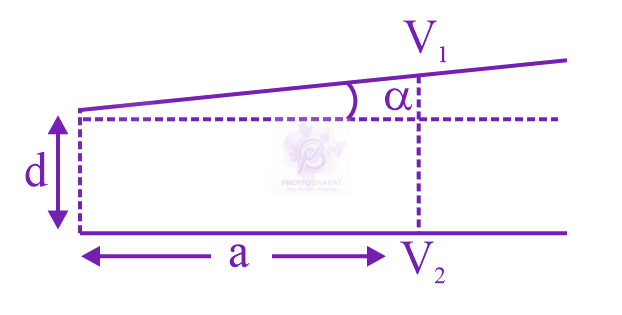
Consider four conducing materials copper, tungsten, mercury and aluminum with resistivity ${\rho }_{C},{\rho }_{T},{\rho }_{M}$ and ${\rho }_{A}$ respectively. Then :
A long, straight Wire of radius a carries a current distributed uniformly over its cross-section. The ratio of the magnetic fields due to the wire at distance $\frac{a}{3}$ and $2a$ , respectively from the axis of the wire is:
The electric field of a plane electromagnetic wave is given by $\vec{E}={E}_{0}\frac{\hat{i}+\hat{j}}{\sqrt{2}}\mathrm{cos}(kz+\omega t)$ . At $t=0$ , a positively charged particle is at the point $(x,y,z)=(0,0,\frac{\pi }{k})$ . If its instantaneous velocity at $(t=0)$ is ${v}_{0}\hat{k}$ , the force acting on it due to the wave is:
A uniform magnetic field B exists in a direction perpendicular to the plane of a square loop made of a metal wire. The wire has a diameter of $4\mathrm{mm}$ and a total length of $30\mathrm{cm}.$ The magnetic field changes with time at a steady rate $\mathrm{dB}/\mathrm{dt}=0.032{\mathrm{Ts}}^{-1}.$ The induced current in the $loop$is close to (Resistivity of the metal wire is $1.23\times {10}^{-8}\Omega m$ )
In a plane electromagnetic wave, the directions of electric field and magnetic field are represented by$\hat{k}$ and $2\hat{i}-2\hat{j}$, respectively. What is the unit vector along direction of propagation of the wave.
Consider a circular coil of wire carrying constant current $I,$ forming a magnetic dipole. The magnetic flux through an infinite plane that contains the circular coil and excluding the circular coil area is given by ${\phi }_{i}$ The magnetic flux through the area of the circular coil area is given by ${\phi }_{0}$ . Which of the following option is correct?
In the given circuit diagram, a wire is joining points B and D. The current in this wire is: 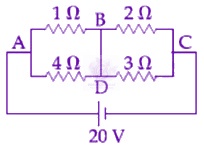
A galvanometer coil has 500 turns and each turn has an average area of $3\times {10}^{-4}{m}^{2}$. If a torque of $1.5\mathrm{Nm}$ is required to keep this coil parallel to a magnetic field when a current of $0.5A$ is flowing through it, the strength of the field (in $T$) is _________ .
A series $L-R$ circuit is connected to a battery of emf $V$. If the circuit is switched on at $t=0$, then the time at which the energy stored in the inductor reaches $(\frac{1}{n})$ times of its maximum value, is :
A particle of mass $m$ and charge $q$ has an initial velocity $\vec{v}={v}_{0}\hat{j}$ . If an electric field $\vec{E}={E}_{0}\hat{i}$ and magnetic field $\vec{B}={B}_{0}\hat{i}$ act on the particle, its speed will double after a time
In finding the electric field using Gauss law the formula $|\vec{E}|=\frac{{q}_{enc}}{{\epsilon }_{0}|A|}$ is applicable. In the formula ${\epsilon }_{0}$ is permittivity of free space, $A$ is the area of Gaussian surface and ${q}_{enc}$ is charge enclosed by the Gaussian surface. This equation can be used in which of the following situation?
Suppose that intensity of a laser is $(\frac{315}{\pi })W{m}^{-2}.$ The rms electric field, in units of $V{m}^{-1}$ associated with this source is close to the nearest integer is $-({\epsilon }_{0}=8.86\times {10}^{-12}{C}^{2}N{m}^{-2};c=3\times {10}^{8}m{s}^{-1})$
A $5\mu F$ capacitor is charged fully by a $220V$ supply. It is then disconnected from the supply and is connected in series to another uncharged $2.5\mu F$ capacitor. If the energy change during the charge redistribution is $\frac{X}{100}J$ then value of $X$ to the nearest integer is :
A $60pF$ capacitor is fully charged by a $20V$ supply. It is then disconnected from the supply and is connected to another uncharged $60pF$ capacitor in parallel. The electrostatic energy that is lost in this process by the time the charge is redistributed between them is (in $nJ$ ) ________
An ideal cell of emf $10V$ is connected in circuit shown in figure. Each resistance is $2\Omega$. The potential difference (in $V$) across the capacitor when it is fully charged is _____________ 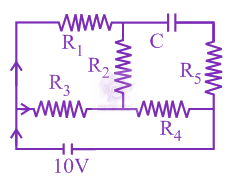
A galvanometer is used in laboratory for detecting the null point in electrical experiments. If, on passing a current of $6mA$ it produces a deflection of $2^{\circ}$, its figure of merit is close to :
In the figure shown, the current in the $10V$ battery is close to : 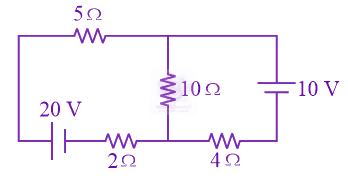
In a meter bridge experiment $S$ is a standard resistance. $R$ is a resistance wire. It is found that balancing length is $l=25cm.$ If $R$ is replaced by a wire of hall length and half diameter that of $R$ of same material, then the balancing distance $l'$ (in $cm$ ) will now be ______________. 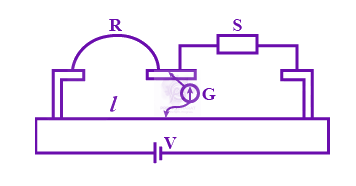
A galvanometer having a coil resistance $100 \Omega$ gives a full scale deflection when a current of $1mA$ is passed through it. What is the value of the resistance which can convert this galvanometer into a voltmeter given full scale deflection for a potential difference of $10V?$
A perfectly diamagnetic sphere has a small spherical cavity at its centre, which is filled with a paramagnetic substance. The whole system is placed in a uniform magnetic field $\vec{B}$. Then the field inside the paramagnetic substance is: 
Two resistors $400\Omega$ and $800\Omega$ are connected in series across a $6\vee$ battery. The potential difference measured by a voltmeter of $10k\Omega$ across $400\Omega$ resistor is close to:
Two isolated conducting spheres ${S}_{1}$ and ${S}_{2}$ of radius $\frac{2}{3}R$ and $\frac{1}{3}R$ have $12\mu C$ and $-3\mu C$ charges, respectively, and are at a large distance from each other, They are now connected by a conducting wire. A long time after this is done the charges on ${S}_{1}$ and ${S}_{2}$ are respectively:
An elliptical loop having resistance $R$, of semi major axis $a$ , and semi minor axis $b$ is placed in a magnetic field as shown in the figure. If the loop is rotated about the $x$-axis with angular frequency $\omega$, the average power loss in the loop due to Joule heating is : 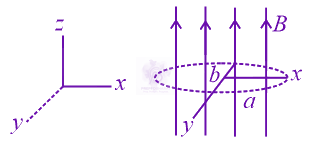
A charged particle carrying charge $1\mu C$ is moving with velocity $(2\hat{i}+3\hat{j}+4\hat{k})m{s}^{-1}$. If an external magnetic field of $(5\hat{i}+3\hat{j}-6\hat{k})\times {10}^{-3}T$ exists in the region where the particle is moving then the force on the particle is $\vec{F}\times {10}^{-9}N$ . the vector $\vec{F}$ is :
Two charged thin infinite plane sheets of uniform charge density ${\sigma }_{+}$ and ${\sigma }_{-}$, where $|{\sigma }_{+}|>|{\sigma }_{-}|$, intersect at the right angle. Which of the following best represents the electric field lines for the system:
A galvanometer of resistance $G$ is converted into a voltameter of range $0-1V$ by connecting a resistance $R$ in series with it. The additional resistance that should be connected in series with ${R}_{1}$ to increase the range of the voltmeter to $0-2V$ will be :
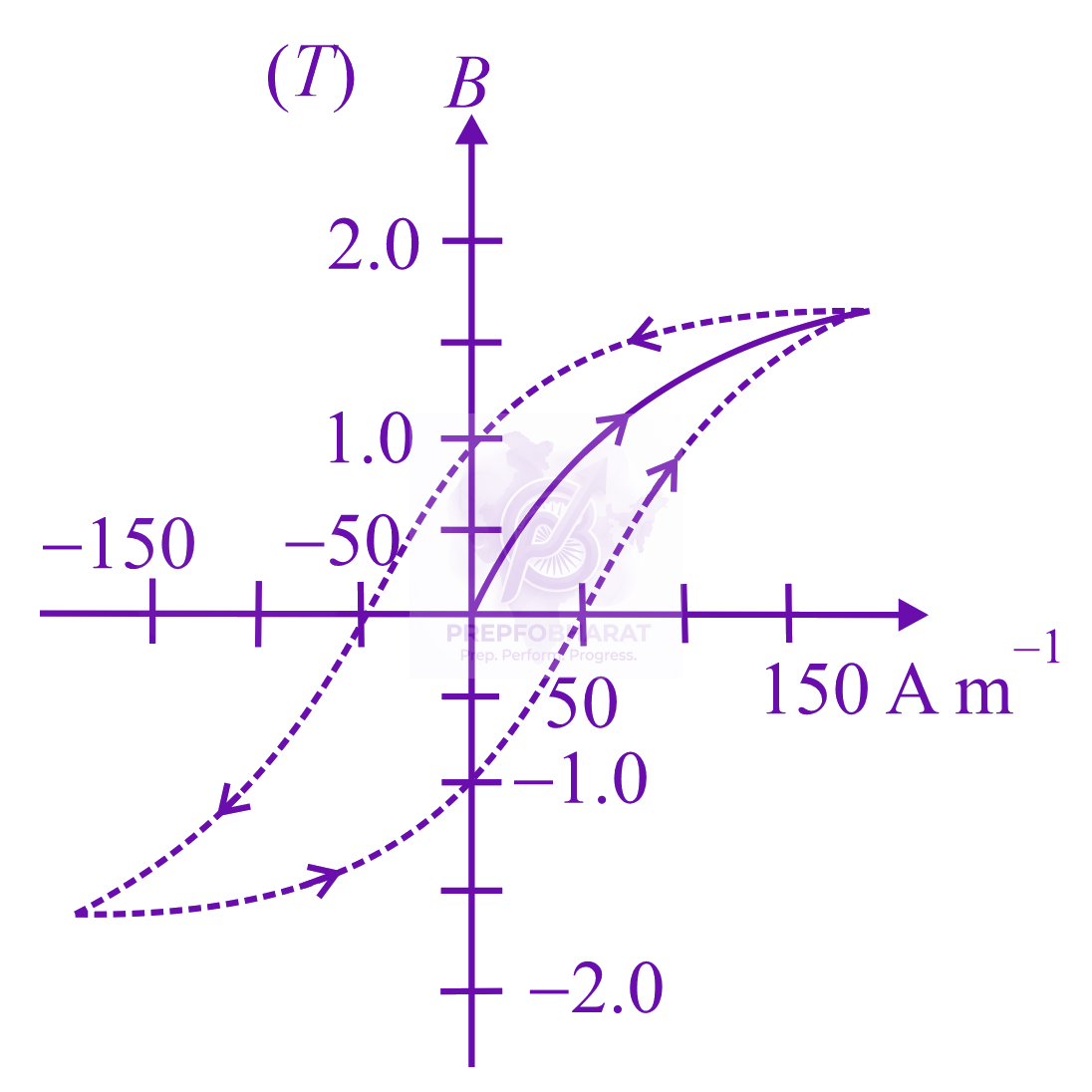 The figure gives experimentally measured $B$ vs. $H$ variation in a ferromagnetic material. The retentivity, coercivity and saturation, respectively, of the material are:
A square loop of side $2a,$ and carrying current $I$ is kept in $XZ$ plane with its centre at origin. A long wire carrying the same current $I$ is placed parallel to the $z$-axis and passing through the point $(0,b,0),(b>>a)$. The magnitude of the torque on the loop about $z$-axis is given by.
Choose the correct option relating wavelengths of different parts of electromagnetic wave spectrum:
Two capacitors of capacitances $C$ and $2C$ are charged to potential differences $V$ and $2V$, respectively. These are then connected in parallel in such a manner that the positive terminal of one is connected to the negative terminal of the other. The final energy of this configuration is :
Which of the following will NOT be observed when a multimeter (operating in resistance measuring mode) probes connected across a component, are just reversed?
A solid sphere of radius $R$ carries a charge $Q+q$ distributed uniformly over its volume. A very small point like piece of it of mass $m$ gets detached from the bottom of the sphere and falls down vertically under gravity. This piece carries charge $q$. If it acquires a speed $\nu$ when it has fallen through a vertical height $y$ (see figure), then (assume the remaining portion to be spherical) 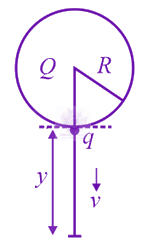
A circular coil of radius $10\mathrm{cm}$ is placed in a uniform magnetic field of $3.0\times {10}^{-5}T$ with its plane perpendicular to the field initially. It is rotated at constant angular speed about an axis along the diameter of coil and perpendicular to magnetic field so that it undergoes half of rotation in $0.2s$. The maximum value of EMF induced (in $\mu V$) in the coil will be close to the integer....
A small bar magnet is moved through a coil at constant speed from one end to the other. Which of the following series of observations will be seen on the galvanometer $\text{G}$ attached across the coil? 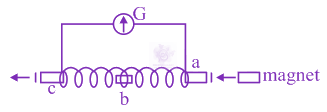 Three positions shown describe: (a) the magnet's entry (b) magnet is completely inside and (c) magnet's exit.
Model a torch battery of length $l$ to be made up of a thin cylindrical bar of radius $a$ and a concentric thin cylindrical shell of radius $b$ filled in between with an electrolyte of resistivity $\rho$ (see figure). If the battery is connected to a resistance of value $R$, the maximum Joule heating in $R$ will take place for : 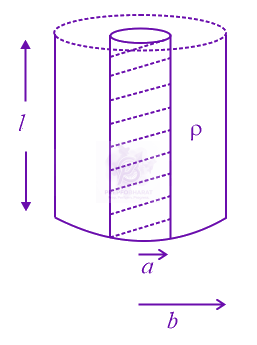
Two concentric circular coils, ${C}_{1}$ and ${C}_{2}$, are placed in the $XY$ plane. ${C}_{1}$ has $500$turns, and a radius of $1\mathrm{cm}$. ${C}_{2}$ has 200 turns and radius of $20\mathrm{cm}\text{.}{C}_{2}$ carries a time dependent current $I(t)=(5{t}^{2}-2t+3)A$ where $t$ is in s. The emf induced in ${C}_{1}(\mathrm{in}\mathrm{mV})$ at the instant $t=1$s is $\frac{4}{x}.$ The value of $x$ is ..........
A square loop of side $2a$ and carrying current $I$ is kept in $\mathrm{xz}$ plane with its centre at origin. A long wire carrying the same current $I$ is placed parallel to $z$-axis and passing through point $(0,b,0),(b>>a)$. The magnitude of torque on the loop about $z$-axis will be :
Consider a sphere of radius $R$ which carries a uniform charge density $\rho$ . If a sphere of radius $\frac{R}{2}$ is carved out of it, as shown, the ratio $\frac{|\vec{{E}_{A}}|}{|\vec{{E}_{B}}|}$ of magnitude of electric field $\vec{{E}_{A}}$ and $\vec{{E}_{B}}$ , respectively, at points $A$ and $B$ due to the remaining portion is: 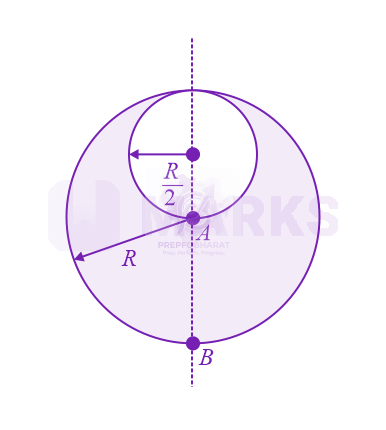
For a plane electromagnetic wave, the magnetic field at a point $x$ and time $t$ is : $\vec{B}(x, t)=[1.2\times {10}^{-7}\mathrm{sin}(0.5\times {10}^{3}x+1.5\times {10}^{11}t)\hat{k}]T$. The instantaneous electric field $\vec{E}$ corresponding to $\vec{B}$ is :
A $10\mu F$ capacitor is fully charged to a potential difference of $50V$ After removing the source voltage it is connected to an uncharged capacitor in parallel. Now the potential difference across them becomes $20V$. The capacitance of the second capacitor is :
An electrical power line, having a total resistance of $2\Omega ,$ delivers $1\mathrm{kW}$ at $220V$. The efficiency of the transmission line is approximately :
A battery of $3.0\text{ V}$ is connected to a resistor dissipating $0.5\text{ W}$ of power. If the terminal voltage of the battery is $2.5\text{ V}$, the power dissipated within the internal resistance is:
A charged particle going around in a circle can be considered to be a current loop. A particle of a mass $m$ carrying charge $q$ is moving in a plane with speed $v$ under the influence of magnetic field $\vec{B}$. The magnetic moment of this moving particle is :
A charged particle (mass $m$ and charge $q$) moves along $X$ axis with velocity ${V}_{0}$. When it passes through the origin it enters a region having uniform electric field $\vec{E}=-E\hat{j}$ which extends upto $x=d$. Equation of path of electron in the region $x>d$ is: 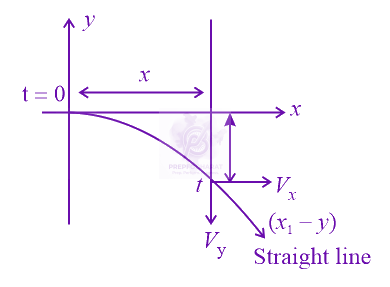
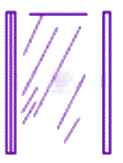 A parallel plate capacitor has plates of area A separated by distance $d$ between them. It is filled with a dielectric which has a dielectric constant that varies as $K(x)={K}_{0}(1+\alpha x)$ where $x$ is the distance measured from one of the plates. If $(\alpha d)<<1,$ the total capacitance of the system is best given by the expression:
An infinitely long straight wire carrying current I, one side opened rectangular loop and a conductor $C$ with a sliding connector are located in the same plane, as shown in the figure. The connector has length l. and resistance $R$. It slides to the right with a velocity $v$. The resistance of the conductor and the self inductance of the loop are negligible. The induced current in the loop, as a function of separation r, between the connector and the straight wire is 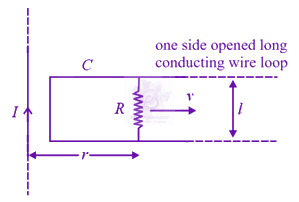
The value of current ${i}_{1}$ flowing from $A$ to $C$ in the circuit diagram is : 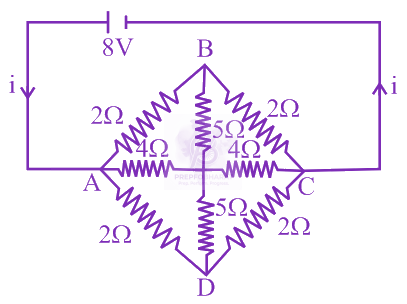
For the given input voltage waveform ${V}_{\text{in }}(t),$ the output voltage waveform ${V}_{0}(t),$ across the capacitor is correctly depicted by : 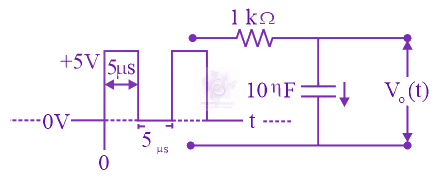
Charges ${Q}_{1}$ and ${Q}_{2}$ are at points $A$ and $B$ of a right-angled triangle $OAB$. The resultant electric field at point $O$ is perpendicular to the hypotenuse, then ${Q}_{1}/{Q}_{2}$ is proportional to: 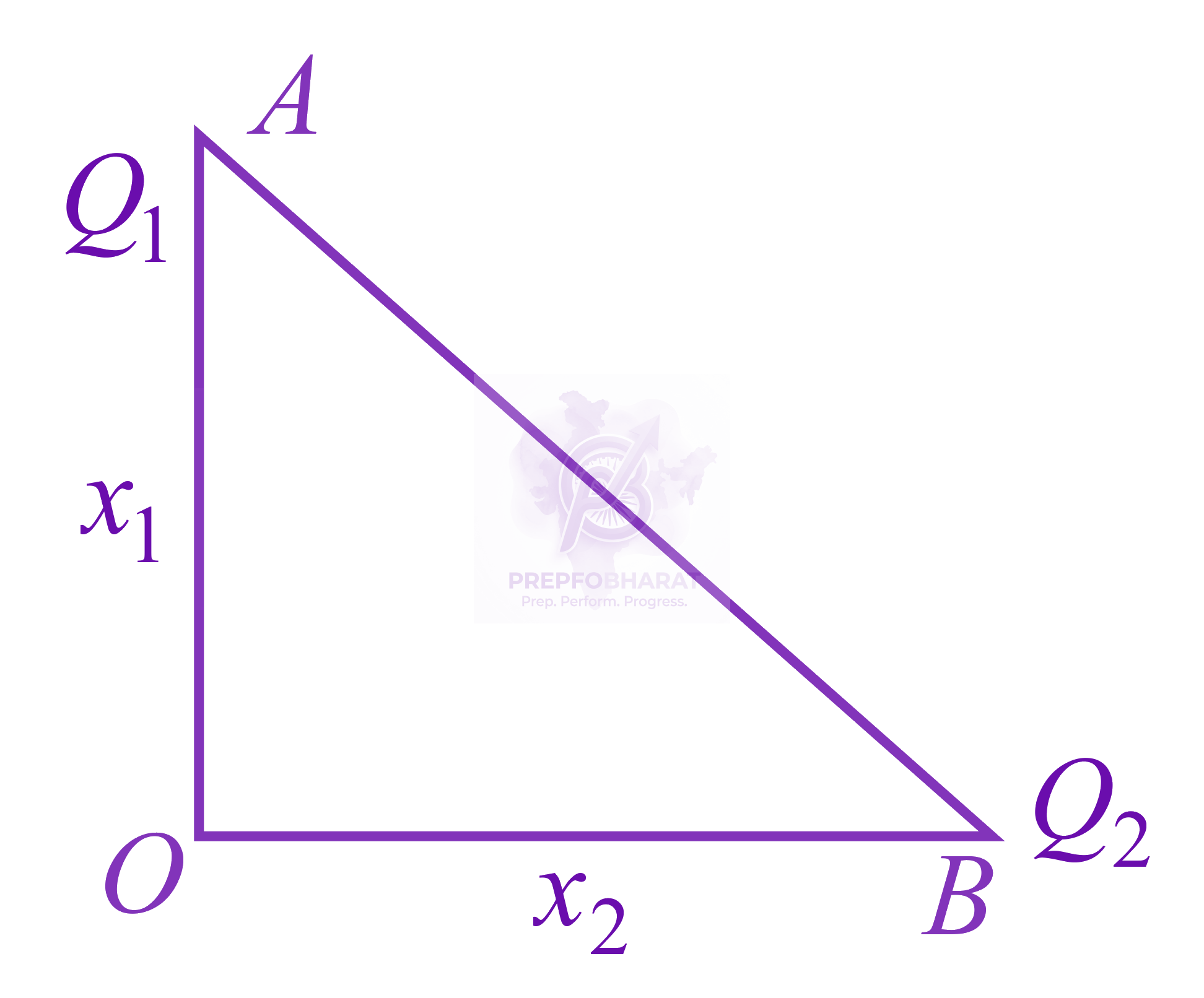
A charge Q is distributed over two concentric conducting thin spherical shells radii $r$ and $R(R>r)$. If the surface charge densities on the two shells are equal, the electric potential at the common centre is : 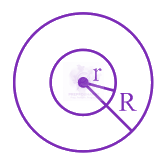
In the circuit shown, charge on the $5\mu F$ capacitor is : 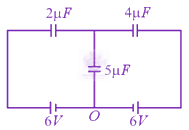
A paramagnetic sample shows a net magnetisation of $6A/m$ when it is placed in an external magnetic field of $0.4T$ at a temperature of $4K$. When the sample is placed in an external magnetic field of $0.3T$ at a temperature of $24K$, then the magnetisation will be :
A circular coil has moment of inertia $0.8\mathrm{kg}{m}^{2}$ around any diameter and is carrying current to produce a magnetic moment of $20{\mathrm{Am}}^{2}$. The coil is kept initially in a vertical position and it can rotate freely around a horizontal diameter. When a uniform magnetic field of $4T$ is applied along the vertical, it starts rotating around its horizontal diameter. The angular speed the coil acquires after rotating by ${60}^{o}$ will be :
An electron is moving along $+x$ direction with a velocity of $6\times {10}^{6}{\mathrm{ms}}^{-1}$. It enters a region of uniform electric field of $300V/cm$ pointing along $+y$ direction. The magnitude and direction of the magnetic field set up in this region such that the electron keeps moving along the x direction will be:
A circuit to verify Ohm's law uses ammeter and voltmeter in series or parallel connected corrected correctly to the resistor. In the circuit :
A wire carrying current $I$ is bent in the shape$\mathrm{ABCDEFA}$ as shown, where rectangle $\mathrm{ABCDA}$ and $\mathrm{ADEFA}$ are perpendicular to each other. If the sides of the rectangles are of lengths $a$ and $b$, then the magnitude and direction of magnetic moment of the loop $\mathrm{ABCDEFA}$ is : 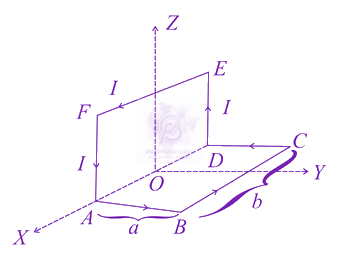
A beam of protons with speed $4\times {10}^{5}m{s}^{-1}$ enters a uniform magnetic field of $0.3T$ at an angle $60^{\circ}$ to the magnetic field, the pitch of the resulting helical path of protons is close to : (Mass of the proton$=1.67\times {10}^{-27}\mathrm{kg}$, charge of the proton$=1.69\times {10}^{-19}C$)
The figure shows a region of length '$l$' with a uniform magnetic field of $0.3T$ in it and a proton entering the region with velocity $4\times {10}^{5}m{s}^{-1}$ making an angle $60^{\circ}$ with the field. If the proton completes $10$ revolution by the time it cross the region shown, '$l$' is close to (mass of proton $=1.67\times {10}^{-27}\mathrm{kg}$, charge of the proton$=1.6\times {10}^{-19}C$) 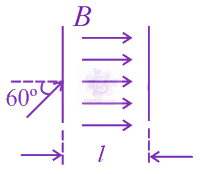
A parallel plate capacitor has plate of length $l$, width $w$ and separation of plates is $d$. It is connected to a battery of emf $V$. A dielectric slab of the same thickness $d$ and of dielectric constant $K=4$ is being inserted between the plates of the capacitor. At what length of the slab inside plates, will the energy stored in the capacitor be two times the initial energy stored?
The series combination of two batteries, both of the same emf $10V,$ but different internal resistance of $20 \Omega$ and $5 \Omega ,$ is connected to the parallel combination of two resistors $30 \Omega$ and $\text{x }\Omega .$ The voltage difference across the battery of internal resistance $20 \Omega$ is zero, the value of $\text{x}$ (in $\Omega )$ is____
The current ${I}_{1}$ (in $A$ ) flowing through $1\Omega$ resistor in the following circuit is: 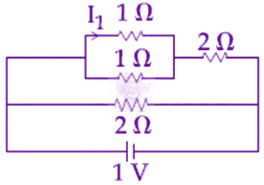
Two identical electric point dipoles have dipole have dipole moments ${\vec{p}}_{1}=p\hat{i}$ and ${\vec{p}}_{2}=-p\hat{i}$ and are held on the $x$-axis at distance '$a$' from each other. When released, they move along the $x$-axis with the direction of their dipole moments remaining unchanged. If the mass of each dipole is '$m$', their speed when they are infinitely far apart is :
Ten charges are placed on the circumference of a circle of radius R with constant angular separation between successive charges. Alternate charges$1,3,5,7,9$ have charge $(+q)$ each, while $2,4,6,8,10$ have charge $(–q)$ each. The potential V and the electric field E at the centre of the circle are respectively : (Take$V=0$ at infinity)
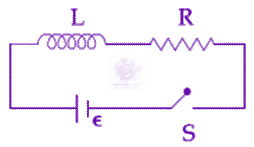 As shown in the figure, a battery of emf $\in$ is connected to an inductor $L$ and resistance $R$ in series. The switch is closed at $t=0.$ The total charge that flows from the battery, between $t=0$ and $t={t}_{c}$ ( ${t}_{c}$ is the time constant of the circuit) is:
Two sources of light emit X-rays of wavelength 1 nm and visible light of wavelength 500 nm, respectively. Both the sources emit light of the same power 200 W. The ratio of the number density of photons of X-rays to the number density of photons of the visible light of the given wavelengths is:
An inductance coil has a reactance of $100\Omega$ . When an AC signal of frequency $1000\mathrm{Hz}$ is applied to the coil, the applied voltage leads the current by $45^{\circ}$. The self-inductance of the coil is
The electric fields of two plane electromagnetic plane waves in vacuum are given by $\vec{{E}_{1}}={E}_{0}\hat{j}\mathrm{cos}(\omega t-kx)$ and $\vec{{E}_{2}}={E}_{0}\hat{k}\mathrm{cos}(\omega t-ky)$ At $t=0,$ a particle of charge $q$ is at origin with a velocity $\vec{v}=08c\hat{j}$ ( $c$ is the speed of light in vaccum). The instantaneous force experienced by the particle is:
Two infinite planes each with uniform surface charge density $+\sigma$ are kept in such a way that the angle between them is ${30}^{o}$ . The electric field in the region shown between them is given by: 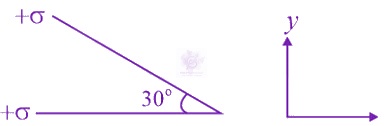
Magnitude of magnetic field (in SI units) at the centre of a hexagonal shape coil of side $10\mathrm{cm},50$ turns and carrying current$I$ (Ampere) in units of $\frac{{\mu }_{0}I}{\pi }$ is :
A particle of charge $q$ and mass $m$ is moving with a velocity $-v\hat{i}(v\neq 0)$ towards a large screen placed in the $Y-Z$ plane at distance d. If there is magnetic field $\vec{B}={B}_{0}\hat{k},$ the minimum value of $v$ for which the particle will not hit the screen is :