JEE Main 2016 — Electromagnetism
Physics Electromagnetism questions from JEE Main 2016.
Other Years
21 Electromagnetism Questions from 2016
The region between two concentric spheres of radii 'a' and 'b', respectively (see figure), has volume charge density $\rho =\frac{A}{r}$ , where A is a constant and r is the distance from the centre. At the centre of the spheres is a point charge Q. The value of A such that the electric field in the region between the spheres will be constant, is: 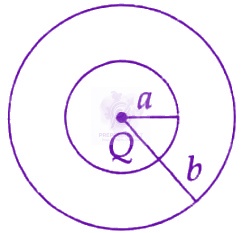
Consider a thin metallic sheet perpendicular to the plane of the paper moving with speed $v$ in a uniform magnetic field $B$ going into the plane of the paper (see figure). If charge densities ${\sigma }_{1}$ and ${\sigma }_{2}$ are induced on the left and right surfaces respectively of the sheet, then (ignore fringe effects) 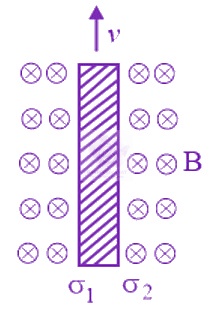
An arc lamp requires a direct current of 10 A at 80 V to function. If it is connected to a 220 V (rms), 50 Hz AC supply, the series inductor needed for it to work is close to:
Two identical wires $A$ and $B$, each of length $l$, carry the same current $I$ . Wire $A$ is bent into a circle of radius $R$ and wire $B$ is bent to form a square of side $a$. If ${B}_{A}$ and ${B}_{B}$ are the values of magnetic field at the centres of the circle and square respectively, then the ratio $\frac{{B}_{A}}{{B}_{B}}$ is
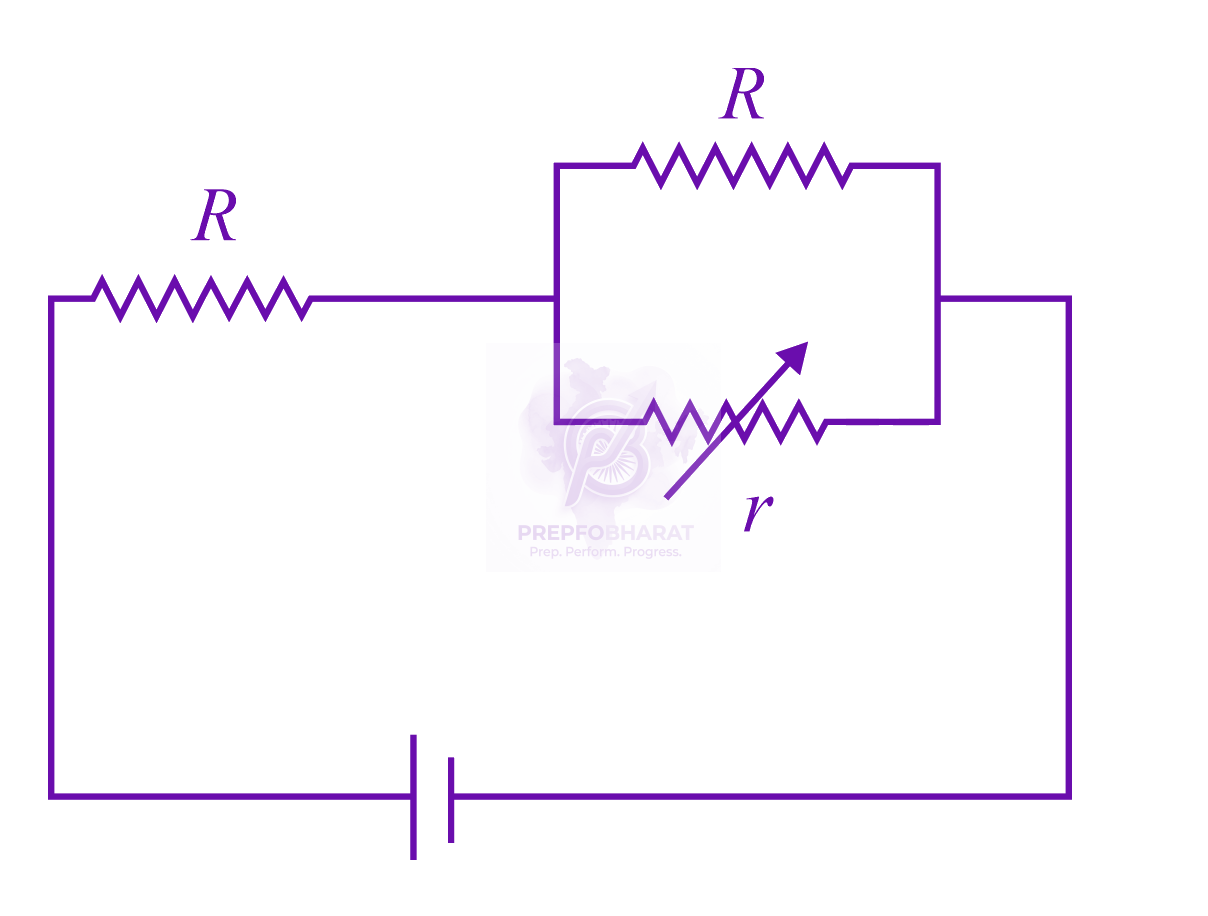 In the circuit shown, the resistance r is a variable resistance. If for $r=fR$ , the heat generation in r is maximum then the value of $f$ is
Microwave oven acts on the principle of:
A galvanometer has a 50 division scale. Battery has no internal resistance. It is found that there is deflection of 40 divisions when $R.B.=2400 \Omega .$Deflection becomes 20 divisions when resistance taken from resistance box is 4900 Ω. Then we can conclude : 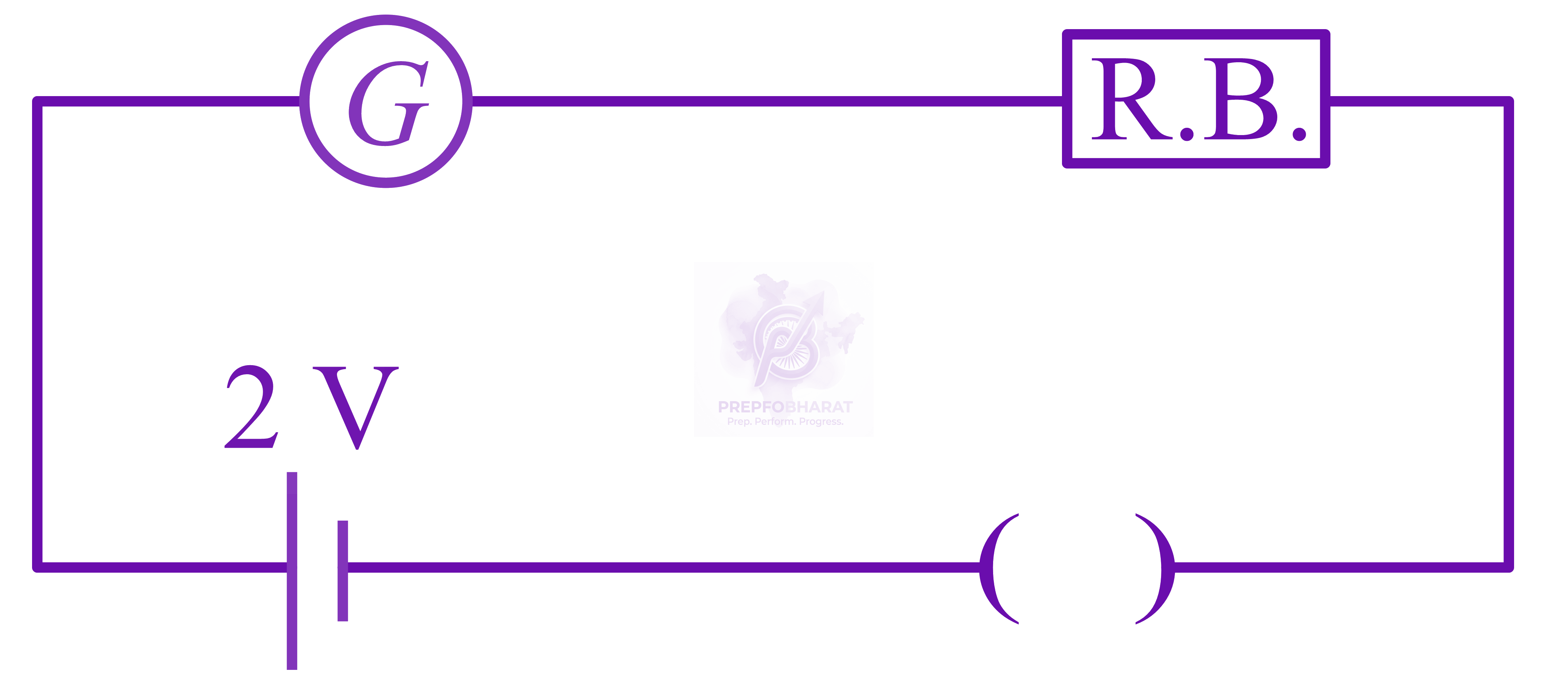 Note: This question is awarded as the bonus. Now the question is corrected.
A magnetic dipole is acted upon by two magnetic fields which are inclined to each other at an angle of ${75}^{o}$. One of the fields has a magnitude of $15\mathrm{mT}$. The dipole attains stable equilibrium at an angle of ${30}^{o}$ with this field. The magnitude of the other field (in $\mathrm{mT}$) is close to
A galvanometer having a coil resistance of $100 \Omega$ gives a full scale deflection, when a current of $1\mathrm{mA}$ is passed through it. The value of the resistance, which can convert this galvanometer into ammeter giving a full scale deflection for a current of $10A$, is:
To know the resistance $G$ of a galvanometer by half deflection method, a battery of emf ${V}_{E}$ and resistance $R$ is used to deflect the galvanometer by angle $\theta$ . If a shunt of resistance $S$ is needed to get half deflection the $G$, $R$ and $S$ are related by the equation:
The resistance of an electrical toaster has a temperature dependence given by $R(T)={R}_{0}[1+\alpha (T-{T}_{0})]$ in its range of operation. At ${T}_{0}=300 K, R=100\Omega \text{and} at T=500 K, R=120 \Omega$. The toaster is connected to a voltage source at $200V$ and its temperature is raised at a constant rate from $300\text{to}500K$ in $30s$. The total work done in raising the temperature is : Note: This question was awarded as the bonus since all options were incorrect in the exam.
Consider an electromagnetic wave propagating in vacuum. Choose the correct statement:
Arrange the following electromagnetic radiations per quantum in the order of increasing energy: $A:$ Blue light $B:$ Yellow light $C:$ X-ray $D:$ Radiowave
Three capacitors each of $4 \mu F$ are to be connected in such a way that the effective capacitance is $6 \mu F$. This can be done by connecting them
A series $LR$ circuit is connected to a voltage source with $V(t)={V}_{0}\mathrm{sin}(\omega t)$ . After a very large time, current $I(t)$ behaves as $({t}_{0}\gg \frac{L}{R})$:
A $50 \Omega$ resistance is connected to a battery of $5V$. A galvanometer of resistance $100 \Omega$ is to be used as an ammeter to measure current through the resistance, for this a resistance ${r}_{S}$ is connected to the galvanometer. Which of the following connections should be employed if the measured current is with in $1%$ of the current without the ammeter in the circuit?
A conducting metal circular-wire-loop of radius $r$ is placed perpendicular to a magnetic field which varies with time as $B={B}_{0}{e}^{-\frac{t}{\tau }},$ where ${B}_{0} \mathrm{and} \tau$ are constants at time $t=0$. If the resistance of the loop is $R$, then the heat generated in the loop after a long time $(t\rightarrow \infty )$ is
A combination of capacitors is set up as shown in the figure. The magnitude of the electric field, due to a point charge Q (having a charge equal to the sum of the charges on the $4 \mu F$ and $9 \mu F$ capacitors), at a point distant 30 m from it, would equal: 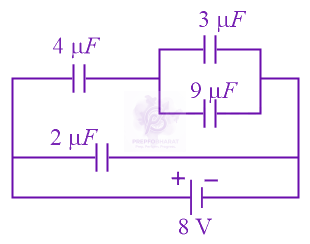
Within a spherical charge distribution of charge density $\rho (r),$ N equipotential surfaces of potential ${V}_{0}, {V}_{0}+\Delta V, {V}_{0}+2\Delta V,\ldots {V}_{0}+N\Delta V (\Delta V>0),$ are drawn and have increasing radii ${r}_{0}, {r}_{1}, {r}_{2},\ldots {r}_{N},$ respectively. If the difference in the radii of the surfaces is constant for all values of ${V}_{0} and \Delta V$ then :
Figure shows a network of capacitors where the number indicates capacitances in micro Farad. The value of capacitance C if the equivalent capacitance between point A and B is to be $1 \mu F$ is : 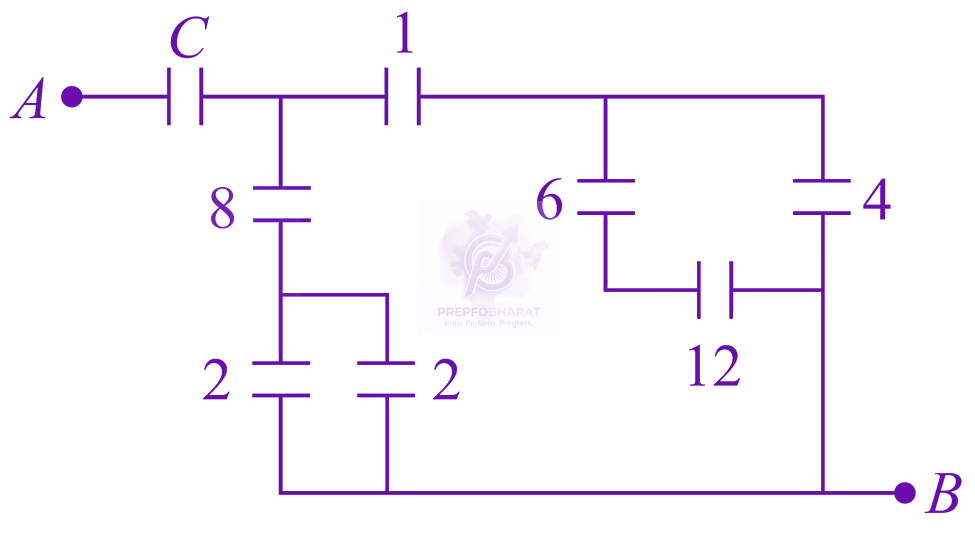
The potential (in volts) of a charge distribution is given by $V(z)=30-5{z}^{2}$ for $|z|\leq 1 m$ $V(z)=35-10 |z|$ for $|z|\geq 1 m$ . $V(z)$ does not depend on x and y. If this potential is generated by a constant charge per unit volume ${\rho }_{0}$ (in units of ${\epsilon }_{0}$ ) which is spread over a certain region, then choose the correct statement.