JEE Main 2017 — Electromagnetism
Physics Electromagnetism questions from JEE Main 2017.
Other Years
25 Electromagnetism Questions from 2017
A small circular loop of wire of radius $a$ is located at the centre of a much larger circular wire loop of radius $b$. The two loops are in the same plane. The outer loop of radius $b$ carries an alternating current $I={I}_{0}\mathrm{cos}(\omega t).$ The emf induced in the smaller inner loop is nearly:
The electric field component of a monochromatic radiation is given by $\vec{E}=2{E}_{0}\mathrm{cos}kz\mathrm{cos}\omega t\hat{i}$, Its magnetic field $\vec{B}$ is then given by:
A uniform magnetic field $B$ of $0.3T$ is along the positive $\text{Z}$ -direction. A rectangular loop ($abcd$) of sides $10 \mathrm{cm}\times 5 \mathrm{cm}$ carries a current $I$ of $12A$. Out of the following different orientations which one corresponds to stable equilibrium?
In the given circuit diagram, when the current reaches a steady-state in the circuit, the charge on the capacitor of capacitance $C$ will be: 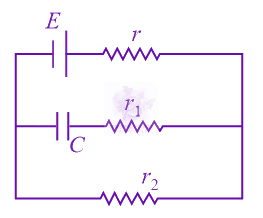
An electron beam is accelerated by a potential difference $V$ to hit a metallic target to produce $X-$rays. It produces continuous as well as characteristic $X-$rays. If ${\lambda }_{min}$ is the smallest possible wavelength of $X-$ray in the spectrum, the variation of $\mathrm{log}({\lambda }_{min})$ with $\mathrm{log}(V)$ is correctly represented in :
Four closed surfaces and corresponding charge distributions are shown below. 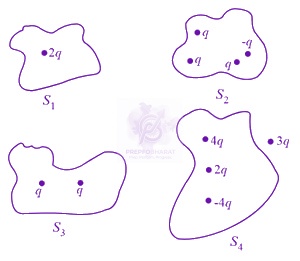 Let the respective electric fluxes through the surfaces be ${\phi }_{1}, {\phi }_{2}, {\phi }_{3}$ and ${\phi }_{4}$. Then:
A capacitance of $2 \mu F$ is required in an electrical circuit across a potential difference of $1\text{.}0\mathrm{kV}$. A large number of $1 \mu F$ capacitors are available which can withstand a potential difference of not more than $300V$. The minimum number of capacitors required to achieve this is:
In a certain region static electric and magnetic fields exist. The magnetic field is given by $\vec{B}={B}_{0}(\hat{i}+2\hat{j}-4\hat{k})$. If a test charge moving with a velocity $\vec{v}={v}_{0}(3\hat{i}-\hat{j}+2\hat{k})$ experiences no force in that region, then the electric field in the region, in SI units, is:
A sinusoidal voltage of peak value $283V$ and angular frequency $320{s}^{-1}$ is applied to a series $LCR$ circuit. Given that $R=5 \Omega , L=25 \mathrm{mH}$ and $C=1000\mu F$. The total impedance and phase difference between the voltage across the source and the current will respectively be-
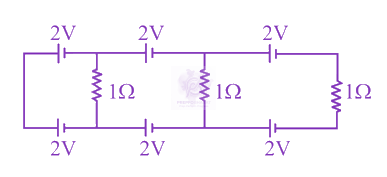 In the above circuit the current in each resistance is:
The energy stored in the electric field produced by a metal sphere is $4.5J$. If the sphere contains $4\mu C$ charge, its radius will be: $[Take:\frac{1}{4\pi {\in }_{0}}=9\times {10}^{9}N{m}^{2}{C}^{-2}]$
The figure shows three circuits $I, II$ and $III$ which are connected to a $3V$ battery. If the powers dissipated by the configurations $I, II$ and $III$ are ${P}_{1}, {P}_{2}$ and ${P}_{3}$ respectively, then - 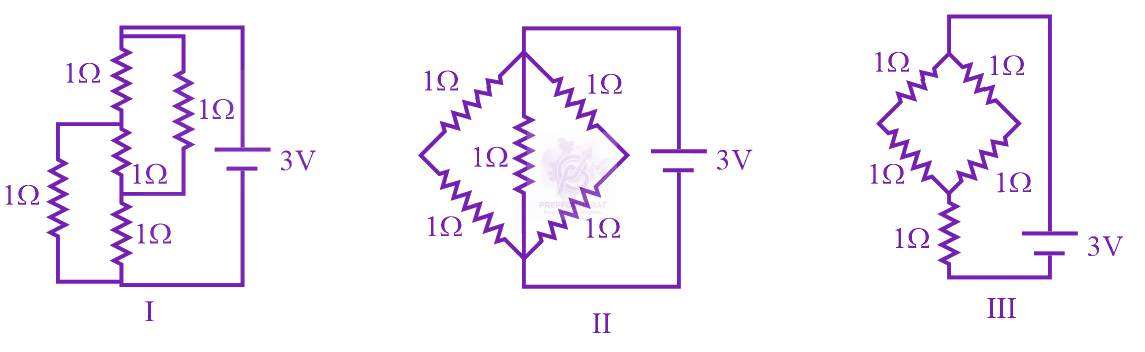
In a meter bridge experiment resistances are connected as shown in the figure. Initially resistance $P=4 \Omega$ and the neutral point $N$ is at $60\mathrm{cm}$ from $A$ . Now an unknown resistance $R$ is connected in series to $P$ and the new position of the neutral point is at $80\mathrm{cm}$ from $A$ . The value of unknown resistance $R$ is - 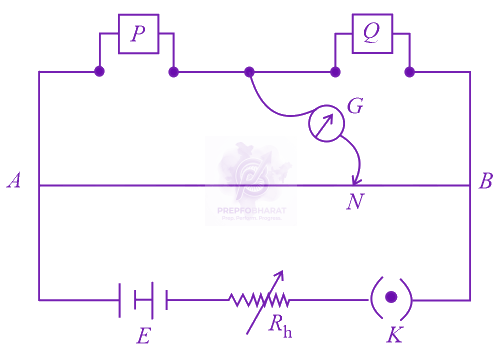
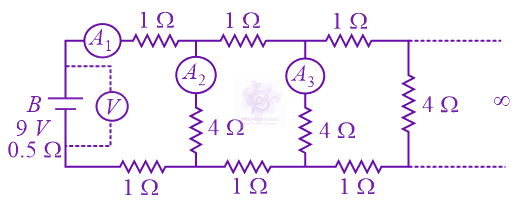 A $9V$ battery with an internal resistance of $0.5 \Omega$ is connected across an infinite network, as shown in the figure. All ammeters ${A}_{1}, {A}_{2}, {A}_{3}$ and voltmeter $V$ are ideal. Choose the correct statement.
An electric dipole has fixed dipole moment $\vec{p}$, which makes angle $\theta$ with respect to $x-$axis. When subjected to an electric field ${\vec{E}}_{1}=E\hat{i},$ it experiences a torque ${\vec{T}}_{1}=\tau \hat{k}$. When subjected to another electric field ${\vec{E}}_{2}= \sqrt{3} {E}_{1}\hat{j}$ it experiences a torque ${\vec{T}}_{2}=-{\vec{T}}_{1}$ . The angle $\theta$ is:
Magnetic field in a plane electromagnetic wave is given by, $\vec{B}={B}_{0}\mathrm{sin}(kx+\omega t)\hat{j} T$. Expression for corresponding electric field will be: (Where $c$ is speed of light)
In a coil of resistance $100\Omega$, a current is induced by changing the magnetic flux through it as shown in the figure. The magnitude of change in flux through the coil is: 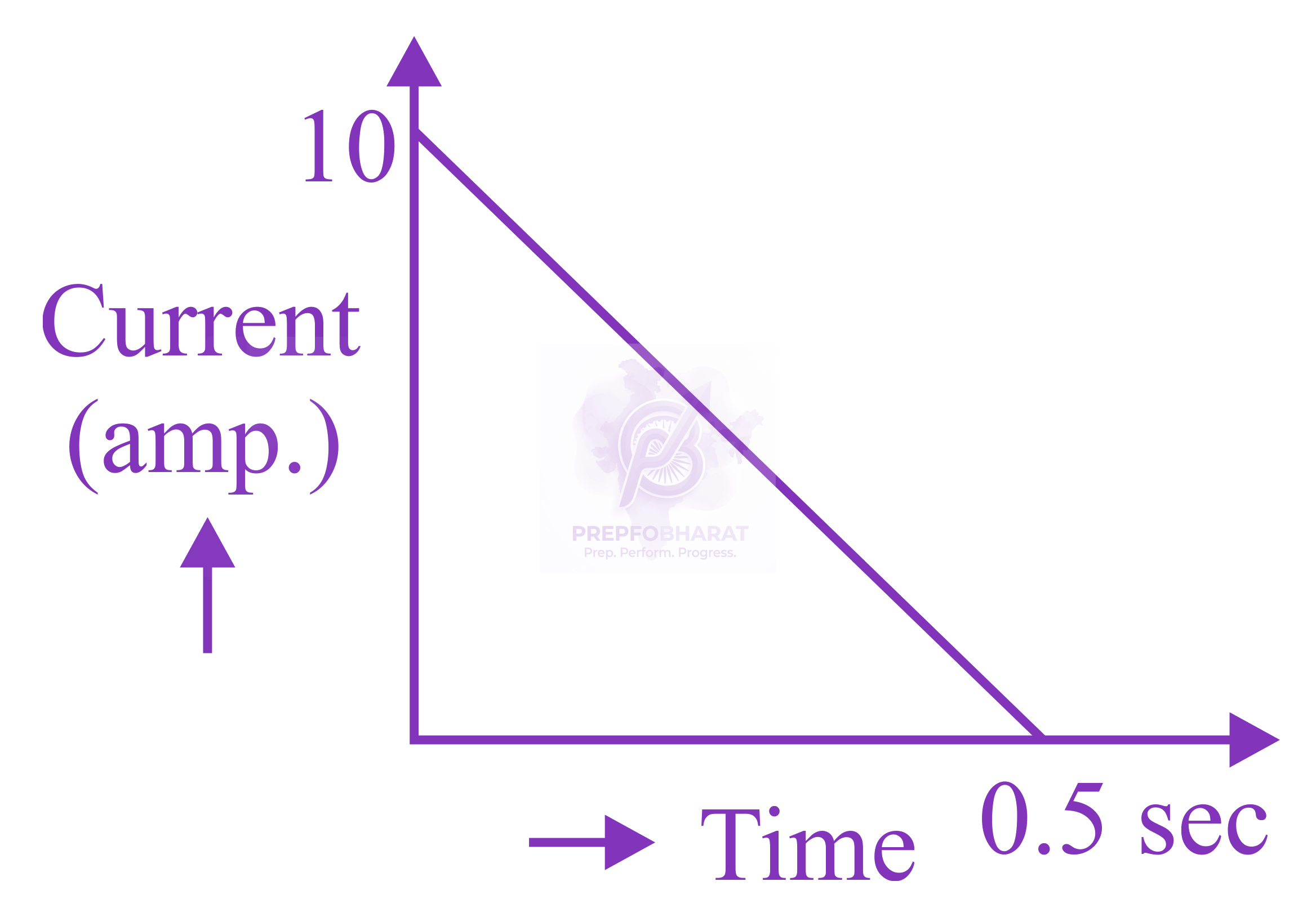
A combination of parallel plate capacitors is maintained at a certain potential difference. 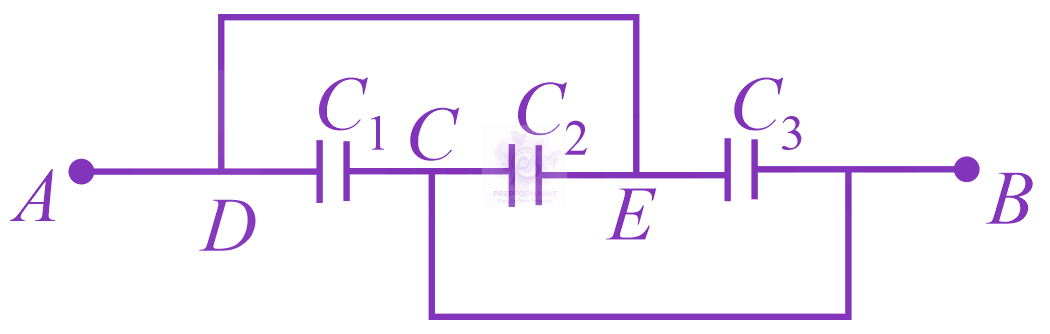 When a $3\mathrm{mm}$ thick slab is introduced between all the plates, in order to maintain the same potential difference, the distance between the plates is increased by $2.4\mathrm{mm}$. Find the dielectric constant of the slab.
A negative test charge is moving near a long straight wire carrying a current. The force acting on the test charge is parallel to the direction of the current. The motion of the charge is:
A uniform wire of length $l$ and radius $r$ has a resistance of $100 \text{Ω}$. It is recast into a wire of radius $\frac{r}{2}$. The resistance of new wire will be-
There is a uniform electrostatic field in a region. The potential at various points on a small sphere centred at $P$, in the region, is found to vary between the limits $589.0V$ to $589.8V$. What is the potential at a point on the sphere whose radius vector makes an angle of $60^{\circ}$ with the direction of the field?
A magnetic needle of magnetic moment $6.7\times {10}^{-2} A{m}^{2}$ and moment of inertia $7.5\times {10}^{-6}\mathrm{kg} {m}^{2}$ is performing simple harmonic oscillations in a magnetic field of $0.01T$. Time taken for $10$ complete oscillations is:
A magnetic dipole in a uniform magnetic field has: (Take zero potential energy when magnetic dipole is perpendicular to magnetic field)
When a current of $5\mathrm{mA}$ is passed through a galvanometer having a coil of resistance $15\Omega$, it shows full-scale deflection. The value of the resistance to be put in series with the galvanometer to convert it into a voltmeter of range $0-10V$ is:
Which of the following statements is false?