JEE Main 2026 — Inorganic Chemistry
Chemistry Inorganic Chemistry questions from JEE Main 2026.
Other Years
129 Inorganic Chemistry Questions from 2026
Which of the following elements has the highest electronegativity?
First and second ionization enthalpies of lithium are $520$ kJ mol$^{-1}$ and $7297$ kJ mol$^{-1}$ respectively. Energy required to convert $3.5$ mg lithium (g) into $\text{Li}^{2+}$(g) $[\text{Li(g)} \rightarrow \text{Li}^{2+}\text{(g)}]$ is _______ kJ mol$^{-1}$. (nearest integer) [Molar mass of Li $= 7$ g mol$^{-1}$]
It is noticed that $\mathrm{Pb}^{2+}$ is more stable than $\mathrm{Pb}^{4+}$ but $\mathrm{Sn}^{2+}$ is less stable than $\mathrm{Sn}^{4+}$. Observe the following reactions. $\mathrm{PbO}_{2}+\mathrm{Pb} \rightarrow 2 \mathrm{PbO} ; \Delta_{\mathrm{r}} \mathrm{G}^{\circ}(1)$ $\mathrm{SnO}_{2}+\mathrm{Sn} \rightarrow 2 \mathrm{SnO} ; \Delta_{\mathrm{r}} \mathrm{G}^{\circ}(2)$ Identify the correct set from the following
An excess of AgNO$_3$ is added to $100$ mL of a $0.05$ M solution of tetraaquadichloridochromium (III) chloride. The number of moles of AgCl precipitated will be __________ $\times 10^{-3}$. (Nearest integer)
Identify the molecule $(X)$ with maximum number of lone pairs of electrons (obtained using Lewis dot structure) among $\mathrm{HNO}_{3}, \mathrm{H}_{2} \mathrm{SO}_{4}, \mathrm{NF}_{3}$ and $\mathrm{O}_{3}$. Choose the correct bond angle made by the central atom of the molecule $(\mathrm{X})$.
The correct order of $\mathrm{C}, \mathrm{N}, \mathrm{O}$ and F in terms of second ionisation potential is
In period 4 of the periodic table, the elements with highest and lowest atomic radii are respectively.
The number of isoelectronic species among $\mathrm{Sc}^{3+}, \mathrm{Cr}^{2+}, \mathrm{Mn}^{3+}, \mathrm{Co}^{3+}$ and $\mathrm{Fe}^{3+}$ is ' $\mathrm{n}^{\prime}$. If ' $\mathrm{n}^{\prime}$ moles of AgCl is formed during the reaction of complex with formula $\mathrm{CoCl}_{3}(\mathrm{en})_{2} \mathrm{NH}_{3}$ with excess of $\mathrm{AgNO}_{3}$ solution, then the number of electrons present in the $t_{2 g}$ orbital of the complex is $\_\_\_\_$.
Given below are two statements: Statement I: Aluminium is more electropositive than thallium as the standard electrode potential value of $E^{\circ}_{\text{Al}^{3+}/\text{Al}}$ is negative and $E^{\circ}_{\text{Tl}^{3+}/\text{Tl}}$ is positive. Statement II: The sum of first three ionization enthalpies of boron is very high when compared to that of aluminium. Due to this reason boron forms covalent compounds only and aluminium forms $\text{Al}^{3+}$ ion. In the light of the above statements, choose the correct answer from the options given below
Consider the elements $\mathrm{N}, \mathrm{P}, \mathrm{O}, \mathrm{S}, \mathrm{Cl}$ and F. The number of valence electrons present in the elements with most and least metallic character from the above list is respectively.
Given below are two statements: Statement I: The second ionisation enthalpy of Na is larger than the corresponding ionisation enthalpy of Mg. Statement II: The ionic radius of $\mathrm{O}^{2-}$ is larger than that of $\mathrm{F}^{-}$. In the light of the above statements, choose the correct answer from the options given below
Given below are two statements : Statement I: $\quad \mathrm{C}<\mathrm{O}<\mathrm{N}<\mathrm{F}$ is the correct order in terms of first ionization enthalpy values. Statement II: $\quad \mathrm{S}>\mathrm{Se}>\mathrm{Te}>\mathrm{Po}>\mathrm{O}$ is the correct order in terms of the magnitude of electron gain enthalpy values. In the light of the above statements, choose the correct answer from the options given below :
Given below are two statements : Statement I : The correct order in terms of atomic/ionic radii is $\mathrm{Al}>\mathrm{Mg}>\mathrm{Mg}^{2+}>\mathrm{Al}^{3+}$. Statement II : The correct order in terms of the magnitude of electron gain enthalpy is $\mathrm{Cl}>\mathrm{Br}>\mathrm{S}>\mathrm{O}$. In the light of the above statements, choose the correct answer from the options given below :
Which of the following pictorial diagram most correctly represents the $\pi^*$ ($\pi$-antibonding) molecular orbital between two atoms if the internuclear axis is taken to be in the z-direction ($\xrightarrow{\text{z-axis}}$)?
Which statements are NOT TRUE about $\mathrm{XeO}_{2} \mathrm{~F}_{2}$ ? A. It has a see-saw shape. B. Xe has 5 electron pairs in its valence shell in $\mathrm{XeO}_{2} \mathrm{~F}_{2}$. C. The $\mathrm{O}-\mathrm{Xe}-\mathrm{O}$ bond angle is close to $180^{\circ}$. D. The $\mathrm{F}-\mathrm{Xe}-\mathrm{F}$ bond angle is close to $180^{\circ}$. E. Xe has 16 valence electrons in $\mathrm{XeO}_{2} \mathrm{~F}_{2}$. Choose the correct answer from the options given below:
Given below are two statements: Statement I : The correct order in terms of bond dissociation enthalpy is $\mathrm{Cl}_{2}>\mathrm{Br}_{2}>\mathrm{F}_{2}>\mathrm{I}_{2}$. Statement II: The correct trend in the covalent character of the metal halides is $\left[\mathrm{SnCl}_{4}>\mathrm{SnCl}_{2}\right]$, $\left[\mathrm{PbCl}_{4}>\mathrm{PbCl}_{2}\right]$ and $\left[\mathrm{UF}_{4}>\mathrm{UF}_{6}\right]$. In the light of the above statements, choose the correct answer from the options given below :
Given below are two statements: Statement I: The correct order of electronegativity of fluorine, oxygen and nitrogen is $F > O > N$. Statement II: The oxidation state of oxygen in OF$_2$ is $+2$ and in Na$_2$O is $-2$. In the light of the above statements, choose the correct answer from the options given below
Choose the INCORRECT statement
Match the LIST-I with LIST-II <table class="pyq-table"><tbody><tr><th>List-I Complex ion</th><th>List-II Calculated spin only magnetic moment (BM)</th></tr><tr><td>A. $[Cr(H_2O)_6]^{2+}$</td><td>I. $3.87$</td></tr><tr><td>B. $[Co(H_2O)_6]^{2+}$</td><td>II. $5.92$</td></tr><tr><td>C. $[Cu(H_2O)_6]^{2+}$</td><td>III. $4.90$</td></tr><tr><td>D. $[Mn(H_2O)_6]^{2+}$</td><td>IV. $1.73$</td></tr></tbody></table> Choose the correct answer from the options given below:
Consider the following statements about manganate and permanganate ions. Identify the correct statements. A. The geometry of both manganate and permanganate ions is tetrahedral. B. The oxidation states of Mn in manganate and permanganate are +7 and +6, respectively. C. Oxidation of Mn (II) salt by peroxodisulphate gives manganate ion as the final product. D. Manganate ion is paramagnetic and permanganate ions is diamagnetic. E. Acidified permanganate ion reduces oxalate, nitrite and iodide ions. Choose the correct answer from the options given below :
Match List - I with List - II according to shape. \(\begin{array}{llll} & \text{List-I} & & \text{List-II} \\ A. & \mathrm{XeO_3} & I. & \mathrm{BrF_5} \\ B. & \mathrm{XeF_2} & II. & \mathrm{NH_3} \\ C. & \mathrm{XeO_2F_2} & III. & [\mathrm{I_3}]^- \\ D. & \mathrm{XeOF_4} & IV. & \mathrm{SF_4} \end{array}\) Choose the correct answer from the options given below :
Given below are two statements : Statement (I) : Oxidising power of halogens decreases in the order $F_2 > Cl_2 > Br_2 > I_2$, which is the basis of "Layer test". Statement (II) : "Layer test" to identify $Br_2$ and $I_2$ in aqueous solution involves the oxidation of bromide or iodide into $Br_2$ or $I_2$ respectively with $Cl_2$, which is a type of displacement redox reaction. In the light of the above statements, choose the correct answer from the options given below :
The mass of iron converted into $Fe_3O_4$ by the action of $18$ g of steam is : (Given : Molar mass of H, O and Fe are $1$, $16$ and $56$ g mol$^{-1}$ respectively) Assume iron is present in excess :
A student has been given 0.314 g of an organic compound and asked to estimate Sulphur. During the experiment, the student has obtained 0.4813 g of barium sulphate. The percentage of sulphur present in the compound is $\_\_\_\_$. (Given Molar mass in $\mathrm{g} \mathrm{mol}^{-1} \mathrm{~S}: 32, \mathrm{BaSO}_{4}: 233$)
Consider a mixture ' X ' which is made by dissolving 0.4 mol of $\left[\mathrm{Co}\left(\mathrm{NH}_{3}\right)_{5} \mathrm{SO}_{4}\right] \mathrm{Br}$ and 0.4 mol of $\left[\mathrm{Co}\left(\mathrm{NH}_{3}\right)_{5} \mathrm{Br}\right] \mathrm{SO}_{4}$ in water to make 4 L of solution. When 2 L of mixture ' X ' is allowed to react with excess of $\mathrm{AgNO}_{3}$, it forms precipitate ' Y '. The rest 2 L of mixture ' X ' reacts with excess $\mathrm{BaCl}_{2}$ to form precipitate ' Z '. Which of the following statements is CORRECT?
Given below are two statements for catalytic properties of transition metals. Statement I: First row transition metals which act as catalyst utilise their 3d electrons only for formation of bonds between reactant molecules and atoms on the surface of catalyst. Statement II: There is increase in the concentration of reactants on the surface of catalyst which strengthens the bonds in reacting molecules. In the light of the above statements, choose the correct answer from the options given below:
Consider the following reactions. $\mathrm{PbCl}_{2}+\mathrm{K}_{2} \mathrm{CrO}_{4} \rightarrow \mathrm{~A}+2 \mathrm{KCl}$ (Hot solution) $\mathrm{A}+\mathrm{NaOH} \rightleftharpoons \mathrm{B}+\mathrm{Na}_{2} \mathrm{CrO}_{4}$ $\mathrm{PbSO}_{4}+4 \mathrm{CH}_{3} \mathrm{COONH}_{4} \rightarrow\left(\mathrm{NH}_{4}\right)_{2} \mathrm{SO}_{4}+\mathrm{X}$ In the above reactions, $\mathrm{A}, \mathrm{B}$ and X are respectively.
In the Group analysis of cations, $\mathrm{Ba}^{2+} ~\&~ \mathrm{Ca}^{2+}$ are precipitated respectively as
The correct statements among the following are. A. Basic vanadium oxide is used in the manufacture of $\text{H}_2\text{SO}_4$. B. The spin-only magnetic moment value of the transition metal halide employed in Ziegler-Natta polymerization is $2.84$ BM. C. The p-block metal compound employed in Ziegler-Natta polymerization has the metal in $+3$ oxidation state. D. The number of electrons present in the outer most 'd' orbital of metal halide employed in Wacker process is $8$. Choose the correct answer from the options given below:
Given below are two statements: Statement I: Among $Zn, Mn, Sc$ and $Cu$, the energy required to remove the third valence electron is highest for $Zn$ and lowest for $Sc$. Statement II: The correct order of the following complexes in terms of CFSE is $[Co(H_2 O)_6]^{2+} < [Co(H_2 O)_6]^{3+} < [Co(en)_3]^{3+}$. In the light of the above statements, choose the correct answer from the options given below:
Given below are two statements: Statement I: The number of pairs among $[\text{Ti}^{4+}, \text{V}^{2+}]$, $[\text{V}^{2+}, \text{Mn}^{2+}]$, $[\text{Mn}^{2+}, \text{Fe}^{3+}]$ and $[\text{V}^{2+}, \text{Cr}^{2+}]$ in which both ions are coloured is $3$. Statement II: The number of pairs among $[\text{La}^{3+}, \text{Yb}^{2+}]$, $[\text{Lu}^{3+}, \text{Ce}^{4+}]$ and $[\text{Ac}^{3+}, \text{Lr}^{3+}]$ ions in which both are diamagnetic is $3$. In the light of the above statements, choose the correct from the options given below:
Given below are two statements: Statement I: The number of paramagnetic species among $\left[\mathrm{CoF}_{6}\right]^{3-},\left[\mathrm{TiF}_{6}\right]^{3-}$, $\mathrm{V}_{2} \mathrm{O}_{5}$ and $\left[\mathrm{Fe}(\mathrm{CN})_{6}\right]^{3-}$ is 3. Statement II: $\mathrm{K}_{4}\left[\mathrm{Fe}(\mathrm{CN})_{6}\right]<\mathrm{K}_{3}\left[\mathrm{Fe}(\mathrm{CN})_{6}\right]<\left[\mathrm{Fe}\left(\mathrm{H}_{2} \mathrm{O}\right)_{6}\right] \mathrm{SO}_{4} \cdot \mathrm{H}_{2} \mathrm{O}<\left[\mathrm{Fe}\left(\mathrm{H}_{2} \mathrm{O}\right)_{6}\right] \mathrm{Cl}_{3}$ is the correct order in terms of number of unpaired electron(s) present in the complexes. In the light of the above statements, choose the correct answer from the options given below
Regarding the hydrides of group 15 elements $\mathrm{EH}_{3}(\mathrm{E}=\mathrm{N}, \mathrm{P}, \mathrm{As}, \mathrm{Sb})$, select the correct statement from the following: A. The stability of hydrides decreases down the group. B. The basicity of hydrides decreases down the group. C. The reducing character increases down the group. D. The boiling point increases down the group. Choose the correct answer from the options given below:
Match List-I with List-II.<table class="pyq-table"><tbody><tr><th>List-I Electronic configuration of neutral atom (where $n=2$)</th><th>List-II $1^{st}$ Ionization Energy (kJ mol$^{-1}$)</th></tr><tr><td>A. $ns^2$</td><td>I. $2080$</td></tr><tr><td>B. $ns^2np^1$</td><td>II. $899$</td></tr><tr><td>C. $ns^2np^3$</td><td>III. $800$</td></tr><tr><td>D. $ns^2np^6$</td><td>IV. $1402$</td></tr></tbody></table>Choose the correct answer from the options given below:
Which of the following sets includes all the species that will change the orange colour of $K_2Cr_2O_7$ in acidic medium?
Given below are two statements: Statement I: Hybridisation, shape and spin only magnetic moment of $\mathrm{K}_{3}\left[\mathrm{Co}\left(\mathrm{CO}_{3}\right)_{3}\right]$ is $\mathrm{sp}^{3} \mathrm{~d}^{2}$, octahedral and 4.9 BM respectively. Statement II: Geometry, hybridisation and spin only magnetic moment values $(\mathrm{BM})$ of the ions $\left[\mathrm{Ni}(\mathrm{CN})_{4}\right]^{2-},\left[\mathrm{MnBr}_{4}\right]^{2-}$ and $\left[\mathrm{CoF}_{6}\right]^{3-}$ respectively are square planar, tetrahedral, octahedral; $\mathrm{dsp}^{2}, \mathrm{sp}^{3}, \mathrm{sp}^{3} \mathrm{~d}^{2}$ and $0,5.9,4.9$. In the light of the above statements, choose the correct answer from the options given below
The correct increasing order of $C-H(A), C-O(B), C=O(C)$ and $C \equiv N(D)$ bonds in terms of covalent bond length is:
Given below are two statements : Statement I : The number of pairs among $\left[\mathrm{SiO}_{2}, \mathrm{CO}_{2}\right],\left[\mathrm{SnO}, \mathrm{SnO}_{2}\right],\left[\mathrm{PbO}, \mathrm{PbO}_{2}\right]$ and $\left[\mathrm{GeO}, \mathrm{GeO}_{2}\right]$, which contain oxides that are both amphoteric is 2. Statement II: $\mathrm{BF}_{3}$ is an electron deficient molecule, can act as a Lewis acid, forms adduct with $\mathrm{NH}_{3}$ and has a trigonal planar geometry. In the light of the above statements, choose the correct answer from the options given below :
Given below are two statements : Statement I : The increasing order of boiling point of hydrogen halides is $\mathrm{HCl}<\mathrm{HBr}<\mathrm{HI}<\mathrm{HF}$. Statement II : The increasing order of melting point of hydrogen halides is $\mathrm{HCl}<\mathrm{HBr}<\mathrm{HF}<\mathrm{HI}$. In the light of the above statements, choose the correct answer from the options given below :
The oxidation state of chromium in the final product formed in the reaction between KI and acidified $\mathrm{K}_{2} \mathrm{Cr}_{2} \mathrm{O}_{7}$ solution is:
On heating a mixture of common salt and $\mathrm{K}_{2} \mathrm{Cr}_{2} \mathrm{O}_{7}$ in equal amount along with concentrated $\mathrm{H}_{2} \mathrm{SO}_{4}$ in a test tube, a gas is evolved. Formula of the gas evolved and oxidation state of the central metal atom in the gas respectively are:
The correct statements from the following are : A. Ionic radii of trivalent cations of group 13 elements decreases down the group. B. Electronegativity of group 13 elements decreases down the group. C. Among the group 13 elements, Boron has highest first ionisation enthalpy. D. The trichloride and triiodide of group 13 elements are covalent in nature. Choose the correct answer from the options given below :
Given below are two statements: Statement I: The number of species among $\mathrm{BF}_{4}{ }^{-}, \mathrm{SiF}_{4}, \mathrm{XeF}_{4}$ and $\mathrm{SF}_{4}$, that have unequal $\mathrm{E}-\mathrm{F}$ bond lengths is two. Here, E is the central atom. Statement II: Among $\mathrm{O}_{2}^{-}, \mathrm{O}_{2}{ }^{2-}, \mathrm{F}_{2}$ and $\mathrm{O}_{2}{ }^{+}, \mathrm{O}_{2}^{-}$has the highest bond order. In the light of the above statements, choose the correct answer from the options given below
Number of paramagnetic ions among the following d- and f-block metal ions is _______. $Mn^{2+}, Cu^{2+}, Zn^{2+}, Yb^{2+}, Sc^{3+}, La^{3+}, Gd^{3+}, Lu^{3+}, Ti^{4+}, Ce^{4+}$ (Atomic number of $Mn = 25, Cu = 29, Zn = 30, Yb = 70, Sc = 21, La = 57, Gd = 64, Lu = 71, Ti = 22, Ce = 58$)
Given below are two statements : Statement I: The first ionization enthalpy of Cr is lower than that of Mn . Statement II: The second and third ionization enthalpies of Cr are higher than those of Mn. In the light of the above statements, choose the correct answer from the options given below :
Which of the following elements has the highest electronegativity?
According to Lewis theory, the total number of $\sigma$ bond-pairs and lone pair of electrons around the central atom of $XeO_6^{4-}$ ion is _____.
Consider the transition metal ions $\mathrm{Mn}^{3+}, \mathrm{Cr}^{3+}, \mathrm{Fe}^{3+}$ and $\mathrm{Co}^{3+}$ and all form low spin octahedral complexes. The correct decreasing order of unpaired electrons in their respective d-orbitals of the complexes is
The crystal field splitting energy of $\left[\mathrm{Co}(\text { oxalate })_{3}\right]^{3-}$ complex is ' $\mathrm{n}^{\prime}$ times that of the $\left[\mathrm{Cr}(\text { oxalate })_{3}\right]^{3-}$ complex. Here ' $\mathrm{n}^{\prime}$ is $\_\_\_\_$. (Assume $\Delta_{0} \gg \mathrm{P}$)
Given below are some of the statements about Mn and $\mathrm{Mn}_{2} \mathrm{O}_{7}$. Identify the correct statements. A. Mn forms the oxide $\mathrm{Mn}_{2} \mathrm{O}_{7}$, in which Mn is in its highest oxidation state. B. Oxygen stabilizes the Mn in higher oxidation states by forming multiple bonds with Mn. C. $\mathrm{Mn}_{2} \mathrm{O}_{7}$ is an ionic oxide. D. The structure of $\mathrm{Mn}_{2} \mathrm{O}_{7}$ consists of one bridged oxygen. Choose the correct answer from the options given below :
X is the number of geometrical isomers exhibited by $\left[\mathrm{Pt}\left(\mathrm{NH}_{3}\right)\left(\mathrm{H}_{2} \mathrm{O}\right) \mathrm{BrCl}\right]$. Y is the number of optically inactive isomer(s) exhibited by $\left[\mathrm{CrCl}_{2}(\mathrm{ox})_{2}\right]^{3-}$ Z is the number of geometrical isomers exhibited by $\left[\mathrm{Co}\left(\mathrm{NH}_{3}\right)_{3}\left(\mathrm{NO}_{2}\right)_{3}\right]$. The value of $\mathrm{X}+\mathrm{Y}+\mathrm{Z}$ is $\_\_\_\_$.
Consider the following reactions: $\mathrm{NaCl}+\mathrm{K}_{2} \mathrm{Cr}_{2} \mathrm{O}_{7}+\mathrm{H}_{2} \mathrm{SO}_{4} \rightarrow \mathrm{~A}+\mathrm{KHSO}_{4}+\mathrm{NaHSO}_{4}+\mathrm{H}_{2} \mathrm{O}$ $\mathrm{A}+\mathrm{NaOH} \rightarrow \mathrm{B}+\mathrm{NaCl}+\mathrm{H}_{2} \mathrm{O}$ $\mathrm{B}+\mathrm{H}_{2} \mathrm{SO}_{4}+\mathrm{H}_{2} \mathrm{O}_{2} \rightarrow \mathrm{C}+\mathrm{Na}_{2} \mathrm{SO}_{4}+\mathrm{H}_{2} \mathrm{O}$ In the product ' $C$ ', ' $X$ ' is the number of $O_{2}^{2-}$ units, ' $Y$ ' is the total number oxygen atoms present and ' $Z$ ' is the oxidation state of $C r$. The value of $X+Y+Z$ is $\_\_\_\_$.
Correct statements from the following are A. Potassium dichromate is an oxidising agent and it oxidises $FeSO_4$ to $Fe_2(SO_4)_3$ in acidic medium. B. Sodium dichromate can be used as primary standard in volumetric estimation. C. $CrO_4^{2-}$ and $Cr_2O_7^{2-}$ are interconvertible in aqueous solution by varying the $pH$ of the solution. D. $Cr$-$O$-$Cr$ bond angle in $Cr_2O_7^{2-}$ is $126^\circ$. Choose the correct answer from the options given below:
The correct trend in the first ionization enthalpies of the elements in the $3^{\text {rd }}$ period of periodic table is :
The $1^{st}$ ionization enthalpy for Mg is $+737$ kJ/mol. The most probable estimated value of the $2^{nd}$ ionization enthalpy of Mg is ______.
By usual analysis, 1.00 g of compound $(\mathrm{X})$ gave 1.79 g of magnesium pyrophosphate. The percentage of phosphorus in compound $(X)$ is : (nearest integer) (Given, molar mass in $\mathrm{g} \mathrm{mol}^{-1}: \mathrm{O}=16, \mathrm{Mg}=24, \mathrm{P}=31$)
Given below are two statements: Statement I: The halogen that makes longest bond with hydrogen in HX, has the smallest covalent radius in its group. Statement II: A group 15 element's hydride $\mathrm{EH}_{3}$ has the lowest boiling point among corresponding hydrides of other group 15 elements. The maximum covalency of that element E is 4. In the light of the above statements, choose the correct answer from the options given below
$\mathrm{MnO}_{4}{ }^{2-}$, in acidic medium, disproportionates to :
Given below are two statements: Statement I: $\mathrm{K}>\mathrm{Mg}>\mathrm{Al}>\mathrm{B}$ is the correct order in terms of metallic character. Statement II: Atomic radius is always greater than the ionic radius for any element. In the light of the above statements, choose the correct answer from the options given below
The pairs among $A = [\text{SO}_3^{2-}, \text{CO}_3^{2-}]$, $B = [\text{O}_2^{2-}, \text{F}_2]$, $C = [\text{CN}^-, \text{CO}]$, $D = [\text{NH}_3, \text{H}_3\text{O}^+]$ and $E = [\text{MnO}_4^{2-}, \text{CrO}_4^{2-}]$ that do not have similar Lewis dot structure are
Total number of unpaired electrons present in the central metal atoms/ions of $\left[\mathrm{Ni}(\mathrm{CO})_{4}\right],\left[\mathrm{NiCl}_{4}\right]^{2-},\left[\mathrm{PtCl}_{2}\left(\mathrm{NH}_{3}\right)_{2}\right],\left[\mathrm{Ni}(\mathrm{CN})_{4}\right]^{2-}$ and $\left[\mathrm{Pt}(\mathrm{CN})_{4}\right]^{2-}$ is $\_\_\_\_$.
Find the correct statements related to group 15 hydrides. A. Reducing nature increases from NH$_3$ to BiH$_3$ B. Tendency to donate lone pair of electrons decreases from NH$_3$ to BiH$_3$ C. The stability of hydrides decreases from NH$_3$ to BiH$_3$ D. HEH bond angle decreases from NH$_3$ to SbH$_3$ (E = Elements of group 15) Choose the correct answer from the options given below:
Consider $|x|$ is the difference in oxidation states of Mn in highest manganese fluoride and highest manganese oxide. The ions with $|x|$ number of unpaired electrons from the following are: A. $Sc^{3+}$ B. $Zn^{2+}$ C. $V^{2+}$ D. $Fe^{2+}$ E. $Co^{2+}$ Choose the correct answer from the options given below:
Given below are two statements : Statement (I) : The first ionisation enthalpy of the elements Na, Mg, Cl and Ar follows the order Na $>$ Mg $>$ Cl $>$ Ar. Statement (II) : Among Ca, Al, Fe and B, the third ionisation enthalpy is very high for Ca. In the light of the above statements, choose the correct answer from the options given below :
Which of the following sequences of hybridisation, geometry and magnetic nature are correct for the given coordination compounds ? A. $[\text{NiCl}_4]^{2-}$ $-$ sp$^3$, tetrahedral, paramagnetic B. $[\text{Ni(NH}_3)_6]^{2+}$ $-$ sp$^3$d$^2$, octahedral, paramagnetic C. $[\text{Ni(CO)}_4]$ $-$ sp$^3$, tetrahedral, paramagnetic D. $[\text{Ni(CN)}_4]^{2-}$ $-$ dsp$^2$, square planar, diamagnetic Choose the correct answer from the options given below :
Given below are two statements: Statement I: Each electron in $e_g$ orbitals destabilizes the orbitals by $+0.6\Delta_o$ and each electron in the $t_{2g}$ orbitals stabilizes the orbitals by $-0.4\Delta_o$ in an octahedral field on the basis of crystal field theory. Statement II: All the d-orbitals of the transition metals have the same energy in their free atomic state but when a complex is formed the ligands destroy the degeneracy of these orbitals on the basis of crystal field theory. In the light of the above statements, choose the correct answer from the options given below
Match List - I with List - II. <table class="pyq-table"><tbody><tr><th>List - I Chromium (III) Complexes (en = ethylene diamine)</th><th>List - II $\Delta_0$ (cm$^{-1}$)</th></tr><tr><td>A. $[Cr(CN)_6]^{3-}$</td><td>I. $15,060$</td></tr><tr><td>B. $[CrF_6]^{3-}$</td><td>II. $17,400$</td></tr><tr><td>C. $[Cr(H_2O)_6]^{3+}$</td><td>III. $22,300$</td></tr><tr><td>D. $[Cr(en)_3]^{3+}$</td><td>IV. $26,600$</td></tr></tbody></table> Choose the correct answer from the options given below :
Which of the following complexes will show coordination isomerism? A. $[Ag(NH_3)_2][Ag(CN)_2]$ B. $[Co(NH_3)_6][Cr(CN)_6]$ C. $[Co(NH_3)_6][Co(CN)_6]$ D. $[Fe(NH_3)_6][Co(CN)_6]$ E. $[Co(NH_3)_6][Fe(CN)_6]$ Choose the correct answer from the options given below:
The correct statement among the following is:
The correct increasing order of spin-only magnetic moment values of the complex ions $\left[\mathrm{MnBr}_{4}\right]^{2-}(\mathrm{A}),\left[\mathrm{Cu}\left(\mathrm{H}_{2} \mathrm{O}\right)_{6}\right]^{2+}(\mathrm{B}),\left[\mathrm{Ni}(\mathrm{CN})_{4}\right]^{2-}(\mathrm{C})$ and $\left[\mathrm{Ni}\left(\mathrm{H}_{2} \mathrm{O}\right)_{6}\right]^{2+}(\mathrm{D})$ is :
Among $Fe^{2+}, Fe^{3+}, Cr^{2+}$ and $Zn^{2+}$, the ion that shows positive borax bead test and with highest ionisation enthalpy is:
A salt with few drops of conc. HCl gives apple green colour in flame test. The group precipitate of the salt is dissolved in acetic acid and treated with $K_2CrO_4$ to give yellow precipitate. When the sodium carbonate extract of the salt solution is heated with conc. $HNO_3$ and ammonium molybdate, it resulted a canary yellow precipitate. The cation and anion present in the salt are respectively,
Among the following oxides of 3 d elements, the number of mixed oxides are $\_\_\_\_$。 $\mathrm{Ti}_{2} \mathrm{O}_{3}, \mathrm{~V}_{2} \mathrm{O}_{4}, \mathrm{Cr}_{2} \mathrm{O}_{3}, \mathrm{Mn}_{3} \mathrm{O}_{4}, \mathrm{Fe}_{3} \mathrm{O}_{4}, \mathrm{Fe}_{2} \mathrm{O}_{3}, \mathrm{Co}_{3} \mathrm{O}_{4}$
$\left[\mathrm{Ni}\left(\mathrm{PPh}_{3}\right)_{2} \mathrm{Cl}_{2}\right]$ is a paramagnetic complex. Identify the INCORRECT statements about this complex. A. The complex exhibits geometrical isomerism. B. The complex is white in colour. C. The calculated spin-only magnetic moment of the complex is 2.84 BM . D. The calculated CFSE (Crystal Field Stabilization Energy) of Ni in this complex is $-0.8 \Delta_{\mathrm{o}}$. E. The geometrical arrangement of ligands in this complex is similar to that in $\mathrm{Ni}(\mathrm{CO})_{4}$. Choose the correct answer from the options given below :
Which of the following represents the correct trend for the mentioned property ? A. $\mathrm{F}>\mathrm{P}>\mathrm{S}>\mathrm{B}$ $\ \ \ $ - $\ \ \ $ First Ionization Energy B. $\mathrm{Cl}>\mathrm{F}>\mathrm{S}>\mathrm{P}$ $\ \ \ $ - $\ \ \ $ Electron Affinity C. $\mathrm{K}>\mathrm{Al}>\mathrm{Mg}>\mathrm{B}$ $\ \ \ $ - $\ \ \ $ Metallic character D. $\mathrm{K}_{2} \mathrm{O}>\mathrm{Na}_{2} \mathrm{O}>\mathrm{MgO}>\mathrm{Al}_{2} \mathrm{O}_{3} \quad$ $\ \ \ $ - $\ \ \ $ Basic character Choose the correct answer from the options given below :
Which of the following are true about the energy of the given d-orbitals of a tetrahedral complex? A. $d_{xy} = d_{xz} > d_{x^2-y^2}$ B. $d_{xy} = d_{yz} > d_{z^2}$ C. $d_{x^2-y^2} > d_{z^2} > d_{xz}$ D. $d_{x^2-y^2} = d_{z^2} < d_{xz}$ Choose the correct answer from the given below:
Pairs of elements with the same number of electrons in their respective 4f orbital are [Atomic number. Eu-63, Gd-64, Dy-66, Ho-67, Tm-69, Yb-70, Lu-71, Hf-72] A. (Eu and Gd) B. (Dy and Ho) C. (Yb and Hf) D. (Lu and Tm) Choose the correct answer from the options given below:
Treatment of a gas '$X$' with a freshly prepared ferrous sulphate solution gives a compound '$Y$' as a brown ring. The compounds $X$ and $Y$ are.
Given below are two statements: Statement I: The number of pairs, from the following, in which both the ions are coloured in aqueous solution is 3. $\left[\mathrm{Sc}^{3+}, \mathrm{Ti}^{3+}\right],\left[\mathrm{Mn}^{2+}, \mathrm{Cr}^{2+}\right],\left[\mathrm{Cu}^{2+}, \mathrm{Zn}^{2+}\right]$ and $\left[\mathrm{Ni}^{2+}, \mathrm{Ti}^{4+}\right]$ Statement II: $\mathrm{Th}^{4+}$ is the strongest reducing agent among $\mathrm{Th}^{4+}, \mathrm{Ce}^{4+}, \mathrm{Gd}^{3+}$ and $\mathrm{Eu}^{2+}$. In the light of the above statements, choose the correct answer from the options given below
Identify the CORRECT set of details from the following: A. $\left[\mathrm{Co}\left(\mathrm{NH}_{3}\right)_{6}\right]^{3+}$ : Inner orbital complex; $\mathrm{d}^{2} \mathrm{sp}^{3}$ hybridized B. $\left[\mathrm{MnCl}_{6}\right]^{3-}$ : Outer orbital complex; $\mathrm{sp}^{3} \mathrm{~d}^{2}$ hybridized C. $\left[\mathrm{CoF}_{6}\right]^{3-}$ : Outer orbital complex; $\mathrm{d}^{2} \mathrm{sp}^{3}$ hybridized D. $\left[\mathrm{FeF}_{6}\right]^{3-}$ : Outer orbital complex; $\mathrm{sp}^{3} \mathrm{~d}^{2}$ hybridized E. $\left[\mathrm{Ni}(\mathrm{CN})_{4}\right]^{2-}$ : Inner orbital complex; $\mathrm{sp}^{3}$ hybridized Choose the correct answer from the options given below:
Elements X and Y belong to Group 15. The difference between the electronegativity values of ' X ' and phosphorus is higher than that of the difference between phosphorus and ' Y '. ' X ' \& ' Y ' are respectively
Consider three metal chlorides $\mathrm{x}, \mathrm{y}$ and z, where x is water soluble at room temperature, y is sparingly soluble in water at room temperature and z is soluble in hot water. $\mathrm{x}, \mathrm{y}$ and z are respectively
$5.33$ g of $CrCl_3 \cdot 6H_2O$, which is a $1 : 3$ electrolyte, is dissolved in water and is passed through a cation exchanger. The chloride ions in the eluted solution, on treatment with $AgNO_3$ results in $8.61$ g of $AgCl$. The ratio of moles of complex reacted and moles of $AgCl$ formed is _______ $\times 10^{-2}$. (Nearest integer) [Molar mass in g mol$^{-1}$ Cr : $52$, Ag : $108$, Cl : $35.5$, H : $1$, O : $16$]
Given below are two statements : Statement I: Elements ' $X$ ' and ' $Y$ ' are the most and least electronegative elements, respectively among $\mathrm{N}, \mathrm{As}, \mathrm{Sb}$ and P. The nature of the oxides $\mathrm{X}_{2} \mathrm{O}_{3}$ and $\mathrm{Y}_{2} \mathrm{O}_{3}$ is acidic and amphoteric, respectively. Statement II : $\quad \mathrm{BCl}_{3}$ is covalent in nature and gets hydrolysed in water. It produces $\left[\mathrm{B}(\mathrm{OH})_{4}\right]^{-}$ and $\left[\mathrm{B}\left(\mathrm{H}_{2} \mathrm{O}\right)_{6}\right]^{3+}$ in aqueous medium. In the light of the above statements, choose the correct answer from the options given below :
A chromium complex with a formula $\mathrm{CrCl}_{3} \cdot 6 \mathrm{H}_{2} \mathrm{O}$ has a spin only magnetic moment value of 3.87 BM and its solution conductivity corresponds to $1: 2$ electrolyte. 2.75 g of the complex solution was initially passed through a cation exchanger. The solution obtained after the process was reacted with excess of $\mathrm{AgNO}_{3}$. The amount of AgCl formed in the above process is $\_\_\_\_$ g. (Nearest integer) [Given: Molar mass in $\mathrm{g} \mathrm{mol}^{-1} \mathrm{Cr}: 52 ; \mathrm{Cl}: 35.5, \mathrm{Ag}: 108, \mathrm{O}: 16, \mathrm{H}: 1$]
Given below are two statements : Statement I : Among $\left.\left[\mathrm{Cu}\left(\mathrm{NH}_{3}\right)_{4}\right]^{2+},\left[\mathrm{Ni}(\mathrm{en})_{3}\right)\right]^{2+},\left[\mathrm{Ni}\left(\mathrm{NH}_{3}\right)_{6}\right]^{2+}$ and $\left[\mathrm{Mn}\left(\mathrm{H}_{2} \mathrm{O}\right)_{6}\right]^{2+}$, $\left[\mathrm{Mn}\left(\mathrm{H}_{2} \mathrm{O}\right)_{6}\right]^{2+}$ has the maximum number of unpaired electrons. Statement II : The number of pairs among $\left\{\left[\mathrm{NiCl}_{4}\right]^{2-},\left[\mathrm{Ni}(\mathrm{CO})_{4}\right]\right\},\left\{\left[\mathrm{NiCl}_{4}\right]^{2-},\left[\mathrm{Ni}(\mathrm{CN})_{4}\right]^{2-}\right\}$ and $\left\{\left[\mathrm{Ni}(\mathrm{CO})_{4}\right],\left[\mathrm{Ni}(\mathrm{CN})_{4}\right]^{2-}\right\}$ that contain only diamagnetic species is two. In the light of the above statements, choose the correct answer from the options given below : Statement I is true but Statement II is false Both Statement I and Statement II are false
The covalent radii of atoms A and B are $r_A$ and $r_B$, respectively. The covalent bond length and total length of AB molecule are respectively
The total number of unpaired electrons present in the $d^3$, $d^4$ (low spin), $d^5$ (high spin), $d^6$ (high spin) and $d^7$ (low spin) octahedral complex systems is _______.
Given below are two statements : Statement I : F$_2$O $<$ H$_2$O $<$ Cl$_2$O is the correct trend in terms of bond angle. Statement II : SiF$_4$, SnF$_4$ and PbF$_4$ are ionic in nature. In the light of the above statements, choose the correct answer from the options given below :
Number of paramagnetic complexes among the following is ________. $[\text{MnBr}_4]^{2-}$, $[\text{NiCl}_4]^{2-}$, $[\text{Ni(CN)}_4]^{2-}$, $[\text{Ni(CO)}_4]$, $[\text{CoF}_6]^{3-}$, $[\text{Fe(CN)}_6]^{4-}$, $[\text{Mn(CN)}_6]^{3-}$, $[\text{Ti(CN)}_6]^{3-}$, $[\text{Cu(H}_2\text{O)}_6]^{2+}$, $[\text{Co(C}_2\text{O}_4\text{)}_3]^{3-}$
Given below are two statements : Statement I : Crystal Field Stabilization Energy (CFSE) of $\left[\mathrm{Cr}\left(\mathrm{H}_{2} \mathrm{O}\right)_{6}\right]^{2+}$ is greater than that of $\left[\mathrm{Mn}\left(\mathrm{H}_{2} \mathrm{O}\right)_{6}\right]^{2+}$. Statement II: Potassium ferricyanide has a greater spin-only magnetic moment than sodium ferrocyanide. In the light of the above statements, choose the correct answer from the options given below :
Consider the following species: BrF$_5$, XeF$_5^-$, BF$_4^-$, ICl$_4^-$, XeF$_4$, SF$_4$, NH$_4^+$, ClF$_3$, XeF$_2$, ICl$_2^-$ Number of species having sp$^3$d hybridized central atom is __________.
The correct statements among the following are, A. $Mo(VI)$ and $W(VI)$ are less stable than $Cr(VI)$. B. $Ce^{4+}$ and $Tb^{4+}$ are oxidant while $Eu^{2+}$ and $Yb^{2+}$ are reductant. C. $Cm$ and $Am$ have seven unpaired electrons. D. Actinoid contraction is greater from element to element than lanthanoid contraction. Choose the correct answer from the options given below:
The formal charges on the atoms marked as (1) to (4) in the Lewis representation of $\mathrm{HNO}_{3}$ molecule respectively are 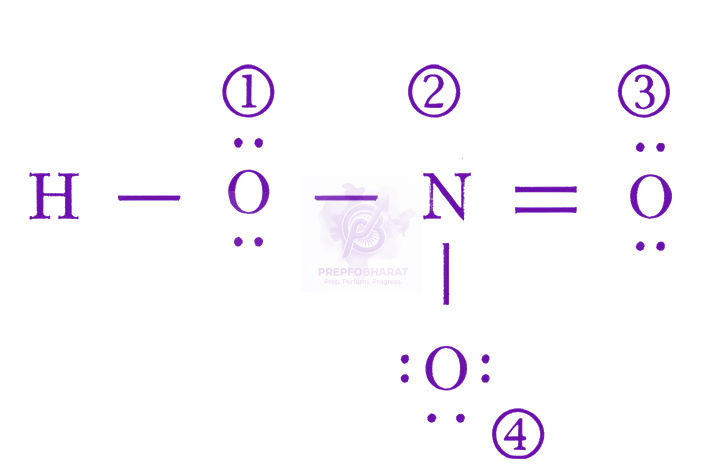
Given below are statements about some molecules/ions. Identify the CORRECT statements. A. The dipole moment value of $\mathrm{NF}_{3}$ is higher than that of $\mathrm{NH}_{3}$. B. The dipole moment value of $\mathrm{BeH}_{2}$ is zero. C. The bond order of $\mathrm{O}_{2}{ }^{2-}$ and $\mathrm{F}_{2}$ is same. D. The formal charge on the central oxygen atom of ozone is -1. E. In $\mathrm{NO}_{2}$, all the three atoms satisfy the octet rule, hence it is very stable. Choose the correct answer from the options given below:
Given below are two statements: Statement I: The covalency of oxygen is generally two but it can exceed upto four. The oxidation state of oxygen in $SO_2$ is $-2$ and in $OF_2$ it is $+2$. Statement II: The anomalous behaviour of oxygen when compared to the other elements of group $16$ is due to its small size and high electronegativity. In the light of the above statements, choose the correct answer from the options given below
Given below are two statements : Statement I: Aluminium upon reaction with NaOH forms $[Al(OH)_6]^{3-}$ ion. Statement II: The geometry of $ICl_4^-$, $ClO_3^-$ and $IBr_2^-$ is square planar, pyramidal and linear respectively. In the light of the above statements, choose the correct answer from the options given below :
Given below are two statements : Statement (I) : The correct sequence of bond lengths in the following species is : $O_2^+ < O_2 < O_2^- < O_2^{2-}$ Statement (II) : The correct sequence of number of unpaired electrons in the following species is : $O_2 > O_2^+ > O_2^- > O_2^{2-}$ In the light of the above statements, choose the correct answer from the options given below :
Match the LIST-I with LIST-II <table class="pyq-table"><tbody><tr><th>List-I Electronic configuration of tetrahedral metal ion</th><th>List-II Crystal Field Stabilization Energy ($\Delta_t$)</th></tr><tr><td>A. $d^2$</td><td>I. $-0.6$</td></tr><tr><td>B. $d^4$</td><td>II. $-0.8$</td></tr><tr><td>C. $d^6$</td><td>III. $-1.2$</td></tr><tr><td>D. $d^8$</td><td>IV. $-0.4$</td></tr></tbody></table> Choose the correct answer from the options given below:
A first row transition metal $(\mathrm{M})$ does not liberate $\mathrm{H}_{2}$ gas from dilute HCl.1 mol of aqueous solution of $\mathrm{MSO}_{4}$ is treated with excess of aqueous KCN and then $\mathrm{H}_{2} \mathrm{~S}(\mathrm{~g})$ is passed through the solution. The amount of MS (metal sulphide) formed from the above reaction is $\_\_\_\_$ mol.
Consider the following reactions $\mathrm{Na}_{2} \mathrm{~B}_{4} \mathrm{O}_{7} \xrightarrow{\Delta} 2 \mathrm{X}+\mathrm{Y}$ $\mathrm{CuSO}_{4}+\mathrm{Y} \xrightarrow{\text { Non-Luminous flame }} \mathrm{Z}+\mathrm{SO}_{3}$ $2 \mathrm{Z}+2 \mathrm{X}+$ Carbon $\xrightarrow{\text { Luminous flame }} 2 \mathrm{Q}+\mathrm{Na}_{2} \mathrm{~B}_{4} \mathrm{O}_{7}+\mathrm{CO}$ The oxidation states of Cu in Z and Q, respectively are :
Given below are two statements : Statement I: The number of pairs among $[Al_2O_3, Cr_2O_3]$, $[Cl_2O_7, Mn_2O_7]$, $[Na_2O, V_2O_3]$ and $[CO, N_2O]$ that contain oxides of same nature (acidic, basic, neutral or amphoteric) is $4$. Statement II: Among $Na_2O$, $Al_2O_3$, $CO$ and $Cl_2O_7$, the most basic and acidic oxides are $Na_2O$ and $Cl_2O_7$, respectively. In the light of the above statements, choose the correct answer from the options given below :
In a period, the first ionisation enthalpy of the element at extreme left and the negative electron gain enthalpy of the extreme right element, except noble gases, are respectively.
Among $\mathrm{H}_{2} \mathrm{~S}, \mathrm{H}_{2} \mathrm{O}, \mathrm{NF}_{3}, \mathrm{NH}_{3}$ and $\mathrm{CHCl}_{3}$, identify the molecule $(\mathrm{X})$ with lowest dipole moment value. The number of lone pairs of electrons present on the central atom of the molecule $(X)$ is :
A ' p '-block element $(\mathrm{E})$ and hydrogen form a binary cation $\left(\mathrm{EH}_{\mathrm{x}}\right)^{+}$, while $\mathrm{EH}_{3}$ on treatment with $\mathrm{K}_{2} \mathrm{HgI}_{4}$ in alkaline medium gives a precipitate of basic mercury(II)amido-iodine. Given below are first ionisation enthalpy values $\left(\mathrm{kJ} \mathrm{mol}^{-1}\right)$ for first element each from group 13, 14, 15 and 16. Identify the correct first ionisation enthalpy value for element E.
Among the following, the CORRECT combinations are A. $\mathrm{IF}_{3} \rightarrow \mathrm{~T}$-shaped (sp$\left.{ }^{3} \mathrm{~d}\right)$ B. $\mathrm{IF}_{5} \rightarrow$ Square pyramidal $\left(\mathrm{sp}^{3} \mathrm{~d}^{2}\right)$ C. $\mathrm{IF}_{7} \rightarrow$ Pentagonal bipyramidal $\left(\mathrm{sp}^{3} \mathrm{~d}^{3}\right)$ D. $\mathrm{ClO}_{4}{ }^{-} \rightarrow$ Square planar $\left(\mathrm{sp}^{2} \mathrm{~d}\right)$ Choose the correct answer from the options given below:
Given below are two statements : Statement I : The number of species among $\mathrm{SF}_{4}, \mathrm{NH}_{4}^{+},\left[\mathrm{NiCl}_{4}\right]^{2-}, \mathrm{XeF}_{4},\left[\mathrm{PtCl}_{4}\right]^{2-}, \mathrm{SeF}_{4}$ and $\left[\mathrm{Ni}(\mathrm{CN})_{4}\right]^{2-}$, that have tetrahedral geometry is 3. Statement II : In the set [$\mathrm{NO}_{2}, \mathrm{BeH}_{2}, \mathrm{BF}_{3}, \mathrm{AlCl}_{3}$], all the molecules have incomplete octet around central atom. In the light of the above statements, choose the correct answer from the options given below :
The correct set that contains all kinds (basic, acidic, amphoteric and neutral) of oxides is:
The wavelength of light absorbed for the following complexes are in the order \(\underset{\text{(I)}}{\left[\mathrm{Co}\left(\mathrm{NH}_3\right)_6\right]^{3+}} ;\underset{\text{(II)}}{\left[\mathrm{Co}\left(\mathrm{H}_2 \mathrm{O}\right)_6\right]^{3+}} ;\underset{\text{(III)}}{\left[\mathrm{Co}(\mathrm{CN})_6\right]^{3-}} ;\underset{\text{(IV)}}{\left[\mathrm{Co}\left(\mathrm{NH}_3\right)_5\left(\mathrm{H}_2 \mathrm{O}\right)\right]^{3+}} ;\underset{\text{(V)}}{\left[\mathrm{CoF}_6\right]^{3-}}\)
" X " is an oxoanion of the lightest element of group 7 (in the periodic table). The metal is in +6 oxidation state in " X ". The color of the potassium salt of X is
A paper dipped in a dil. $H_2SO_4$ solution of '$X$' upon treatment with $SO_2$ gas turns into green. The compound '$X$' is :
Consider the metal complexes $[Ni(en)_3]^{2+}$ (A), $[NiCl_4]^{2-}$ (B) and $[Ni(NH_3)_6]^{2+}$ (C). Choose the CORRECT option by considering the number of unpaired electrons present in (A), (B) and (C) respectively and the order of frequency of absorption.
Identify the metal ions among $\mathrm{Co}^{2+}, \mathrm{Ni}^{2+}, \mathrm{Fe}^{2+}, \mathrm{V}^{3+}$ and $\mathrm{Ti}^{2+}$ having a spin-only magnetic moment value more than 3.0 BM. The sum of unpaired electrons present in the high spin octahedral complexes formed by those metal ions is $\_\_\_\_$.
Given below are two statements: Statement I: The second ionization enthalpy of B, Al and Ga is in the order of $B > Al > Ga$. Statement II: The correct order in terms of first ionization enthalpy is $Si < Ge < Pb < Sn$. In the light of the above statements, choose the correct answer from the options given below:
Pair of species among the following having same bond order as well as paramagnetic character will be-
Which of the following is NOT a physical or chemical characteristics of interstitial compounds?
Bromine trifluoride autoionizes to form $\text{BrF}_2^{\oplus}$ and $\text{BrF}_4^{\ominus}$. The shapes of the cation and anion are respectively ________, and ________.
The correct order of first $(\Delta_i H_1)$ and second $(\Delta_i H_2)$ ionisation enthalpy values of Cr and Mn are : A. $\Delta_i H_1 :$ Cr $>$ Mn B. $\Delta_i H_2 :$ Cr $>$ Mn C. $\Delta_i H_1 :$ Mn $>$ Cr D. $\Delta_i H_2 :$ Mn $>$ Cr Choose the correct answer from the options given below :
The statements that are incorrect about the nickel(II) complex of dimethylglyoxime are : A. It is red in colour. B. It has a high solubility in water at $\mathrm{pH}=9$. C. The Ni ion has two unpaired d-electrons. D. The $\mathrm{N}-\mathrm{Ni}-\mathrm{N}$ bond angle is almost close to $90^{\circ}$. E. The complex contains four five-membered metallacycles (metal containing rings). Choose the correct answer from the options given below :
$SF_4$ is isostructural with: A. $BrF_4^{\ominus}$ B. $CH_4$ C. $IF_4^{\oplus}$ D. $XeF_4$ E. $XeO_2 F_2$ Choose the correct answer from the options given below:
Correct statements from the following are: A. Nitrogen in oxidation states from $+1$ to $+4$ disproportionates in acid medium. B. Nitrogen has the ability to form $d\pi - p\pi$ multiple bonds with itself and other elements with small size and high electronegativity. C. N-N single bond is stronger than P-P single bond. D. Nitrogen has highest density in its group due to small size. E. The maximum covalency of nitrogen is four since it has only four valence orbitals for bonding. Choose the correct answer from the options given below:
The correct statements about metal carbonyls are A. The metal-carbon bonds in metal carbonyls possess both $\sigma$ and $\pi$-character. B. Due to synergic bonding interactions between metal and CO ligand, the metal-carbon bond becomes weak. C. The metal-carbon $\sigma$ bond is formed by the donation of lone pair of electrons on the carbonyl carbon into a vacant orbital of metal. D. The metal-carbon $\pi$ bond is formed by the donation of electrons from filled d-orbital of metal into vacant $\pi^*$ orbital of CO. Choose the correct answer from the options given below:
The electronegativity of a group 13 element 'E' is same as that of Ge (on Pauling scale and upto one decimal point). The CORRECT statements about $E^{3+}$ are A. It can act as a reducing agent. B. It can act as an oxidizing agent. C. $E^{3+}$ is more stable than $E^+$. D. The standard electrode potential value for $E^{3+}/E$ is positive. Choose the correct answer from the options given below:
Among $Fe^{3+}$, $Pb^{2+}$, $Cu^{2+}$ and $Mn^{2+}$, identify the one that gets precipitated out while passing $H_2S$ in presence of $NH_4OH$ as group reagent. The highest possible oxidation state of the corresponding metal is
Given below are two statements : Statement I : The number of compounds among SO$_2$, SO$_3$, SF$_4$, SF$_6$ and H$_2$S in which sulphur does not obey the Octet rule is $3$. Statement II : Among [H$_2$O, ClF$_3$, SF$_4$], [NH$_3$, BrF$_5$, SF$_4$], [BrF$_5$, ClF$_3$, XeF$_4$] and [XeF$_4$, ClF$_3$, H$_2$O], the number of sets in which all the molecules have one lone pair of electrons on the central atom is $1$. In the light of the above statements, choose the correct answer from the options given below :
Given below are two statements : Statement I: $\quad\left[\mathrm{CoBr}_{4}\right]^{2-}$ ion will absorb light of lower energy than $\left[\mathrm{CoCl}_{4}\right]^{2-}$ ion. Statement II : In $\left[\mathrm{CoI}_{4}\right]^{2-}$ ion, the energy separation between the two set of d-orbitals is more than $\left[\mathrm{CoCl}_{4}\right]^{2-}$ ion. In the light of the above statements, choose the correct answer from the options given below :
Given below are two statements : Statement I: Presence of large number of unpaired electrons in transition metal atoms results in higher enthalpies of their atomisation. Statement II: $d_{xy} = d_{xz} = d_{yz} < d_{x^2-y^2} = d_{z^2}$ and $d_{x^2-y^2} = d_{z^2} < d_{xy} = d_{xz} = d_{yz}$ are the d-orbital splittings in $[Fe(H_2O)_6]^{3+}$ and $[Ni(Cl)_4]^{2-}$ complex ions respectively. In the light of the above statements, choose the correct answer from the options given below :
Identify the correct statements from the following A. $[Fe(C_2O_4)_3]^{3-}$ is the most stable complex among $[Fe(OH)_6]^{3-}$, $[Fe(C_2O_4)_3]^{3-}$ and $[Fe(SCN)_6]^{3-}$ B. The stability of $[Cu(NH_3)_4]^{2+}$ is greater than that of $[Cu(en)_2]^{2+}$ C. The hybridization of Fe in $K_4[Fe(CN)_6]$ is $d^2sp^3$ D. $[Fe(NO_2)_3Cl_3]^{3-}$ exhibits linkage isomerism E. $NO_2^-$ and $SCN^-$ ligands are NOT ambidentate ligands Choose the correct answer from the options given below :
Two p-block elements X and Y form fluorides of the type $\mathrm{EF}_{3}$. The fluoride compound $\mathrm{XF}_{3}$ is a Lewis acid and $\mathrm{YF}_{3}$ is a Lewis base. The hybridizations of the central atoms of $\mathrm{XF}_{3}$ and $\mathrm{YF}_{3}$ respectively are