JEE Main 2018 — Inorganic Chemistry
Chemistry Inorganic Chemistry questions from JEE Main 2018.
Other Years
41 Inorganic Chemistry Questions from 2018
Xenon hexafluoride on partial hydrolysis produces compounds ' $\mathrm{X}$ ' and ' $\mathrm{Y}$ '. Compounds ' $\mathrm{X}$ ' and ' $\mathrm{Y}$ ' and the oxidation state of $\mathrm{Xe}$ are respectively :
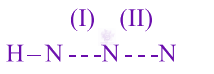 In hydrogen azide, the bond orders of bonds (I) and (II) are ______.
According to molecular orbital theory, which of the following molecule will not be available?
In the molecular orbital diagram for the molecular ion ${N}_{2}^{+}$ , the number of electrons in the ${\sigma }_{2p}$ molecular orbital is
When metal $M$is treated with $\mathrm{NaOH}$, a white gelatinous precipitate $X$is obtained, which is soluble in excess of $\mathrm{NaOH}$. Compound $X$when heated strongly gives an oxide which is used in chromatography as an adsorbent. The metal $M$is
Xenon hexafluoride on partial hydrolysis produces compounds 'X' and 'Y' and the respective oxidation states of Xe are:
The correct order of spin-only magnetic moments among the following is: (Atomic number: $\mathrm{Mn}=$ $25, \mathrm{Co}=27, \mathrm{Ni}=28, \mathrm{Zn}=30$ )
The incorrect geometry is represented by:
The correct combination is
In Wilkinson's catalyst, the hybridization of central metal ion and its shape are respectively:
In $\mathrm{XeO}_3 \mathrm{~F}_2$, the number of bond pair(s), $\pi$-bond(s) and lone pair(s) on Xe atom respectively are:
A white sodium salt dissolves readily in water to give a solution which is neutral to litmus. When silver nitrate solution is added to the before mentioned solution, a white precipitate is obtained which does not dissolve in dilute nitric acid. The anion is:
The compound that does not produce nitrogen gas by thermal decomposition is:
In a complexometric titration of metal ion with ligand $M (Metal ion)+L(Ligand)\rightarrow C (Complex)$ end point is estimated spectrophotometrically (through light absorption). If 'M' and 'C' do not absorb light and only 'L' absorbs then the titration plot between absorbed light $(A)$ versus volume of ligand 'L' $(V)$ would look like:
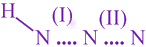 In the above compound, the bond orders of bonds $(I)$ and $(\mathrm{II})$ are:
In graphite and diamond, the percentage of $p$ characters of the hybrid orbitals in hybridization are respectively:
Identify the pair in which the geometry of the species is T-shaped and square-pyramidal, respectively,
The correct order of electron affinity is:
Identify the pair in which the geometry of the species is T-shape and square pyramidal, respectively
Which of the following conversions involves change in both shape and hybridisation?
The decreasing order of bond angles in $\mathrm{BF}_3, \mathrm{NH}_3, \mathrm{PF}_3$ and $\mathrm{I}_3^{-}$is :
The incorrect statement is:
Lithium aluminium hydride reacts with silicon tetrachloride to form:
In the molecular orbital diagram for the molecular ion, $\mathrm{N}_2^{+}$, the number of electrons in the $\sigma_{2 p}$ molecular orbital is :
Which of the following compounds contain(s) no covalent bond(s)? $\mathrm{KCl}, {\mathrm{PH}}_{3}, {O}_{2}, {B}_{2}{H}_{6}, {H}_{2}{\mathrm{SO}}_{4}$
Consider the following reaction and statements: ${[\mathrm{Co}{({\mathrm{NH}}_{3})}_{4}{\mathrm{Br}}_{2}]}^{+}+{\mathrm{Br}}^{-}\rightarrow [\mathrm{Co}{({\mathrm{NH}}_{3})}_{3}{\mathrm{Br}}_{3}]+{\mathrm{NH}}_{3}$ (i) Two isomers are produced if the reactant complex ion is a cis-isomer. (ii) Two isomers are produced if the reactant complex ion is a trans-isomer. (iii) Only one isomer is produced if the reactant complex ion is a trans-isomer. (iv) Only one isomer is produced if the reactant complex ion is a cis-isomer. The correct statements are
For $\mathrm{Na}^{+}, \mathrm{Mg}^{2+}, \mathrm{F}^{-}$and $\mathrm{O}^{2-}$; the correct order of increasing Ionic radii is :
Total number of lone pair of electrons in ${{I}_{3}}^{-}$ ion is:
The most polar compound among the following is:
When $X{O}_{2}$ is fused with an alkali metal hydroxide in presence of an oxidizing agent such as ${\mathrm{KNO}}_{3}$; a dark green product is formed which disproportionate in acidic solution to afford a dark purple solution. $X$ is:
The total number of possible isomers for squareplanar $\left[\mathrm{Pt}(\mathrm{Cl})\left(\mathrm{NO}_2\right)\left(\mathrm{NO}_3\right)(\mathrm{SCN})\right]^{2-}$ is:
Which of the following complexes will show geometrical isomerism?
For ${\mathrm{Na}}^{+}, {\mathrm{Mg}}^{2+}, {F}^{-}$ and ${O}^{2-}$, the correct order of increasing ionic radii is:
Among the oxides of nitrogen: ${N}_{2}{O}_{3}, {N}_{2}{O}_{4} and {N}_{2}{O}_{5};$ the molecule$(s)$ having nitrogen - nitrogen bond is/are:
The decreasing order of bond angles in${\mathrm{BF}}_{3}, {\mathrm{NH}}_{3},{\mathrm{PF}}_{3}$ and ${I}_{3}^{-}$ is:
A group 13 element ${ }^{'}{X}^{'}$ reacts with chlorine gas to produce a compound ${\mathrm{XCl}}_{3}. {\mathrm{XCl}}_{3}$ is electron deficient and easily reacts with ${\mathrm{NH}}_{3} \mathrm{to} \mathrm{form} {\mathrm{Cl}}_{3}X\leftarrow {\mathrm{NH}}_{3}$ adduct; however, ${\mathrm{XCl}}_{3}$ does not dimerize. X is:
The oxidation states of $\mathrm{Cr}$ in $[\mathrm{Cr}{({H}_{2}O)}_{6}]{\mathrm{Cl}}_{3}, [\mathrm{Cr}{({C}_{6}{H}_{6})}_{2}]$ and ${K}_{2}[\mathrm{Cr}{(\mathrm{CN})}_{2}{(O)}_{2}({O}_{2})({\mathrm{NH}}_{3})]$, respectively, are:
The correct combination is :
The number of $\mathrm{P}-\mathrm{O}$ bonds in $\mathrm{P}_4 \mathrm{O}_6$ is:
Which of the following best describes the diagram of molecular orbital? 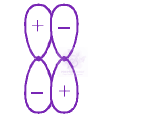
In graphite and diamond, the percentage of p-characters of the hybrid orbitals in hybridization respectively, are