JEE Main 2023 — Inorganic Chemistry
Chemistry Inorganic Chemistry questions from JEE Main 2023.
Other Years
174 Inorganic Chemistry Questions from 2023
Which of the following oxides is amphoteric?
The correct order of spin only magnetic moments for the following complex ions is
The magnetic moment is measured in Bohr Magneton (BM). Spin only magnetic moment of $\mathrm{Fe}$ in ${[\mathrm{Fe}{({H}_{2}O)}_{6}]}^{3+}$ and ${[\mathrm{Fe}{(\mathrm{CN})}_{6}]}^{3-}$ complexes respectively is:
The sum of oxidation state of the metals in $\mathrm{Fe}(\mathrm{CO}{)}_{5}$, ${\mathrm{VO}}^{2+}$ and ${\mathrm{WO}}_{3}$ is
An ammoniacal metal salt solution gives a brilliant red precipitate on addition of dimethylglyoxime. The metal ion is :
The incorrect statement from the following for borazine is:
Match the List-I with List-II : <table class="pyq-table"><tbody><tr><td>Cations</td><td>Group reaction</td></tr><tr><td>$P\rightarrow {\mathrm{Pb}}^{2+},{\mathrm{Cu}}^{2+}$</td><td>${H}_{2}S$ gas in presence of dilute $\mathrm{HCl}$</td></tr><tr><td>$Q\rightarrow {\mathrm{Al}}^{3+},{\mathrm{Fe}}^{3+}$</td><td>${({\mathrm{NH}}_{4})}_{2}{\mathrm{CO}}_{3}$ in presence of ${\mathrm{NH}}_{4}\mathrm{OH}$</td></tr><tr><td>$R\rightarrow {\mathrm{Co}}^{2+},{\mathrm{Ni}}^{2+}$</td><td>${\mathrm{NH}}_{4}\mathrm{OH}$ in presence of ${\mathrm{NH}}_{4}\mathrm{CI}$</td></tr><tr><td>$S\rightarrow {\mathrm{Ba}}^{2+},{\mathrm{Ca}}^{2+}$</td><td>${H}_{2}S$ in presence of ${\mathrm{NH}}_{4}\mathrm{OH}$</td></tr></tbody></table>
Given below are two statements: Statement I: Boron is extremely hard indicating its high lattice energy. Statement II: Boron has highest melting and boiling point compared to its other group members. In the light of the above statements, choose the most appropriate answer from the options given below
Which of the following has the highest first ionization energy?
The IUPAC name of ${K}_{3}[\mathrm{Co}({C}_{2}{O}_{4}{)}_{3}]$ is:
Inert gases have positive electron gain enthalpy. Its correct order is
The ratio of sigma and $\pi$ bonds present in pyrophosphoric acid is
Which of the following are the example of double salt? (A) ${\mathrm{FeSO}}_{4}\cdot {({\mathrm{NH}}_{4})}_{2}{\mathrm{SO}}_{4}\cdot 6{H}_{2}O$ (B) ${\mathrm{CuSO}}_{4}\cdot 4{\mathrm{NH}}_{3}\cdot {H}_{2}O$ (C) ${K}_{2}{\mathrm{SO}}_{4}\cdot {\mathrm{Al}}_{2}{({\mathrm{SO}}_{4})}_{3}\cdot 24{H}_{2}O$ (D) $\mathrm{Fe}(\mathrm{CN}{)}_{2}\cdot 4\mathrm{KCN}$ Choose the correct answer.
Which of the following cannot be explained by crystal field theory?
Given below are two statements: Statement I: The decrease in first ionization enthalpy from $B$ to $\mathrm{Al}$ is much larger than that from $\mathrm{Al}$ to $\mathrm{Ga}$. Statement II: The d orbitals in $\mathrm{Ga}$ are completely filled. In the light of the above statements, choose the most appropriate answer from the options given below
${\mathrm{Nd}}^{2+}=______$
The incorrect statement regarding the reaction given below is 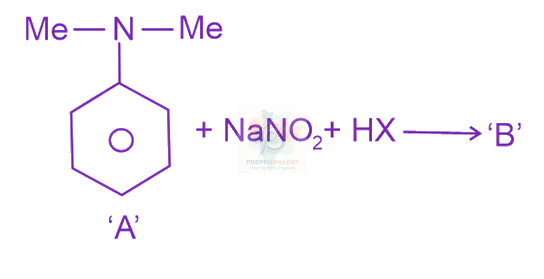
${\mathrm{ClF}}_{5}$ at room temperature is a
According to $\mathrm{MO}$ theory the bond orders for ${{O}_{2}}^{2-}$, $\mathrm{CO}$ and ${\mathrm{NO}}^{+}$ respectively, are
For ${\mathrm{OF}}_{2}$ molecule consider the following: (A) Number of lone pairs on oxygen is $2$. (B) $\mathrm{FOF}$ angle is less than $104.5^{\circ}$. (C) Oxidation state of $O$ is $-2$. (D) Molecule is bent '$V$' shaped. (E) Molecular geometry is linear. Correct options are:
The number of species from the following which have square pyramidal structure is $_______$ ${\mathrm{PF}}_{5},{\mathrm{BrF}}_{4}^{-},{\mathrm{IF}}_{5},{\mathrm{BrF}}_{5},{\mathrm{XeOF}}_{4},{\mathrm{ICl}}_{4}^{-}$
The number of $P-O-P$ bonds in ${H}_{4}{P}_{2}{O}_{7},{({\mathrm{HPO}}_{3})}_{3}$, and ${P}_{4}{O}_{10}$ are respectively
The compound which does not exist is
The correct order of metallic character is
The correct order of electronegativity for given elements is
The complex cation which has two isomers is:
The correct order of bond enthalpy ($\mathrm{kJ}{\mathrm{mol}}^{–1}$) is:
Structures of ${\mathrm{BeCl}}_{2}$ in solid state, vapour phase and at very high temperature respectively are:
Given below are two statements : one is labelled as Assertion (A) and the other is labelled as Reason (R). Assertion (A): In expensive scientific instruments, silica gel is kept in watch-glasses or in semipermeable membrane bags. Reason (R): Silica gel adsorbs moisture from air via adsorption, thus protects the instrument from water corrosion (rusting) and / or prevents malfunctioning. In the light of the above statements, choose the correct answer from the options given below:
Which of the following statements are correct? (A) The ${M}^{3+}/{M}^{2+}$ reduction potential for iron is greater than manganese. (B) The higher oxidation states of first row d-block elements get stabilized by oxide ion (C) Aqueous solution of ${\mathrm{Cr}}^{2+}$ can liberate hydrogen from dilute acid (D) Magnetic moment of ${V}^{2+}$ is observed between $4.4-5.2\mathrm{BM}$ Choose the correct answer from the options given below:
For electron gain enthalpies of the elements denoted as ${\Delta }_{\mathrm{eg}}H$, the incorrect option is :
Group-$13$ elements react with ${O}_{2}$ in amorphous form to form oxides of type ${M}_{2}{O}_{3}$ ($M=$ element). Which among the following is the most basic oxide?
Match List I with List II: <table class="pyq-table"><tbody><tr><td colspan="2" rowspan="1">List I (Complexes)</td><td colspan="2" rowspan="1">List II (Hybridisation)</td></tr><tr><td>(A)</td><td>$[\mathrm{Ni}(\mathrm{CO}{)}_{4}]$</td><td>I</td><td>${\mathrm{sp}}^{3}$</td></tr><tr><td>(B)</td><td>${[\mathrm{Cu}{({\mathrm{NH}}_{3})}_{4}]}^{2+}$</td><td>II</td><td>${\mathrm{dsp}}^{2}$</td></tr><tr><td>(C)</td><td>${[\mathrm{Fe}{({\mathrm{NH}}_{3})}_{6}]}^{2+}$</td><td>III</td><td>${\mathrm{sp}}^{3}{d}^{2}$</td></tr><tr><td>(D)</td><td>${[\mathrm{Fe}{({H}_{2}O)}_{6}]}^{2+}$</td><td>IV</td><td>${d}^{2}{\mathrm{sp}}^{3}$</td></tr></tbody></table>
The homoleptic and octahedral complex of ${\mathrm{Co}}^{2+}$ and ${H}_{2}O$ has ______ unpaired electron(s) in the ${t}_{2g}$ set of orbitals.
If ${\mathrm{Ni}}^{2+}$ is replaced by ${\mathrm{Pt}}^{2+}$ in the complex ${[{\mathrm{NiCl}}_{2}{\mathrm{Br}}_{2}]}^{2-}$, which of the following properties are expected to get changed? A. Geometry B. Geometrical isomerism C. Optical isomerism D. Magnetic properties
The maximum number of lone pairs of electron on the central atom from the following species is ...... ${\mathrm{ClO}}_{{3}^{-}},{\mathrm{XeF}}_{4},{\mathrm{SF}}_{4}$ and ${l}_{{3}^{-}}$
The number of species having a square planar shape from the following is ${\mathrm{XeF}}_{4},{\mathrm{SF}}_{4},{\mathrm{SiF}}_{4},{{\mathrm{BF}}_{4}}^{-},{{\mathrm{BrF}}_{4}}^{-},{[\mathrm{Cu}{({\mathrm{NH}}_{3})}_{4}]}^{2+},{[{\mathrm{FeCl}}_{4}]}^{2-},{[{\mathrm{PtCl}}_{4}]}^{2-}$
Given below are two statements, one is labelled as Assertion $A$ and the other is labelled as Reason $R.$ Assertion A: The spin only magnetic moment value for ${[\mathrm{Fe}(\mathrm{CN}{)}_{6}]}^{3-}$ is $1.74\mathrm{BM},$ whereas for [Fe(H2O)6]${[\mathrm{Fe}{({H}_{2}O)}_{6}]}^{3+}$ is $5.92\mathrm{BM}.$ Reason B: In both complexes, $\mathrm{Fe}$ is present in $+3$ oxidation state. In the light of the above statements, choose the correct answer from the options given below:
Total number of acidic oxides among ${N}_{2}{O}_{3},{\mathrm{NO}}_{2},{N}_{2}O,{\mathrm{Cl}}_{2}{O}_{7},{\mathrm{SO}}_{2},\mathrm{CO},\mathrm{CaO},{\mathrm{Na}}_{2}O$ and $\mathrm{NO}$ is _____ .
The correct order of basicity of oxides of vanadium is
Match List-I with List-II: <table class="pyq-table"><tbody><tr><td></td><td>List-I Species</td><td></td><td>List-II Geometry/Shape</td></tr><tr><td>A.</td><td>${H}_{3}{O}^{+}$</td><td>I.</td><td>Tetrahedral</td></tr><tr><td>B.</td><td>Acetylide anion</td><td>II.</td><td>Linear</td></tr><tr><td>C.</td><td>${\mathrm{NH}}_{4}^{+}$</td><td>III.</td><td>Pyramidal</td></tr><tr><td>D.</td><td>${\mathrm{ClO}}_{2}^{-}$</td><td>IV.</td><td>Bent</td></tr></tbody></table>Choose the correct answer from the options given below:
In potassium ferrocyanide, there are ______ pairs of electrons in the ${t}_{2g}$ set of orbitals.
Match List-I with . <table class="pyq-table"><tbody><tr><td colspan="2" rowspan="1">List-I Name of reaction</td><td colspan="2" rowspan="1">List-II Reagent used</td></tr><tr><td>$A$</td><td>Hell-Volhard Zelinsky reaction</td><td>$I$</td><td>$\mathrm{NaOH}+{I}_{2}$</td></tr><tr><td>$B$</td><td>Iodoform reaction</td><td>$\mathrm{II}$</td><td>$(i){\mathrm{CrO}}_{2}{\mathrm{Cl}}_{2},{\mathrm{CS}}_{2} (\mathrm{ii}){H}_{2}O$</td></tr><tr><td>$C$</td><td>Etard reaction</td><td>$\mathrm{III}$</td><td>$(i){\mathrm{Br}}_{2}/\mathrm{red}\mathrm{phosphorus} (\mathrm{ii}){H}_{2}O$</td></tr><tr><td>$D$</td><td>Gatterman-Koch reaction</td><td>$\mathrm{IV}$</td><td>$\mathrm{CO},\mathrm{HCl},\mathrm{anhyd}.{\mathrm{AlCl}}_{3}$</td></tr></tbody></table>Choose the correct answer from the options given below:
Given below are two statements: Statement I: ${\mathrm{SbCl}}_{5}$ is more covalent than ${\mathrm{SbCl}}_{3}$ Statement II: The higher oxides of halogens also tend to be more stable than the lower ones. In the light of the above statements, choose the most appropriate answer from the options given below.
Which of the following complex has a possibility to exist as meridional isomer?
Compound A reacts with ${\mathrm{NH}}_{4}\mathrm{Cl}$ and forms a compound B. Compound B reacts with ${H}_{2}O$ and excess of ${\mathrm{CO}}_{2}$ to form compound C which on passing through or reaction with saturated NaCl solution forms sodium hydrogen carbonate. Compound A. B and C, are respectively.
The complex that dissolves in water is
Given below are two statements: one is labelled as Assertion (A) and the other is labelled as Reason (R). Assertion (A): The first ionization enthalpy of $3d$ series elements is more than that of group $2$ metals Reason (R): In $3d$ series of elements successive filling of $d$-orbitals takes place. In the light of the above statements, choose the correct answer from the options given below:
The total number of lone pairs of electrons on oxygen atoms of ozone is
The correct group of halide ions which can be oxidised by oxygen in acidic medium is
“$A$” obtained by Ostwald's method involving air oxidation of ${\mathrm{NH}}_{3}$, upon further air oxidation produces “$B$”. “$B$” on hydration forms an oxoacid of Nitrogen along with evolution of “$A$”. The oxoacid also produces “$A$” and gives positive brown ring test
Which one of the following elements will remain as liquid inside pure boiling water?
Which of the following elements have half-filled f-orbitals in their ground state ? (Given : atomic number $\mathrm{Sm}-62;\mathrm{Eu}=63;\mathrm{Tb}=65;\mathrm{Gd}=64,\mathrm{Pm}=61$) Choose the correct answer from the options given below :
During the qualitative analysis of ${\mathrm{SO}}_{3}^{2-}$ using dilute ${H}_{2}{\mathrm{SO}}_{4},{\mathrm{SO}}_{2}$ gas is evolved which turns ${K}_{2}{\mathrm{Cr}}_{2}{O}_{7}$ solution (acidified with dilute ${H}_{2}{\mathrm{SO}}_{4}$):
When ${\mathrm{Cu}}^{2+}$ ion is treated with $\mathrm{KI}$, a white precipitate, $X$ appears in solution. The solution is titrated with sodium thiosulphate, the compound $Y$ is formed. $X$ and $Y$ respectively are
Given below are two statements : Statement-I : Methane and steam passed over a heated $\mathrm{Ni}$ catalyst produces hydrogen gas. Statement-II : Sodium nitrite reacts with ${\mathrm{NH}}_{4}\mathrm{Cl}$ to give ${H}_{2}O,{N}_{2}$ and $\mathrm{NaCl}$. In the light of the above statements, choose the most appropriate answer from the options given below :
The Lewis acid character of boron tri halides follows the order:
Match List-I with List-II<table class="pyq-table"><tbody><tr><td></td><td>LIST-I Coordination Complex</td><td></td><td>LIST-II Number of unpaired electrons</td></tr><tr><td>A.</td><td>${[\mathrm{Cr}(\mathrm{CN}{)}_{6}]}^{3-}$</td><td>I.</td><td>0</td></tr><tr><td>B.</td><td>${[\mathrm{Fe}{({H}_{2}O)}_{6}]}^{2+}$</td><td>II.</td><td>3</td></tr><tr><td>C.</td><td>${[\mathrm{Co}{({\mathrm{NH}}_{3})}_{6}]}^{3+}$</td><td>III.</td><td>2</td></tr><tr><td>D.</td><td>${[\mathrm{Ni}{({\mathrm{NH}}_{3})}_{6}]}^{2+}$</td><td>IV.</td><td>4</td></tr></tbody></table>Choose the correct answer from the options given below:
Which of the following statements are not correct? A. The electron gain enthalpy of $F$ is more negative than that of $\mathrm{Cl}.$ B. Ionization enthalpy decreases in a group of periodic table. C. The electronegativity of an atom depends upon the atoms bonded to it. D. ${\mathrm{Al}}_{2}{O}_{3}$ and $\mathrm{NO}$ are examples of amphoteric oxides. Choose the most appropriate answer from the options given below:
Prolonged heating is avoided during the preparation of ferrous ammonium sulphate to
In the wet tests for detection of various cations by precipitation, ${\mathrm{Ba}}^{2+}$ cations are detected by obtaining precipitate of
If the CFSE of ${[\mathrm{Ti}{({H}_{2}O)}_{6}]}^{3+}$ is $-96.0\mathrm{kJ}/\mathrm{mol}$, this complex will absorb maximum at wavelength $\mathrm{nm}$. (nearest integer) Assume Planck' constant $(h)=6.4\times {10}^{-34}\mathrm{Js}$, Speed of light $(c)=3.0\times {10}^{8}m/s$ and Avogadro's constant $({N}_{A})=6\times {10}^{23}/\mathrm{mol}$.
$1L,0.02M$ solution of $[\mathrm{Co}{({\mathrm{NH}}_{3})}_{5}{\mathrm{SO}}_{4}]\mathrm{Br}$ is mixed with $1L,0.02M$ solution of $[\mathrm{Co}{({\mathrm{NH}}_{3})}_{5}\mathrm{Br}]{\mathrm{SO}}_{4}$. The resulting solution is divided into two equal parts $(X)$ and treated with excess ${\mathrm{AgNO}}_{3}$ solution and ${\mathrm{BaCl}}_{2}$ solution respectively as shown below: $1L$ Solution $(X)+{\mathrm{AgNO}}_{3}$ solution (excess) $\rightarrow Y$ $1L$ Solution $(X)+{\mathrm{BaCl}}_{2}$ solution (excess) $\rightarrow Z$ The number of moles of $Y$ and $Z$ respectively are
Element not present in Nessler’s reagent is
Which halogen is known to cause the reaction given below?
The oxidation sate of phosphorus in hypophosphoric acid is
The bond dissociation energy is highest for
The number of paramagnetic species from the following is ${[\mathrm{Ni}(\mathrm{CN}{)}_{4}]}^{2-},[\mathrm{Ni}(\mathrm{CO}{)}_{4}],{[{\mathrm{NiCl}}_{4}]}^{2-}$ ${[\mathrm{Fe}(\mathrm{CN}{)}_{6}]}^{4-},{[\mathrm{Cu}{({\mathrm{NH}}_{3})}_{4}]}^{2+}$ ${[\mathrm{Fe}(\mathrm{CN}{)}_{6}]}^{3-}\text{ and }{[\mathrm{Fe}{({H}_{2}O)}_{6}]}^{2+}$
Which element is not present in Nessler’s reagent?
. Identify the correct order of standard enthalpy of formation of sodium halides.
Highest oxidation state of $\mathrm{Mn}$ is exhibited in ${\mathrm{Mn}}_{2}{O}_{7}$. The correct statements about ${\mathrm{Mn}}_{2}{O}_{7}$ are (A) $\mathrm{Mn}$ is tetrahedrally surrounded by oxygen atoms (B) $\mathrm{Mn}$ is octahedrally surrounded by oxygen atoms (C) Contains $\mathrm{Mn}-O-\mathrm{Mn}$ bridge (D) Contains $\mathrm{Mn}-\mathrm{Mn}$ bond. Choose the correct answer from the options given below
Cobalt chloride when dissolved in water forms pink colored complex $X$ which has octahedral geometry. This solution on treating with cone $\mathrm{HCl}$ forms deep blue complex, $Y$ which has a $Z$ geometry. $X,Y$ and $Z$, respectively, are
The difference between electron gain enthalpies will be maximum between :
Sum of $\pi$-bonds present in peroxodisulphuric acid and pyrosulphuric acid is
The set which does not have ambidentate ligand(s) is
The volume (in $\mathrm{mL}$) of $0.1M{\mathrm{AgNO}}_{3}$ required for complete precipitation of chloride ions present in $20\mathrm{mL}$ of $0.01M$ solution of $[\mathrm{Cr}{({H}_{2}O)}_{5}\mathrm{Cl}]{\mathrm{Cl}}_{2}$ as silver chloride is_______
Given below are two statements : one is labelled as Assertion (A) and the other is labelled as Reason (R). Assertion (A) : ${\mathrm{Cu}}^{2+}$ in water is more stable than ${\mathrm{Cu}}^{+}$. Reason (R) : Enthalpy of hydration for ${\mathrm{Cu}}^{2+}$ is much less than that of ${\mathrm{Cu}}^{+}$. In the light of the above statements, choose the correct answer from the options given below :
Given below are two statements, one is labelled as Assertion A and the other is labelled as Reason R Assertion A :- Carbon forms two important oxides $\mathrm{CO}$ and ${\mathrm{CO}}_{2}$. $\mathrm{CO}$ is neutral whereas ${\mathrm{CO}}_{2}$ is acidic in nature. Reason R : ${\mathrm{CO}}_{2}$ can combine with water in a limited way to form carbonic acid, while $\mathrm{CO}$ is sparingly soluble in water. In the light of the above statements, choose the most appropriate answer from the options given below :-
Bond dissociation energy of $E-H$ bond of the "${H}_{2}E$" hydrides of group $16$ elements (given below), follows order. (A) $O$ (B) $S$ (C) $\mathrm{Se}$ (D) $\mathrm{Te}$
Given below are two statements: one is labelled as Assertion A and the other is labelled as Reason R. Assertion A : The energy required to form ${\mathrm{Mg}}^{2+}$from $\mathrm{Mg}$ is much higher than that required to produce ${\mathrm{Mg}}^{+}$ Reason R:${\mathrm{Mg}}^{2+}$ is small ion and carry more charge than ${\mathrm{Mg}}^{+}$ In the light of the above statements, choose the correct answer from the options given below.
The bond order and magnetic property of acetylide ion are same as that of
For elements $B,C,N\mathrm{Li},\mathrm{Be},O\mathrm{and}F$, the correct order of first ionisation enthalpy is
Match List I with List II <table class="pyq-table"><tbody><tr><td></td><td>List I Complex</td><td></td><td>List II $CFSE$ $({\Delta }_{0})$</td></tr><tr><td>A.</td><td>${[Cu{(N{H}_{3})}_{6}]}^{2+}$</td><td>I.</td><td>$-0.6$</td></tr><tr><td>B.</td><td>${[Ti{({H}_{2}O)}_{6}]}^{3+}$</td><td>II.</td><td>$-2.0$</td></tr><tr><td>C.</td><td>${[Fe{(CN)}_{6}]}^{3-}$</td><td>III.</td><td>$-1.2$</td></tr><tr><td>D.</td><td>${[Ni{F}_{6}]}^{4-}$</td><td>IV.</td><td>$-0.4$</td></tr></tbody></table>Choose the correct answer from the options given below:
Match List I with List II<table class="pyq-table"><tbody><tr><td colspan="2" rowspan="1">LIST-I Complex</td><td colspan="2" rowspan="1">LIST-II Colour</td></tr><tr><td>A.</td><td>$\mathrm{Mg}({\mathrm{NH}}_{4}){\mathrm{PO}}_{4}$</td><td>I.</td><td>brown</td></tr><tr><td>B.</td><td>${K}_{3}[\mathrm{Co}{({\mathrm{NO}}_{2})}_{6}]$</td><td>II.</td><td>white</td></tr><tr><td>C.</td><td>$\mathrm{MnO}{(\mathrm{OH})}_{2}$</td><td>III.</td><td>yellow</td></tr><tr><td>D.</td><td>${\mathrm{Fe}}_{4}{[\mathrm{Fe}{(\mathrm{CN})}_{6}]}_{3}$</td><td>IV.</td><td>blue</td></tr></tbody></table>Choose the correct answer from the options given below:
The correct order of the number of unpaired electrons in the given complexes is (A) $[\mathrm{Fe}(\mathrm{CN}{)}_{6}{]}^{3-}$ (B) ${[{\mathrm{FeF}}_{6}]}^{3-}$ (C) ${[{\mathrm{CoF}}_{6}]}^{3-}$ (D) ${[\mathrm{Cr}(\mathrm{oxalate}{)}_{3}]}^{3-}$ (E) $[\mathrm{Ni}(\mathrm{CO}{)}_{4}]$ Choose the correct answer from the options given below:
Match List-I with List-II. 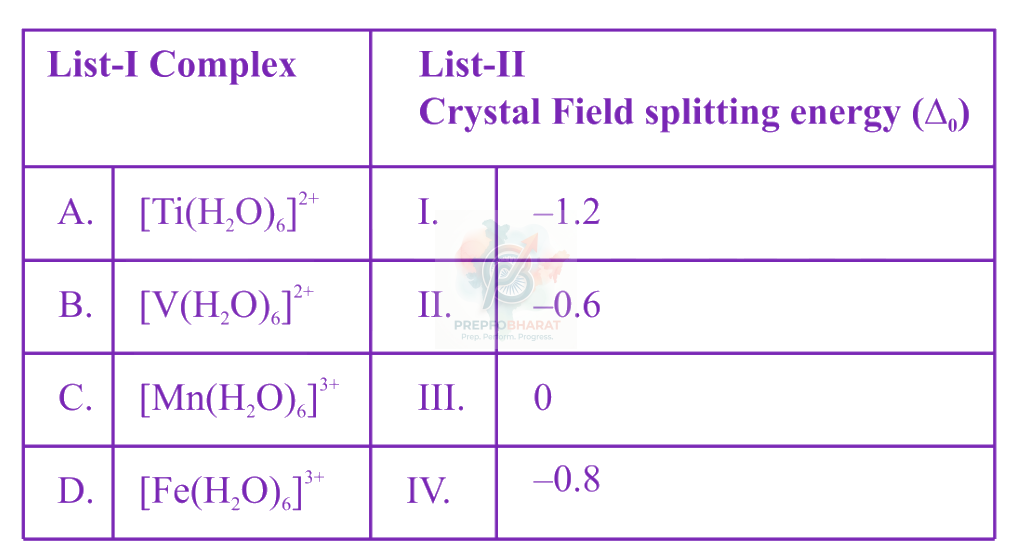 Choose the correct answer from the options given below:
Which of the following complex will show largest splitting of d-orbitals?
The d-electronic configuration of ${[{\mathrm{CoCl}}_{4}]}^{2-}$ in tetrahedral crystal field is ${e}^{m}{t}_{2}^{n}$. The sum of $m$ and number of unpaired electrons is
The primary and secondary valencies of cobalt respectively in $[\mathrm{Co}({\mathrm{NH}}_{3}{)}_{5}\mathrm{Cl}]{\mathrm{Cl}}_{2}$ are:
Identify $X,Y$ and $Z$ in the following reaction. (Equation not balanced) $\mathrm{Cl}\overset{\cdot }{O}+{\mathrm{NO}}_{2}\rightarrow \underset{¯}{X}\overset{{H}_{2}O}{\longrightarrow }\underset{¯}{Y}+\underset{¯}{Z}$
The denticity of the ligand present in the Fehling's reagent is _____ .
The observed magnetic moment of the complex $[\mathrm{Mn}(\mathrm{NCS}{)}_{6}){]}^{x-}$ is $6.06\mathrm{BM}$. The numerical value of $x$ is
Match List I with List II <table class="pyq-table"><tbody><tr><td colspan="2" rowspan="1">List I (molecules/ions)</td><td colspan="2" rowspan="1">List II (No. of lone pairs of ${e}^{-}$ on central atom)</td></tr><tr><td>(A)</td><td>${\mathrm{IF}}_{7}$</td><td>I.</td><td>Three</td></tr><tr><td>(B)</td><td>${\mathrm{ICl}}_{4}^{-}$</td><td>II.</td><td>One</td></tr><tr><td>(C)</td><td>${\mathrm{XeF}}_{6}$</td><td>III.</td><td>Two</td></tr><tr><td>(D)</td><td>${\mathrm{XeF}}_{2}$</td><td>IV.</td><td>Zero</td></tr></tbody></table>Choose the correct answer from the options given below:
The number of molecules or ions from the following, which do not have odd number of electrons are _____ . (A) ${\mathrm{NO}}_{2}$ (B) ${\mathrm{ICl}}_{4}^{-}$ (C) ${\mathrm{BrF}}_{3}$ (D) ${\mathrm{ClO}}_{2}$ (E) ${\mathrm{NO}}_{2}^{+}$ (F) $\mathrm{NO}$
The magnetic moment of a transition metal compound has been calculated to be $3.87\mathrm{BM}$. The metal ion is
Which of the Phosphorus oxoacid can create silver mirror from ${\mathrm{AgNO}}_{3}$ solution?
The pair of lanthanides in which both elements have high third-ionization energy is:
Number of ambidentate ligands in a representative metal complex $[M(\mathrm{en})(\mathrm{SCN}{)}_{4}]$ is $_________.$ [$\mathrm{en}=$ethylenediamine]
Given below are two statements : One is labelled as $\mathrm{Assertion}A$ and the other is labelled as $\mathrm{Reason}R$. $\mathrm{Assertion}A:$ Butan–$1$–ol has higher boiling point than ethoxyethane. $\mathrm{Reason}R:$ Extensive hydrogen bonding leads to stronger association of molecules. In the light of the above statements, choose the correct answer from the options given below :
Potassium dichromate acts as a strong oxidizing agent in acidic solution. During this process, the oxidation state changes from
Better method for preparation of ${\mathrm{BeF}}_{2}$, among the following is
Statement I:- Dipole moment is a vector quantity and by convention it is depicted by a small arrow with tail on the negative centre and head pointing towards the positive centre. Statement II:- The crossed arrow of the dipole moment symbolizes the direction of the shift of charges in the molecules. In the light of the above statements, choose the most appropriate answer from the options given below:-
What is the number of unpaired electron(s) in the highest occupied molecular orbital of the following species : ${N}_{2},N{}_{2}^{+},{O}_{2},{O}_{2}^{+}$ ?
Given below are two statements: one is labelled as “Assertion A” and the other is labelled as “Reason R” Assertion A : In the complex $\mathrm{Ni}(\mathrm{CO}{)}_{4}$ and $\mathrm{Fe}(\mathrm{CO}{)}_{5}$, the metals have zero oxidation state. Reason R : Low oxidation states are found when a complex has ligands capable of $\pi$-donor character in addition to the $\sigma$-bonding. In the light of the above statements, choose the most appropriate answer from the options given below
The complex with highest magnitude of crystal field splitting energy $({\Delta }_{0})$ is
For compound having the formula ${\mathrm{GaAlCl}}_{4}$, the correct option from the following is
A chloride salt solution acidified with dil. ${\mathrm{HNO}}_{3}$ gives a curdy white precipitate, $[A]$, on addition of ${\mathrm{AgNO}}_{3}$. [A] on treatment with ${\mathrm{NH}}_{4}\mathrm{OH}$ gives a clear solution, B.
In Chromyl chloride, the oxidation state of chromium is $(+)$ ___________.
How many of the following metal ions have similar value of spin only magnetic moment in gaseous state? ________ (Given: Atomic number$:V,23;\mathrm{Cr},24;\mathrm{Fe},26;\mathrm{Ni},28)$ ${V}^{3+},{\mathrm{Cr}}^{3+},{\mathrm{Fe}}^{2+},{\mathrm{Ni}}^{3+}$
If the formula of Borax is ${\mathrm{Na}}_{2}{B}_{4}{O}_{x}(\mathrm{OH}{)}_{y}\cdot {\mathrm{zH}}_{2}O$, then $x+y+z=______$
Given below are two statements : Statement I : ${\mathrm{SO}}_{2}$ and ${H}_{2}O$ both possess V-shaped structure Statement II : The bond angle of ${\mathrm{SO}}_{2}$ is less than that of ${H}_{2}O$. In the light of the above statements, choose the most appropriate answer from the options given below:
The ratio of spin-only magnetic moment values ${\mu }_{\mathrm{eff}}{[\mathrm{Cr}(\mathrm{CN}{)}_{6}]}^{3-}/{\mu }_{\mathrm{eff}}{[\mathrm{Cr}({H}_{2}O)6]}^{3+}$ is _______
The octahedral diamagnetic low spin complex among the following is
In ammonium$-$phosphomolybdate, the oxidation state of $\mathrm{Mo}$ is $+_______$
Which one amongst the following are good oxidising agents? (a) ${\mathrm{Sm}}^{2+}$ (b) ${\mathrm{Ce}}^{2+}$ (c) ${\mathrm{Ce}}^{4+}$ (d) ${\mathrm{Tb}}^{4+}$ Choose the most appropriate answer from the options given below :
A solution of ${\mathrm{CrO}}_{5}$ in amyl alcohol has a....colour
Which of the following complex is octahedral, diamagnetic and the most stable?
The sum of bridging carbonyls in $W{(\mathrm{CO})}_{6}$ and ${\mathrm{Mn}}_{2}{(\mathrm{CO})}_{10}$ is _____ .
In an ice crystal, each water molecule is hydrogen bonded to _____ neighbouring molecules.
Chiral complex from the following is : Here en = ethylene diamine
The number of species trom the following carrying a single lone pair on central atom Xenon is ${\mathrm{XeF}}_{5}^{+},{\mathrm{XeO}}_{3},{\mathrm{XeO}}_{2}{F}_{2},{\mathrm{XeF}}_{5}^{-},{\mathrm{XeO}}_{3}{F}_{2},{\mathrm{XeOF}}_{4},{\mathrm{XeF}}_{4}$
Which of the following is correct order of ligand field strength?
The difference in the oxidation state of $\mathrm{Xe}$ between the oxidised product of $\mathrm{Xe}$ formed on complete hydrolysis of ${\mathrm{XeF}}_{4}$and ${\mathrm{XeF}}_{4}$ is
Which one of the following pairs is an example of polar molecular solids?
The covalency and oxidation state respectively of boron in ${[{\mathrm{BF}}_{4}]}^{-}$, are
A solution of ${\mathrm{FeCl}}_{3}$ when treated with ${K}_{4}[\mathrm{Fe}(\mathrm{CN}{)}_{6}]$ gives a prussian blue precipitate due to the formation of
The spin only magnetic moment of ${[\mathrm{Mn}{({H}_{2}O)}_{6}]}^{2+}$ complexes is $B.M.$ (Nearest integer) (Given atomic number of $\mathrm{Mn}=25$)
Given below are two statements: Statement I: Chlorine can easily combine with oxygen to from oxides: and the product has a tendency to explode. Statement II: Chemical reactivity of an element can be determined by its reaction with oxygen and halogens. In the light of the above statements, choose the correct answer from the options given below
The number of molecules from the following which contain only two lone pair of electrons is _____________ ${H}_{2}O,{N}_{2},\mathrm{CO},{\mathrm{XeF}}_{4},{\mathrm{NH}}_{3},\mathrm{NO},{\mathrm{CO}}_{2},{F}_{2}$
Match List I with List II <table class="pyq-table"><tbody><tr><td colspan="2" rowspan="1">List I Oxide</td><td colspan="2" rowspan="1">List II Type of bond</td></tr><tr><td>$A$</td><td>${N}_{2}{O}_{4}$</td><td>$I$</td><td>$1N=O\mathrm{bond}$</td></tr><tr><td>$B$</td><td>${\mathrm{NO}}_{2}$</td><td>$\mathrm{II}$</td><td>$1N–O–N\mathrm{bond}$</td></tr><tr><td>$C$</td><td>${N}_{2}{O}_{5}$</td><td>$\mathrm{III}$</td><td>$1N–N\mathrm{bond}$</td></tr><tr><td>$D$</td><td>${N}_{2}O$</td><td>$\mathrm{IV}$</td><td>$1N=N/N\equiv N\mathrm{bond}$</td></tr></tbody></table>Choose the correct answer from the options given below :
Reaction of thionyl chloride with white phosphorus forms a compound $[A]$, which on hydrolysis gives $[B]$, a dibasic acid. $[A]$ and $[B]$ are respectively
Among the following compounds, the one which shows highest dipole moment is
Match List I with List II <table class="pyq-table"><tbody><tr><td></td><td>List I Coordination entity</td><td></td><td>List II Wavelength of light absorbed in nm</td></tr><tr><td>A</td><td>${[\mathrm{CoCl}{({\mathrm{NH}}_{3})}_{5}]}^{2+}$</td><td>I.</td><td>$310$</td></tr><tr><td>B</td><td>${[\mathrm{Co}{({\mathrm{NH}}_{3})}_{6}]}^{3+}$</td><td>II.</td><td>$475$</td></tr><tr><td>C</td><td>${[\mathrm{Co}(\mathrm{CN}{)}_{6}]}^{3-}$</td><td>III.</td><td>$535$</td></tr><tr><td>D</td><td>${[\mathrm{Cu}{({H}_{2}O)}_{4}]}^{2+}$</td><td>IV.</td><td>$600$</td></tr></tbody></table>Choose the correct answer from the options given below :-
In which of the following processes, the bond order increases and paramagnetic character changes to diamagnetic one?
${K}_{2}{\mathrm{Cr}}_{2}{O}_{7}$ paper acidified with dilute ${H}_{2}{\mathrm{SO}}_{4}$ turns green when exposed to
The pair from the following pairs having both compounds with net non-zero dipole moment is
Boric acid in solid, whereas ${\mathrm{BF}}_{3}$ is gas at room temperature because of
Consider the following statement (A) ${\mathrm{NF}}_{3}$ molecules has a trigonal planar structure. (B) Bond Length of ${N}_{2}$ is shorter than ${O}_{2}$. (C) Isoelectronic molecules or ions have identical bond order. (D) Dipole moment of ${H}_{2}S$ is higher than that of water molecule. Choose the correct answer from the options given below:
Order of Covalent bond; A. $\mathrm{KF}>\mathrm{KI};\mathrm{LiF}>\mathrm{KF}$ B. $\mathrm{KF}<\mathrm{KI};\mathrm{LiF}>\mathrm{KF}$ C. ${\mathrm{SnCl}}_{4}>{\mathrm{SnCl}}_{2};\mathrm{CuCl}>\mathrm{NaCl}$ D. $\mathrm{LiF}>\mathrm{KF};\mathrm{CuCl}>\mathrm{NaCl}$ E. $\mathrm{KF}<\mathrm{KI};\mathrm{CuCl}>\mathrm{NaCl}$
To inhibit the growth of tumours, identify the compounds used from the following: (A) EDTA (B) Coordination Compounds of $\mathrm{Pt}$ (C) D-Penicillamine (D) Cis - Platin Choose the correct answer from the option given below:
${\mathrm{XeF}}_{4}$ reacts with ${\mathrm{SbF}}_{5}$ to form ${[{\mathrm{XeF}}_{m}]}^{n+}{[{\mathrm{SbF}}_{y}]}^{2-}m+n+y+z=?$.
Match List - I with List - II <table class="pyq-table"><tbody><tr><td colspan="2" rowspan="1">LIST-I (Atomic number)</td><td colspan="2" rowspan="1">LIST-II (Block of periodic table)</td></tr><tr><td>(A)</td><td>$37$</td><td>I.</td><td>$p$-block</td></tr><tr><td>(B)</td><td>$78$</td><td>II.</td><td>$d$-block</td></tr><tr><td>(C)</td><td>$52$</td><td>III.</td><td>$f$-block</td></tr><tr><td>(D)</td><td>$65$</td><td>IV.</td><td>$s$-block</td></tr></tbody></table>Choose the correct answer from the options given below:
Given below are two statements: Statement I : Nickel is being used as the catalyst for producing syn gas and edible fats. Statement II : Silicon forms both electron rich and electron deficient hydrides. In the light of the above statements, choose the most appropriate answer from the options given below:
For a good quality cement, the ratio of silica to alumina is found to be
Given below are two statements : Statement I : Upon heating a borax bead dipped in cupric sulphate in a luminous flame, the colour of the bead becomes green. Statement II : The green colour observed is due to the formation of copper(I) metaborate In the light of the above statements, choose the most appropriate answer from the options given below:
The hybridization and magnetic behaviour of cobalt ion in $[\mathrm{Co}({\mathrm{NH}}_{3}{)}_{6}{]}^{3+}$ complex, respectively is
Given below are two statements, one is labelled as Assertion $A$ and the other is labelled as Reasom $R$. Assertion $A$: A solution of the product obtained by heating a mole of glycine with a mole of chlorine in presence of red phosphorous generates chiral carbon atom. Reason $R$: A molecule with $2$ chiral carbons is always optically active. In the light of above statements, chose the correct answer from the options given below:
Correct order of spin only magnetic moment of the following complex ions is: (Given At. No. $\mathrm{Fe}:26,\mathrm{Co}:27$)
Formulae for Nessler's reagent is:
The number of following factors which affect the percent covalent character of the ionic bond is______ A) Polarising power of cation B) Extent of distortion of anion C) Polarisability of the anion D) Polarising power of anion
During the borax bead test with ${\mathrm{CuSO}}_{4}$, a blue green colour of the bead was observed in oxidising flame due to the formation of
Amongst the following, the number of species having the linear shape is ${\mathrm{XeF}}_{2},{I}_{3}^{+},{C}_{3}{O}_{2},{I}_{3}^{-},{\mathrm{CO}}_{2},{\mathrm{SO}}_{2},{\mathrm{BeCl}}_{2}$ and ${\mathrm{BCl}}_{2}^{\ominus }$
When a solution of mixture having two inorganic salts was treated with freshly prepared ferrous sulphate in acidic medium, a dark brown ring was formed whereas on treatment with neutral ${\mathrm{FeCl}}_{3}$, it gave deep red colour which disappeared on boiling and a brown red ppt was formed. The mixture contains
Decreasing order of the hydrogen bonding in following forms of water is correctly represented by A. Liquid water B. Ice C. Impure water
One mole of ${P}_{4}$ reacts with $8$ moles of ${\mathrm{SOCl}}_{2}$ to give $4$ moles of $A$, $x$ mole of ${\mathrm{SO}}_{2}$ and $2$ moles of $B$. $A,B$ and $x$ respectively are
Formation of which complex, among the following, is not a confirmatory test of ${\mathrm{Pb}}^{2+}$ ions
The correct increasing order of the ionic radii is
The mismatched combinations are A. Chlorophyll$–\mathrm{Co}$ B. Water hardness$–\mathrm{EDTA}$ C. Photography$-{[\mathrm{Ag}(\mathrm{CN}{)}_{2}]}^{-}$ D. Wilkinson catalyst$-[{({\mathrm{Ph}}_{3}P)}_{3}\mathrm{RhCl}]$ E. Chelating ligand$–D-$Penicillamine Choose the correct answer from the options given below.
The sum of lone pairs present on the central atom of the interhalogen ${\mathrm{IF}}_{5}$ and ${\mathrm{IF}}_{7}$ is ______
In chromyl chloride, the number of d-electrons present on chromium is same as in (Given at no. of $\mathrm{Ti}:22,V:23,\mathrm{Cr}:24,\mathrm{Mn}:25,\mathrm{Fe}:26$)
The number of electrons involved in the reduction of permanganate to manganese dioxide in acidic medium is _____ .
The set of correct statements is: (i) Manganese exhibits $+7$ oxidation state in its oxide. (ii) Ruthenium and Osmium exhibit $+8$ oxidation in their oxides. (iii) $\mathrm{Sc}$ shows $+4$ oxidation state which is oxidizing in nature. (iv) $\mathrm{Cr}$ shows oxidising nature in $+6$ oxidation state.
The number of bent-shaped molecule/s from the following is ______ ${N}_{3}^{-},{\mathrm{NO}}_{2}^{-},{I}_{3}^{-},{O}_{3},{\mathrm{SO}}_{2}$
In the wet tests for identification of various cations by precipitation, which transition element cation doesn't belong to group IV in qualitative inorganic analysis?
Total number of moles of AgCl precipitated on addition of excess of ${\mathrm{AgNO}}_{3}$ to one mole each of the following complexes $[\mathrm{Co}{({\mathrm{NH}}_{3})}_{4}{\mathrm{Cl}}_{2}]\mathrm{Cl}$, $[\mathrm{Ni}{({H}_{2}O)}_{6}]{\mathrm{Cl}}_{2},[\mathrm{Pt}{({\mathrm{NH}}_{3})}_{2}{\mathrm{Cl}}_{2}]$ and $[\mathrm{Pd}{({\mathrm{NH}}_{3})}_{4}]{\mathrm{Cl}}_{2}$ is
Match List I with List II <table class="pyq-table"><tbody><tr><td>List I</td><td>List II</td></tr><tr><td>A. ${\mathrm{XeF}}_{4}$</td><td>I.See-saw</td></tr><tr><td>B. ${\mathrm{SF}}_{4}$</td><td>II. Square planar</td></tr><tr><td>C. ${\mathrm{NH}}_{4}^{+}$</td><td>III. Bent $T-$ shaped</td></tr><tr><td>D.${\mathrm{BrF}}_{3}$</td><td>IV. Tetrahedral</td></tr></tbody></table>Choose the correct answer from the options given below :
${\mathrm{KMnO}}_{4}$ oxidises ${I}^{-}$ in acidic and neutral/faintly alkaline solution, respectively to
Match Lis-I with List-II. <table class="pyq-table"><tbody><tr><td></td><td>List-1</td><td></td><td>List-II</td></tr><tr><td>A.</td><td>Weak intermolecular forces of attraction</td><td>I.</td><td>Hexamethylenediamine + adipic acid</td></tr><tr><td>B.</td><td>Hydrogen bonding</td><td>II.</td><td>${\mathrm{AlEt}}_{3}+{\mathrm{TiCl}}_{4}$</td></tr><tr><td>C.</td><td>Heavily branched polymer</td><td>III.</td><td>$2-\mathrm{chloro}-1,3-\mathrm{butadiene}$</td></tr><tr><td>D.</td><td>High density polymer</td><td>IV.</td><td>$\mathrm{Phenol}+\mathrm{formaldehyde}$</td></tr></tbody></table>Choose the correct answer from the options given below
Given below are two statements, one is labelled as assertion $A$ and the other is labelled as Reason $R$. assertion $A$ : ${[\mathrm{CoCl}{({\mathrm{NH}}_{3})}_{5}]}^{2+}$ absorbs at lower wavelength of light with respect to ${[\mathrm{Co}{({\mathrm{NH}}_{3})}_{5}({H}_{2}O)]}^{3+}$ Reason $R$: It is because the wavelenght of light absorbed depends on the oxidation state of the metal ion. In the light of the above statements,choose the correct answer from the options given below:
Which of the following complexes will exhibit maximum attraction to an applied magnetic field?
Given below are two statements: Statement I : Aqueous solution of ${K}_{2}{\mathrm{Cr}}_{2}{O}_{7}$ is preferred as a primary standard in volumetric analysis over ${\mathrm{Na}}_{2}{\mathrm{Cr}}_{2}{O}_{7}$ aqueous solution. Statement II : ${K}_{2}{\mathrm{Cr}}_{2}{O}_{7}$ has a higher solubility in water than ${\mathrm{Na}}_{2}{\mathrm{Cr}}_{2}{O}_{7}$. In the light of the above statements, choose the correct answer from the options given below:
Sum of oxidation states of bromine in bromic acid and perbromic acid is
The total number of stereoisomers for the complex $[\mathrm{Cr}(\mathrm{ox}{)}_{2}\mathrm{ClBr}{]}^{3–}$ (where ox = oxalate) is
The $\mathrm{Cl}-\mathrm{Co}-\mathrm{Cl}$ bond angle values in a fac- $[\mathrm{Co}{({\mathrm{NH}}_{3})}_{3}{\mathrm{Cl}}_{3}]$ complex is/are: