JEE Main 2020 — Inorganic Chemistry
Chemistry Inorganic Chemistry questions from JEE Main 2020.
Other Years
99 Inorganic Chemistry Questions from 2020
The atomic number of the element unnilennium is :
The number of unpaired electrons in Fe²⁺ ion is:
The oxidation states of iron atoms in compounds $(A)$, $(B)$ and $(C)$, respectively, are $x,y$ and $z$. Then sum of $x,y$ and $z$ is ........... $\underset{(A)}{{\mathrm{Na}}_{4}[\mathrm{Fe}{(\mathrm{CN})}_{5}(\mathrm{NOS})]} \underset{(B)}{{\mathrm{Na}}_{4}[{\mathrm{FeO}}_{4}]} \underset{(C)}{[{\mathrm{Fe}}_{2}{(\mathrm{CO})}_{9}]}$
The IUPAC name of the complex $[Pt{(N{H}_{3})}_{2}Cl(N{H}_{2}C{H}_{3})]Cl$ is
The ionic radii of ${O}^{2–},{F}^{–},{\mathrm{Na}}^{+}$ and ${\mathrm{Mg}}^{2+}$ are in the order:
Three elements $X,Y$ and $Z$ are in the ${3}^{\text{rd }}$period of the periodic table. The oxides of$X,Y$ and $Z$, respectively, are basic, amphoteric and acidic. The correct order of the atomic numbers of $X,Y$ and $Z$ is:
Complex A has a composition of ${H}_{12}{O}_{6}{\mathrm{Cl}}_{3}Cr$. If the complex on treatment with conc. ${H}_{2}{\mathrm{SO}}_{4}$ loses $13.5%$ of its original mass, the correct molecular formulas of $A$ is: [Given : atomic mass of $Cr=52$ amu and $CI=35$amu]
The increasing order of the atomic radii of the following elements is: $(a)C$ $(b)O$ $(c)F$ $(d)Cl$ $(e)Br$
The one that can exhibit highest paramagnetic behaviour among the following is : $\mathrm{gly}=$ glycinato; $\mathrm{bpy}=2,2$'$-$bipyridine
‘ $X$ ’ melts at low temperature and is a bad conductor of electricity in both liquid and solid state. $X$ is:
Among the statements $(a)-(d)$ , the incorrect ones are: $(a)$ Octahedral $Co(III)$ complexes with strong field ligands have very high magnetic moments $(b)$ When ${\Delta }_{0}<P$ , the d-electron configuration of $Co(III)$ in an octahedral complex is ${t}_{eg}^{4}{e}_{g}^{2}$ $(c)$ Wavelength of light absorbed by ${[Co{(en)}_{3}]}^{3+}$ is lower than that of ${[{CoF}_{6}]}^{3-}$ $(d)$ If the ${\Delta }_{0}$ for an octahedral complex of $Co(III)$ is $18,000c{m}^{-1}$, the ${\Delta }_{t}$ for its tetrahedral complex with the same ligand will be $16,000c{m}^{-1}$.
Arrange the following bonds according to their average bond energies in descending order: $C-Cl,C-Br,C-F,C-I$
Of the species, $\mathrm{NO},{\mathrm{NO}}^{+},{\mathrm{NO}}^{2+}$ and ${\mathrm{NO}}^{-},$ the one with minimum bond strength is :
The complex that can show optical activity is :
The electronic spectrum of ${[\mathrm{Ti}{({H}_{2}O)}_{6}]}^{3+}$ shows a single broad peak with a maximum at $20,300{\mathrm{cm}}^{-1}.$The crystal field stabilization energy (CFSE) of the complex ion, in ${\mathrm{kJmol}}^{-1},$ is : $(1{\mathrm{kJmol}}^{-1}=83.7{\mathrm{cm}}^{-1})$
The one that is not expected to show isomerism is:
The correct order of the spin-only magnetic moments of the following complexes is: $(I)$ $[Cr{({H}_{2}O)}_{6}]B{r}_{2}$ $(II)$ $N{a}_{4}[Fe{(CN)}_{6}]$ $(III)$ $N{a}_{3}[Fe{({C}_{2}{O}_{4})}_{3}]({\Delta }_{0}>P)$ $(IV)$ ${(E{t}_{4}N)}_{2}[CoC{l}_{4}]$
White phosphorus on reaction with concentrated $NaOH$ solution in an inert atmosphere of $C{O}_{2}$ gives phosphine and compound $(X).(X)$ on acidification with $HCl$ gives compound $(Y).$ The basicity of compound $(Y)$ is:
The dipole moments of $CC{l}_{4},CHC{l}_{3}$ and $C{H}_{4}$ are in the order
On heating, lead (ll) nitrate gives a brown gas (A). The gas (A) on cooling changes to a colourless solid/liquid (B). (B) on heating with NO changes to ablue solid (C). The oxidation number of nitrogen in solid (C) is:
Consider that ${d}^{6}$ metal ion $({M}^{2+})$ forms a complex with aqua ligands, and the spin only magnetic moment of the complex is $4.90 \mathrm{BM}$. The geometry and the crystal field stabilization energy of the complex is :
If ${\mathrm{AB}}_{4}$ molecule is a polar molecule, a possible geometry of ${\mathrm{AB}}_{4}$ is :
The intermolecular potential energy for the molecules$A$ ,$B$ , $C$ and $D$ given below suggests that: 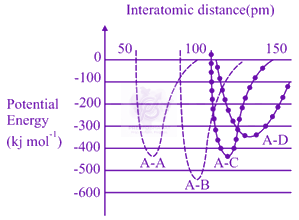
The electron gain enthalpy (in $\frac{\mathrm{kJ}}{mol}$ ) of fluorine, chlorine, bromine and iodine, respectively, are
Among the compounds $A$ and $B$ with molecular formula ${C}_{9}{H}_{18}{O}_{3},$ $A$ is having higher boiling point than $B.$ The possible structures of $A$ and $B$ are:
The INCORRECT statement is :
The molecular geometry of ${\mathrm{SF}}_{6}$ is octahedral. What is the geometry of ${\mathrm{SF}}_{4}$ (including lone pair(s) of electrons, if (any)?
Reaction of an inorganic sulphite $X$ with dilute ${H}_{2}{\mathrm{SO}}_{4}$ generated compound $Y$. Reaction of $Y$ with $\mathrm{NaOH}$ gives $X$. Further, the reaction of $X$ with $Y$ and water affords compound $Z,Y$ and $X$, respectively, are :
Consider the complex ions, trans- ${[\mathrm{Co}(\mathrm{en}{)}_{2}{\mathrm{Cl}}_{2}]}^{*}(A)$ and $\mathrm{cis}-{[\mathrm{Co}(\mathrm{en}{)}_{2}{\mathrm{Cl}}_{2}]}^{+}(B).$ The correct statement regarding them is :
Chlorine reacts with hot and concentrated $NaOH$ and produces compounds $(X)$ and $(Y)$. Compound $(X)$ gives white precipitate with silver nitrate solution. The average bond order between $\mathrm{Cl}$ and $O$ atoms in $(Y)$ is _______________.
The shape of XeF₄ molecule is:
In a molecule of pyrophosphoric acid, the number of $P-OH,P=0\mathrm{and}P-O-P$ bonds/moiety(ies) respectively are :
In the following reactions, products $(A)$ and $(B)$ , respectively, are: $NaOH+C{l}_{2}\rightarrow (A)+sideproducts$ $(hotandconc.)$ $Ca{(OH)}_{2}+C{l}_{2}\rightarrow (B)+sideproducts$ $(dry)$
The elements with atomic numbers $101$ and $104$ belong to, respectively:
The number of $\mathrm{Cl}=O$ bonds in perchloric acid is, $"\ldots \ldots \ldots ..."$
Reaction of ammonia with excess $C{l}_{2}$ gives :
Complexes $(M{L}_{5})$ of metals $Ni$ and $Fe$ have ideal square pyramidal and trigonal bipyramidal geometries, respectively. The sum of the ${90}^{o},{120}^{o}$ and ${180}^{o}$ $L-M-L$ angles in the two complexes is_______
The bond order and the magnetic characteristic of ${CN}^{-}$ are
The predominant intermolecular forces present in ethyl acetate, a liquid, are:
The molecule in which hybrid $\mathrm{MOs}$ involve only one d-robital of the central atom is :
The incorrect statement(s) among (a) - (c) is (are) : (a) $W(\mathrm{VI})$ is more stable than $\mathrm{Cr}(\mathrm{VI})$. (b) in the presence of $\mathrm{HCl}$, permanganate titrations provide satisfactory results. (c) some lanthanoid oxides can be used as phosphors
Match the type of interaction in column $A$ with the distance dependence of their interaction energy in column $B:$ <table class="pyq-table"><tbody><tr><td>A</td><td>B</td></tr><tr><td>(i) ion - ion</td><td>(a) $\frac{1}{r}$</td></tr><tr><td>(ii) Dipole - dipole</td><td>(b) $\frac{1}{{r}^{2}}$</td></tr><tr><td>(iii) London dispersion</td><td>(c) $\frac{1}{{r}^{3}}$</td></tr><tr><td></td><td>(iv) $\frac{1}{{r}^{6}}$</td></tr></tbody></table>
The volume (in $\mathrm{mL}$) of $0.1N\mathrm{NaOH}$ required to neutralise$10\mathrm{mL}\mathrm{of}0.1N$ phosphinic acid is ____________.
The total number of coordination sites in ethylenediaminetetraacetate ( ${\mathrm{EDTA}}^{4-}$) is ...................
The shape/structure of${[{\mathrm{XeF}}_{5}]}^{-}$ and ${\mathrm{XeO}}_{3}{F}_{2}$, respectively are :
The correct order of the ionic radii of ${O}^{2-},{N}^{3-},{F}^{-},{\mathrm{Mg}}^{2+},{\mathrm{Na}}^{+}$ and ${\mathrm{Al}}^{3+}$ is :
Mischmetal is an alloy consisting mainly of :
Aqua regia is used for dissolving noble metals (Au, Pt, etc.). The gas evolved in this process is
The acidic, basic and amphoteric oxides, respectively, are
Hydrogen has three isotopes $(A),(B)$ and $(C).$ If the number of neutron(s) in $(A),(B)$ and $(C)$ respectively, are $(x),(y)$ and $(z),$ the sum of $(x),(y)$ and $(z)$ is
The structure of ${\mathrm{PCl}}_{5}$ in the solid state is :
Considering that ${\Delta }_{0}>P$, the magnetic moment (in BM) of ${[\mathrm{Ru}{({H}_{2}O)}_{6}]}^{2+}$ would be
Complex $X$ Of composition $Cr{({H}_{2}O)}_{6}C{l}_{n}$ Has a spin only magnetic moment of $3.83B.M.$ It reacts with ${AgNO}_{3}$ And shows geometrical isomerism. The IUPAC nomenclature of $X$ Is:
The process that is NOT endothermic in nature is :
The increasing order of boiling points of the following compounds is : 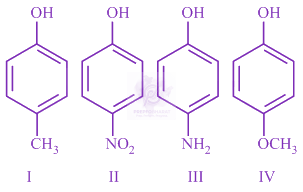
The lanthanoid that does NOT show + 4 oxidation state is:
The set that contains atomic numbers of only transition elements, is :
The electronic configurations of bivalent europium and trivalent cerium are: (atomic number: $Xe=54$ , $Ce=58$ , $Eu=63)$
The major product $[B]$ in the following sequence of reactions is: 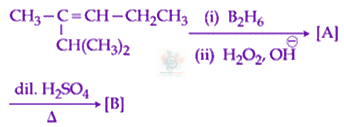
For octahedral $\mathrm{Mn}(\mathrm{II})$ and tetrahedral $\mathrm{Ni}(\mathrm{II})$ complexes, consider the following statements : $(I)$ both the complexes can be high spin. $(\mathrm{II})$ $\mathrm{Ni}(\mathrm{II})$ complex can very rarely be of low spin. $(\mathrm{III})$ with strong field ligands, $\mathrm{Mn}(\mathrm{II})$ complexes can be low spin. $(\mathrm{IV})$ aqueous solution of $\mathrm{Mn}(\mathrm{II})\mathrm{ions}$ is yellow in color. The correct statements are :
Consider the following molecules and statements related to them: 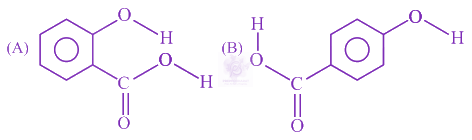 (a) (B) is more likely to be crystaline than (A) (b) (B) has higher boiling point than (A) (c) (B) dissolves more readily than (A) in water Identify the correct option from below:
The presence of soluble fluoride ion upto 1 ppm concentration in drinking water, is :
The number of isomers possible for $[\mathrm{Pt}(\mathrm{en}){({\mathrm{NO}}_{2})}_{2}]$ is:
The reaction of $\mathrm{NO}$ with ${N}_{2}{O}_{4}$ at $250K$ gives :
The incorrect statement is:
${[Pd(F)(Cl)(Br)(I)]}^{2-}$ has $n$ number of geometrical isomers. Then, the spin-only magnetic moment and crystal field stabilization energy $[CFSE]$ of ${[Fe{(CN)}_{6}]}^{n-6}$ , respectively, are: [Note: Ignore the pairing energy]
The relative strength of the interionic/ intermolecular forces in a decreasing order is:
The species that has a spin-only magnetic moment of $5.9\mathrm{BM},$ is : (${T}_{d}=$tetrahedral)
The theory that can completely/properly explain the nature of bonding in $[\mathrm{Ni}{(\mathrm{CO})}_{4}]$ is:
The correct statement with respect to dinitrogen is:
The number of bonds between sulphur and oxygen atoms in ${S}_{2}{O}_{8}^{2-}$ and the number of bonds between sulphur and sulphur atoms in rhombic sulphur, respectively are:
The pair in which both the species have the same magnetic moment (spin only) is:
On heating compound $(A)$ gives a gas $(B)$ which is constituent of air. This gas when treated with ${H}_{2}$ in the presence of a catalyst gives another gas $(C)$ which is basic in nature. $(A)$ should not be :
A metal $(A)$ on heating in nitrogen gas gives compound $B.$ $B$ on treatment with ${H}_{2}O$ gives a colourless gas which when passed through $CuS{O}_{4}$ solution gives a dark blue-violet coloured solution. $A$ and $B$ respectively, are:
In general, the property (magnitudes only) that shows an opposite trend in comparison to other properties across a period is :
The complex that can show $fac$ - and $mer$ -isomers is:
Simplified absorption spectra of three complexes ((i) and (ii) and (iii)) of ${M}^{+n}$ ion are provided below; their ${\lambda }_{\mathrm{max}}$ values are marked as $A,B$ and $C$ respectively. The correct match between the complexes and their ${\lambda }_{\mathrm{max}}$ values is: 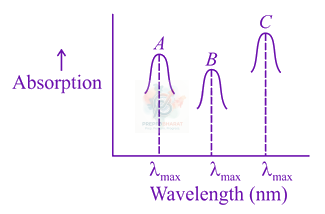 (i) ${[M(\mathrm{NCS}{)}_{6}]}^{(-6+n)}$ (ii) ${[{\mathrm{MF}}_{6}]}^{(-6+n)}$ (iii) ${[M{({\mathrm{NH}}_{3})}_{6}]}^{n+}$
The isomer(s) of $[Co{(N{H}_{3})}_{4}C{l}_{2}]$ that has/ have a $Cl-Co-Cl$ angle of ${90}^{o},$ is/are:
The five successive ionization enthalpies of an element are $800,2427,3658,3502432824\mathrm{kJ}{\mathrm{mol}}^{–1}$ . The number of valence electrons in the element is:
The reaction in which the hybridisation of the underlined atom is affected is
The sum of the total number of bonds between chromium and oxygen atoms in chromate and dichromate ions is ______________.
Within each pair of elements $F$ and $Cl$ , $S$ and $Se$ , and $\text{Li}$and $\mathrm{Na}$ , respectively, the elements that release more energy upon an electron gain are
The atomic radius of $Ag$ is closest to
The atomic number of Unnilumium is ______.
For a ${d}^{4}$ metal ion in an octahedral field, the correct electronic configuration is :
The Crystal Field Stabilization Energy $(\mathrm{CFSE})$ of $[\mathrm{CoF}({H}_{2}O)33]({\Delta }_{0}<P)$ is :
$B$ has a smaller first ionization enthalpy than $Be$. Consider the following statement: (I) it is easier to remove $2p$ electron than$2s$ electron (II) $2p$ electron of $B$ is more shielded from the nucleus by the inner core of electrons than the $2s$ electrons of $Be$ (III) $2s$ electron has more penetration power than $2p$ electron (IV) atomic radius of $B$ is more than $Be$ (atomic number $B:5,Be=4$ ) The correct statements are.
The reaction of ${H}_{3}{N}_{3}{B}_{3}C{l}_{3}(A)$ with $LiB{H}_{4}$ in tetrahydrofuran gives inorganic benzene $(B)$ . Further, the reaction of $(A)$ with $(C)$ leads to ${H}_{3}{N}_{3}{B}_{3}{(Me)}_{3}$ . Compounds $(B)$ and $(C)$ respectively, are:
The correct electronic configuration and spin-only magnetic moment (BM) of ${\mathrm{Gd}}^{3+}(Z=64),$ respectively, are :
The first ionization energy (in $kJ/mol$ ) of $Na,Mg,Al$ and $Si$ respectively are:
The number of possible optical isomers for the complexes ${MA}_{2}{B}_{2}$ with $s{p}^{3}$ and $ds{p}^{2}$ hybridized metal atom, respectively, is: Note: $A$ and $B$ are unidentate neutral and unidentate monoanionic ligands, respectively.
The d-electron configuration of $[\mathrm{Ru}(\mathrm{en}{)}_{3}]{\mathrm{Cl}}_{2}$, and $[\mathrm{Fe}{({H}_{2}O)}_{6}]{\mathrm{Cl}}_{2}$ respectively are:
The third ionization enthalpy is minimum for:
The potential energy curve for the ${H}_{2}$ molecule as a function of internuclear distance is:
If the magnetic moment of a di-oxygen species is $1.73 B.M.$, it may be
The compound that has the largest $H–M–H$ bond angle $(M=N,O,S,C)$, is :
The first and second ionisation enthalpies of a metal are $496$ and $4560kJmo{l}^{-1}$, respectively. How many moles of $HCl$ and ${H}_{2}S{O}_{4},$ respectively, will be needed to react completely with $1$ mole of the metal hydroxide?
If the boiling point of ${H}_{2}O$ is $373K$, and the boiling point of ${H}_{2}S$ will be :
The values of the crystal field stabilization energies for a high spin ${d}^{6}$ metal ion in octahedral and tetrahedral fields, respectively, are: