JEE Main 2019 — Inorganic Chemistry
Chemistry Inorganic Chemistry questions from JEE Main 2019.
Other Years
93 Inorganic Chemistry Questions from 2019
The one that will show optical activity is ($\mathrm{en}=$ethane$-1,2-$diamine)
The complex that has highest crystal field splitting energy $(\Delta )$ , is:
The pair that contains two $P-H$ bonds in each of the oxoacids is:
${C}_{60},$ an allotrope of carbon contains
Among the following, the molecule expected to be stabilized by anion formation is: ${C}_{2}, {O}_{2}, NO, {F}_{2}$
During the change of ${O}_{2}$ to ${O}_{2}^{-}$ , the incoming electron goes to the orbital:
The hydride that is NOT electron deficient is:
The chloride that CANNOT get hydrolysed is:
The calculated spin-only magnetic moments $(BM)$ of the anionic and cationic species of ${ [ \text{Fe}{ ( {\text{H}}_{2} \text{O})}_{6} ]}^{ +2}$ and ${[\text{Fe }{(\text{CN})}_{6}]}^{4-}$ respectively, are:
In which of the following processes, the bond order has increased and paramagnetic character has changed to diamagnetic?
The relative stability of +1 oxidation state of group 13 elements follows the order
Among the following molecules/ ions, ${C}_{2}^{2-}, {N}_{2}^{2-},{O}_{2}^{2-}, {O}_{2}$ Which one is diamagnetic and has the shortest bond length?
The species that can have a trans-isomer is: $(en = ethane-1, 2-diamine, ox=oxalate)$
The correct order of the oxidation states of nitrogen in $NO, {N}_{2}O, N{O}_{2}$ and ${N}_{2}{O}_{3}$ is
The statement that is INCORRECT about the interstitial compounds is:
Chlorine on reaction with hot and concentrated sodium hydroxide gives.
The number of pentagons in ${C}_{60}$ and trigons (triangles) in white phosphorus, are;
The transition elements that has the lowest enthalpy of atomisation is:
The correct statement among the following is:
$\quad \mathrm{A} \stackrel{4 \mathrm{KOH}, \mathrm{O}_{2}}{\longrightarrow} \underset{(\mathrm{Green})}{2 \mathrm{~B}}+2 \mathrm{H}_{2} \mathrm{O}$ $\mathrm{B} \stackrel{4 \mathrm{HCl}}{\longrightarrow} \underset{(\text { Purple })}{2 \mathrm{C}}+\mathrm{MnO}_{2}+2 \mathrm{H}_{2} \mathrm{O}$ $2 \mathrm{C} \stackrel{\mathrm{H}_{2} \mathrm{O}, \mathrm{KI}}{\longrightarrow} 2 \mathrm{~A}+\mathrm{KOH}+\mathrm{D}$ In the above sequence of reactions, A and D, respectively, are:
Homoleptic octahedral complexes of a metal ion $'{M}^{3+}'$ with three monodentate ligands ${L}_{1},{L}_{2}and {L}_{3}$ absorb wavelengths in the region of green, blue and red respectively. The increasing order of the ligand strength is:
The coordination number of Th in $\mathrm{K}_{4}\left[\mathrm{Th}\left(\mathrm{C}_{2} \mathrm{O}_{4}\right)_{4}\left(\mathrm{H}_{2} \mathrm{O}\right)_{2}\right]$ is: $\left(\mathrm{C}_{2} \mathrm{O}_{4}^{2-}=\right.$ oxalato $)$
The correct order of catenation is:
The effect of lanthanoid contraction in the lanthanoid series of elements by and large means
The highest possible oxidation states of uranium and plutonium, respectively, are
$M{n}_{2}{(CO)}_{10}$ is an organometallic compound due to the presence of:
The metal's $d-$ orbitals that are directly facing the ligands in ${K}_{3}[Co{(CN)}_{6}]$ are:
The element that shows greater ability to form $p\pi -p\pi$ multiple bonds is:
Iodine reacts with concentrated $HN{O}_{3}$ to yield $Y$ along with other products. The oxidation state of iodine in $Y$ , is:
Sodium metal on dissolution in liquid ammonia gives a deep blue solution due to the formation of:
The difference in the number of unpaired electrons of a metal ion in its high-spin and low-spin octahedral complexes is two. The metal ion is:
Thermal decomposition of a Mn compound $(X)$ at $513 K$ results in compound $Y,$ $Mn{O}_{2}$ and a gaseous product. $Mn{O}_{2}$ reacts with $NaCl$ and concentrated ${H}_{2}S{O}_{4}$ to give a pungent gas$Z$ . $X, Y$ and $Z,$ respectively, are:
The pair that has similar atomic radii is:
The correct option with respect to the Pauling electronegativity values of the elements is:
The correct statement about $I{\mathrm{Cl}}_{5}$ and $I{\mathrm{Cl}}_{4}^{-}$ is:
The element having the greatest difference between its first and second ionization energies, is
The following ligand is: 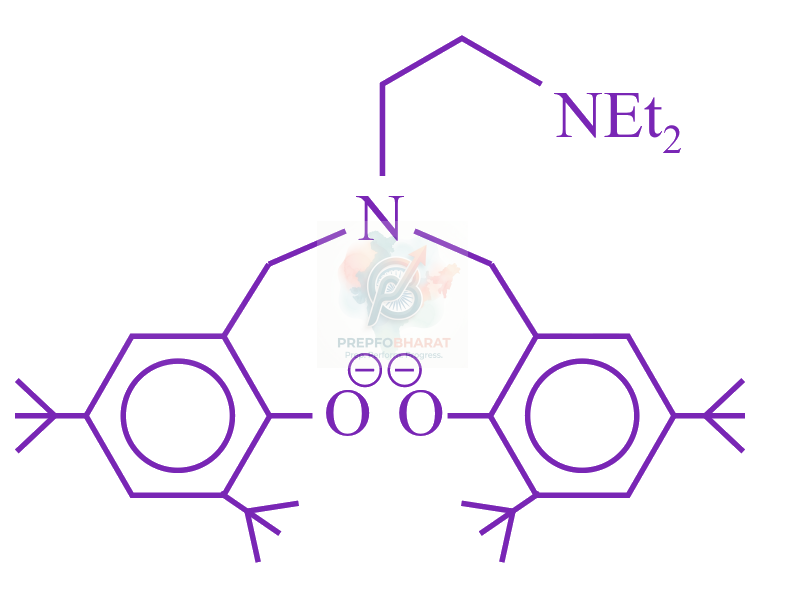
The type of hybridization and no. of lone pair(s) of electron of $Xe$ in $XeO{F}_{4}$ , respectively, are:
The metal that gives hydrogen gas upon treatment with both the acid as well as the base is
The number of water molecules not coordinated to copper ion directly in $CuS{O}_{4}\cdot 5{H}_{2}O,$ is
The incorrect statement is.
The correct statements among I to III are: (I) Valence bond theory cannot explain the color exhibited by transition metal complexes. (II) Valence bond theory can predict quantitatively the magnetic properties of transition metal complexes. (III) Valence bond theory cannot distinguish ligands as weak and strong field ones.
Two complexes $[\mathrm{Cr}{({H}_{2}O)}_{6 }]{\mathrm{Cl}}_{3} (A)$ and $[\mathrm{Cr}{({\mathrm{NH}}_{3})}_{6}]{\mathrm{Cl}}_{3}(B)$ are violet and yellow coloured, respectively, The incorrect statement regarding them is:
In general, the properties that decrease and increase down a group in the periodic table, respectively, are :
Two pi and half sigma bonds are present in:
The lanthanide ion that would show colour is:
The degenerate orbitals of ${[Cr{({H}_{2}O)}_{6}]}^{3+}$ are
The basic structural unit of feldspar, zeolites mica, and asbestos is:
The crystal field stabilization energy (CFSE) of $[Fe{({H}_{2}O)}_{6}]C{l}_{2}$ and ${K}_{2}[NiC{l}_{4}]$, respectively, are:
Match the catalysts (Column $I$) with products (Column $\mathrm{II}$)<table class="pyq-table"><tbody><tr><th></th><th>Column I</th><th></th><th>Column II</th></tr><tr><td></td><td>Catalyst</td><td></td><td>Product</td></tr><tr><td>A.</td><td>${V}_{2}{O}_{5}$</td><td>P.</td><td>Polyethylene</td></tr><tr><td>B.</td><td>$TiC{l}_{4}/Al{(Me)}_{3}$</td><td>Q.</td><td>Ethanal</td></tr><tr><td>C.</td><td>$PdC{l}_{2}$</td><td>R.</td><td>${H}_{2}S{O}_{4}$</td></tr><tr><td>D.</td><td>Iron Oxide</td><td>S.</td><td>$N{H}_{3}$</td></tr></tbody></table>
The size of the iso-electronic species $C{l}^{-}$ , Ar and $C{a}^{2+}$ is affected by:
Consider the hydrated ions of $T{i}^{2+}, {V}^{2+}, T{i}^{3+}$ and $S{c}^{3+}$ . The correct order of their spin-only magnetic moments is:
Among the following species, the diamagnetic molecule is:
The coordination numbers of $Co$ and $Al$ in $[Co(Cl){(en)}_{2}]Cl$ and ${K}_{3}[Al{({C}_{2}{O}_{4})}_{3}],$ respectively are: (en $=$ ethane-1, 2-diamine)
Aluminium is usually found in $+3$ oxidation state. In contrast, thallium exists in $+1$ and $+3$ oxidation states. This is due to:
The maximum number of possible oxidation states of actinoids are shown by:
The oxoacid of sulphur that does not contain bond between sulphur atom is:
The compound that inhibits the growth of tumors is:
The correct order of the first ionization enthalpies is:
The number of bridging CO ligand(s) and Co-Co bond(s) in $\mathrm{Co}_{2}(\mathrm{CO})_{8},$ respectively are:
The magnetic moment of an octahedral homoleptic $\mathrm{Mn}(\mathrm{II})$ complex is $5.9 B.M.$ . The suitable ligand for this complex is:
The IUPAC symbol for the element with atomic number $119$ would be:
The number of $2$-centre-$2$-electron and $3$-centre-$2$-electron bonds in ${B}_{2}{H}_{6}$, respectively, are:
The complex ion that will lose its crystal field stabilization energy upon oxidation of metal to $+3$ state is: 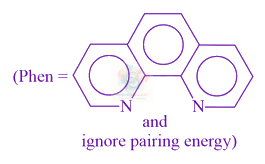
The $C-C$ bond length is maximum in:
According to molecular orbital theory, which of the following is true with respect to ${\mathrm{Li}}_{2}^{+}$ and ${\mathrm{Li}}_{2}^{-}$ ?
The major product of the following reaction is, 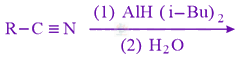
The total number of isomers for a square planar complex: $[\mathrm{MCl}(F)({\mathrm{NO}}_{2})(\mathrm{SCN})]$ is:
Among the following reactions of hydrogen with halogens, the one that requires a catalyst is:
The correct statements among I to III regrading group 13 element oxides are, (I) Boron trioxide is acidic. (II) Oxides of aluminum and gallium are amphoteric. (III) Oxides of indium and thallium are basic.
An organic compound ‘A’ is oxidized with $N{a}_{2}{O}_{2}$ followed by boiling with $HN{O}_{3}.$ The resultant solution is then treated with ammonium molybdate to yield a yellow percipitate. Based on a above observation, the element present in the given compound is:
Diborane $({B}_{2}{H}_{6})$ reacts independently with ${O}_{2}$ and ${H}_{2}O$ to produce, respectively:
The correct order of the atomic radii of $\mathrm{C}, \mathrm{Cs}, \mathrm{Al},$ and $\mathrm{S}$ is:
The element that does not show catenation is
The pair of metal ions that can give a spin only magnetic moment of $3.9 BM$ for the complex $[M{({H}_{2}O)}_{6}]C{l}_{2}$ , is:
Correct statements among regarding silicones are: $(a)$ They are polymers with hydrophobic character. $(b)$ They are biocompatible. $(c)$ In general, they have high thermal stability and low dielectric strength. $(d)$ Usually, they are resistant to oxidation and used as greases.
Three complexes, ${[CoCl{(N{H}_{3})}_{5}]}^{2+}(I), {[Co{(N{H}_{3})}_{5}{H}_{2}O]}^{3+}(II)$ and ${[Co{(N{H}_{3})}_{6}]}^{3+}(III)$ absorb light in the visible region. The correct order of the wavelength of light absorbed by them is:
Complete removal of both the axial ligands (along the $z-axis$ ) from an octahedral complex leads to which of the following splitting patterns? (relative orbital energies not on scale).
The element that usually does NOT show variable oxidation states is:
A reaction of cobalt $(\mathrm{III})$ chloride and ethylenediamine in a $1:2$ mole ratio generates two isomeric products $A$ (violet-coloured) and $B$ (green-coloured). $A$ can show optical activity, but, $B$ is optically inactive. What type of isomers do $A$ and $B$ represent?
$HF$ has highest boiling point among hydrogen halides, because it has:
The maximum possible denticities of a ligand given below towards a common transition and inner-transition metal ion, respectively, are: 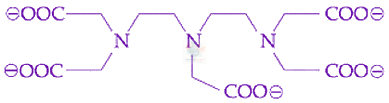
The group number, number of valence electrons, and valency of an element with atomic number $15,$ respectively, are:
Good reducing nature of ${H}_{3}P{O}_{2}$ is attributed to the presence of:
The correct order of the spin –only magnetic moment of metal ions in the following low-spin complexes, ${[V{(CN)}_{6}]}^{4-},{[Fe{(CN)}_{6}]}^{4-},{[Ru{(N{H}_{3})}_{6}]}^{3+}$ and ${[Cr{(N{H}_{3})}_{6}]}^{2+},$ is:
The ion that has ${sp}^{3}{d}^{2}$ hybridization for the central atom is:
In comparison to boron, berylium has:
When the first electron gain enthalpy $( \Delta {H}_{ eg} )$ of oxygen is $-141 kJ/mol$ , its second electron gain enthalpy is:
The compound used in the treatment of lead poisoning is:
The correct order of atomic radii is:
The element with $Z=120$ (not yet discovered) will be a/an
The amorphous form of silica is:
Wilkinson catalyst is