JEE Main 2022 — Inorganic Chemistry
Chemistry Inorganic Chemistry questions from JEE Main 2022.
Other Years
156 Inorganic Chemistry Questions from 2022
The hybridization of central atom in SF₆ is:
${\mathrm{PCl}}_{5}+{H}_{2}O\rightarrow A+\mathrm{HCl}$ $A+{H}_{2}O\rightarrow B+\mathrm{HCl}$ Find number of ionisable hydrogen in $B$
In neutral or faintly alkaline medium, ${\mathrm{KMnO}}_{4}$ being a powerful oxidant can oxidise, thiosulphate almost quantitatively, to sulphate. In this reaction overall change in oxidation state of manganese will be
Among the following species ${N}_{2},{N}_{2}^{+},{N}_{2}^{-},{N}_{2}^{2-},{O}_{2},{O}_{2}^{+},{O}_{2}^{-},{O}_{2}^{2-}$ the number of species showing diamagnetism is
Which one of the lanthanoids given below is the most stable in divalent form?
Amongst ${\mathrm{SF}}_{4},{\mathrm{XeF}}_{4},{\mathrm{CF}}_{4}$ and ${H}_{2}O$, the number of species with two lone pairs of electrons is
${[\mathrm{Fe}{(\mathrm{CN})}_{6}]}^{4-}$ ${[\mathrm{Fe}{(\mathrm{CN})}_{6}]}^{3-}$ ${[\mathrm{Ti}{(\mathrm{CN})}_{6}]}^{3-}$ ${[\mathrm{Ni}{(\mathrm{CN})}_{4}]}^{2-}$ ${[\mathrm{Co}{(\mathrm{CN})}_{6}]}^{3-}$ Among the given complexes, number of paramagnetic complexes is
Concentrated ${\mathrm{HNO}}_{3}$ reacts with Iodine to give
Consider the following metal complexes : ${[\mathrm{Co}({\mathrm{NH}}_{3})]}^{3+}$ ${[\mathrm{CoCl}{({\mathrm{NH}}_{3})}_{5}]}^{2+}$ ${[\mathrm{Co}(\mathrm{CN}{)}_{6}]}^{3-}$ ${[\mathrm{Co}{({\mathrm{NH}}_{3})}_{5}({H}_{2}O)]}^{3+}$ The spin-only magnetic moment value of the complex that absorbs light with shortest wavelength is B.M. (Nearest integer)
The correct decreasing order for metallic character is
The disproportionation of ${\mathrm{MnO}}_{4}^{2-}$ in acidic medium resulted in the formation of two manganese compounds $A$ and $B$. If the oxidation state of $\mathrm{Mn}$ in $B$ is smaller than that of $A$, then the spin-only magnetic moment $(\mu )$ value of $B$ in $\mathrm{BM}$ is____ . (Nearest integer)
The number of molecule(s) or ion(s) from the following having non-planar structure is______. ${\mathrm{NO}}_{3}^{-},{H}_{2}{O}_{2},{\mathrm{BF}}_{3},{\mathrm{PCl}}_{3},{\mathrm{XeF}}_{4}$, ${\mathrm{SF}}_{4},{\mathrm{XeO}}_{3},{\mathrm{PH}}_{4}^{+},{\mathrm{SO}}_{3},{[\mathrm{Al}{(\mathrm{OH})}_{4}]}^{-}$
Match List I with List II <table class="pyq-table"><tbody><tr><td></td><td>List-I</td><td></td><td>List-II</td></tr><tr><td>A</td><td>${\mathrm{XeO}}_{3}$</td><td>I</td><td>${\mathrm{sp}}^{3}d$; linear</td></tr><tr><td>B</td><td>${\mathrm{XeF}}_{2}$</td><td>II</td><td>${\mathrm{sp}}^{3}$; pyramidal</td></tr><tr><td>C</td><td>${\mathrm{XeOF}}_{4}$</td><td>III</td><td>${\mathrm{sp}}^{3}{d}^{3}$; distorted octahedral</td></tr><tr><td>D</td><td>${\mathrm{XeF}}_{6}$</td><td>IV</td><td>${\mathrm{sp}}^{3}{d}^{2}$; square pyramidal</td></tr></tbody></table>Choose the correct answer from the options given below
Polar stratospheric clouds facilitate the formation of
Identify the incorrect statement for ${\mathrm{PCl}}_{5}$ from the following.
(a) ${\mathrm{CoCl}}_{3}.4{\mathrm{NH}}_{3}$, (b) ${\mathrm{CoCl}}_{3}\cdot 5{\mathrm{NH}}_{3}$, (c) ${\mathrm{CoCl}}_{3}\cdot 6{\mathrm{NH}}_{3}$ and (d) $\mathrm{CoCl}{({\mathrm{NO}}_{3})}_{2}\cdot 5{\mathrm{NH}}_{3}$ Number of complex(es) which will exist in cis-trans form is/are
According to $\mathrm{MO}$ theory, number of species/ions from the following having identical bond order is____ ${\mathrm{CN}}^{-},{\mathrm{NO}}^{+},{O}_{2},{O}_{2}^{+},{O}_{2}^{2+}$
The oxidation state of manganese in the product obtained in a reaction of potassium permanganate and hydrogen peroxide in basic medium is
${\mathrm{Fe}}^{3+}$ cation gives a prussian blue precipitate on addition of potassium ferrocyanide solution due to the formation of
Match List - I with List - II. <table class="pyq-table"><tbody><tr><td></td><td>List-I ($\mathrm{Si}$-Compounds)</td><td></td><td>List-II ($\mathrm{Si}$-Polymeric/Other Products)</td></tr><tr><td>A</td><td>${({\mathrm{CH}}_{3})}_{4}\mathrm{Si}$</td><td>I</td><td>Chain Silicone</td></tr><tr><td>B</td><td>$({\mathrm{CH}}_{3})\mathrm{Si}{(\mathrm{OH})}_{3}$</td><td>II</td><td>Dimeric Silicone</td></tr><tr><td>C</td><td>${({\mathrm{CH}}_{3})}_{2}\mathrm{Si}{(\mathrm{OH})}_{2}$</td><td>III</td><td>Silane</td></tr><tr><td>D</td><td>${({\mathrm{CH}}_{3})}_{3}\mathrm{Si}(\mathrm{OH})$</td><td>IV</td><td>$2D$- Silicone</td></tr></tbody></table>Choose the correct answer from the options given below
The correct order of increasing intermolecular hydrogen bond strength is
The correct order of energy of absorption for the following metal complexes is $A:{[\mathrm{Ni}{(\mathrm{en})}_{3}]}^{2+},B:{[\mathrm{Ni}{({\mathrm{NH}}_{3})}_{6}]}^{2+},C:{[\mathrm{Ni}{({H}_{2}O)}_{6}]}^{2+}$
Arrange the following coordination compounds in the increasing order of magnetic moments. (Atomic numbers: $\mathrm{Mn}=25;\mathrm{Fe}=26$) A. ${[{\mathrm{FeF}}_{6}]}^{3-}$ B. ${[\mathrm{Fe}{(\mathrm{CN})}_{6}]}^{3-}$ C. ${[{\mathrm{MnCl}}_{6}]}^{3-}$ (high spin) D. ${[\mathrm{Mn}{(\mathrm{CN})}_{6}]}^{3-}$ Choose the correct answer from the options given below
In the cobalt-carbonyl complex : $[{\mathrm{Co}}_{2}{(\mathrm{CO})}_{8}]$, number of $\mathrm{Co}-\mathrm{Co}$ bonds is "$X$" and terminal $\mathrm{CO}$ ligands is " $Y$". $X+Y=$___
Transition metal complex with highest value of crystal field splitting $({\Delta }_{0})$ will be
Consider the following reaction : $2{\mathrm{HSO}}_{4}^{-}(\mathrm{aq})\frac{(1)\mathrm{Electrolysis}}{(2)\mathrm{Hydrolysis}}2{\mathrm{HSO}}_{4}^{-}+2{H}^{+}+A$ The dihedral angle in product $A$ in its solid phase at $110K$ is
The hybridization of $P$ exhibited in ${\mathrm{PF}}_{5}$ is ${\mathrm{sp}}^{x}{d}^{y}$. The value of $y$ is
The total number of $\mathrm{Mn}=O$ bonds in ${\mathrm{Mn}}_{2}{O}_{7}$ is
${[\mathrm{Fe}{(\mathrm{CN})}_{6}]}^{3-}$ should be an inner orbital complex. Ignoring the pairing energy, the value of crystal field stabilization energy for this complex is $(-)$_____${\Delta }_{0}$.
The spin-only magnetic moment value of the most basic oxide of vanadium among ${V}_{2}{O}_{3}$' ${V}_{2}{O}_{4}$ and ${V}_{2}{O}_{5}$ is____B.M. (Nearest integer)
White phosphorus reacts with thionyl chloride to give
Match List-I with List-II <table class="pyq-table"><tbody><tr><td></td><td>List-I</td><td></td><td>List-II</td></tr><tr><td>A</td><td>${\Psi }_{\mathrm{MO}}={\Psi }_{A}-{\Psi }_{B}$</td><td>I</td><td>Dipole moment</td></tr><tr><td>B</td><td>$\mu =Q\times r$</td><td>II</td><td>Bonding molecular orbital</td></tr><tr><td>C</td><td>$\frac{{N}_{b}-{N}_{a}}{2}$</td><td>III</td><td>Anti-bonding molecualr orbital</td></tr><tr><td>D</td><td>${\Psi }_{\mathrm{MO}}={\Psi }_{A}+{\Psi }_{B}$</td><td>IV</td><td>Bond order</td></tr></tbody></table>
In the structure of ${\mathrm{SF}}_{4}$, the lone pair of electrons on $S$ is in.
Given below are two statements : one is labelled as Assertion and the other is labelled as Reason. Assertion: The ionic radii of ${O}^{2-}$ and ${\mathrm{Mg}}^{2+}$ are same. Reason: Both ${O}^{2-}$ and ${\mathrm{Mg}}^{2+}$ are isoelectronic species. In the light of the above statements, choose the correct answer from the options given below.
Total number of relatively more stable isomer(s) possible for octahedral complex $[\mathrm{Cu}{(\mathrm{en})}_{2}{(\mathrm{SCN})}_{2}]$ will be____
Dinitrogen is a robust compound, but reacts at hig altitude to form oxides. The oxide of nitrogen the can damage plant leaves and retard photosynthes is
Metals generally melt at very high temperatures, Among the following which one has the highest melting point?
Match List-I with List-II. <table class="pyq-table"><tbody><tr><td></td><td>List-I</td><td></td><td>List-II</td></tr><tr><td>A</td><td>$4{\mathrm{NH}}_{3}(g)+5{O}_{2}(g)\rightarrow 4\mathrm{NO}(g)+6{H}_{2}O(g)$</td><td>I</td><td>$\mathrm{NO}(g)$</td></tr><tr><td>B</td><td>${N}_{2}(g)+3{H}_{2}(g)\rightarrow 2{\mathrm{NH}}_{3}(g)$</td><td>II</td><td>${H}_{2}{\mathrm{SO}}_{4}(l)$</td></tr><tr><td>C</td><td>${C}_{12}{H}_{22}{O}_{11}(\mathrm{aq})+{H}_{2}O(l)\rightarrow {C}_{6}{H}_{12}{O}_{6}(\mathrm{Glucose})+{C}_{6}{H}_{12}{O}_{6}(\mathrm{Fructose})$</td><td>III</td><td>$\mathrm{Pt}(s)$</td></tr><tr><td>D</td><td>$2{\mathrm{SO}}_{2}(g)+{O}_{2}(g)\rightarrow 2{\mathrm{SO}}_{3}(g)$</td><td>IV</td><td>$\mathrm{Fe}(s)$</td></tr></tbody></table>Choose the correct answer from the options given below
The number of inter halogens from the following having square pyramidal structure is ${\mathrm{ClF}}_{3},{\mathrm{IF}}_{7},{\mathrm{BrF}}_{5},{\mathrm{BrF}}_{3},{I}_{2}{\mathrm{Cl}}_{6},{\mathrm{IF}}_{5},\mathrm{ClF},{\mathrm{ClF}}_{5}$
The most stable trihalide of nitrogen is.
Dihydrogen reacts with $\mathrm{CuO}$ to give
Aqueous solution of which of the following boron compounds will be strongly basic in nature?
An acidified manganate solution undergoes disproportionation reaction. The spin-only magnetic moment value of the product having manganese in higher oxidation state is____B.M. (Nearest integer)
Borazine, also known as inorganic benzene, can be prepared by the reaction of $3$-equivalents of "$X$" with $6$-equivalents of "$Y$". "$X$" and "$Y$", respectively are
Element "$E$" belongs to the period $4$ and group $16$ of the periodic table. The valence shell electron configuration of the element, which is just above "$E$" in the group is
Given below are two statements: one is labelled as Assertion A and the other is labelled as Reason $R$. Assertion $A$ : Boric acid is a weak acid Reason $R$ : Boric acid is not able to release ${H}^{+}$ ion on its own. It receives ${\mathrm{OH}}^{-}$ ion from water and releases ${H}^{+}$ ion. In the light of the above statements, choose the most appropriate answer from the options given below.
Given below are two statements. One is labelled as Assertion $A$ and the other is labelled as Reason $R$. Assertion $A$ : The first ionization enthalpy for oxygen is lower than that of nitrogen. Reason $R$ : The four electrons in $2p$ orbitals of oxygen experience more electron-electron repulsion. In the light of the above statements, choose the correct answer from the options given below.
The sum of number of lone pairs of electrons present on the central atoms of ${\mathrm{XeO}}_{3},{\mathrm{XeOF}}_{4}$ and ${\mathrm{XeF}}_{6}$ is
Which one of the following elemental forms is not present in the enamel of the teeth?
Number of lone pair $(s)$ of electrons on central atom and the shape of ${\mathrm{BrF}}_{3}$ molecule respectively, are :
The correct order of ionic size of ${N}^{3-},{\mathrm{Na}}^{+},{F}^{-},{\mathrm{Mg}}^{2+}$ and ${O}^{2-}$ is :
The most common oxidation state of Lanthanoid elements is $+3$. Which of the following is likely to deviate easily from $+3$ oxidation state?
The total number of acidic oxides from the following list is: $\mathrm{NO},{N}_{2}O,{B}_{2}{O}_{3},{N}_{2}{O}_{5},\mathrm{CO},{\mathrm{SO}}_{3},{P}_{4}{O}_{10}$
Among the given oxides of nitrogen ; ${N}_{2}O,{N}_{2}{O}_{3},{N}_{2}{O}_{4}$ and ${N}_{2}{O}_{5}$, the number of compound/(s) having $N-N$ bond is
Match List-I with List-II, match the gas evolved during each reaction. <table class="pyq-table"><tbody><tr><td></td><td>List-I</td><td></td><td>List-II</td></tr><tr><td>A</td><td>${({\mathrm{NH}}_{4})}_{2}{\mathrm{Cr}}_{2}{O}_{7}\overset{\Delta }{\longrightarrow }$</td><td>I</td><td>${H}_{2}$</td></tr><tr><td>B</td><td>${\mathrm{KMnO}}_{4}+\mathrm{HCl}\rightarrow$</td><td>II</td><td>${N}_{2}$</td></tr><tr><td>C</td><td>$\mathrm{Al}+\mathrm{NaOH}+{H}_{2}O\rightarrow$</td><td>III</td><td>${O}_{2}$</td></tr><tr><td>D</td><td>${\mathrm{NaNO}}_{3}\overset{\Delta }{\longrightarrow }$</td><td>IV</td><td>${\mathrm{Cl}}_{2}$</td></tr></tbody></table>Choose the correct answer from the options given below
Amongst the following the number of oxide(s) which are paramagnetic in nature is ${\mathrm{Na}}_{2}O,{\mathrm{KO}}_{2},{\mathrm{NO}}_{2},{N}_{2}O,{\mathrm{ClO}}_{2},\mathrm{NO},{\mathrm{SO}}_{2},{\mathrm{Cl}}_{2}O$
Given below are two statements : Statement I: The pentavalent oxide of group-$15$ element, ${E}_{2}{O}_{5}$, is less acidic than trivalent oxide, ${E}_{2}{O}_{3}$, of the same element. Statement II : The acidic character of trivalent oxide of group $15$ elements, ${E}_{2}{O}_{3}$, decreases down the group. In light of the above statements, choose most appropriate answer from the options given below
Amongst ${\mathrm{FeCl}}_{3}.3{H}_{2}O,{K}_{3}[\mathrm{Fe}{(\mathrm{CN})}_{6}]$ and $[\mathrm{Co}{({\mathrm{NH}}_{3})}_{6}]{\mathrm{Cl}}_{3}$, the spin-only magnetic moment value of the inner-orbital complex that absorbs light at shortest wavelength is B.M. [nearest integer]
The metal complex that is diamagnetic is (Atomic number : $\mathrm{Fe},26;\mathrm{Cu},29$)
Match List I with List II. <table class="pyq-table"><tbody><tr><td></td><td>List-I (Anion)</td><td></td><td>List-II (gas evolved on reaction with dil. ${H}_{2}{\mathrm{SO}}_{4}$)</td></tr><tr><td>(A)</td><td>${\mathrm{CO}}_{3}^{2-}$</td><td>(I)</td><td>Colourless gas which turns lead acetate paper black.</td></tr><tr><td>(B)</td><td>${S}^{2-}$</td><td>(II)</td><td>Colourless gas which turns acidified potassium dichromate solution green.</td></tr><tr><td>(C)</td><td>${\mathrm{SO}}_{3}^{2-}$</td><td>(III)</td><td>Brown fumes which turns acidified KI solution containing starch blue.</td></tr><tr><td>(D)</td><td>${\mathrm{NO}}_{2}^{-}$</td><td>(IV)</td><td>Colourless gas evolved with brisk effervescence, which turns lime water milky.</td></tr></tbody></table>Choose the correct answer from the options given below
The IUPAC nomenclature of an element with electronic configuration $[\mathrm{Rn}]5{f}^{14}6{d}^{1}7{s}^{2}$ is
Given below are two statements: Statement I : The chlorides of $\mathrm{Be}$ and $\mathrm{Al}$ have Cl-bridged structure. Both are soluble in organic solvents and act as Lewis bases. Statement II: Hydroxides of $\mathrm{Be}$ and $\mathrm{Al}$ dissolve in excess alkali to give beryllate and aluminate ions. In the light of the above statements. Choose the correct answer from the options given below.
${\mathrm{PCl}}_{5}$ is well known but ${\mathrm{NCl}}_{5}$ is not.Because,
Match List - I with List - II <table class="pyq-table"><tbody><tr><td></td><td>List-II</td><td></td><td>List-II</td></tr><tr><td>A</td><td>${N}_{2}(g)+3{H}_{2}(g)\rightarrow 2{\mathrm{NH}}_{3}(g)$</td><td>I</td><td>$\mathrm{Cu}$</td></tr><tr><td>B</td><td>$\mathrm{CO}(g)+3{H}_{2}(g)\rightarrow {\mathrm{CH}}_{4}(g)+{H}_{2}O(g)$</td><td>II</td><td>$\mathrm{Cu}/\mathrm{ZnO}-{\mathrm{Cr}}_{2}{O}_{3}$</td></tr><tr><td>C</td><td>$\mathrm{CO}(g)+{H}_{2}(g)\rightarrow \mathrm{HCHO}(g)$</td><td>III</td><td>${\mathrm{Fe}}_{x}{O}_{y}+{K}_{2}O+{\mathrm{Al}}_{2}{O}_{3}$</td></tr><tr><td>D</td><td>$\mathrm{CO}(g)+2{H}_{2}(g)\rightarrow {\mathrm{CH}}_{3}\mathrm{OH}(g)$</td><td>IV</td><td>$\mathrm{Ni}$</td></tr></tbody></table>Choose the correct answer from the options given below
Given below are the oxides : ${\mathrm{Na}}_{2}O,{\mathrm{As}}_{2}{O}_{3},{N}_{2}O,\mathrm{NO}$ and ${\mathrm{Cl}}_{2}{O}_{7}$ Number of amphoteric oxides is :
The coordination number of central metal ion in [Fe(CN)₆]⁴⁻ is:
The incorrect statement is
The geometry around boron in the product '$B$' formed from the following reaction is ${\mathrm{BF}}_{3}+\mathrm{NaH}\overset{450K}{\longrightarrow }A+\mathrm{NaF}$ $A+{\mathrm{NMe}}_{3}\rightarrow B$
The spin-only magnetic moment value of ${M}^{3+}$ ion (in gaseous state) from the pairs ${\mathrm{Cr}}^{3+}/{\mathrm{Cr}}^{2+},{\mathrm{Mn}}^{3+}/{\mathrm{Mn}}^{2},{\mathrm{Fe}}^{3+}/{\mathrm{Fe}}^{2+}$ and ${\mathrm{Co}}^{3+}/{\mathrm{Co}}^{2+}$ that has negative standard electrode potential, is_____ $B.M.$
Low oxidation state of metals in their complexes are common when ligands
Given below are two statements : Statement I: ${[\mathrm{Ni}{(\mathrm{CN})}_{4}]}^{2-}$ is square planar and diamagnetic complex, with ${\mathrm{dsp}}^{2}$ hybridization for $\mathrm{Ni}$ but $[\mathrm{Ni}{(\mathrm{CO})}_{4}]$ is tetrahedral, paramagnetic and with ${\mathrm{sp}}^{3}$ hybridication for $\mathrm{Ni}$. Statement II : ${[{\mathrm{NiCl}}_{4}]}^{2-}$ and $[\mathrm{Ni}{(\mathrm{CO})}_{4}]$ both have same d-electron configuration, have same geometry and are paramagnetic. In light the above statements, choose the correct answer form the options given below
If ${[\mathrm{Cu}{({H}_{2}O)}_{4}]}^{2+}$ absorbs a light of wavelength $600\mathrm{nm}$ for $d-d$ transition, then the value of octahedral crystal field splitting energy for ${[\mathrm{Cu}{({H}_{2}O)}_{6}]}^{2+}$ will be____$\times {10}^{-21}J$ [Nearest integer] (Given : $h=6.63\times {10}^{-34}\mathrm{Js}$ and $c=3.08\times {10}^{8}{\mathrm{ms}}^{-1}$)
White precipitate of $\mathrm{AgCl}$ dissolves in aqueous ammonia solution due to formation of
Match List - I with List - II : <table class="pyq-table"><tbody><tr><td></td><td>List-II</td><td></td><td>List-II</td></tr><tr><td>(A)</td><td>${[{\mathrm{PtCl}}_{4}]}^{2-}$</td><td>(I)</td><td>${\mathrm{sp}}^{3}d$</td></tr><tr><td>(B)</td><td>${\mathrm{BrF}}_{5}$</td><td>(II)</td><td>${d}^{2}{\mathrm{sp}}^{3}$</td></tr><tr><td>(C)</td><td>${\mathrm{PCl}}_{5}$</td><td>(III)</td><td>${\mathrm{dsp}}^{2}$</td></tr><tr><td>(D)</td><td>${[\mathrm{Co}{({\mathrm{NH}}_{3})}_{6}]}^{3+}$</td><td>(IV)</td><td>${\mathrm{sp}}^{3}{d}^{2}$</td></tr></tbody></table>Choose the most appropriate answer from the options given below
The oxidation state of Cr in K₂Cr₂O₇ is
Arrange the following in increasing order of their covalent character. (A) ${\mathrm{CaF}}_{2}$ (B) ${\mathrm{CaCl}}_{2}$ (C) ${\mathrm{CaBr}}_{2}$ (D) ${\mathrm{CaI}}_{2}$ Choose the correct answer from the options given below.
Given below are two statements: one is labelled as Assertion and the other is labelled as Reason. Assertion: Flourine forms one oxoacid. Reason: Flourine has smallest size amongst all halogens and is highly electronegative. In the light of the above statements, choose the most appropriate answer from the Question: options given below.
The dark purple colour of ${\mathrm{KMnO}}_{4}$ disappears in the titration with oxalic acid in acidic medium. The overall change in the oxidation number of manganese in the reaction is
Which of the following is a metalloid?
Choose the correct stability order of group $13$ elements in their $+1$ oxidation state.
Given below are two statements: Statement I : Iron (III) catalyst, acidified ${K}_{2}{\mathrm{Cr}}_{2}{O}_{7}$ and neutral ${\mathrm{KMnO}}_{4}$ have the ability to oxidise ${I}^{-}$ to ${I}_{2}$ independently. Statement II: Manganate ion is paramagnetic in nature and involves $p\pi -p\pi$ bonding. In the light of the above statements, choose the correct answer from the options.
Given below are two statements. Statement I : ${O}_{2},{\mathrm{Cu}}^{2+}$ and ${\mathrm{Fe}}^{3+}$ are weakly attracted by magnetic field and are magnetized in the same direction as magnetic field. Statement II : $\mathrm{NaCl}$ and ${H}_{2}O$ are weakly magnetized in opposite direction to magnetic field. In the light of the above statements, choose the most appropriate answer form the options given below
The gas produced by treating an aqueous solution of ammonium chloride with sodium nitrite is
Match List - I with List - II. <table class="pyq-table"><tbody><tr><td></td><td>List-I (Compound)</td><td></td><td>List-II (Shape)</td></tr><tr><td>A</td><td>${\mathrm{BrF}}_{5}$</td><td>I</td><td>bent</td></tr><tr><td>B</td><td>${[{\mathrm{CrF}}_{6}]}^{3-}$</td><td>II</td><td>square pyramidal</td></tr><tr><td>C</td><td>${O}_{3}$</td><td>III</td><td>trigonal bipyramidal</td></tr><tr><td>D</td><td>${\mathrm{PCl}}_{5}$</td><td>IV</td><td>octahedral</td></tr></tbody></table>Choose the correct answer from the options given below
Cerium $(\mathrm{IV})$ has a noble gas configuration. Which of the following is correct statement about it?
The metal ion (in gaseous state) with lowest spin-only magnetic moment value is
During the qualitative analysis of salt with cation ${y}^{2+}$, addition of a reagent $(X)$ to alkaline solution of the salt gives a bright red precipitate. The reagent $(X)$ and the cation $({y}^{2+})$ present respectively are :
Given below are two statements: one is labelled as Assertion $A$ and the other is labelled as Reason $R$ Assertion $A$: Boron is unable to form ${\mathrm{BF}}_{6}^{3-}$ Reason $R$: Size of $B$ is very small. In the light of the above statements, choose the correct answer from the options given below
Identify the correct statement for ${B}_{2}{H}_{6}$ from those given below. (A) In ${B}_{2}{H}_{6}$, all $B-H$ bonds are equivalent. (B) In ${B}_{2}{H}_{6}$, there are four $3$-centre- $2$-electron bonds. (C) ${B}_{2}{H}_{6}$ is a Lewis acid. (D) ${B}_{2}{H}_{6}$ can be synthesized from both ${\mathrm{BF}}_{3}$ and ${\mathrm{NaBH}}_{4}$. (E) ${B}_{2}{H}_{6}$ is a planar molecule. Choose the most appropriate answer from the options given below :
The interhalogen compound formed from the reaction of bromine with excess of fluorine is a
Match List-I with Match List-II <table class="pyq-table"><tbody><tr><td></td><td>List-I (Metal)</td><td></td><td>List-II (Application)</td></tr><tr><td>(A)</td><td>$\mathrm{Cs}$</td><td>(I)</td><td>High temperature thermometer</td></tr><tr><td>(B)</td><td>$\mathrm{Ga}$</td><td>(II)</td><td>Water repellent sprays</td></tr><tr><td>(C)</td><td>$B$</td><td>(III)</td><td>Photoelectric cells</td></tr><tr><td>(D)</td><td>$\mathrm{Si}$</td><td>(V)</td><td>Bullet proof vest</td></tr></tbody></table>Choose the most appropriate answer from the options given below
The number of non-ionisable protons present in the product $B$ obtained from the following reaction is___${C}_{2}{H}_{5}\mathrm{OH}+{\mathrm{PCl}}_{3}\rightarrow {C}_{2}{H}_{5}\mathrm{Cl}+A$ $A+{\mathrm{PCl}}_{3}\rightarrow B$
Which of the following $3d-\mathrm{metal}$ ion will give the lowest enthalpy of hydration $({\Delta }_{\mathrm{hyd}}H)$ when dissolved in water?
The correct order of melting points of hydrides of group $16$ elements is
On the surface of polar stratospheric clouds, hydrolysis of chlorine nitrate gives $A$ and $B$ while its reaction with $\mathrm{HCl}$ produces $B$ and $C$. $A.B$ and $C$ are, respectively
Given two statements below : Statement I : In ${\mathrm{Cl}}_{2}$ molecule the covalent radius is double of the atomic radius of chlorine. Statement II : Radius of anionic species is always greater than their parent atomic radius. Choose the most appropriate answer from options given below
Number of complexes which will exhibit synergic bonding amongst, $[\mathrm{Cr}{(\mathrm{CO})}_{6}],[\mathrm{Mn}{(\mathrm{CO})}_{5}]$ and $[{\mathrm{Mn}}_{2}{(\mathrm{CO})}_{10}]$ is
The oxoacid of phosphorus that is easily obtained from a reaction of alkali and white phosphorus and has two $P-H$ bonds, is
Reaction of ${[\mathrm{Co}{({H}_{2}O)}_{6}]}^{2+}$ with excess ammonia and in the presence of oxygen results into a diamagnetic product. Number of electrons present in ${t}_{2g}$-orbitals of the product is
Consider the ions/molecule ${O}_{2}^{+},{O}_{2},{O}_{2}^{-},{O}_{2}^{2-}$. For increasing bond order the correct option is
Which of the following pair of molecules contain odd electron molecule and an expanded octet molecule?
Outermost electronic configurations of four elements $A,B,C,D$ are given below: (A) $3{s}^{2}$ (B) $3{s}^{2}3{p}^{1}$ (C) $3{s}^{2}3{p}^{3}$ (D) $3{s}^{2}3{p}^{4}$ The correct order of first ionization enthalpy for them is
The number of statement(s) correct from the following for Copper is/are (A) $\mathrm{Cu}(\mathrm{II})$ complexes are always paramagnetic (B) $\mathrm{Cu}(I)$ complexes are generally colourless (C) $\mathrm{Cu}(I)$ is easily oxidized (D) In Fehling solution, the active reagent has $\mathrm{Cu}(I)$
The difference between spin only magnetic moment values of $[\mathrm{Co}{({H}_{2}O)}_{6}]{\mathrm{Cl}}_{2}$ and $[\mathrm{Cr}{({H}_{2}O)}_{6}]{\mathrm{Cl}}_{3}$ is
The spin only magnetic moment of the complex present in Fehling's reagent is____$B.M.$ (Round off your answer to the nearest integer)
The spin-only magnetic moment value of the compound with strongest oxidizing ability among ${\mathrm{MnF}}_{4},{\mathrm{MnF}}_{3}$ and ${\mathrm{MnF}}_{2}$ is_____ $B.M$ (nearest integer)
Number of lone pairs of electrons in the central atom of ${\mathrm{SCl}}_{2},{O}_{3},{\mathrm{ClF}}_{3}$ and ${\mathrm{SF}}_{6}$, respectively, are
Given below are two statements : One is labelled as Assertion $A$ and the other is labelled as Reason $R$ Assertion $A$ : Zero orbital overlap is an out of phase overlap. Reason $R$ : It results due to different orientation/ direction of approach of orbitals. In the light of the above statements. Choose the correct answer from the options given below
When borax is heated with $\mathrm{CoO}$ on a platinum loop, blue coloured bead formed is largely due to
In neutral or alkaline solution, ${\mathrm{MnO}}_{4}^{-}$ oxidises thiosulphate to
The first ionization enthalpies of $\mathrm{Be},B,N$ and $O$ follow the order
In the flame test of a mixture of salts, a green flame with blue centre was observed. Which one of the following cations may be present?
Arrange the following in the decreasing order of their covalent character : (A) $\mathrm{LiCl}$ (B) $\mathrm{NaCl}$ (C) $\mathrm{KCl}$ (D) $\mathrm{CsCl}$ Choose the most appropriate answer from the options given below
The spin-only magnetic moment value of an octahedral complex among ${\mathrm{CoCl}}_{3}\cdot 4{\mathrm{NH}}_{3}$, ${\mathrm{NiCl}}_{2}\cdot 6{H}_{2}O$ and ${\mathrm{PtCl}}_{4}\cdot 2\mathrm{HCl}$, which upon reaction with excess of ${\mathrm{AgNO}}_{3}$ gives $2$ moles of $\mathrm{AgCl}$ is_____B.M. (Nearest Integer)
What is the correct oder of electron gain enthalpy of $\mathrm{Cl},F,\mathrm{Te},\mathrm{Po}$
In following pairs, the one in which both transition metal ions are colourless is
In which of the following pairs, electron gain enthalpies of constituent elements are nearly the same or identical? (A) $\mathrm{Rb}$ and $\mathrm{Cs}$ (B) Na and $K$ (C) $\mathrm{Ar}$ and $\mathrm{Kr}$ (D) $I$ and $\mathrm{At}$ Choose the correct answer from the options given below
Among ${\mathrm{Co}}^{3+},{\mathrm{Ti}}^{2+},{V}^{2+}$ and ${\mathrm{Cr}}^{2+}$ ions, one if used as a reagent cannot liberate ${H}_{2}$ from dilute mineral acid solution, its spin-only magnetic moment in gaseous state is _____ B.M. (Nearest integer)
Based upon VSEPR theory, match the shape (geometry) of the molecules in List-I with the molecules in List - II and select the most appropriate option. <table class="pyq-table"><tbody><tr><td></td><td>List-I (Shape)</td><td></td><td>List-II (Molecules)</td></tr><tr><td>A</td><td>T-shaped</td><td>I.</td><td>${\mathrm{XeF}}_{4}$</td></tr><tr><td>B</td><td>Trigonal planar</td><td>II.</td><td>${\mathrm{SF}}_{4}$</td></tr><tr><td>C</td><td>Square planar</td><td>III.</td><td>${\mathrm{ClF}}_{3}$</td></tr><tr><td>D</td><td>See-saw</td><td>IV.</td><td>${\mathrm{BF}}_{3}$</td></tr></tbody></table>
Among the following, which is the strongest oxidizing agent?
How many of the following molecules are with non-zero net dipole moment, ${\mathrm{NH}}_{3},\mathrm{HCl},{H}_{2}O,{\mathrm{BeF}}_{2},{\mathrm{BH}}_{3},{\mathrm{CCl}}_{4}$
Which of the following is structure of a separating funnel?
Which of the following will have maximum stabilization due to crystal field?
Consider, ${\mathrm{PF}}_{5},{\mathrm{BrF}}_{5},{\mathrm{PCl}}_{3},{\mathrm{SF}}_{6},{[{\mathrm{ICl}}_{4}]}^{-},{\mathrm{ClF}}_{3}$ and ${\mathrm{IF}}_{5}$ Amongst the above molecule(s) ion(s), the number of molecule(s)/ion(s) having ${\mathrm{sp}}^{3}{d}^{2}$ hybridisation is
The '$f$' orbitals are half and completely filled, respectively in lanthanide ions [Given : Atomic no. $\mathrm{Eu},63:\mathrm{Sm},62:\mathrm{Tm},69;\mathrm{Tb},65;\mathrm{Yb},70;\mathrm{Dy},66$]
Consider the following reaction : $A+\mathrm{alkali}\rightarrow B(\mathrm{Major}Product)$ If $B$ is an oxoacid of phosphorus with no $P-H$ bond, then $A$ is
In the titration of ${\mathrm{KMnO}}_{4}$ and oxalic acid in acidic medium, the change in oxidation number of carbon at the end point is
Consider the species ${\mathrm{CH}}_{4},{\mathrm{NH}}_{4}^{+}$ and ${\mathrm{BH}}_{4}^{-}$. Choose the correct option with respect to the there species:
The products obtained from a reaction of hydrogen peroxide and acidified potassium permanganate are
A white precipitate was formed when ${\mathrm{BaCl}}_{2}$ was added to water extract of an inorganic salt. Further, a gas $'X'$ with characteristic odour was released when the formed white precipitate was dissolved in dilute HCI. The anion present in the inorganic salt is:
Sum of oxidation state (magnitude) and coordination number of cobalt in $\mathrm{Na}[\mathrm{Co}(\mathrm{bpy}){\mathrm{Cl}}_{4}]$ is 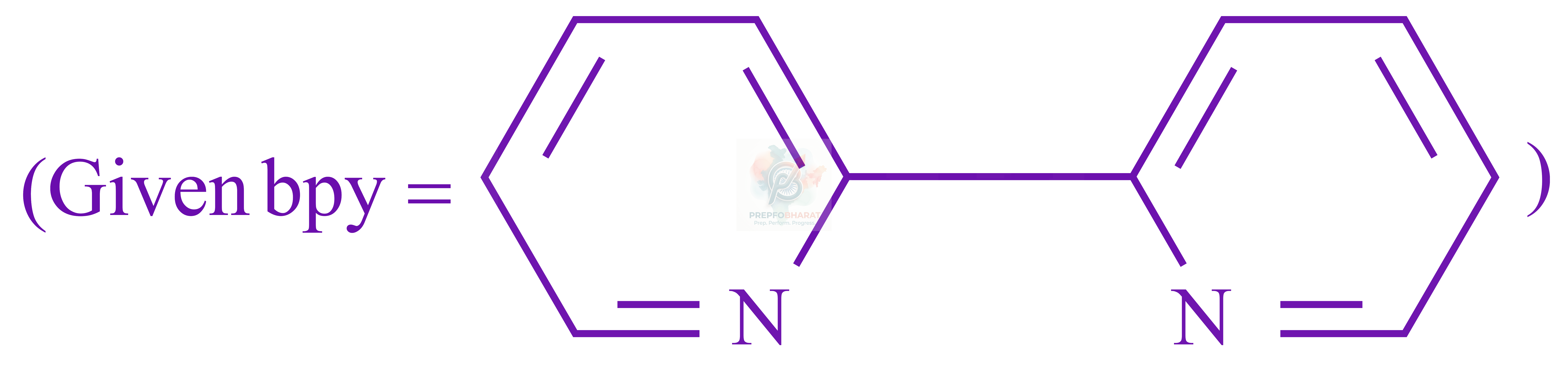
The oxide which contains an odd electron at the nitrogen atom is
Dinitrogen and dioxygen the main constituents of air do not react with each other in atmosphere to form oxides of nitrogen because
The conductivity of a solution of complex with formula ${\mathrm{CoCl}}_{3}{({\mathrm{NH}}_{3})}_{4}$ corresponds to $1:1$ electrolyte, then the primary valency of central metal ion is
Which oxoacid of phosphorous has the highest number of oxygen atoms present in its chemical formula?
Match List-I with List-II <table class="pyq-table"><tbody><tr><td></td><td>List-I</td><td></td><td>List-II</td></tr><tr><td>(A)</td><td>${\mathrm{Cl}}_{2}{O}_{7}$</td><td>(I)</td><td>Amphoteric</td></tr><tr><td>(B)</td><td>${\mathrm{Na}}_{2}O$</td><td>(II)</td><td>Basic</td></tr><tr><td>(C)</td><td>${\mathrm{Al}}_{2}{O}_{3}$</td><td>(III)</td><td>Neutral</td></tr><tr><td>(D)</td><td>${N}_{2}O$</td><td>(IV)</td><td>Acidic</td></tr></tbody></table>Choose the correct answer from the options given below
The correct order of bond orders of ${C}_{2}^{2-},{N}_{2}^{2-}$ and ${O}_{2}^{2-}$ is
The number of paramagnetic species among the following is ${B}_{2},{\mathrm{Li}}_{2},{C}_{2},{C}_{2}^{-},{O}_{2}^{2-},{O}_{2}^{+}$ and ${\mathrm{He}}_{2}^{+}$
Which of the following oxoacids of sulphur contains "S" in two different oxidation states?
Acidified potassium permanganate solution oxidises oxalic acid. The spin-only magnetic moment of the mangenese product formed from the above reaction is B.M.___(Nearest Integer)
The metal that has very low melting point and its periodic position is closer to a metalloid is
Number of electron deficient molecules among the following ${\mathrm{PH}}_{3},{B}_{2}{H}_{6},{\mathrm{CCl}}_{4},{\mathrm{NH}}_{3},\mathrm{LiH}$ and ${\mathrm{BCl}}_{3}$ is
Nitrogen gas is obtained by thermal decomposition of:
Which of the following has least tendency to liberate ${H}_{2}$ from mineral acids?
The number of bridged oxygen atoms present in compound $B$ formed from the following reactions is $\mathrm{Pb}{({\mathrm{NO}}_{3})}_{2}\overset{673K}{\longrightarrow }A+\mathrm{PbO}+{O}_{2}$ $A\overset{\mathrm{Dimerise}}{\longrightarrow }B$
Heating white phosphorus with conc. $\mathrm{NaOH}$ solution gives mainly
Bonding in which of the following diatomic molecule(s) become(s) stronger, on the basis of $\mathrm{MO}$ Theory, by removal of an electron? (A) $\mathrm{NO}$ (B) ${N}_{2}$ (C) ${O}_{2}$ (D) ${C}_{2}$ (E) ${B}_{2}$ Choose the most appropriate answer from the options given below :
The number of terminal oxygen atoms present in the product $B$ obtained from the following reaction is ${\mathrm{FeCr}}_{2}{O}_{4}+{\mathrm{Na}}_{2}{\mathrm{CO}}_{3}+{O}_{2}\rightarrow A+{\mathrm{Fe}}_{2}{O}_{3}+{\mathrm{CO}}_{2}$ $A+{H}^{+}\rightarrow B+{H}_{2}O+{\mathrm{Na}}^{+}$
Which statement is not true with respect to nitrate ion test?
The first ionization enthalpy of $\mathrm{Na},\mathrm{Mg}$ and $\mathrm{Si}$, respectively, are: $496,737$ and $786\mathrm{kJ}{\mathrm{mo}1}^{-1}$. The first ionization enthalpy $({\mathrm{kJmol}}^{-1})$ of $\mathrm{Al}$ is
Match List-I with List-II <table class="pyq-table"><tbody><tr><td></td><td>List-I (Complex)</td><td></td><td>List-II (Hybridization)</td></tr><tr><td>A</td><td>$\mathrm{Ni}{(\mathrm{CO})}_{4}$</td><td>I</td><td>${\mathrm{sp}}^{3}$</td></tr><tr><td>B</td><td>${[\mathrm{Ni}{(\mathrm{CN})}_{4}]}^{2-}$</td><td>II</td><td>${\mathrm{sp}}^{3}{d}^{2}$</td></tr><tr><td>C</td><td>${[\mathrm{Co}{(\mathrm{CN})}_{6}]}^{3-}$</td><td>III</td><td>${d}^{2}{\mathrm{sp}}^{3}$</td></tr><tr><td>D</td><td>${[{\mathrm{CoF}}_{6}]}^{3-}$</td><td>IV</td><td>${\mathrm{dsp}}^{2}$</td></tr></tbody></table>Choose the correct answer from the options given below
Consider the following sulphure based oxoacids. ${H}_{2}{\mathrm{SO}}_{3},{H}_{2}{\mathrm{SO}}_{4},{H}_{2}{S}_{2}{O}_{8}$ and ${H}_{2}{S}_{2}{O}_{7}$. Amongst these oxoacids, the number of those with peroxo $(O-O)$bond is
Octahedral complexes of copper $(\mathrm{II})$ undergo structural distortion (Jahn-Teller). Which one of the given copper $(\mathrm{II})$ complexes will show the maximum structural distortion? (en-ethylenediamine; ${H}_{2}N-{\mathrm{CH}}_{2}-{\mathrm{CH}}_{2}-{\mathrm{NH}}_{2}$)
Given below are two statements . Statement $I$ : In ${\mathrm{CuSO}}_{4}\cdot 5{H}_{2}O,\mathrm{Cu}-O$ bonds are present. Statement $\mathrm{II}$ : In ${\mathrm{CuSO}}_{4}.5{H}_{2}O$, ligands coordinating with $\mathrm{Cu}(\mathrm{II})$ ion are $O$-and $S$-based ligands. In the light of the above statements, choose the correct answer from the options given below
Spin only magnetic moment of ${[{\mathrm{MnBr}}_{6}]}^{4-}$ is _____ B.M. (round off to the closest integer)
The difference in oxidation state of chromium in chromate and dichromate salts is___