JEE Main 2024 — Inorganic Chemistry
Chemistry Inorganic Chemistry questions from JEE Main 2024.
Other Years
198 Inorganic Chemistry Questions from 2024
The number of species from the following that have pyramidal geometry around the central atom is _______. \(\mathrm{S}_2 \mathrm{O}_3^{2-}, \mathrm{SO}_4^{2-}, \mathrm{SO}_3^{2-}, \mathrm{S}_2 \mathrm{O}_7^{2-}\)
Arrange the following elements in the increasing order of number of unpaired electrons in it. (A) \(\mathrm{Sc}\) (B) \(\mathrm{Cr}\) (C) \(\mathrm{V}\) (D) \(\mathrm{Ti}\) (E) Mn Choose the correct answer from the options given below :
Number of Complexes with even number of electrons in \(t_{2 g}\) orbitals is - \(\left[\mathrm{Fe}\left(\mathrm{H}_2 \mathrm{O}\right)_6\right]^{2+},\left[\mathrm{Co}\left(\mathrm{H}_2 \mathrm{O}\right)_6\right]^{2+},\left[\mathrm{Co}\left(\mathrm{H}_2 \mathrm{O}\right)_6\right]^{3+},\left[\mathrm{Cu}\left(\mathrm{H}_2 \mathrm{O}\right)_6\right]^{2+},\left[\mathrm{Cr}\left(\mathrm{H}_2 \mathrm{O}\right)_6\right]^{2+}\)
Match List I with List II \(\begin{array}{llll} \text{List - I} & \text{List - II} \\ \text{(A) } \mathrm{ICl} & \text{(I) T - shape} \\ \text{(B) } \mathrm{ICl}_3 & \text{(II) pyramidal} \\ \text{(C) } \mathrm{ClF}_5 & \text{(III) Pentagonal bipyramidal} \\ \text{(D) } \mathrm{IF}_7 & \text{(IV) Linear} \\ \end{array}\) Choose the correct answer from the options given below :
Number of colourless lanthanoid ions among the following is ________ \(\mathrm{Eu}^{3+}, \mathrm{Lu}^{3+}, \mathrm{Nd}^{3+}, \mathrm{La}^{3+}, \mathrm{Sm}^{3+}\)
If an iron (III) complex with the formula \(\left[\mathrm{Fe}\left(\mathrm{NH}_3\right)_x(\mathrm{CN})_y\right]^{-}\)has no electron in its \(e_g\) orbital, then the value of \(x+y\) is
The correct sequence of electron gain enthalpy of the elements listed below is A. Ar B. Br C. F D. S Choose the most appropriate from the options given below:
In which one of the following pairs the central atoms exhibit \(\mathrm{sp}^2\) hybridization ?
Match List I with List II \(\begin{array}{|l|l|l|l|} \hline & \text{List - I} & & \text{List - II} \\ & \text{(Molecule/Species)} & & \text{(Property/Shape)} \\ \hline \text { A. } & \mathrm{SO}_2 \mathrm{Cl}_2 & \text { I. } & \text { Paramagnetic } \\ \hline \text { B. } & \mathrm{NO} & \text { II. } & \text { Diamagnetic } \\ \hline \text { C. } & \mathrm{NO}_2^{-} & \text {III. } & \text { Tetrahedral } \\ \hline \text { D. } & \mathrm{I}_3^{-} & \text {IV. } & \text { Linear } \\ \hline \end{array}\) Choose the correct answer from the options given below:
Given below are two statements : Statement I : The correct order of first ionization enthalpy values of \(\mathrm{Li}, \mathrm{Na}, \mathrm{F}\) and \(\mathrm{Cl}\) is \(\mathrm{Na} < \mathrm{Li} < \mathrm{Cl} < \mathrm{F}\). Statement II : The correct order of negative electron gain enthalpy values of \(\mathrm{Li}\), \(\mathrm{Na}, \mathrm{F}\) and \(\mathrm{Cl}\) is \(\mathrm{Na} < \mathrm{Li} < \mathrm{F} < \mathrm{Cl}\) In the light of the above statements, choose the correct answer from the options given below :
Given below are two statements: One is labelled as Assertion A and the other is labelled as Reason R. Assertion A : ${H}_{2}\mathrm{Te}$ is more acidic than ${H}_{2}S$. Reason R: Bond dissociation enthalpy of ${H}_{2}\mathrm{Te}$ is lower than ${H}_{2}S$. In the light of the above statements. Choose the most appropriate from the options given below.
The number of non-polar molecules from the following is $\mathrm{HF},{H}_{2}O,{\mathrm{SO}}_{2},{H}_{2},{\mathrm{CO}}_{2},{\mathrm{CH}}_{4},{\mathrm{NH}}_{3},\mathrm{HCl},{\mathrm{CHCl}}_{3},{\mathrm{BF}}_{3}$
Choose the correct option having all the elements with ${d}^{10}$ electronic configuration from the following:
Number of compounds / species from the following with non-zero dipole moment is ______ \(\mathrm{BeCl}_2, \mathrm{BCl}_3, \mathrm{NF}_3, \mathrm{XeF}_4, \mathrm{CCl}_4, \mathrm{H}_2 \mathrm{O}, \mathrm{H}_2 \mathrm{~S}, \mathrm{HBr}, \mathrm{CO}_2, \mathrm{H}_2, \mathrm{HCl}\)
Number of molecules having bond order 2 from the following molecules is ________ \(\mathrm{C}_2, \mathrm{O}_2, \mathrm{Be}_2, \mathrm{Li}_2, \mathrm{Ne}_2, \mathrm{~N}_2, \mathrm{He}_2\)
The total number of species from the following in which one unpaired electron is present, is _______ \(\mathrm{N}_2, \mathrm{O}_2, \mathrm{C}_2^{-}, \mathrm{O}_2^{-}, \mathrm{O}_2^{2-}, \mathrm{H}_2^{+}, \mathrm{CN}^{-}, \mathrm{He}_2^{+}\)
$\mathrm{NaCl}$ reacts with conc. ${H}_{2}{\mathrm{SO}}_{4}$ and ${K}_{2}{\mathrm{Cr}}_{2}{O}_{7}$ to give reddish fumes (B), which react with $\mathrm{NaOH}$ to give yellow solution (C). (B) and (C) respectively are ;
Yellow compound of lead chromate gets dissolved on treatment with hot $\mathrm{NaOH}$ solution. The product of lead formed is a :
The Spin only magnetic moment value of square planar complex $[\mathrm{Pt}{({\mathrm{NH}}_{3})}_{2}\mathrm{Cl}({\mathrm{NH}}_{2}{\mathrm{CH}}_{3})]\mathrm{Cl}$ is _______ B.M. (Nearest integer) ( Given atomic number for $\mathrm{Pt}=78)$
In alkaline medium. ${\mathrm{MnO}}_{4}^{-}$ oxidises ${I}^{-}$ to
Iron (III) catalyses the reaction between iodide and persulphate ions, in which A. \(\mathrm{Fe}^{3+}\) oxidises the iodide ion B. \(\mathrm{Fe}^{3+}\) oxidises the persulphate ion C. \(\mathrm{Fe}^{2+}\) reduces the iodide ion D. \(\mathrm{Fe}^{2+}\) reduces the persulphate ion Choose the most appropriate answer from the options given below:
The number of element from the following that do not belong to lanthanoids is \(\mathrm{Eu}, \mathrm{Cm}, \mathrm{Er}, \mathrm{Tb}, \mathrm{Yb}\) and \(\mathrm{Lu}\)
The correct IUPAC name of ${K}_{2}{\mathrm{MnO}}_{4}$ is:
Identify the incorrect statements about group 15 elements : (A) Dinitrogen is a diatomic gas which acts like an inert gas at room temperature. (B) The common oxidation states of these elements are \(-3,+3\) and +5 . (C) Nitrogen has unique ability to form \(\mathrm{p} \pi-\mathrm{p} \pi\) multiple bonds. (D) The stability of +5 oxidation states increases down the group. (E) Nitrogen shows a maximum covalency of 6. Choose the correct answer from the options given below :
The correct statements from the following are : (A) The decreasing order of atomic radii of group 13 elements is \(\mathrm{Tl}>\) In \(>\mathrm{Ga}>\mathrm{Al}>\mathrm{B}\). (B) Down the group 13 electronegativity decreases from top to bottom. (C) \(\mathrm{Al}\) dissolves in dil. \(\mathrm{HCl}\) and liberates \(\mathrm{H}_2\) but conc. \(\mathrm{HNO}_3\) renders \(\mathrm{Al}\) passive by forming a protective oxide layer on the surface. (D) All elements of group 13 exhibits highly stable +1 oxidation state. (E) Hybridisation of \(\mathrm{Al}\) in \(\left[\mathrm{Al}\left(\mathrm{H}_2 \mathrm{O}\right)_6\right]^{3+}\) ion is \(\mathrm{sp}^3 \mathrm{~d}^2\). Choose the correct answer from the options given below :
Given below are two statements: Statement (I) : In the Lanthanoids, the formation of ${\mathrm{Ce}}^{+4}$ is favoured by its noble gas configuration. Statement (II) : ${\mathrm{Ce}}^{+4}$ is a strong oxidant reverting to the common $+3$ state. In the light of the above statements, choose the most appropriate answer from the options given below:
Given below are two statements: Statement I: Fluorine has most negative electron gain enthalpy in its group. Statement II: Oxygen has least negative electron gain enthalpy in its group. In the light of the above statements, choose the most appropriate from the options given below.
The correct sequence of ligands in the order of decreasing field strength is :
Which one of the following complexes will exhibit the least paramagnetic behaviour? [Atomic number, \(\mathrm{Cr}=24, \mathrm{Mn}=25, \mathrm{Fe}=26, \mathrm{Co}=27\) ]
Given below are two statements : Statement (I) : Dimethyl glyoxime forms a six membered covalent chelate when treated with ${\mathrm{NiCl}}_{2}$ solution in presence of ${\mathrm{NH}}_{4}\mathrm{OH}.$ Statement (II) : Prussian blue precipitate contains iron both in $(+2)$ and $(+3)$ oxidation states. In the light of the above statements, choose the most appropriate answer from the options given below:
Total number of unpaired electrons in the complex ions \(\left[\mathrm{Co}\left(\mathrm{NH}_3\right)_6\right]^{3+}\) and \(\left[\mathrm{NiCl}_4\right]^{2-}\) is \(\qquad\)
The difference in the 'spin-only' magnetic moment values of \(\mathrm{KMnO}_4\) and the manganese product formed during titration of \(\mathrm{KMnO}_4\) against oxalic acid in acidic medium is _______ BM. (nearest integer)
Given below are two statements : Statement (I) : Fusion of \(\mathrm{MnO}_2\) with \(\mathrm{KOH}\) and an oxidising agent gives dark green \(\mathrm{K}_2 \mathrm{MnO}_4\). Statement (II) : Manganate ion on electrolytic oxidation in alkaline medium gives permanganate ion. In the light of the above statements, choose the correct answer from the options given below :
Select the compound from the following that will show intramolecular hydrogen bonding.
The number of species from the following which are paramagnetic and with bond order equal to one is ${H}_{2},{\mathrm{He}}_{2}^{+},{O}_{2}^{+},{N}_{2}^{2-},{O}_{2}^{2-},{F}_{2},{\mathrm{Ne}}_{2}^{+},{B}_{2}$
The number of unpaired d-electrons in \(\left[\mathrm{Co}\left(\mathrm{H}_2 \mathrm{O}\right)_6\right]^{3+}\) is
When \(\psi_{\mathrm{A}}\) and \(\psi_{\mathrm{B}}\) are the wave functions of atomic orbitals, then \(\sigma^*\) is represented by :
Which of the following material is not a semiconductor.
Match List - I with List - II. \(\begin{array}{ll} \text{List - I} & \text{List - II} \\ \text{Reaction} & \text{Type of redox reaction} \\ \text{(A) } \mathrm{TiCl}_4 & \text{(I) } \mathrm{e}^2, \mathrm{t}_2^0 \\ \text{(B) } \left[\mathrm{FeO}_4\right]^{2-} & \text{(II) } e^4, t_2^3 \\ \text{(C) } \left[\mathrm{FeCl}_4\right]^{-} & \text{(III) } e^0, t_2^0 \\ \text{(D) } \left[\mathrm{CoCl}_4\right]^{2-} & \text{(IV) } \mathrm{e}^2, \mathrm{t}_2^3 \end{array}\) Choose the correct answer from the options given below :
Consider the following test for a group-IV cation. \(\begin{aligned} & \mathrm{M}^{2+}+\mathrm{H}_2 \mathrm{~S} \rightarrow \mathrm{A} \text { (Black precipitate) }+ \text { by product } \\ & \mathrm{A}+\text { aqua regia } \rightarrow \mathrm{B}+\mathrm{NOCl}+\mathrm{S}+\mathrm{H}_2 \mathrm{O} \\ & \mathrm{B}+\mathrm{KNO}_2+\mathrm{CH}_3 \mathrm{COOH} \rightarrow \mathrm{C}+\text { by product } \end{aligned}\) The spin-only magnetic moment value of the metal complex \(\mathrm{C}\) is ______ BM (Nearest integer)
The statement(s) that are correct about the species \(\mathrm{O}^{2-}, \mathrm{F}^{-}, \mathrm{Na}^{+}\)and \(\mathrm{Mg}^{2+}\). (A) All are isoelectronic (B) All have the same nuclear charge (C) \(\mathrm{O}^{2-}\) has the largest ionic radii (D) \(\mathrm{Mg}^{2+}\) has the smallest ionic radii Choose the most appropriate answer from the options given below :
Given below are two statements : Statement (I) : A $\pi$ bonding $\mathrm{MO}$ has lower electron density above and below the inter-nuclear axis. Statement (II) : The ${\pi }^{*}$ antibonding $\mathrm{MO}$ has a node between the nuclei. In light of the above statements, choose the most appropriate answer from the options given below:
The correct increasing order for bond angles among \(\mathrm{BF}_3, \mathrm{PF}_3\) and \(\mathrm{ClF}_3\) is :
Given below are two statements: one is labelled as Assertion $(A)$ and the other is labelled as Reason $(R).$ Assertion $(A):$ ${\mathrm{PH}}_{3}$ has lower boiling point than ${\mathrm{NH}}_{3}.$ Reason $(R):$ In liquid state ${\mathrm{NH}}_{3}$ molecules are associated through Vander Waal's forces, but ${\mathrm{PH}}_{3}$ molecules are associated through hydrogen bonding. In the light of the above statements, choose the most appropriate answer from the options given below:
Match List I with List II \(\begin{array}{|l|l|c|l|} \hline & \text{List - I} & & \text{List - II} \\ \hline & \text{(Elements)} & & \text{(Properties in their respective groups)} \\ \hline \text { A. } & \mathrm{Cl}, \mathrm{S} & \text { I. } & \text { Elements with highest electronegativity } \\ \hline \text { B. } & \mathrm{Ge}, \mathrm{As} & \text { II. } & \text { Elements with largest atomic size } \\ \hline \text { C. } & \text { Fr, Ra } & \text { III. } & \begin{array}{l} \text { Elements which show properties of both } \\ \text { metals and non-metal } \end{array} \\ \hline \text { D. } & \text { F, O } & \text { IV. } & \begin{array}{l} \text { Elements with highest negative electron } \\ \text { gain enthalpy } \end{array} \\ \hline \end{array}\) Choose the correct answer from the options given below:
Match List I with List II \(\begin{array}{|l|l|l|l|} \hline & \text{List - I} & & \text{List - II} \\ & \text{(Hybridization)} & & \text{(Orientation in Space)} \\ \hline \text { A. } & \mathrm{sp}^3 & \text { I. } & \text { Trigonal bipyramidal } \\ \hline \text { B. } & \mathrm{dsp}^2 & \text { II. } & \text { Octahedral } \\ \hline \text { C. } & \mathrm{sp}^3 \mathrm{~d} & \text { III. } & \text { Tetrahedral } \\ \hline \text { D. } & \mathrm{sp}^3 \mathrm{~d}^2 & \text { IV. } & \text { Square planar } \\ \hline \end{array}\) Choose the correct answer from the options given below:
An octahedral complex with the formula \(\mathrm{CoCl}_3 \cdot \mathrm{nNH}_3\) upon reaction with excess of \(\mathrm{AgNO}_3\) solution gives 2 moles of \(\mathrm{AgCl}\). Consider the oxidation state of \(\mathrm{Co}\) in the complex is ' \(x\) '. The value of " \(x+n\) " is ______
Choose the correct statements about the hydrides of group $15$ elements. A. The stability of the hydrides decreases in the order ${\mathrm{NH}}_{3}>{\mathrm{PH}}_{3}>{\mathrm{AsH}}_{3}>{\mathrm{SbH}}_{3}>{\mathrm{BiH}}_{3}$ B. The reducing ability of the hydrides increases in the order ${\mathrm{NH}}_{3}<{\mathrm{PH}}_{3}<{\mathrm{AsH}}_{3}<{\mathrm{SbH}}_{3}<{\mathrm{BiH}}_{3}$ C. Among the hydrides, ${\mathrm{NH}}_{3}$ is strong reducing agent while ${\mathrm{BiH}}_{3}$ is mild reducing agent. D. The basicity of the hydrides increases in the order ${\mathrm{NH}}_{3}<{\mathrm{PH}}_{3}<{\mathrm{AsH}}_{3}<{\mathrm{SbH}}_{3}<{\mathrm{BiH}}_{3}$ Choose the most appropriate from the option given below:
The coordination geometry around the manganese in decacarbonyldimanganese$(0)$
Match List I with List II \(\begin{array}{|l|l|l|l|} \hline & \text{List-I} & & \text{List-II} \\ \hline & \text{(Molecule)} & & \text{(Shape)} \\ \hline \text { A. } & \mathrm{NH}_3 & \text { I. } & \text { Square pyramid } \\ \hline \text { B. } & \mathrm{BrF}_5 & \text { II. } & \text { Tetrahedral } \\ \hline \text { C. } & \mathrm{PCl}_5 & \text { III. } & \text { Trigonal pyramidal } \\ \hline \text { D. } & \mathrm{CH}_4 & \text { IV. } & \text { Trigonal bipyramidal } \\ \hline \end{array}\) Choose the correct answer from the options given below:
Consider the following complex ions $P=[{\mathrm{FeF}}_{6}{]}^{3–}$, $Q=[V({H}_{2}O){}_{6}{]}^{2+}$, $R=[\mathrm{Fe}({H}_{2}O{)}_{6}{]}^{2+}$ The correct order of the complex ions, according to their spin only magnetic moment values (in B.M.) is :
Match List I with List II \(\begin{array}{|l|l|l|l|} \hline & \text{List - I} & & \text{List - II} \\ & \text{(Compound/Species)} & & \text{(Shape/Geometry)} \\ \hline \text { A. } & \mathrm{SF}_4 & \text { I. } & \text { Tetrahedral } \\ \hline \text { B. } & \mathrm{BrF}_3 & \text { II. } & \text { Pyramidal } \\ \hline \text { C. } & \mathrm{BrO}_3^{-} & \text {III. } & \text { See saw } \\ \hline \text { D. } & \mathrm{NH}_4^{+}{ }^{+} \mathrm{KS} & \text { IV. } & \text { Bent T-Shape } \\ \hline \end{array}\) Choose the correct answer from the options given below:
Given below are two statements: Statement - I: Along the period, the chemical reactivity of the element gradually increases from group $1$ to group $18$ . Statement - II: The nature of oxides formed by group $1$ element is basic while that of group $17$ elements is acidic. In the the light above statements, choose the most appropriate from the questions given below:
Given below are two statements : Statement I : The metallic radius of \(\mathrm{Na}\) is \(1.86 \mathrm{~A}^{\circ}\) and the ionic radius of \(\mathrm{Na}^{+}\)is lesser than \(1.86 \mathrm{~A}^{\circ}\). Statement II : Ions are always smaller in size than the corresponding elements. In the light of the above statements, choose the correct answer from the options given below :
Given below are two statements : Statement I : The electronegativity of group $14$ elements from $\mathrm{Si}$ to $\mathrm{Pb}$ gradually decreases. Statement II : Group $14$ contains non-metallic, metallic, as well as metalloid elements. In the light of the above statements, choose the most appropriate from the options given below :
The metal atom present in the complex MABXL (where A, B, X and L are unidentate ligands and \(\mathrm{M}\) is metal) involves \(\mathrm{sp}^3\) hybridization. The number of geometrical isomers exhibited by the complex is:
The 'spin only' magnetic moment value of \(\mathrm{MO}_4{ }^{2-}\) is _______ BM. (Where M is a metal having least metallic radii. among \(\mathrm{Sc}, \mathrm{Ti}, \mathrm{V}, \mathrm{Cr}, \mathrm{Mn}\) and \(\mathrm{Zn}\) ). (Given atomic number: \(\mathrm{Sc}=21, \mathrm{Ti}=22, \mathrm{~V}=23, \mathrm{Cr}=24, \mathrm{Mn}=25\) and \(\mathrm{Zn}=30\))
Among \(\mathrm{CrO}, \mathrm{Cr}_2 \mathrm{O}_3\) and \(\mathrm{CrO}_3\), the sum of spin-only magnetic moment values of basic and amphoteric oxides is _______ \(10^{-2} \mathrm{BM}\) (nearest integer). (Given atomic number of \(\mathrm{Cr}\) is 24)
A first row transition metal with highest enthalpy of atomisation, upon reaction with oxygen at high temperature forms oxides of formula \(\mathrm{M}_2 \mathrm{O}_{\mathrm{n}}\) (where \(\mathrm{n}=3,4\), 5). The 'spin-only' magnetic moment value of the amphoteric oxide from the above oxides is ______ \(\mathrm{BM}\) (near integer) (Given atomic number: \(\mathrm{Sc}: 21, \mathrm{Ti}: 22, \mathrm{~V}: 23, \mathrm{Cr}: 24, \mathrm{Mn}: 25, \mathrm{Fe}: 26, \mathrm{Co}: 27\), \(\mathrm{Ni}: 28, \mathrm{Cu}: 29, \mathrm{Zn}: 30\))
A first row transition metal in its +2 oxidation state has a spin-only magnetic moment value of \(3.86 \mathrm{BM}\). The atomic number of the metal is
Identify correct statements from below: A. The chromate ion is square planar. B. Dichromates are generally prepared from chromates. C. The green manganate ion is diamagnetic. D. Dark green coloured ${K}_{2}{\mathrm{MnO}}_{4}$ disproportionates in a neutral or acidic medium to give permanganate. E. With increasing oxidation number of transition metal, ionic character of the oxides decreases. Choose the correct answer from the options given below:
Given below are two statements : Statement (I) : The 4f and 5f - series of elements are placed separately in the Periodic table to preserve the principle of classification. Statement (II) : s-block elements can be found in pure form in nature. In light of the above statements, choose the most appropriate answer from the options given below:
Given below are two statements : Statement (I) : Both metal and non-metal exist in $\mathrm{p}$ and d-block elements. Statement (II) : Non-metals have higher ionisation enthalpy and higher electronegativity than the metals. In the light of the above statements, choose the most appropriate answer from the option given below:
Given below are two statements: Statement (I) : ${\mathrm{SiO}}_{2}$ and ${\mathrm{GeO}}_{2}$ are acidic while $\mathrm{SnO}$ and $\mathrm{PbO}$ are amphoteric in nature. Statement (II) : Allotropic forms of carbon are due to property of catenation and $p\pi -d\pi$ bond formation. In the light of the above statements, choose the most appropriate answer from the options given below:
Oxidation state of Fe(Iron) in complex formed in Brown ring test.
Given below are two statements : one is labelled as Assertion $(A)$ and the other is labelled as Reason $(R)$. Assertion (A) : Melting point of Boron $(2453K)$ is unusually high in group $13$ elements. Reason (R) : Solid Boron has very strong crystalline lattice. In the light of the above statements, choose the most appropriate answer from the options given below ;
Element not showing variable oxidation state is :
Number of molecules from the following which are exceptions to octet rule is ______ \(\mathrm{CO}_2, \mathrm{NO}_2, \mathrm{H}_2 \mathrm{SO}_4, \mathrm{BF}_3, \mathrm{CH}_4, \mathrm{SiF}_4, \mathrm{ClO}_2, \mathrm{PCl}_5, \mathrm{BeF}_2, \mathrm{C}_2 \mathrm{H}_6, \mathrm{CHCl}_3, \mathrm{CBr}_4\)
The transition metal having highest ${3}^{\mathrm{rd}}$ ionisation enthalpy is:
Given below are two statements : one is labelled as Assertion $(A)$ and the other is labelled as Reason $(R).$ Assertion $(A)$ : In aqueous solutions ${\mathrm{Cr}}^{2+}$ is reducing while ${\mathrm{Mn}}^{3+}$ is oxidising in nature. Reason $(R):$ Extra stability to half filled electronic configuration is observed than incompletely filled electronic configuration. In the light of the above statement, choose the most appropriate answer from the options given below:
Match List I with List II \(\begin{array}{|l|l|l|l|} \hline & \text{List - I} & & \text{List - II} \\ & \text{(Compound)} & & \text{(Uses)} \\ \hline \text { A. } & \text { Iodoform } & \text { I. } & \text { Fire extinguisher } \\ \hline \text { B. } & \text { Carbon tetrachloride } & \text { II. } & \text { Insecticide } \\ \hline \text { C. } & \text { CFC } & \text { III. } & \text { Antiseptic } \\ \hline \text { D. } & \text { DDT } & \text { IV. } & \text { Refrigerants } \\ \hline \end{array}\) Choose the correct answer from the options given below:
The molecule/ion with square pyramidal shape is:
Consider the following reaction \(\mathrm{MnO}_2+\mathrm{KOH}+\mathrm{O}_2 \rightarrow \mathrm{A}+\mathrm{H}_2 \mathrm{O}\). Product ' \(\mathrm{A}\) ' in neutral or acidic medium disproportionate to give products ' \(\mathrm{B}\) ' and ' \(\mathrm{C}\) ' along with water. The sum of spin-only magnetic moment values of \(\mathrm{B}\) and \(\mathrm{C}\) is \(\qquad\) BM. (nearest integer) (Given atomic number of \(\mathrm{Mn}\) is 25)
The compound that is white in color is
Match List I with List II \(\begin{array}{|l|l|l|l|} \hline & \text{List - I} & & \text{List - II} \\ & \text{(Precipitating reagent and conditions)} & & \text{(Cation)} \\ \hline \text { A. } & \mathrm{NH}_4 \mathrm{Cl}+\mathrm{NH}_4 \mathrm{OH} / \mathrm{ARKS} & \text { I. } & \mathrm{Mn}^{2+} \\ \hline \text { B. } & \mathrm{NH}_4 \mathrm{OH}+\mathrm{Na}_2 \mathrm{CO}_3 & \text { II. } & \mathrm{Pb}^{2+} \\ \hline \text { C. } & \mathrm{NH}_4 \mathrm{OH}+\mathrm{NH}_4 \mathrm{Cl}+\mathrm{H}_2 \mathrm{~S} \text { gas } & \text { III. } & \mathrm{Al}^{3+} \\ \hline \text { D. } & \text { dilute } \mathrm{HCl} & \text { IV. } & \mathrm{Sr}^{2+} \\ \hline \end{array}\) Choose the correct answer from the options given below:
Match List I with List II \(\begin{array}{|l|l|l|l|} \hline & \text{ List - I } & & \text{List - II} \\ \hline \text { A. } & \mathrm{K}_2\left[\mathrm{Ni}(\mathrm{CN})_4\right] & \text { I. } & \mathrm{sp}^3 \\ \hline \text { B. } & {\left[\mathrm{Ni}(\mathrm{CO})_4\right]} & \text { II. } & \mathrm{sp}^3 \mathrm{~d}^2 \\ \hline \text { C. } & {\left[\mathrm{Co}\left(\mathrm{NH}_3\right)_6\right] \mathrm{Cl}_3} & \text { III. } & \mathrm{dsp}^2 \\ \hline \text { D. } & \mathrm{Na}_3\left[\mathrm{CoF}_6\right] & \text { IV. } & \mathrm{d}^2 \mathrm{sp}^3 \\ \hline \end{array}\) Choose the correct answer from the options given below:
Match List I with List II \(\begin{array}{|l|l|l|l|} \hline & \text{List-I} & & \text{List-II} \\ \hline & \text{(Molecule)} & & \text{(Shape)} \\ \hline \text { A. } & \mathrm{Fe}_4\left[\mathrm{Fe}(\mathrm{CN})_6\right]_3 \cdot \mathrm{xH}_2 \mathrm{O} & \text { I. } & \text { Violet } \\ \hline \text { B. } & {\left[\mathrm{Fe}(\mathrm{CN})_5 \mathrm{NOS}^{4-}\right.} & \text { II. } & \text { Blood Red } A \\ \hline \text { C. } & {[\mathrm{Fe}(\mathrm{SCN})]^{2+}} & \text { III. } & \text { Prussian Blue } \\ \hline \text { D. } & \left(\mathrm{NH}_4\right)_3 \mathrm{PO}_4 \cdot 12 \mathrm{MoO}_3 & \text { IV. } & \text { Yellow } \\ \hline \end{array}\) Choose the correct answer from the options given below:
Given below are two statements : one is labelled as Assertion (A) and the other is labelled as Reason (R). Assertion (A) : Both rhombic and monoclinic sulphur exist as \(\mathrm{S}_8\) while oxygen exists as \(\mathrm{O}_2\). Reason (R) : Oxygen forms \(\mathrm{p} \pi-\mathrm{p} \pi\) multiple bonds with itself and other elements having small size and high electronegativity like \(\mathrm{C}, \mathrm{N}\), which is not possible for sulphur. In the light of the above statements, choose the most appropriate answer from the options given below :
The total number of molecular orbitals formed from $2s$ and $2p$ atomic orbitals of a diatomic molecule
Match List I with List II \(\begin{array}{|l|l|c|l|} \hline & \text{ List - I } & & \text{List - II} \\ \hline \text { A. } & \text { Melting Point }[\mathrm{K}] & \text { I. } & \mathrm{T} 1>\mathrm{In}>\mathrm{Ga}>\mathrm{A} 1>\mathrm{B} \\ \hline \text { B. } & \text { Ionic Radius }\left[\mathrm{M}^{+3} / \mathrm{pm}\right] & \text { II. } & \mathrm{B}>\mathrm{T} 1>\mathrm{A} 1 \approx \mathrm{Ga}>\mathrm{In} \\ \hline \text { C. } & \Delta_{\mathrm{i}} \mathrm{H}_1\left[\mathrm{~kJ} \mathrm{~mol}^{-1}\right] & \text { III. } & \mathrm{T} 1>\mathrm{In}>\mathrm{A} 1>\mathrm{Ga}>\mathrm{B} \\ \hline \text { D. } & \text { Atomic Radius }[\mathrm{pm}] & \text { IV. } & \mathrm{B}>\mathrm{A} 1>\mathrm{T} 1>\mathrm{In}>\mathrm{Ga} \\ \hline \end{array}\) Choose the correct answer from the options given below:
When \(\mathrm{MnO}_2\) and \(\mathrm{H}_2 \mathrm{SO}_4\) is added to a salt (A), the greenish yellow gas liberated as salt (A) is :
Give below are two statements: Statement I : The higher oxidation states are more stable down the group among transition elements unlike p-block elements. Statement II : Copper can not liberate hydrogen from weak acids. In the light of the above statements, choose the correct answer from the options given below :
Given below are two statements: Statement I: \(\mathrm{N}\left(\mathrm{CH}_3\right)_3\) and \(\mathrm{P}\left(\mathrm{CH}_3\right)_3\) can act as ligands to form transition metal complexes. Statement II: As N and P are from same group, the nature of bonding of \(\mathrm{N}\left(\mathrm{CH}_3\right)_3\) and \(\mathrm{P}\left(\mathrm{CH}_3\right)_3\) is always same with transition metals. In the light of the above statements, choose the most appropriate answer from the options given below:
Molar mass of the salt from $\mathrm{NaBr},{\mathrm{NaNO}}_{3},\mathrm{KI}$ and ${\mathrm{CaF}}_{2}$ which does not evolve coloured vapours on heating with concentrated ${H}_{2}{\mathrm{SO}}_{4}$ is ____ $g{\mathrm{mol}}^{–1}$, (Molar mass in $g{\mathrm{mol}}^{–1}:\mathrm{Na}:23,N:14,K:39,O:16,\mathrm{Br}:80,I:127,F:19,\mathrm{Ca}:40$)
Number of complexes from the following with even number of unpaired " \(\mathrm{d}\) " electrons is \(\qquad\) \(\left[\mathrm{V}\left(\mathrm{H}_2 \mathrm{O}\right)_6\right]^{3+},\left[\mathrm{Cr}\left(\mathrm{H}_2 \mathrm{O}\right)_6\right]^{2+},\left[\mathrm{Fe}\left(\mathrm{H}_2 \mathrm{O}\right)_6\right]^{3+},\left[\mathrm{Ni}\left(\mathrm{H}_2 \mathrm{O}\right)_6\right]^{3+},\left[\mathrm{Cu}\left(\mathrm{H}_2 \mathrm{O}\right)_6\right]^{2+}\) [Given atomic numbers : \(\mathrm{V}=23, \mathrm{Cr}=24, \mathrm{Fe}=26, \mathrm{Ni}=28 \mathrm{Cu}=29\)]
In the reaction of potassium dichromate, potassium chloride and sulfuric acid (conc.), the oxidation state of the chromium in the product is $(+)$ _______.
\(0.05 \mathrm{M} \mathrm{CuSO}_4\) when treated with \(0.01 \mathrm{M} \mathrm{K}_2 \mathrm{Cr}_2 \mathrm{O}_7\) gives green colour solution of \(\mathrm{Cu}_2 \mathrm{Cr}_2 \mathrm{O}_7\). The two solutions are separated as shown below : [SPM : Semi Permeable Membrane] 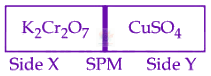 Due to osmosis :
The 'Spin only’ Magnetic moment for $[\mathrm{Ni}({\mathrm{NH}}_{3}{)}_{6}]{}^{2+}$ is______$\times {10}^{–1}$ BM. (given = Atomic number of $\mathrm{Ni}:28$) Round off your answer to the nearest integer.
The electron affinity value are negative for A. \(\mathrm{Be} \rightarrow \mathrm{Be}^{-}\) B. \(\mathrm{N} \rightarrow \mathrm{N}^{-}\) C. \(\mathrm{O} \rightarrow \mathrm{O}^{2-}\) D. \(\mathrm{Na} \rightarrow \mathrm{Na}^{-}\) E. \(\mathrm{Al} \rightarrow \mathrm{Al}^{-}\) Choose the most appropriate answer from the options given below :
Number of complexes which show optical isomerism among the following is _________. $cis-{[\mathrm{Cr}(\mathrm{ox}{)}_{2}{\mathrm{Cl}}_{2}]}^{3-},{[\mathrm{Co}(\mathrm{en}{)}_{3}]}^{3+}$$\text{, cis }-{[\mathrm{Pt}(\mathrm{en}{)}_{2}{\mathrm{Cl}}_{2}]}^{2+}\text{, cis }-{[\mathrm{Co}(\mathrm{en}{)}_{2}{\mathrm{Cl}}_{2}]}^{+}$ $,trans-{[\mathrm{Pt}(\mathrm{en}{)}_{2}{\mathrm{Cl}}_{2}]}^{2+},\text{ trans }-{[\mathrm{Cr}(\mathrm{ox}{)}_{2}{\mathrm{Cl}}_{2}]}^{3-}$
Given below are two statements : Statement I : In group 13, the stability of +1 oxidation state increases down the group. Statement II : The atomic size of gallium is greater than that of aluminium. In the light of the above statements, choose the most appropriate answer from the options given below :
Choose the polar molecule from the following :
The Lassiagne's extract is boiled with dil ${\mathrm{HNO}}_{3}$ before testing for halogens because,
Given below are the two statements: one is labeled as Assertion (A) and the other is labeled as Reason (R). Assertion (A): There is a considerable increase in covalent radius from $N$ to $P$. However from $As$ to $Bi$ only a small increase in covalent radius is observed. Reason (R): covalent and ionic radii in a particular oxidation state increases down the group. In the light of the above statement, choose the most appropriate answer from the options given below:
Given below are two statements: Statement-I: The gas liberated on warming a salt with dil ${H}_{2}{\mathrm{SO}}_{4}$, turns a piece of paper dipped in lead acetate into black, it is a confirmatory test for sulphide ion. Statement-II: In statement-I the colour of paper turns black because of formation of lead sulphite. In the light of the above statements, choose the most appropriate answer from the options given below:
The correct order of the first ionization enthalpy is
Number of compounds with one lone pair of electrons on central atom amongst following is _ ${O}_{3},{H}_{2}O,{\mathrm{SF}}_{4},{\mathrm{ClF}}_{3},{\mathrm{NH}}_{3},{\mathrm{BrF}}_{5},{\mathrm{XeF}}_{4}$
The number of ions from the following that have the ability to liberate hydrogen from a dilute acid is _____. \(\mathrm{Ti}^{2+}, \mathrm{Cr}^{2+}\) and \(\mathrm{V}^{2+}\)
The spin-only magnetic moment value of the ion among \(\mathrm{Ti}^{2+}, \mathrm{V}^{2+}, \mathrm{Co}^{3+}\) and \(\mathrm{Cr}^{2+}\), that acts as strong oxidising agent in aqueous solution is _______ BM (Near integer). (Given atomic numbers : \(\mathrm{Ti}: 22, \mathrm{~V}: 23, \mathrm{Cr}: 24, \mathrm{Co}: 27\))
Which of the following statements are correct about $\mathrm{Zn},\mathrm{Cd}$ and $\mathrm{Hg}$ ? A. They exhibit high enthalpy of atomization as the d-subshell is full. B. $\mathrm{Zn}$ and $\mathrm{Cd}$ do not show variable oxidation state while $\mathrm{Hg}$ shows $+I$ and $+\mathrm{II}$. C. Compounds of $\mathrm{Zn},\mathrm{Cd}$ and $\mathrm{Hg}$ are paramagnetic in nature. D. $\mathrm{Zn},\mathrm{Cd}$ and $\mathrm{Hg}$ are called soft metals. Choose the most appropriate from the options given below:
Match List - I with List - II. \(\begin{array}{lll} \begin{array}{l} \text { List - I } \\ \text { (Complex ion) } \end{array} & \begin{array}{l} \text { List - II } \\ \text { (Spin only magnetic moment in B.M.) } \end{array} \\ \text { (A) }\left[\mathrm{Cr}\left(\mathrm{NH}_3\right)_6\right]^{3+} & \text { (I) } 4.90 \\ \text { (B) }\left[\mathrm{NiCl}_4\right]^{2-} & \text { (II) } 3.87 \\ \text { (C) }\left[\mathrm{CoF}_6\right]^{3-} & \text { (III) } 0.0 \\ \text { (D) }\left[\mathrm{Ni}(\mathrm{CN})_4\right]^{2-} & \text { (IV) } 2.83 \end{array}\) Choose the correct answer from the options given below :
Number of molecules/species from the following having one unpaired electron is \(\qquad\) \(\mathrm{O}_2, \mathrm{O}_2^{-1}, \mathrm{NO}, \mathrm{CN}^{-1}, \mathrm{O}_2^{2-}\)
Given below are two statements : one is labelled as Assertion (A) and the other is labelled as Reason (R). Assertion (A) : \(\mathrm{NH}_3\) and \(\mathrm{NF}_3\) molecule have pyramidal shape with a lone pair of electrons on nitrogen atom. The resultant dipole moment of \(\mathrm{NH}_3\) is greater than that of \(\mathrm{NF}_3\). Reason (R) : In \(\mathrm{NH}_3\), the orbital dipole due to lone pair is in the same direction as the resultant dipole moment of the \(\mathrm{N}-\mathrm{H}\) bonds. \(\mathrm{F}\) is the most electronegative element. In the light of the above statements, choose the correct answer from the options given below :
From the given list, the number of compounds with $+4$oxidation state of Sulphur ${\mathrm{SO}}_{3},{H}_{2}{\mathrm{SO}}_{3},{\mathrm{SOCl}}_{2},{\mathrm{SF}}_{4},{\mathrm{BaSO}}_{4},{H}_{2}{S}_{2}{O}_{7}$
Match List I with List II \(\begin{array}{|l|l|l|l|} \hline & \text{List-I} & & \text{List-II} \\ \hline & \text{(Name of the test)} & & \text{(Reaction sequence involved) [M is metal]} \\ \hline \text { A. } & \text { Borax bead test } & \text { I. } & \mathrm{MCO}_3 \rightarrow \mathrm{MO} \xrightarrow{\mathrm{Co}\left(\mathrm{NO}_3\right)_2} \mathrm{CoO} \cdot \mathrm{MO} \\ \hline \text { B. } & \begin{array}{l} \text { Charcoal } \\ \text { cavity test } \end{array} & \text { II. } & \mathrm{MCO}_3 \rightarrow \mathrm{MCl}_2 \rightarrow \mathrm{M}^{2+} \\ \hline \text { C } & \begin{array}{l} \text { Cobalt nitrate } \\ \text { test } \end{array} & \text { III } & \mathrm{MSO}_4 \xrightarrow[\Delta]{\mathrm{Na}_2 \mathrm{~B}_4 \mathrm{O}_7} \mathrm{M}\left(\mathrm{BO}_2\right)_2 \rightarrow \mathrm{MBO}_2 \rightarrow \mathrm{M} \\ \hline \text { D. } & \text { Flame test } & \text { IV } & \mathrm{MSO}_4 \xrightarrow[\Delta]{\mathrm{Na}_2 \mathrm{CO}_3} \mathrm{MCO}_3 \rightarrow \mathrm{MO} \rightarrow \mathrm{M} \\ \hline \end{array}\) Choose the correct answer from the options given below:
Diamagnetic Lanthanoid ions are:
lectronic configuration of \(\mathrm{Cu}(\mathrm{II})\) is \(3 \mathrm{~d}^9\) whereas that of \(\mathrm{Cu}(\mathrm{I})\) is \(3 \mathrm{~d}^{10}\). Which of the following is correct?
Given below are two statements : Statement (I) : The oxidation state of an element in a particular compound is the charge acquired by its atom on the basis of electron gain enthalpy consideration from other atoms in the molecule. Statement (II) : \(\mathrm{p} \pi-\mathrm{p} \pi\) bond formation is more prevalent in second period elements over other periods. In the light of the above statements, choose the most appropriate answer from the options given below :
Which of the following compounds show colour due to $d-d$ transition?
he following complexes \(\underset{\large \text{(A)}}{\left[\mathrm{CoCl}\left(\mathrm{NH}_3\right)_5\right]^{2+}},\underset{\large \text{(B)}}{\left[\mathrm{Co}(\mathrm{CN})_6\right]^{3-}},\underset{\large \text{(C)}}{\left[\mathrm{Co}\left(\mathrm{NH}_3\right)_5\left(\mathrm{H}_2 \mathrm{O}\right)\right]^{3+}},\underset{\large \text{(D)}}{\left[\mathrm{Cu}\left(\mathrm{H}_2 \mathrm{O}\right)_4\right]^{2+}}\) The correct order of A, B, C and D in terms of wavenumber of light absorbed is :
Select the option with correct property:
Aluminium chloride in acidified aqueous solution forms an ion having geometry
The correct order of ligands arranged in increasing field strength.
Consider the following elements. 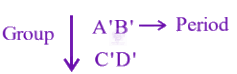 Which of the following is/are true about ${A}^{'},{B}^{'},{C}^{'}$ and ${D}^{'}$ ? A. Order of atomic radii: ${B}^{'}<{A}^{'}<{D}^{'}<{C}^{'}$ B. Order of metallic character : ${B}^{'}<{A}^{'}<{D}^{'}<{C}^{'}$ C. Size of the element : ${D}^{'}<{C}^{'}<{B}^{'}<{A}^{'}$ D. Order of ionic radii : ${{B}^{'}}^{+}<{{A}^{'}}^{+}<{{D}^{'}}^{+}<{{C}^{'}}^{+}$ Choose the correct answer from the options given below:
The shape of carbocation is :
Choose the correct Statements from the following: (A) $\mathrm{Ethane}-1,2-\mathrm{diamine}$ is a chelating ligand. (B) Metallic aluminium is produced by electrolysis of aluminium oxide in presence of cryolite. (C) Cyanide ion is used as ligand for leaching of silver. (D) Phosphine act as a ligand in Wilkinson catalyst. (E) The stability constants of ${\mathrm{Ca}}^{2+}$ and ${\mathrm{Mg}}^{2+}$ are similar with EDTA complexes. Choose the correct answer from the options given below:
The total number of molccules with zero dipole moment among ${\mathrm{CH}}_{4},{\mathrm{BF}}_{3},{H}_{2}O,\mathrm{HF},{\mathrm{NH}}_{3},{\mathrm{CO}}_{2}$ and ${\mathrm{SO}}_{2}$ is ______.
During the detection of acidic radical present in a salt, a student gets a pale yellow precipitate soluble with difficulty in \(\mathrm{NH}_4 \mathrm{OH}\) solution when sodium carbonate extract was first acidified with dil. \(\mathrm{HNO}_3\) and then \(\mathrm{AgNO}_3\) solution was added. This indicates presence of :
Match List - I with List - II. \(\begin{array}{ll} \text{List - I} & \text{List - II} \\ \text{Reaction} & \text{Type of redox reaction} \\ \text{(A) } \mathrm{Li} & \text{(I) } 589.2 \\ \text{(B) } \mathrm{Na} & \text{(II) } 455.5 \\ \text{(C) } \mathrm{Rb} & \text{(III) } 670.8 \\ \text{(D) } \mathrm{Cs} & \text{(IV) } 780.0 \\ \end{array}\) Choose the correct answer from the options given below :
In the precipitation of the iron group (III) in qualitative analysis, ammonium chloride is added before adding ammonium hydroxide to :
Given below are two statements: Statement (I): A solution of ${[\mathrm{Ni}{({H}_{2}O)}_{6}]}^{2+}$ is green in colour. Statement (II): A solution of ${[\mathrm{Ni}(\mathrm{CN}{)}_{4}]}^{2-}$ is colourless. In the light of the above statements, choose the most appropriate answer from the options given below:
Alkaline oxidative fusion of ${\mathrm{MnO}}_{2}$ gives "$A$ " which on electrolytic oxidation in alkaline solution produces $B.A$and $B$ respectively are:
The correct order of first ionization enthalpy values of the following elements is : (A) \(\mathrm{O}\) (B) \(\mathrm{N}\) (C) \(\mathrm{Be}\) (D) \(\mathrm{F}\) (E) \(\mathrm{B}\) Choose the correct answer from the options given below :
What will be the decreasing order of basic strength of the following conjugate bases? \({ }^{-} \mathrm{OH}, \mathrm{R} \overline{\mathrm{O}}, \mathrm{CH}_3 \mathrm{CO} \overline{\mathrm{O}}, \mathrm{C} \overline{\mathrm{I}}\)
Identity the incorrect pair from the following:
Total number of species from the following with central atom utilising \(\mathrm{sp}^2\) hybrid orbitals for bonding is _____. \(\mathrm{NH}_3, \mathrm{SO}_2, \mathrm{SiO}_2, \mathrm{BeCl}_2, \mathrm{C}_2 \mathrm{H}_2, \mathrm{C}_2 \mathrm{H}_4, \mathrm{BCl}_3, \mathrm{HCHO}, \mathrm{C}_6 \mathrm{H}_6, \mathrm{BF}_3, \mathrm{C}_2 \mathrm{H}_4 \mathrm{Cl}_2\)
Identify the correct statements about p-block elements and their compounds. (A) Non metals have higher electronegativity than metals. (B) Non metals have lower ionisation enthalpy than metals. (C) Compounds formed between highly reactive nonmetals and highly reactive metals are generally ionic. (D) The non-metal oxides are generally basic in nature. (E) The metal oxides are generally acidic or neutral in nature. Choose the correct answer from the options given below :
Number of metal ions characterized by flame test among the following is _________. ${\mathrm{Sr}}^{2+},{\mathrm{Ba}}^{2+},{\mathrm{Ca}}^{2+},{\mathrm{Cu}}^{2+},{\mathrm{Zn}}^{2+},{\mathrm{Co}}^{2+},{\mathrm{Fe}}^{2+}$
The total number of 'Sigma' and $\mathrm{Pi}$ bonds in 2-formylhex-4-enoic acid is
The number of ions from the following that are expected to behave as oxidising agent is : \(\mathrm{Sn}^{4+}, \mathrm{Sn}^{2+}, \mathrm{Pb}^{2+}, \mathrm{Tl}^{3+}, \mathrm{Pb}^{4+}, \mathrm{Tl}^{+}\)
The strongest reducing agent amont the following is:
Which one of the following molecules has maximum dipole moment?
Identify from the following species in which ${d}^{2}{\mathrm{sp}}^{3}$ hybridization is shown by central atom:
The linear combination of atomic orbitals to form molecular orbitals takes place only when the combining atomic orbitals A. have the same energy B. have the minimum overlap C. have same symmetry about the molecular axis D. have different symmetry about the molecular axis Choose the most appropriate from the options given below:
The number of neutrons present in the more abundant isotope of boron is ' \(x\) '. Amorphous boron upon heating with air forms a product, in which the oxidation state of boron is ' \(y\) '. The value of \(x+y\) is _______
Sum of bond order of $\mathrm{CO}$ and ${\mathrm{NO}}^{+}$ is
On reaction of Lead Sulphide with dilute nitric acid which of the following is not formed?
The correct statement/s about Hydrogen bonding is/are A. Hydrogen bonding exists when \(\mathrm{H}\) is covalently bonded to the highly electro negative atom. B. Intermolecular \(\mathrm{H}\) bonding is present in o-nitro phenol C. Intramolecular \(\mathrm{H}\) bonding is present in HF. D. The magnitude of \(\mathrm{H}\) bonding depends on the physical state of the compound. E. H-bonding has powerful effect on the structure and properties of compounds Choose the correct answer from the options given below:
In case of isoelectronic species the size of ${F}^{–},\mathrm{Ne}$ and ${\mathrm{Na}}^{+}$ is affected by:
Number of molecules from the following which can exhibit hydrogen bonding is _______ (nearest integer) 
Which of the following is least ionic?
Number of molecules/ions from the following in which the central atom is involved in \(\mathrm{sp}^3\) hybridization is \(\qquad\) \(\mathrm{NO}_3^{-}, \mathrm{BCl}_3, \mathrm{ClO}_2^{-}, \mathrm{ClO}_3\)
$A$ and $B$ formed in the following reactions are: ${\mathrm{CrO}}_{2}{\mathrm{Cl}}_{2}+4\mathrm{NaOH}\rightarrow A+2\mathrm{NaCl}+2{H}_{2}O$ $A+2\mathrm{HCl}+2{H}_{2}{O}_{2}\rightarrow B+3{H}_{2}O$
The correct IUPAC name of \(\left[\mathrm{PtBr}_2\left(\mathrm{PMe}_3\right)_2\right]\) is :
While preparing crystals of Mohr's salt, dil \(\mathrm{H}_2 \mathrm{SO}_4\) is added to a mixture of ferrous sulphate and ammonium sulphate, before dissolving this mixture in water, dil \(\mathrm{H}_2 \mathrm{SO}_4\) is added here to :
Evaluate the following statements related to group 14 elements for their correctness. (A) Covalent radius decreases down the group from \(\mathrm{C}\) to \(\mathrm{Pb}\) in a regular manner. (B) Electronegativity decreases from \(\mathrm{C}\) to \(\mathrm{Pb}\) down the group gradually. (C) Maximum covalance of \(\mathrm{C}\) is 4 whereas other elements can expand their covalance due to presence of d orbitals. (D) Heavier elements do not form \(\mathrm{p} \pi-\mathrm{p} \pi\) bonds. (E) Carbon can exhibit negative oxidation states. Choose the correct answer from the options given below :
${[\mathrm{Co}{({\mathrm{NH}}_{3})}_{6}]}^{3+}$ and ${[{\mathrm{CoF}}_{6}]}^{3-}$ are respectively known as:
A transition metal ' \(\mathrm{M}\) ' among \(\mathrm{Sc}, \mathrm{Ti}, \mathrm{V}, \mathrm{Cr}, \mathrm{Mn}\) and \(\mathrm{Fe}\) has the highest second ionisation enthalpy. The spin-only magnetic moment value of \(\mathrm{M}^{+}\)ion is _______. \(\mathrm{BM}\) (Near integer) (Given atomic number \(\mathrm{Sc}: 21, \mathrm{Ti}: 22, \mathrm{~V}: 23, \mathrm{Cr}: 24, \mathrm{Mn}: 25, \mathrm{Fe}: 26\))
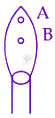 In a borax bead test under hot condition, a metal salt (one from the given) is heated at point B of the flame, resulted in green colour salt bead. The spin-only magnetic moment value of the salt is _______ BM (Nearest integer) [Given atomic number of \(\mathrm{Cu}=29, \mathrm{Ni}=28, \mathrm{Mn}=25, \mathrm{Fe}=26\)]
Given below are two statements : one is labelled as Assertion A and the other is labelled as Reason R: Assertion A: The first ionisation enthalpy decreases across a period. Reason R: The increasing nuclear charge outweighs the shielding across the period. In the light of the above statements, choose the most appropriate from the options given below:
Given below are two statements: Statement (I) : Oxygen being the first member of group $16$ exhibits only$–2$ oxidation state. Statement (II) : Down the group $16$ stability of $+4$ oxidation state decreases and $+6$ oxidation state increases. In the light of the above statements, choose the most appropriate answer from the options given below:
Given below are two statements : Statement I: Group $13$ trivalent halides get easily hydrolysed by water due to their covalent nature. Statement II: ${\mathrm{AlCl}}_{3}$ upon hydrolysis in acidified aqueous solution forms octahedral ${[\mathrm{Al}{({H}_{2}O)}_{6}]}^{3+}$ ion. In the light of the above statements, choose the correct answer from the options given below :
A diatomic molecule has a dipole moment of $1.2D$. If the bond distance is $1\overset{o}{A}$, then fractional charge on each atom is _____ $\times {10}^{-1}$ esu. (Given $1D={10}^{-18}\mathrm{esu}\mathrm{cm}$)
Given below are two statements : Statement I : \(\quad \mathrm{PF}_5\) and \(\mathrm{BrF}_5\) both exhibit \(\mathrm{sp}^3 \mathrm{~d}\) hybridisation. Statement II : Both \(\mathrm{SF}_6\) and \(\left[\mathrm{Co}\left(\mathrm{NH}_3\right)_6\right]^{3+}\) exhibit \(\mathrm{sp}^3 \mathrm{~d}^2\) hybridisation. In the light of the above statements, choose the correct answer from the options given below :
Match List - I with List - II. <table class="pyq-table"><tbody><tr><td colspan="2" rowspan="1">List - I Compound</td><td colspan="2" rowspan="1">List-II Use</td></tr><tr><td>(A)</td><td>Carbon tetrachloride</td><td>(I)</td><td>Paint remover</td></tr><tr><td>(B)</td><td>Methylene chloride</td><td>(II)</td><td>Refrigerators and air conditioners</td></tr><tr><td>(C)</td><td>DDT</td><td>(III)</td><td>Fire extinguisher</td></tr><tr><td>(D)</td><td>Freons</td><td>(IV)</td><td>Non Biodegradable insecticide</td></tr></tbody></table>Choose the correct answer from the options given below:
Number of elements from the following that CANNOT form compounds with valencies which match with their respective group valencies is ______. B, C, N, S, O, F, P, Al, Si
Lowest Oxidation number of an atom in a compound ${A}_{2}B$ is $-2.$ The number of an electron in its valence shell is
Match List I with List II <table class="pyq-table"><tbody><tr><td></td><td>LIST – I (Complex ion)</td><td></td><td>LIST – II (Electronic Configuration</td></tr><tr><td>A.</td><td>${[Cr{({H}_{2}O)}_{6}]}^{3+}$</td><td>I.</td><td>${t}_{2g}^{2}{e}_{g}^{0}$</td></tr><tr><td>B.</td><td>${[Fe{({H}_{2}O)}_{6}]}^{3+}$</td><td>II.</td><td>${t}_{2g}^{3}{e}_{g}^{0}$</td></tr><tr><td>C.</td><td>${[Ni{({H}_{2}O)}_{6}]}^{2+}$</td><td>III.</td><td>${t}_{2g}^{3}{e}_{g}^{2}$</td></tr><tr><td>D.</td><td>${[V{({H}_{2}O)}_{6}]}^{3+}$</td><td>IV.</td><td>${t}_{2g}^{6}{e}_{g}^{2}$</td></tr></tbody></table>Choose the correct answer from the options given below :
Number of oxygen atoms present in chemical formula of fuming sulphuric acid is ______.
Choose the correct statements from the following A. All group $16$ elements form oxides of general formula $E{O}_{2}$ and $E{O}_{3}$ where $E=S,Se,Te$ and $Po$. Both the types of oxides are acidic in nature. B. $Te{O}_{2}$ is an oxidising agent while $S{O}_{2}$ is reducing in nature. C. The reducing property decreases from ${H}_{2}S$ to ${H}_{2}Te$ down the group. D. The ozone molecule contains five lone pairs of electrons. Choose the correct answer from the options given below:
Which of the following complex is homoleptic?
The number of white coloured salts among the following is ....... $(A){\mathrm{SrSO}}_{4}(B)\mathrm{Mg}({\mathrm{NH}}_{4}){\mathrm{PO}}_{4}(C){\mathrm{BaCrO}}_{4}$ $(D)\mathrm{Mn}(\mathrm{OH}{)}_{2}(E){\mathrm{PbSO}}_{4}(F){\mathrm{PbCrO}}_{4}$ $(G)\mathrm{AgBr}(H){\mathrm{PbI}}_{2}(I){\mathrm{CaC}}_{2}{O}_{4}$ $(J)[\mathrm{Fe}(\mathrm{OH}{)}_{2}({\mathrm{CH}}_{3}\mathrm{COO})]$
The number of species from the following in which the central atom uses ${\mathrm{sp}}^{3}$ hybrid orbitals in its bonding is _________. ${\mathrm{NH}}_{3},{\mathrm{SO}}_{2},{\mathrm{SiO}}_{2},{\mathrm{BeCl}}_{2},{\mathrm{CO}}_{2},{H}_{2}O,{\mathrm{CH}}_{4},{\mathrm{BF}}_{3}$
Arrange the bonds in order of increasing ionic character in the molecules. $\mathrm{LiF},{K}_{2}O,{N}_{2},{\mathrm{SO}}_{2}$ and ${\mathrm{ClF}}_{3}.$
The fusion of chromite ore with sodium carbonate in the presence of air leads to the formation of products \(\mathrm{A}\) and \(\mathrm{B}\) along with the evolution of \(\mathrm{CO}_2\). The sum of spin-only magnetic moment values of \(A\) and \(B\) is ______ B.M. (Nearest integer) [Given atomic number : \(\mathrm{C}: 6, \mathrm{Na}: 11, \mathrm{O}: 8, \mathrm{Fe}: 26, \mathrm{Cr}: 24\)]
An amine \((\mathrm{X})\) is prepared by ammonolysis of benzyl chloride. On adding p-toluenesulphonyl chloride to it the solution remains clear. Molar mass of the amine (X) formed is ______ \(\mathrm{g} \mathrm{mol}^{-1}\). (Given molar mass in \(\mathrm{gmol}^{-1} \mathrm{C}: 12, \mathrm{H}: 1, \mathrm{O}: 16, \mathrm{~N}: 14\))
Number of ambidentate ligands among the following is ______ \(\mathrm{NO}_2^{-}, \mathrm{SCN}^{-}, \mathrm{C}_2 \mathrm{O}_4^{2-}, \mathrm{NH}_3, \mathrm{CN}^{-}, \mathrm{SO}_4^{2-}, \mathrm{H}_2 \mathrm{O}\).
Given below are two statements: Statement-I: Since fluorine is more electronegative than nitrogen, the net dipole moment of ${\mathrm{NF}}_{3}$ is greater than ${\mathrm{NH}}_{3}$. Statement-II: In ${\mathrm{NH}}_{3}$, the orbital dipole due to lone pair and the dipole moment of $\mathrm{NH}$ bonds are in opposite direction, but in ${\mathrm{NF}}_{3}$ the orbital dipole due to lone pair and dipole moments of N-F bonds are in same direction. In the light of the above statements. Choose the most appropriate from the options given below.
The coordination environment of \(\mathrm{Ca}^{2+}\) ion in its complex with \(\mathrm{EDTA}^{4-}\) is :
In the lewis dot structure for \(\mathrm{NO}_2^{-}\), total number of valence electrons around nitrogen is _______
The element which shows only one oxidation state other than its elemental form is :
The total number of anti bonding molecular orbitals, formed from $2s$ and $2p$ atomic orbitals in a diatomic molecule is _____________.
A reagent which gives brilliant red precipitate with Nickel ions in basic medium is
In which one of the following metal carbonyls, $\mathrm{CO}$ forms a bridge between metal atoms?
Number of compounds from the following with zero dipole moment is ______ \(\mathrm{HF}, \mathrm{H}_2, \mathrm{H}_2 \mathrm{~S}, \mathrm{CO}_2, \mathrm{NH}_3, \mathrm{BF}_3, \mathrm{CH}_4, \mathrm{CHCl}_3, \mathrm{SiF}_4, \mathrm{H}_2 \mathrm{O}, \mathrm{BeF}_2\)
The metal that shows highest and maximum number of oxidation state is :
Match List-I with List-II <table class="pyq-table"><tbody><tr><td></td><td>List I (Species)</td><td></td><td>List II (Electronic distribution)</td></tr><tr><td>A.</td><td>${\mathrm{Cr}}^{+2}$</td><td>i.</td><td>$3{d}^{8}$</td></tr><tr><td>B.</td><td>${\mathrm{Mn}}^{+}$</td><td>ii.</td><td>$3{d}^{3}4{s}^{1}$</td></tr><tr><td>C.</td><td>${\mathrm{Ni}}^{+2}$</td><td>iii.</td><td>.$3{d}^{4}$</td></tr><tr><td>D.</td><td>${V}^{+}$</td><td>iv.</td><td>$3{d}^{5}4{s}^{1}$</td></tr></tbody></table>Choose the correct answer from the options given below:
Anomalous behaviour of oxygen is due to its
Among the following oxide of $p$ - block elements, ${\mathrm{Cl}}_{2}{O}_{7},\mathrm{CO},{\mathrm{PbO}}_{2},{N}_{2}O,\mathrm{NO},{\mathrm{Al}}_{2}{O}_{3},{\mathrm{SiO}}_{2},{N}_{2}{O}_{5},{\mathrm{SnO}}_{2}$
Number of moles of ${H}^{+}$ ions required by $1$ mole of ${\mathrm{MnO}}_{4}^{-}$ to oxidise oxalate ion to ${\mathrm{CO}}_{2}$ is ______.
On passing a gas, '$X$', through Nessler's reagent, a brown precipitate is obtained. The gas '$X$ ' is
Given below are two statements : one is labelled as Assertion (A) and the other is labelled as Reason (R). Assertion (A) : The total number of geometrical isomers shown by \(\left[\mathrm{Co}(\mathrm{en})_2 \mathrm{Cl}_2\right]^{+}\)complex ion is three. Reason (R): \(\quad\left[\mathrm{Co}(\mathrm{en})_2 \mathrm{Cl}_2\right]^{+}\)complex ion has an octahedral geometry. In the light of the above statements, choose the most appropriate answer from the options given below :
The element having the highest first ionization enthalpy is
Which of the following acts as a strong reducing agent? (Atomic number : $\mathrm{Ce}=58,\mathrm{Eu}=63$, $\mathrm{Gd}=64,\mathrm{Lu}=71)$
The number of molecules/ion/s having trigonal bipyramidal shape is …….. . ${\mathrm{PF}}_{5},{\mathrm{BrF}}_{5},{\mathrm{PCl}}_{5},{[{\mathrm{PtCl}}_{4}]}^{2-},{\mathrm{BF}}_{3},\mathrm{Fe}(\mathrm{CO}{)}_{5}$
Match List - I with List-II <table class="pyq-table"><tbody><tr><td></td><td>List I (Molecule)</td><td></td><td>List II (Shape)</td></tr><tr><td>A.</td><td>${\mathrm{BrF}}_{5}$</td><td>i.</td><td>T-shape</td></tr><tr><td>B.</td><td>${H}_{2}O$</td><td>ii.</td><td>See saw</td></tr><tr><td>C.</td><td>${\mathrm{ClF}}_{3}$</td><td>iii.</td><td>Bent</td></tr><tr><td>D.</td><td>${\mathrm{SF}}_{4}$</td><td>iv.</td><td>Square pyramidal</td></tr></tbody></table>
The \(\mathrm{F}^{-}\)ions make the enamel on teeth much harder by converting hydroxyapatite (the enamel on the surface of teeth) into much harder fluoroapatite having the formula.
Give below are two statements: Statement-I : Noble gases have very high boiling points. Statement-II: Noble gases are monoatomic gases. They are held together by strong dispersion forces. Because of this they are liquefied at very low temperature. Hence, they have very high boiling points. In the light of the above statements. choose the correct answer from the options given below:
Consider the oxides of group $14$ elements $Si{O}_{2},Ge{O}_{2},Sn{O}_{2},Pb{O}_{2},CO$ and $GeO$. The amphoteric oxides are
If IUPAC name of an element is "Unununnium" then the element belongs to nth group of periodic table. The value of $n$ is _______.
Total number of electrons present in \(\left(\pi^*\right)\) molecular orbitals of \(\mathrm{O}_2, \mathrm{O}_2{ }^{+}\) and \(\mathrm{O}_2^{-}\) is _______.
In chromyl chloride test for confirmation of ${\mathrm{Cl}}^{–}$ ion, a yellow solution is obtained. Acidification of the solution and addition of amyl alcohol and $10%{H}_{2}{O}_{2}$turns organic layer blue indicating formation of chromium pentoxide. The oxidation state of chromium in that is
The number of complexes from the following with no electrons in the \(t_2\) orbital is \(\qquad\) \(\mathrm{TiCl}_4,\left[\mathrm{MnO}_4\right]^{-},\left[\mathrm{FeO}_4\right]^{2-},\left[\mathrm{FeCl}_4\right]^{-},\left[\mathrm{CoCl}_4\right]^{2-}\)
The incorrect statement regarding ethyne is
The orange colour of ${K}_{2}{\mathrm{Cr}}_{2}{O}_{7}$ and purple colour of ${\mathrm{KMnO}}_{4}$ is due to
Choose the correct statements from the following A. ${\mathrm{Mn}}_{2}{O}_{7}$ is an oil at room temperature B. ${V}_{2}{O}_{4}$ reacts with acid to give ${\mathrm{VO}}_{2}^{2+}$ C. $\mathrm{CrO}$ is a basic oxide D. ${V}_{2}{O}_{5}$ does not react with acid Choose the correct answer from the options given below:
Give below are two statements: One is labelled as Assertion \(\mathrm{A}\) and the other is labelled as Reason R: Assertion A: The stability order of +1 oxidation state of Ga, In and T1 is \(\mathrm{Ga} < \mathrm{In} < \) T1. Reason R: The inert pair effect stabilizes the lower oxidation state down the group. In the light of the above statements, choose the correct answer from the options given below:
The correct statements from the following are: A. The strength of anionic ligands can be explained by crystal field theory. B. Valence bond theory does not give a quantitative interpretation of kinetic stability of coordination compounds. C. The hybridization involved in formation of $[\mathrm{Ni}(\mathrm{CN}{)}_{4}]{}^{2–}$ complex is ${\mathrm{dsp}}^{2}$. D. The number of possible isomer(s) of cis-$[{\mathrm{PtCl}}_{2}(\mathrm{en}{)}_{2}]{}^{2+}$ is one Choose the correct answer from the options given below: