JEE Main 2025 — Inorganic Chemistry
Chemistry Inorganic Chemistry questions from JEE Main 2025.
Other Years
127 Inorganic Chemistry Questions from 2025
Identify the homoleptic complexes with odd number of d electrons in the central metal : (A) $\left[\mathrm{FeO}_4\right]^{2-}$ (B) $\left[\mathrm{Fe}(\mathrm{CN})_6\right]^{3-}$ (C) $\left[\mathrm{Fe}(\mathrm{CN})_5 \mathrm{NO}\right]^{2-}$ (D) $\left[\mathrm{CoCl}_4\right]^{2-}$ (E) $\left[\mathrm{Co}\left(\mathrm{H}_2 \mathrm{O}\right)_3 \mathrm{~F}_3\right]$ Choose the correct answer from the options given below :
An octahedral complex having molecular composition Co. $5 \mathrm{NH}_3. \mathrm{Cl}. \mathrm{SO}_4$ has two isomers A and B. The solution of A gives a white precipitate with $\mathrm{AgNO}_3$ solution and the solution of B gives white precipitate with $\mathrm{BaCl}_2$ solution. The type of isomerism exhibited by the complex is,
Given below are the atomic numbers of some group 14 elements. The atomic number of the element with lowest melting point is :
The group 14 elements A and B have the first ionisation enthalpy values of $708$ and $715 \mathrm{~kJ} \mathrm{~mol}^{-1}$ respectively. The above values are lowest among their group members. The nature of their ions $\mathrm{A}^{2+}$ $\mathrm{B}^{4+}$ respectively is
Match List-I with List-II 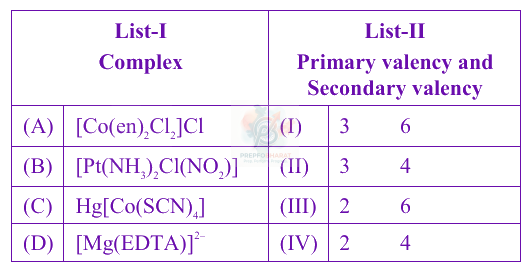 Choose the correct answer from the options given below :
In the given structure, number of sp and $\mathrm{sp}^2$ hybridized carbon atoms present respectively are : 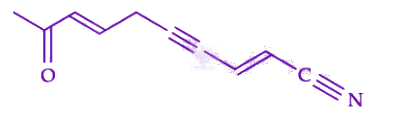
Which of the following electronegativity order is incorrect?
Identify the inorganic sulphides that are yellow in colour : (A) $\left(\mathrm{NH}_4\right)_2 \mathrm{~S}$ (B) $\mathrm{Pbs}$ (C) $\mathrm{Cus}$ (D) $\mathrm{As}_2 \mathrm{~S}_3$ (E) $\mathrm{As}_2 \mathrm{~S}_5$ Choose the correct answer from the options given below :
The correct statements from the following are : (A) $\mathrm{Tl}^{3+}$ is a powerful oxidising agent (B) $\mathrm{Al}^{3+}$ does not get reduced easily (C) Both $\mathrm{Al}^{3+}$ and $\mathrm{Tl}^{3+}$ are very stable in solution (D) $\mathrm{Tl}^{+}$is more stable than $\mathrm{Tl}^{3+}$ (E) $\mathrm{Al}^{3+}$ and $\mathrm{Tl}^{+}$are highly stable Choose the correct answer from the options given below :
Which of the following statements are correct? A. The process of the addition an electron to a neutral gaseous atom is always exothermic B. The process of removing an electron from an isolated gaseous atom is always endothermic C. The $1^{\text {st }}$ ionization energy of the boron is less than that of the beryllium D. The electronegativity of C is 2.5 in $\mathrm{CH}_4$ and $\mathrm{CCl}_4$ E. Li is the most electropositive among elements of group I Choose the correct answer from the options gives below
Match List-I with List-II. $\begin{array}{llll} & \text{List-I} & & \text{List-II} \\(A) & \mathrm{Al}^{3+} < \mathrm{Mg}^{2+} < \mathrm{Na}^{+} < \mathrm{F}^{-} & (I) & \text{Ionisation Enthalpy} \\(B) & \mathrm{B} < \mathrm{C} < \mathrm{O} < \mathrm{N} & (II) & \text{Metallic character} \\(C) & \mathrm{B} < \mathrm{Al} < \mathrm{Mg} < \mathrm{K} & (III) & \text{Electronegativity} \\(D) & \mathrm{Si} < \mathrm{P} < \mathrm{S} < \mathrm{Cl} & (IV) & \text{Ionic radii}\end{array}$ Choose the correct answer from the options given below :
Which of the following molecules(s) show/s paramagnetic behavior? (A) $\mathrm{O}_2$ (B) $\mathrm{N}_2$ (C) $\mathrm{F}_2$ (D) $\mathrm{S}_2$ (E) $\mathrm{Cl}_2$ Choose the correct answer from the options given below :
Given below are two statements : Statement (I): Experimentally determined oxygen-oxygen bond lengths in the $\mathrm{O}_3$ are found to be same and the bond length is greater than that of a $\mathrm{O}=\mathrm{O}$ (double bond) but less than that of a single $(O-O)$ bond. Statement (II) : The strong lone pair-lone pair repulsion between oxygen atoms is solely responsible for the fact that the bond length in ozone is smaller than that of a double bond $(\mathrm{O}=\mathrm{O})$ but more than that of a single bond $(\mathrm{O}-\mathrm{O})$. In the light of the above statements, choose the correct answer from the options given below :
Which of the following statement is true with respect to $\mathrm{H}_2 \mathrm{O}, \mathrm{NH}_3$ and $\mathrm{CH}_4$ ? A. The central atoms of all the molecules are $\mathrm{sp}^3$ hybridized. B. The $\mathrm{H}-\mathrm{O}-\mathrm{H}, \mathrm{H}-\mathrm{N}-\mathrm{H}$ and $\mathrm{H}-\mathrm{C}-\mathrm{H}$ angles in the above molecules are $104.5^{\circ}, 107.5^{\circ}$ and $109.5^{\circ}$, respectively. C. The increasing order of dipole moment is $\mathrm{CH}_4 \lt \mathrm{NH}_3 \lt \mathrm{H}_2 \mathrm{O}$. D. Both $\mathrm{H}_2 \mathrm{O}$ and $\mathrm{NH}_3$ are Lewis acids and $\mathrm{CH}_4$ is a Lewis base. E. A solution of $\mathrm{NH}_3$ in $\mathrm{H}_2 \mathrm{O}$ is basic. In this solution $\mathrm{NH}_3$ and $\mathrm{H}_2 \mathrm{O}$ act as Lowry-Bronsted acid and base respectively. Choose the correct answer from the options given below:
Niobium ( Nb ) and ruthenium $(\mathrm{Ru})$ have " $x$ " and " $y$ " number of electrons in their respective 4 d orbitals. The value of $x+y$ is ______ -.
The molecules having square pyramidal geometry are
The number of molecules/ions that show linear geometry among the following is ________ $\mathrm{SO}_2, \mathrm{BeCl}_2, \mathrm{CO}_2, \mathrm{~N}_3^{-}, \mathrm{NO}_2, \mathrm{~F}_2 \mathrm{O}, \mathrm{XeF}_2, \mathrm{NO}_2^{+}, \mathrm{I}_3^{-}, \mathrm{O}_3$
Among \(\mathrm{SO}_2, \mathrm{NF}_3, \mathrm{NH}_3, \mathrm{XeF}_2, \mathrm{ClF}_3\) and \(\mathrm{SF}_4\), the hybridization of the molecule with non-zero dipole moment and highest number of lone-pairs of electrons on the central atom is
Given below are two statements : Statement I: $\mathrm{H}_2 \mathrm{Se}$ is more acidic than $\mathrm{H}_2 \mathrm{Te}$. Statement II : $\mathrm{H}_2 \mathrm{Se}$ has higher bond enthalpy for dissociation than $\mathrm{H}_2 \mathrm{Te}$. In the light of the above statements, choose the correct answer from the options given below.
The metal ion whose electronic configuration is not affected by the nature of the ligand and which gives a violet colour in non-luminous flame under hot condition in borax bead test is
Which of the following ions is the strongest oxidizing agent? (Atomic Number of $\mathrm{Ce}=58, \mathrm{Eu}=63, \mathrm{~Tb}=65, \mathrm{Lu}=71$ )
The number of paramagnetic metal complex species among $\left[\mathrm{Co}\left(\mathrm{NH}_3\right)_6\right]^{3+}, \quad\left[\mathrm{Co}\left(\mathrm{C}_2 \mathrm{O}_4\right)_3\right]^{3-}$, $\left[\mathrm{MnCl}_6\right]^{3-},\left[\mathrm{Mn}(\mathrm{CN})_6\right]^{3-},\left[\mathrm{CoF}_6\right]^{3-},\left[\mathrm{Fe}(\mathrm{CN})_6\right]^{3^{3-}}$ and $\left[\mathrm{FeF}_6\right]^{3-}$ with same number of unpaired electrons is ________.
Total number of sigma ($\sigma$) and $\mathrm{pi}(\pi)$ bonds respectively present in hex-1-en-4-yne are :
Choose the incorrect trend in the atomic radii $(\mathrm{r})$ of the elements :
Given below are two statements Statement I : The N-N single bond is weaker and longer than that of $\mathrm{P}-\mathrm{P}$ single bond Statement II : Compounds of group 15 elements in +3 oxidation states readily undergo disproportionation reactions. In the light of above statements, choose the correct answer from the options given below
Given below are two statements : Statement (I) : An element in the extreme left of the periodic table forms acidic oxides. Statement (II) : Acid is formed during the reaction between water and oxide of a reactive element present in the extreme right of the periodic table. In the light of the above statements, choose the correct answer from the options given below :
Given below are two statements : Statement (I) : In octahedral complexes, when \(\Delta_{\mathrm{o}} \lt \mathrm{P}\) high spin complexes are formed. When \(\Delta_{\mathrm{o}} \gt \mathrm{P}\) low spin complexes are formed. Statement (II) : In tetrahedral complexes because of \(\Delta_{\mathrm{t}} \lt \mathrm{P}\), low spin complexes are rarely formed. In the light of the above statements, choose the most appropriate answer from the options given below :
Given below are two statements: Statement (I) : for $\mathrm{ClF}_3$, all three possible structures may be drawn as follows. 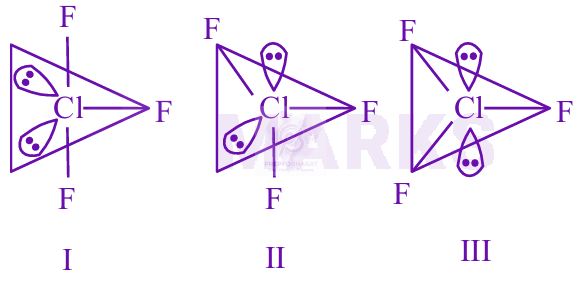 Statement (II) : Structure III is most stable, as the orbitals having the lone pairs are axial, where the $\ell \mathrm{p}-\mathrm{bp}$ repulsion is minimum. In the light of the above statements, choose the most appropriate answer from the options given below:
The number of valence electrons present in the metal among $\mathrm{Cr}, \mathrm{Co}, \mathrm{Fe}$ and Ni which has the lowest enthalpy of atomisation is
The elements of Group 13 with highest and lowest first ionisation enthalpies are respectively:
The spin only magnetic moment ( $\mu$ ) value (B.M.) of the compound with strongest oxidising power among $\mathrm{Mn}_2 \mathrm{O}_3, \mathrm{TiO}$ and VO is ____ B.M. (Nearest integer).
Given below are the pairs of group 13 element showing their relation in terms of atomic radius. $(\mathrm{B} \lt \mathrm{Al}),(\mathrm{Al} \lt \mathrm{Ga}),(\mathrm{Ga} \lt \mathrm{In}) \text { and }(\mathrm{In} \lt \mathrm{Tl})$ Identify the elements present in the incorrect pair and in that pair find out the element (X) that has higher ionic radius $\left(\mathrm{M}^{3+}\right)$ that the other one. The atomic number of the element $(\mathrm{X})$ is
Lanthanoid ions with $4 f^7$ configuration are : (A) $\mathrm{Eu}^{2+}$ (B) $\mathrm{Gd}^{3+}$ (C) $\mathrm{Eu}^{3+}$ (D) $\mathrm{Tb}^{3+}$ (E) $\mathrm{Sm}^{2+}$ Choose the correct answer from the options given below :
The molar mass of the water insoluble product formed from the fusion of chromite ore \(\left(\mathrm{FeCr}_2 \mathrm{O}_4\right)\) with \(\mathrm{Na}_2 \mathrm{CO}_3\) in presence of \(\mathrm{O}_2\) is _______ \(\mathrm{g} \mathrm{mol}^{-1}\).
The correct option with order of melting points of the pairs \((\mathrm{Mn}, \mathrm{Fe}),(\mathrm{Tc}, \mathrm{Ru})\) and \((\mathrm{Re}, \mathrm{Os})\) is :
Given below are two statements : Statement (I): The metallic radius of Al is less than that of Ga. Statement (II) : The ionic radius of \(\mathrm{Al}^{3+}\) is less than that of \(\mathrm{Ga}^{3+}\). In the light of the above statements, choose the most appropriate answer from the options given below :
Find the compound ' A ' from the following reaction sequences. $\mathrm{A} \xrightarrow{\text { aqua-regia }} \mathrm{B} \xrightarrow[\text { (2) } \mathrm{AcOH}]{\text { (1) } \mathrm{KNO}_2 \mid \mathrm{NH}_4 \mathrm{OH}} \text { yellow ppt }$
The spin-only magnetic moment value of $\mathrm{M}^{\mathrm{n+-}}$ ion formed among $\mathrm{Ni}, \mathrm{Zn} \mathrm{Mn}$ and Cu that has the least enthalpy of atomisation is ________. (in nearest integer) Here n is equal to the number of diamagnetic complexes among $\mathrm{K}_2\left[\mathrm{NiCl}_4\right],\left[\mathrm{Zn}\left(\mathrm{H}_2 \mathrm{O}\right)_6\right] \mathrm{Cl}_2$, $\mathrm{K}_3\left[\mathrm{Mn}(\mathrm{CN})_6\right] \text { and }\left[\mathrm{Cu}\left(\mathrm{PPh}_3\right)_3 \mathrm{I}\right]$
Arrange the following compounds in increasing order of their dipole moment : $\mathrm{HBr}, \mathrm{H}_2 \mathrm{~S}, \mathrm{NF}_3$ and $\mathrm{CHCl}_3$
Which one of the following complexes will have $\Delta_0=0$ and $\mu=5.96$ B.M.?
Among, $\mathrm{Sc}, \mathrm{Mn}, \mathrm{Co}$ and Cu , identify the element with highest enthalpy of atomisation. The spin only magnetic moment value of that element in its +2 oxidation state is _____ BM (in nearest integer).
A group 15 element forms $\mathrm{d} \pi-\mathrm{d} \pi$ bond with transition metals. It also forms hydride, which is a strongest base among the hydrides of other group members that form $\mathrm{d} \pi-\mathrm{d} \pi$ bond. The atomic number of the element is ____.
Identify the coordination complexes in which the central metal ion has $d^4$ configuration. 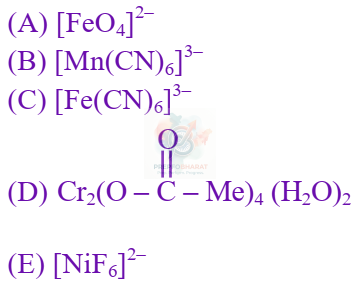 Choose the correct answer from the options given below :
Match the LIST-I with LIST-II 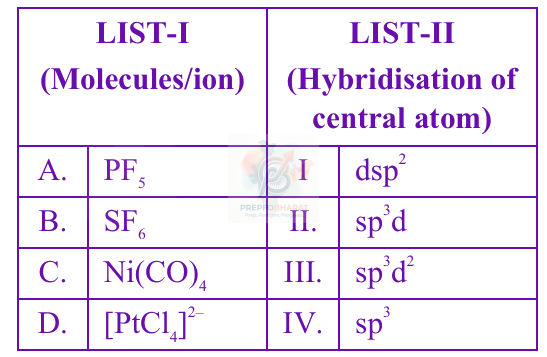 Choose the correct answer from the options given below :
The d-orbital electronic configuration of the complex among $\quad\left[\mathrm{Co}(\mathrm{en})_3\right]^{3+}, \quad\left[\mathrm{CoF}_6\right]^{3-}$, $\left[\mathrm{Mn}\left(\mathrm{H}_2 \mathrm{O}\right)_6\right]^{2+}$ and $\left[\mathrm{Zn}\left(\mathrm{H}_2 \mathrm{O}\right)_6\right]^{2+}$ that has the highest CFSE is :
$\mathrm{KMnO}_4$ acts as an oxidising agent in acidic medium. ' X ' is the difference between the oxidation states of Mn in reactant and product. ' Y ' is the number of ' d ' electrons present in the brown red precipitate formed at the end of the acetate ion test with neutral ferric chloride. The value of $\mathrm{X}+\mathrm{Y}$ is ______.
The incorrect decreasing order of atomic radii is
The correct order of $\left[\mathrm{FeF}_6\right]^{3-},\left[\mathrm{CoF}_6\right]^{3-},\left[\mathrm{Ni}(\mathrm{CO})_4\right]$ and $\left[\mathrm{Ni}(\mathrm{CN})_4\right]^{2-}$ complex species based on the number of unpaired electrons present is :
The sum of sigma \((\sigma)\) and pi \((\pi)\) bonds in Hex-1,3-dien-5-yne is _______.
The complex that shows Facial - Meridional isomerism is:
Which of the following linear combination of atomic orbitals will lead to formation of molecular orbitals in homonuclear diatomic molecules [internuclear axis in $z$-direction] ? A. $2 \mathrm{p}_{\mathrm{z}}$ and $2 \mathrm{p}_{\mathrm{x}}$ B. 2 s and $2 \mathrm{p}_{\mathrm{x}}$ C. $3 \mathrm{~d}_{\mathrm{xy}}$ and $3 \mathrm{~d}_{\mathrm{x}^2-y^2}$ D. 2 s and $2 \mathrm{p}_{\mathrm{z}}$ E. $2 p_z$ and $3 d_x{ }^2-y^2$ Choose the correct answer from the options given below:
The metal ions that have the calculated spin only magnetic moment value of 4.9 B.M. are A. $\mathrm{Cr}^{2+}$ B. $\mathrm{Fe}^{2+}$ C. $\mathrm{Fe}^{3+}$ D. $\mathrm{Co}^{2+}$ E. $\mathrm{Mn}^{3+}$ Choose the correct answer from the options given below
Match List - I with List - II. 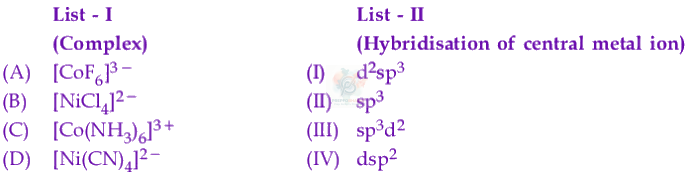 Choose the correct answer from the options given below :
The number of unpaired electrons responsible for the paramagnetic nature of the following complex species are respectively: $\left[\mathrm{Fe}(\mathrm{CN})_6\right]^{3-},\left[\mathrm{FeF}_6\right]^{3-},\left[\mathrm{CoF}_6\right]^{3-},\left[\mathrm{Mn}(\mathrm{CN})_6\right]^{3-}$
Pair of transition metal ions having the same number of unpaired electrons is :
An element ' \(E^{\prime}\) has the ionisation enthalpy value of \(374 \mathrm{~kJ} \mathrm{~mol}^{-1}\). ' \(E\) ' reacts with elements \(\mathrm{A}, \mathrm{B}, \mathrm{C}\) and D with electron gain enthalpy values of \(-328,-349,-325\) and \(-295 \mathrm{~kJ} \mathrm{~mol}^{-1}\), respectively. The correct order of the products EA, EB, EC and ED in terms of ionic character is :
Match the LIST-I withLIST-II.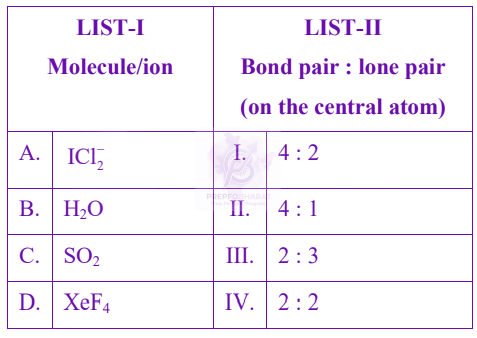 Choose the correct answer from the options given below :
Given below are two statements : Statement I : Nitrogen forms oxides with +1 to +5 oxidation states due to the formation of $\mathrm{p} \pi-\mathrm{p} \pi$ bond with oxygen. Statement II : Nitrogen does not form halides with +5 oxidation state due to the absence of d-orbital in it. In the light of given statements, choose the correct answer from the options given below.
First ionisation enthalpy values of first four group 15 elements are given below. Choose the correct value for the element that is a main component of apatite family :
The large difference between the melting and boiling points of oxygen and sulphur may be explained on the basis of
Match List - I with List - II. \begin{array}{llll} & List - I & & List - II \\(A) & Bronze & (I) &\mathrm{Cu}, \mathrm{Ni} \\(B) & Brass & (II) &\mathrm{Fe}, \mathrm{Cr}, \mathrm{Ni}, \mathrm{C} \\(C) & UK silver coin & (III) &\mathrm{Cu}, \mathrm{Zn} \\(D) & Stainless steel & (IV) &\mathrm{Cu}, \mathrm{Sn}\end{array} Choose the correct answer from the options given below :
Consider the following reactions 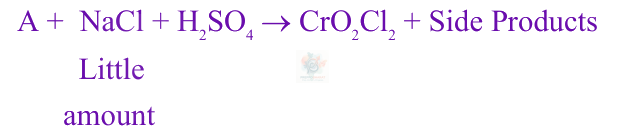 $\begin{aligned}<br />& \mathrm{CrO}_2 \mathrm{Cl}_{2(\text { Vapour })}+\mathrm{NaOH} \rightarrow \mathrm{~B}+\mathrm{NaCl}+\mathrm{H}_2 \mathrm{O} \\ & \mathrm{~B}+\mathrm{H}^{+} \rightarrow \mathrm{C}+\mathrm{H}_2 \mathrm{O}<br />\end{aligned}$ The number of terminal ' O ' present in the compound ' C ' is ______.
Match the LIST-I with LIST-II $\begin{array}{|l|l|c|l|}\hline & \begin{array}{c} \text{LIST-I} \\ \text{(Complex/} \\ \text{Species)} \end{array} & & \begin{array}{c} \text{LIST-II} \\ \text{(Shape & magnetic} \\ \text{moment)} \end{array} \\ \hline \text{A.} & {\left[\mathrm{Ni}(\mathrm{CO})_4\right]} & \text{I.} & \text{Tetrahedral, 2.8 BM} \\ \hline \text{B.} & {\left[\mathrm{Ni}(\mathrm{CN})_4\right]^{2-}} & \text{II.} & \text{Square planar, 0 BM} \\ \hline \text{C.} & {\left[\mathrm{NiCl}_4\right]^{2-}} & \text{III.} & \text{Tetrahedral, 0 BM} \\ \hline \text{D.} & {\left[\mathrm{MnBr}_4\right]^{2-}} & \text{IV.} & \text{Tetrahedral, 5.9 BM} \\ \hline \end{array}$ Choose the correct answer from the options given below :
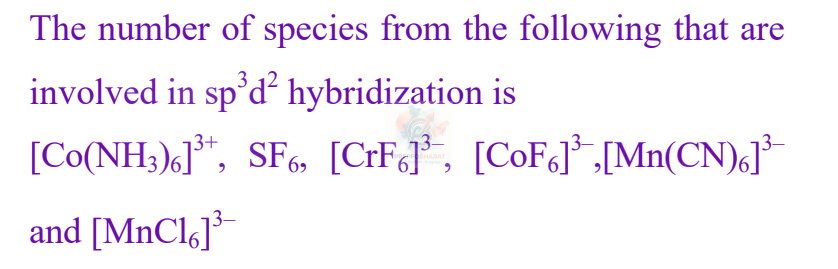
The number of paramagnetic complex among $\left[\mathrm{FeF}_6\right]^{3-},\left[\mathrm{Fe}(\mathrm{CN})_6\right]^{3-},\left[\mathrm{Mn}(\mathrm{CN})_6\right]^{3-},\left[\mathrm{Co}\left(\mathrm{C}_2 \mathrm{O}_4\right)_3\right]^{3-}$, $\left[\mathrm{MnCl}_6\right]^{3-}$ and $\left[\mathrm{CoF}_6\right]^{3-}$, which involved $\mathrm{d}^2 \mathrm{sp}^3$ hybridization is ____
Consider the following low-spin complexes $\mathrm{K}_3\left[\mathrm{Co}\left(\mathrm{NO}_2\right)_6\right], \mathrm{K}_4\left[\mathrm{Fe}(\mathrm{CN})_6\right]$, $\mathrm{K}_3\left[\mathrm{Fe}(\mathrm{CN})_6\right], \mathrm{Cu} u_2\left[\mathrm{Fe}(\mathrm{CN})_6\right] \text { and } \mathrm{Zn}_2\left[\mathrm{Fe}(\mathrm{CN})_6\right]$ The sum of the spin-only magnetic moment values of complexes having yellow colour is. _____ B.M. (answer in nearest integer)
Match List - I with List - II. 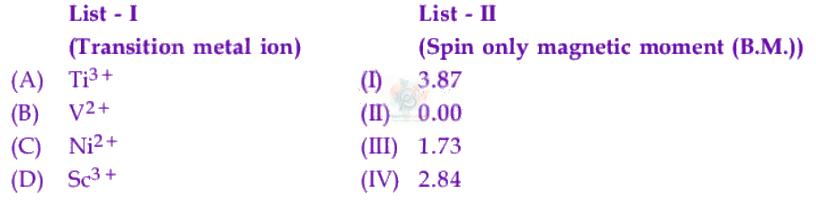 Choose the correct answer from the options given below :
One mole of the octahedral complex compound $\mathrm{Co}\left(\mathrm{NH}_3\right)_5 \mathrm{Cl}_3$ gives 3 moles of ions on dissolution in water. One mole of the same complex reacts with excess of $\mathrm{AgNO}_3$ solution to yield two moles of $\mathrm{AgCl}_{(\mathrm{s})}$. The structure of the complex is:
Identify the homoleptic complex(es) that is/are low spin. (A) $\left[\mathrm{Fe}(\mathrm{CN})_5 \mathrm{NO}\right]^{2-}$ (B) $\left[\mathrm{CoF}_6\right]^{3-}$ (C) $\left[\mathrm{Fe}(\mathrm{CN})_6\right]^{4-}$ (D) $\left[\mathrm{Co}\left(\mathrm{NH}_3\right)_6\right]^{3+}$ (E) $\quad\left[\mathrm{Cr}\left(\mathrm{H}_2 \mathrm{O}\right)_6\right]^{2+}$ Choose the correct answer from the options given below :
In which of the following complexes the CFSE, $\Delta_{\mathrm{o}}$ will be equal to zero?
Match the LIST-I with LIST-II 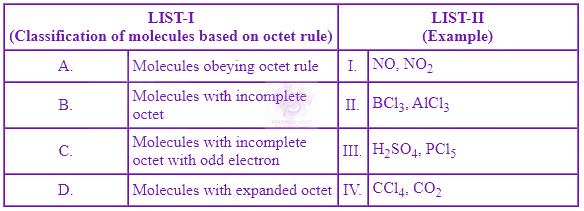 Choose the correct answer from the options given below:
Given below are two statements : Statement (I) : The first ionisation enthalpy of group 14 elements is higher than the corresponding elements of group 13. Statement (II) : Melting points and boiling points of group 13 elements are in general much higher than those of the corresponding elements of group 14. In the light of the above statements, choose the most appropriate answer from the options given below :
$\mathrm{CrCl}_3 \cdot \mathrm{xNH}_3$ can exist as a complex. 0.1 molal aqueous solution of this complex shows a depression in freezing point of $0.558^{\circ} \mathrm{C}$. Assuming $100 \%$ ionisation of this complex and coordination number of Cr is 6 , the complex will be (Given $\mathrm{K}_{\mathrm{f}}=1.86 \mathrm{~K} \mathrm{~kg} \mathrm{~mol}^{-1}$ )
Given below are two statements : Statement I : A homolepitc octahedral complex, formed using monodentate ligands, will not show stereoisomerism. Statement II : cis- and trans- platin are heteroleptic complexes of Pd. In the light of the above statements, choose the correct answer from the options given below.
Consider the following elements $\mathrm{In}, \mathrm{Tl}, \mathrm{Al}, \mathrm{Pb}, \mathrm{Sn}$ and Ge . The most stable oxidation states of elements with highest and lowest first ionisation enthalpies, respectively, are
Choose the correct tests with respective observations. (A) \(\mathrm{CuSO}_4\) (acidified with acetic acid) \(+ \mathrm{K}_4\left[\mathrm{Fe}(\mathrm{CN})_6\right] \rightarrow\) Chocolate brown precipitate. (B) \(\mathrm{FeCl}_3+\mathrm{K}_4\left[\mathrm{Fe}(\mathrm{CN})_6\right] \rightarrow\) Prussian blue precipitate. (C) \(\mathrm{ZnCl}_2+\mathrm{K}_4\left[\mathrm{Fe}(\mathrm{CN})_6\right]\), neutralised with \(\mathrm{NH}_4 \mathrm{OH}\) \(\rightarrow\) White or bluish white precipitate. (D) \(\mathrm{MgCl}_2+\mathrm{K}_4\left[\mathrm{Fe}(\mathrm{CN})_6\right] \rightarrow\) Blue precipitate. (E) \(\mathrm{BaCl}_2+\mathrm{K}_4\left[\mathrm{Fe}(\mathrm{CN})_6\right]\), neutralised with NaOH \(\rightarrow\) White precipitate. Choose the correct answer from the options given below :
Among the following cations, the number of cations which will give characteristic precipitate in their identification tests with $\mathrm{K}_4\left[\mathrm{Fe}(\mathrm{CN})_6\right]$ is _____. $\mathrm{Cu}^{2+}, \mathrm{Fe}^{3+}, \mathrm{Ba}^{2+}, \mathrm{Ca}^{2+}, \mathrm{NH}_4^{+}, \mathrm{Mg}^{2+}, \mathrm{Zn}^{2+}$
A molecule with the formula \(\mathrm{AX}_4 \mathrm{Y}\) has all it's elements from p-block. Element A is rarest, monoatomic, non-radioactive from its group and has the lowest ionization enthalpy value among A, X and Y. Elements X and Y have first and second highest electronegativity values respectively among all the known elements. The shape of the molecule is :
The correct set of ions (aqueous solution) with same colour from the following is:
In $\mathrm{SO}_2, \mathrm{NO}_2^{-}$and $\mathrm{N}_3^{-}$the hybridizations at the central atom are respectively :
The correct increasing order of stability of the complexes based on \(\Delta_{\mathrm{o}}\) value is : I. \(\left[\mathrm{Mn}(\mathrm{CN})_6\right]^{3-}\) II. \(\left[\mathrm{Co}(\mathrm{CN})_6\right]^{4-}\) III. \(\left[\mathrm{Fe}(\mathrm{CN})_6\right]^{4-}\) IV. \(\left[\mathrm{Fe}(\mathrm{CN})_6\right]^{3-}\)
Formation of $\mathrm{Na}_4\left[\mathrm{Fe}(\mathrm{CN})_5 \mathrm{NOS}\right]$, a purple coloured complex formed by addition of sodium nitroprusside in sodium carbonate extract of salt indicates the presence of :
Match the LIST-I with LIST-II. $\begin{array}{|l|l|l|l|}\hline & \begin{array}{c} \text{LIST-I} \\ \text{(Family)} \end{array} & & \begin{array}{c} \text{LIST-II} \\ \text{(Symbol of Element)} \end{array} \\ \hline \text{A.} & \begin{array}{l} \text{Pnicogen} \\ \text{(group 15)} \end{array} & \text{I.} & \text{Ts} \\ \hline \text{B.} & \text{Chalcogen} & \text{II.} & \text{Og} \\ \hline \text{C.} & \text{Halogen} & \text{III.} & \text{Lv} \\ \hline \text{D.} & \text{Noble gas} & \text{IV.} & \text{Mc} \\ \hline\end{array}$ Choose the correct answer from the options given below :
The atomic number of the element from the following with lowest $1^{\text {st }}$ ionisation enthalpy is :
The d- electronic configuration of an octahedral Co(II) complex having magnetic moment of 3.95 BM is:
The successive 5 ionisation energies of an element are $800,2427,3658,25024$ and $32824 \mathrm{~kJ} / \mathrm{mol}$, respectively. By using the above values predict the group in which the above element is present :
' $X$ ' is the number of electrons in $t_{2 g}$ orbitals of the most stable complex ion among $\left[\mathrm{Fe}\left(\mathrm{NH}_3\right)_6\right]^{3+}$, $\left[\mathrm{Fe}\left(\mathrm{Cl}_6\right)\right]^{3-},\left[\mathrm{Fe}\left(\mathrm{C}_2 \mathrm{O}_4\right)_3\right]^{3-}$ and $\left[\mathrm{Fe}\left(\mathrm{H}_2 \mathrm{O}\right)_6\right]^{3+}$. The nature of oxide of vanadium of the type $\mathrm{V}_2 \mathrm{O}_{\mathrm{X}}$ is:
The amphoteric oxide among $\mathrm{V}_2 \mathrm{O}_3, \mathrm{~V}_2 \mathrm{O}_4$ and $\mathrm{V}_2 \mathrm{O}_5$, upon reaction with alkali leads to formation of an oxide anion. The oxidation state of V in the oxide anion is :
When Ethane-1,2-diamine is added progressively to an aqueous solution of Nickel (II) chloride, the sequence of colour change observed will be :
The first transition series metal ' M ' has the highest enthalpy of atomisation in its series. One of its aquated ion $\left(\mathrm{M}^{\mathrm{n} \dagger}\right)$ exists in green colour. The nature of the oxide formed by the above $\mathrm{M}^{\mathrm{n}-}$ ion is :
Given below are two statements : Statement I : $\mathrm{CrO}_3$ is a stronger oxidizing agent than $\mathrm{MoO}_3$ Statement II : $\mathrm{Cr}(\mathrm{VI})$ is more stable than $\mathrm{Mo}(\mathrm{VI})$ In the light of the above statements, choose the correct answer from the options given below
Electronic configuration of four elements $\mathrm{A}, \mathrm{B}, \mathrm{C}$ and D are given below : (A) $1 \mathrm{~s}^2 2 \mathrm{~s}^2 2 \mathrm{p}^3$ (B) $1 \mathrm{~s}^2 2 \mathrm{~s}^2 2 \mathrm{p}^4$ (C) $1 \mathrm{~s}^2 2 \mathrm{~s}^2 2 \mathrm{p}^5$ (D) $1 \mathrm{~s}^2 2 \mathrm{~s}^2 2 \mathrm{p}^2$ Which of the following is the correct order of increasing electronegativity (Pauling's scale)?
' X ' is the number of acidic oxides among $\mathrm{VO}_2$, $\mathrm{V}_2 \mathrm{O}_3, \mathrm{CrO}_3, \mathrm{~V}_2 \mathrm{O}_5$ and $\mathrm{Mn}_2 \mathrm{O}_7$. The primary valency of cobalt in $\left[\mathrm{Co}\left(\mathrm{H}_2 \mathrm{NCH}_2 \mathrm{CH}_2 \mathrm{NH}_2\right)_3\right]_2\left(\mathrm{SO}_4\right)_3$ is Y. The value of $\mathrm{X}+\mathrm{Y}$ is :
Number of stereoisomers possible for the complexes, $\left[\mathrm{CrCl}_3(\mathrm{py})_3\right]$ and $\left[\mathrm{CrCl}_2(\mathrm{ox})_2\right]^{3-}$ are respectively ( $\mathrm{py}=$ pyridine, $\mathrm{ox}=$ oxalate)
The correct orders among the following are Atomic radius : $\mathrm{B} \lt \mathrm{Al} \lt \mathrm{Ga} \lt \mathrm{In} \lt \mathrm{Tl}$ Electronegativity : $\mathrm{Al} \lt \mathrm{Ga} \lt \mathrm{In} \lt \mathrm{Tl} \lt \mathrm{B}$ Density : $\mathrm{Tl} \lt \mathrm{In} \lt \mathrm{Ga} \lt \mathrm{Al} \lt \mathrm{B}$ 1st Ionisation Energy : In $ \lt \mathrm{Al} \lt \mathrm{Ga} \lt \mathrm{Tl} \lt \mathrm{B}$ Choose the correct answer from the options given below :
The property/properties that show irregularity in first four elements of group-17 is/are : (A) Covalent radius (B) Electron affinity (C) Ionic radius (D) First ionization energy Choose the correct answer from the options given below:
The correct decreasing order of spin only magnetic moment values $(\mathrm{BM})$ of $\mathrm{Cu}^{+}, \mathrm{Cu}^{2+}, \mathrm{Cr}^{2+}$ and $\mathrm{Cr}^{3+}$ ions is :
Given below are two statements : Statement (I): According to the Law of Octaves, the elements were arranged in the increasing order of their atomic number. Statement (II): Meyer observed a periodically repeated pattern upon plotting physical properties of certain elements against their respective atomic numbers. In the light of the above statements, choose the correct answer from the options given below :
A transition metal \((\mathrm{M})\) among \(\mathrm{Mn}, \mathrm{Cr}, \mathrm{Co}\) and Fe has the highest standard electrode potential \(\left(\mathrm{M}^{3+} / \mathrm{M}^{2+}\right)\). It forms a metal complex of the type \(\left[\mathrm{M}(\mathrm{CN})_6\right]^{4-}\). The number of electrons present in the \(\mathrm{e}_{\mathrm{g}}\) orbital of the complex is _________.
The nature of oxide $\left(\mathrm{TeO}_2\right)$ and hydride $\left(\mathrm{TeH}_2\right)$ formed by Te , respectively are :
When a salt is treated with sodium hydroxide solution it gives gas $\mathrm{X}$. On passing gas $\mathrm{X}$ through reagent $\mathrm{Y}$ a brown coloured precipitate is formed. $\mathrm{X}$ and $\mathrm{Y}$ respectively, are
Which of the following statements are NOT true about the periodic table? A. The properties of elements are function of atomic weights. B. The properties of elements are function of atomic numbers. C. Elements having similar outer electronic configurations are arranged in same period. D. An element's location reflects the quantum numbers of the last filled orbital. E. The number of elements in a period is same as the number of atomic orbitals available in energy level that is being filled. Choose the correct answer from the options given below:
Match List - I with List - II. \(\begin{array}{ll} & \text { List - I } & & \text { List - II } \\ & \text { (Complex) } & & \text { (Hybridisation & Magnetic characters) } \\ \text{(A)} & \left[\mathrm{MnBr}_4\right]^{2-} & \text{(I)} & d^2 s^3 \text{ & diamagnetic} \\ \text{(B)} & \left[\mathrm{FeF}_6\right]^{3-} & \text{(II)} & \mathrm{sp}^3 \mathrm{~d}^2 \text{ & paramagnetic} \\ \text{(C)} & \left[\mathrm{Co}\left(\mathrm{C}_2 \mathrm{O}_4\right)_3\right]^{3-} & \text{(III)} & \mathrm{sp}^3 \text{ & diamagnetic} \\ \text{(D)} & \left[\mathrm{Ni}(\mathrm{CO})_4\right] & \text{(IV)} & \mathrm{sp}^3 \text{ & paramagnetic} \end{array}\) Choose the correct answer from the options given below :
Consider the following reactions $\mathrm{K}_2 \mathrm{Cr}_2 \mathrm{O}_7 \xrightarrow[-\mathrm{H}_2 \mathrm{O}]{\mathrm{KOH}}[\mathrm{A}] \xrightarrow[-\mathrm{H}_2 \mathrm{O}]{\mathrm{H}_2 \mathrm{SO}_4}[\mathrm{~B}]+\mathrm{K}_2 \mathrm{SO}_4$ The products $[A]$ and $[B]$, respectively are :
The complex of $\mathrm{Ni}^{2+}$ ion and dimethyl glyoxime contains ________ number of Hydrogen $(\mathrm{H})$ atoms.
The correct order of the complexes $\left[\mathrm{Co}\left(\mathrm{NH}_3\right)_5\left(\mathrm{H}_2 \mathrm{O}\right)\right]^{3+}$ (A), $\left[\mathrm{Co}\left(\mathrm{NH}_3\right)_6\right]^{3+}$ (B), $\left[\mathrm{Co}(\mathrm{CN})_6\right]^{3-}(\mathrm{C})$ and $\left[\mathrm{CoCl}\left(\mathrm{NH}_3\right)_5\right]^{2+}(\mathrm{D})$ in terms wavelength of light absorbed is :
Total number of molecules/species from following which will be paramagnetic is ______ $\mathrm{O}_2, \mathrm{O}_2^{+}, \mathrm{O}_2^{-}, \mathrm{NO}, \mathrm{NO}_2, \mathrm{CO}, \mathrm{K}_2\left[\mathrm{NiCl}_4\right],\left[\mathrm{Co}\left(\mathrm{NH}_3\right)_6\right] \mathrm{Cl}_3, \mathrm{~K}_2\left[\mathrm{Ni}(\mathrm{CN})_4\right]$
Preparation of potassium permanganate from $\mathrm{MnO}_2$ involves two step process in which the 1st step is a reaction with KOH and $\mathrm{KNO}_3$ to produce
In 3, 3-dimethylhex-1-ene-4-yne, there are _______ $\mathrm{sp}^3$, _______ $\mathrm{sp}^2$ and _______ sp hybridised carbon atoms respectively :
The incorrect relationship in the following pairs in relation to ionisation enthalpies is :
The correct order of the following complexes in terms of their crystal field stabilization energies is :
The maximum covalency of a non-metallic group 15 element ' E ' with weakest $\mathrm{E}-\mathrm{E}$ bond is :
Identify the diamagnetic octahedral complex ions from below ; A. $\left[\mathrm{Mn}(\mathrm{CN})_6\right]^{3-}$ B. $\left[\mathrm{Co}\left(\mathrm{NH}_3\right)_6\right]^{3+}$ C. $\left[\mathrm{Fe}(\mathrm{CN})_6\right]^{4-}$ D. $\left[\mathrm{Co}\left(\mathrm{H}_2 \mathrm{O}\right)_3 \mathrm{~F}_3\right]$ Choose the correct answer from the options given below :
Which among the following molecules is (a) involved in $\mathrm{sp}^3 \mathrm{~d}$ hybridization, (b) has different bond lengths and (c) has lone pair of electrons on the central atom?
The type of oxide formed by the element among $\mathrm{Li}, \mathrm{Na}, \mathrm{Be}, \mathrm{Mg}, \mathrm{B}$ and Al that has the least atomic radius is :
The element that does not belong to the same period of the remaining elements (modern periodic table) is:
The number of optical isomers exhibited by the iron complex (A) obtained from the following reaction is ________ $\mathrm{FeCl}_3+\mathrm{KOH}+\mathrm{H}_2 \mathrm{C}_2 \mathrm{O}_4 \rightarrow \mathrm{~A}$
The conditions and consequence that favours the $t_{2 g}^3 e_g^1$ configuration in a metal complex are
Identify $\mathrm{A}, \mathrm{B}$ and C in the given below reaction sequence $\mathrm{A} \xrightarrow{\mathrm{HNO}_3} \mathrm{~Pb}\left(\mathrm{NO}_3\right)_2 \xrightarrow{\mathrm{H}_2 \mathrm{SO}_4}$ B $\xrightarrow[\substack{\text { (2) Acetic acid } \\ \text { (3) } \mathrm{K}_2 \mathrm{CrO}_4}]{\substack{\text { (1) Ammonium } \\ \text { acetate }}}$
Which of the following oxidation reactions are carried out by both $\mathrm{K}_2 \mathrm{Cr}_2 \mathrm{O}_7$ and $\mathrm{KMnO}_4$ in acidic medium? A. $\Gamma^{-} \rightarrow \mathrm{I}_2$ B. $S^{2-} \rightarrow S$ C. $\mathrm{Fe}^{2+} \rightarrow \mathrm{Fe}^{3+}$ D. $\Gamma^{-} \rightarrow \mathrm{IO}_3{ }^{-}$ E. $\mathrm{S}_2 \mathrm{O}_3{ }^{2-} \rightarrow \mathrm{SO}_4{ }^{2-}$ Choose the correct answer from the options given below:
The type of hybridization and the magnetic property of $\left[\mathrm{MnCl}_6\right]^{3-}$ are :
Which of the following electrolyte can be used to obtain $\mathrm{H}_2 \mathrm{~S}_2 \mathrm{O}_8$ by the process of electrolysis?
Given below are two statements : Statement (I) : The first ionization energy of Pb is greater than that of Sn . Statement (II) : The first ionization energy of Ge is greater than that of Si . In the light of the above statements, choose the correct answer from the options given below :
A metal complex with a formula $\mathrm{MC} \ell_4 \cdot 3 \mathrm{NH}_3$ is involved in $\mathrm{sp}^3 \mathrm{~d}^2$ hybridisation. It upon reaction with excess of $\mathrm{AgNO}_3$ solution gives ' x ' moles of AgCl. Consider ' x ' is equal to the number of lone pairs of electron present in central atom of $\mathrm{BrF}_5$. Then the number of geometrical isomers exhibited by the complex is ______.
From the magnetic behaviour of $\left[\mathrm{NiCl}_4\right]^{2-}$ (paramagnetic) and $\left[\mathrm{Ni}(\mathrm{CO})_4\right]$ (diamagnetic), choose the correct geometry and oxidation state.
The incorrect statement among the following is options ${ }_1$.
Consider ' $n$ ' is the number of lone pair of electrons present in the equatorial position of the most stable structure of $\mathrm{ClF}_3$. The ions from the following with ' $n$ ' number of unpaired electrons are A. $\mathrm{V}^{3+}$ B. $\mathrm{Ti}^{3+}$ C. $\mathrm{Cu}^{2+}$ D. $\mathrm{Ni}^{2+}$ E. $\mathrm{Ti}^{2+}$ Choose the correct answer from the options given below: