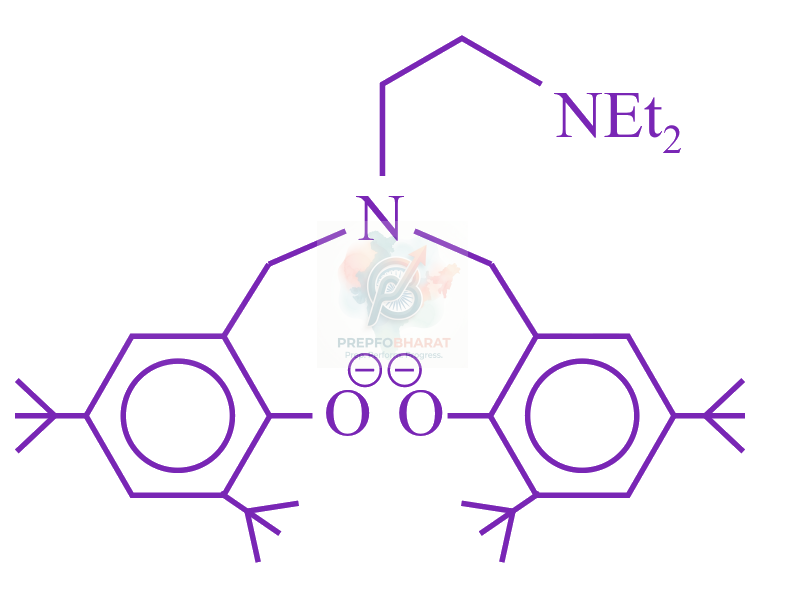
The number of lone pairs that can be used by ligands is a measure of its denticity. In the given compound, both oxygen atoms and both nitrogen atoms are used as ligands and have lone pairs. Hence denticity is tetradentate.
The following ligand is: JEE Main 2019 Chemistry, Coordination Compounds — question figure
JEE Main 2019 — Chemistry Inorganic Chemistry
2019mcqmedium
The following ligand is:
Official previous-year question
Held on 8 Apr 2019 · Verified 6 Jul 2026.
Options
- A
tridentate
- B
hex dentate
- C
bidentate
- D
tetradentate
Did you get this right?
Sign in to track your attempts and accuracy.
Your note
Sign in to keep a private note on this question. Nothing you write is ever public.
JEE Main Inorganic Chemistry in other years
More JEE Main Inorganic Chemistry questions
It is noticed that $\mathrm{Pb}^{2+}$ is more stable than $\mathrm{Pb}^{4+}$ but $\mathrm{Sn}^{2+}$ is less stable than $\mathrm{Sn}^{4+}$. Observe the following reactions. $\mathrm{PbO}_{2}+\mathrm{Pb} \rightarrow 2 \mathrm{PbO} ; \Delta_{\mathrm{r}} \mathrm{G}^{\circ}(1)$ $\mathrm{SnO}_{2}+\mathrm{Sn} \rightarrow 2 \mathrm{SnO} ; \Delta_{\mathrm{r}} \mathrm{G}^{\circ}(2)$ Identify the correct set from the following
2026medium
An excess of AgNO$_3$ is added to $100$ mL of a $0.05$ M solution of tetraaquadichloridochromium (III) chloride. The number of moles of AgCl precipitated will be __________ $\times 10^{-3}$. (Nearest integer)
2026medium
Which of the following elements has the highest electronegativity?
2026easy
First and second ionization enthalpies of lithium are $520$ kJ mol$^{-1}$ and $7297$ kJ mol$^{-1}$ respectively. Energy required to convert $3.5$ mg lithium (g) into $\text{Li}^{2+}$(g) $[\text{Li(g)} \rightarrow \text{Li}^{2+}\text{(g)}]$ is _______ kJ mol$^{-1}$. (nearest integer) [Molar mass of Li $= 7$ g mol$^{-1}$]
2026medium
Identify the molecule $(X)$ with maximum number of lone pairs of electrons (obtained using Lewis dot structure) among $\mathrm{HNO}_{3}, \mathrm{H}_{2} \mathrm{SO}_{4}, \mathrm{NF}_{3}$ and $\mathrm{O}_{3}$. Choose the correct bond angle made by the central atom of the molecule $(\mathrm{X})$.
2026hard
Other Chemistry topics for JEE Main
Keep practicing Inorganic Chemistry
Work through every JEE Main Inorganic Chemistry PYQ, year by year.