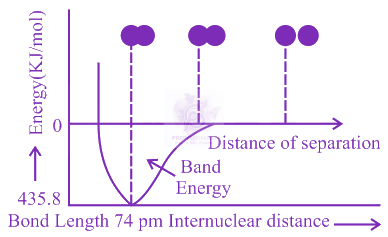
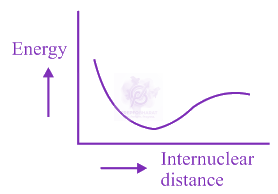
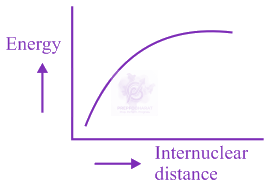
The potential energy curve for the formation of H2 molecule as a function of internuclear distance of the H atoms. The minima in the curve corresponds to the most stable state of H2.
JEE Main 2020 — Chemistry Inorganic Chemistry
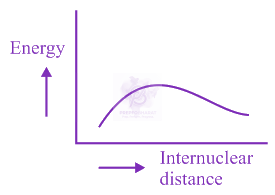
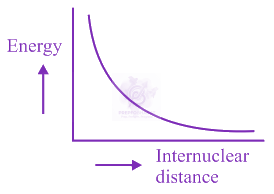
The potential energy curve for the H2 molecule as a function of internuclear distance is:
Held on 5 Sept 2020 · Verified 6 Jul 2026.
Sign in to track your attempts and accuracy.
Sign in to keep a private note on this question. Nothing you write is ever public.
It is noticed that $\mathrm{Pb}^{2+}$ is more stable than $\mathrm{Pb}^{4+}$ but $\mathrm{Sn}^{2+}$ is less stable than $\mathrm{Sn}^{4+}$. Observe the following reactions. $\mathrm{PbO}_{2}+\mathrm{Pb} \rightarrow 2 \mathrm{PbO} ; \Delta_{\mathrm{r}} \mathrm{G}^{\circ}(1)$ $\mathrm{SnO}_{2}+\mathrm{Sn} \rightarrow 2 \mathrm{SnO} ; \Delta_{\mathrm{r}} \mathrm{G}^{\circ}(2)$ Identify the correct set from the following
An excess of AgNO$_3$ is added to $100$ mL of a $0.05$ M solution of tetraaquadichloridochromium (III) chloride. The number of moles of AgCl precipitated will be __________ $\times 10^{-3}$. (Nearest integer)
Which of the following elements has the highest electronegativity?
First and second ionization enthalpies of lithium are $520$ kJ mol$^{-1}$ and $7297$ kJ mol$^{-1}$ respectively. Energy required to convert $3.5$ mg lithium (g) into $\text{Li}^{2+}$(g) $[\text{Li(g)} \rightarrow \text{Li}^{2+}\text{(g)}]$ is _______ kJ mol$^{-1}$. (nearest integer) [Molar mass of Li $= 7$ g mol$^{-1}$]
Identify the molecule $(X)$ with maximum number of lone pairs of electrons (obtained using Lewis dot structure) among $\mathrm{HNO}_{3}, \mathrm{H}_{2} \mathrm{SO}_{4}, \mathrm{NF}_{3}$ and $\mathrm{O}_{3}$. Choose the correct bond angle made by the central atom of the molecule $(\mathrm{X})$.
Work through every JEE Main Inorganic Chemistry PYQ, year by year.