BCl3
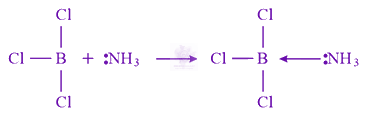
Boron react with chlorine gas to produce compound BCl3 which is electron deficient. It does not dimerize because of small boron atom. It react with ammonia to form aduct. In it ammonia act as lewis base and BCl3 act as lewis acid.
JEE Main 2018 — Chemistry Inorganic Chemistry
A group 13 element ′X′ reacts with chlorine gas to produce a compound XCl3.XCl3 is electron deficient and easily reacts with NH3toformCl3X←NH3 adduct; however, XCl3 does not dimerize. X is:
Held on 16 Apr 2018 · Verified 6 Jul 2026.
B
Al
In
Ga
Sign in to track your attempts and accuracy.
Sign in to keep a private note on this question. Nothing you write is ever public.
It is noticed that $\mathrm{Pb}^{2+}$ is more stable than $\mathrm{Pb}^{4+}$ but $\mathrm{Sn}^{2+}$ is less stable than $\mathrm{Sn}^{4+}$. Observe the following reactions. $\mathrm{PbO}_{2}+\mathrm{Pb} \rightarrow 2 \mathrm{PbO} ; \Delta_{\mathrm{r}} \mathrm{G}^{\circ}(1)$ $\mathrm{SnO}_{2}+\mathrm{Sn} \rightarrow 2 \mathrm{SnO} ; \Delta_{\mathrm{r}} \mathrm{G}^{\circ}(2)$ Identify the correct set from the following
An excess of AgNO$_3$ is added to $100$ mL of a $0.05$ M solution of tetraaquadichloridochromium (III) chloride. The number of moles of AgCl precipitated will be __________ $\times 10^{-3}$. (Nearest integer)
Which of the following elements has the highest electronegativity?
First and second ionization enthalpies of lithium are $520$ kJ mol$^{-1}$ and $7297$ kJ mol$^{-1}$ respectively. Energy required to convert $3.5$ mg lithium (g) into $\text{Li}^{2+}$(g) $[\text{Li(g)} \rightarrow \text{Li}^{2+}\text{(g)}]$ is _______ kJ mol$^{-1}$. (nearest integer) [Molar mass of Li $= 7$ g mol$^{-1}$]
Identify the molecule $(X)$ with maximum number of lone pairs of electrons (obtained using Lewis dot structure) among $\mathrm{HNO}_{3}, \mathrm{H}_{2} \mathrm{SO}_{4}, \mathrm{NF}_{3}$ and $\mathrm{O}_{3}$. Choose the correct bond angle made by the central atom of the molecule $(\mathrm{X})$.
Work through every JEE Main Inorganic Chemistry PYQ, year by year.