
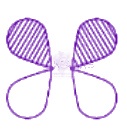

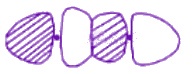
To determine the correct pictorial representation of a π∗ (π-antibonding) molecular orbital, we need to consider how it is formed.
A π molecular orbital is formed by the sideways (lateral) overlap of atomic orbitals (like p-orbitals) whose axes are perpendicular to the internuclear axis (z-axis).
An antibonding molecular orbital (π∗) is formed by the out-of-phase (subtractive) overlap of these atomic orbitals. This means the positive lobe of one orbital overlaps with the negative lobe of the other.
Visually, this out-of-phase overlap results in a nodal plane between the two nuclei, perpendicular to the internuclear axis, where the electron density is zero. The lobes of the orbitals are often depicted as bending away from each other due to repulsion.
Evaluating the given options:
Option (A) shows continuous electron density above and below the internuclear axis, which represents a π bonding molecular orbital.
Option (B) shows two p-orbitals with in-phase alignment (shaded lobe next to shaded lobe), which would combine to form a π bonding orbital.
Option (C) shows two p-orbitals with out-of-phase alignment (shaded lobe next to unshaded lobe). This creates a nodal plane between the nuclei, correctly representing a π∗ antibonding molecular orbital.
Option (D) shows overlap along the internuclear axis with a node between the nuclei, which represents a σ∗ antibonding molecular orbital.
Therefore, the diagram in (C) most correctly represents the π∗ molecular orbital.
Answer: