JEE Main 2025 — Coordinate Geometry
Mathematics Coordinate Geometry questions from JEE Main 2025.
Other Years
77 Coordinate Geometry Questions from 2025
Let \(A B C\) be a triangle formed by the lines \(7 x-6 y+3=0, x+2 y-31=0\) and \(9 x-2 y-19=0\). Let the point \((h, k)\) be the image of the centroid of \(\Delta A B C\) in the line \(3 x+6 y-53=0\). Then \(h^2+k^2+h k\) is equal to:
The axis of a parabola is the line $y=x$ and its vertex and focus are in the first quadrant at distances $\sqrt{2}$ and $2 \sqrt{2}$ units from the origin, respectively. If the point $(1, \mathrm{k})$ lies on the parabola, then a possible value of $k$ is :-
Let $e_1$ and $e_2$ be the eccentricities of the ellipse $\frac{\mathrm{x}^2}{\mathrm{~b}^2}+\frac{\mathrm{y}^2}{25}=1 \quad$ and the hyperbola $\quad \frac{\mathrm{x}^2}{16}-\frac{\mathrm{y}^2}{\mathrm{~b}^2}=1$, respectively. If $\mathrm{b} \lt 5$ and $\mathrm{e}_1 \mathrm{e}_2=1$, then the eccentricity of the ellipse having its axes along the coordinate axes and passing through all four foci (two of the ellipse and two of the hyperbola) is :
The length of the chord of the ellipse $\frac{x^2}{4}+\frac{y^2}{2}=1$, whose mid-point is $\left(1, \frac{1}{2}\right)$, is :
Let ${ }^{\mathrm{n}} \mathrm{C}_{\mathrm{r}-1}=28,{ }^{\mathrm{n}} \mathrm{C}_{\mathrm{r}}=56$ and ${ }^{\mathrm{n}} \mathrm{C}_{\mathrm{r}+1}=70$. Let $\mathrm{A}(4 \cos t, 4 \sin t), \mathrm{B}(2 \sin t,-2 \cos \mathrm{t})$ and $C\left(3 r-n, r^2-n-1\right)$ be the vertices of a triangle $A B C$, where $t$ is a parameter. If $(3 x-1)^2+(3 y)^2$ $=\alpha$, is the locus of the centroid of triangle ABC , then $\alpha$ equals
The focus of the parabola $y^2=4 x+16$ is the centre of the circle $C$ of radius 5 . If the values of $\lambda$, for which C passes through the point of intersection of the lines $3 x-y=0$ and $x+\lambda y=4$, are $\lambda_1$ and $\lambda_2, \lambda_1 \lt \lambda_2$, then $12 \lambda_1+29 \lambda_2$ is equal to $\qquad$
Let circle $C$ be the image of $x^2+y^2-2 x+4 y-4=0$ in the line $2 x-3 y+5=0$ and $A$ be the point on $C$ such that $O A$ is parallel to $x$-axis and $A$ lies on the right hand side of the centre $O$ of $C$. If $B(\alpha, \beta)$, with $\beta \lt 4$, lies on $C$ such that the length of the are $A B$ is $(1 / 6)^{\text {th }}$ of the perimeter of $C$, then $\beta-\sqrt{3} \alpha$ is equal to
Let $r$ be the radius of the circle, which touches x -axis at point $(\mathrm{a}, 0), \mathrm{a} \lt 0$ and the parabola $\mathrm{y}^2=9 \mathrm{x}$ at the point $(4,6)$. Then $r$ is equal to ________
Let $A B C D$ be a trapezium whose vertices lie on the parabola $y^2=4 x$. Let the sides $A D$ and $B C$ of the trapezium be parallel to y -axis. If the diagonal AC is of length $\frac{25}{4}$ and it passes through the point $(1,0)$, then the area of $A B C D$ is
Let the product of the focal distances of the point $\left(\sqrt{3}, \frac{1}{2}\right)$ on the ellipse $\frac{x^2}{a^2}+\frac{y^2}{b^2}=1,(\mathrm{a}\gt\mathrm{b})$, be $\frac{7}{4}$. Then the absolute difference of the eccentricities of two such ellipses is
Let the line \(x+y=1\) meet the circle \(x^2+y^2=4\) at the points A and B . If the line perpendicular to \(A B\) and passing through the mid point of the chord \(A B\) intersects the circle at \(C\) and \(D\), then the area of the quadrilateral ADBC is equal to :
Let the lines $3 x-4 y-\alpha=0,8 x-11 y-33=0$, and $2 x-3 y+\lambda=0$ be concurrent. If the image of the point $(1,2)$ in the line $2 x-3 y+\lambda=0$ is $\left(\frac{57}{13}, \frac{-40}{13}\right)$, then $|\alpha \lambda|$ is equal to
Let the parabola $y=x^2+\mathrm{p} x-3$, meet the coordinate axes at the points $\mathrm{P}, \mathrm{Q}$ and R . If the circle C with centre at $(-1,-1)$ passes through the points $P, Q$ and $R$, then the area of $\triangle P Q R$ is :
Let $y^2=12 x$ be the parabola and $S$ be its focus. Let PQ be a focal chord of the parabola such that $(\mathrm{SP})(\mathrm{SQ})=\frac{147}{4}$. Let C be the circle described taking PQ as a diameter. If the equation of a circle $C$ is $64 x^2+64 y^2-\alpha x-64 \sqrt{3} y=\beta$, then $\beta-\alpha$ is equal to ________.
The distance between two points (x₁,y₁) and (x₂,y₂) in a plane is:
A circle $C$ of radius 2 lies in the second quadrant and touches both the coordinate axes. Let $r$ be the radius of a circle that has centre at the point $(2,5)$ and intersects the circle $C$ at exactly two points. If the set of all possible values of r is the interval $(\alpha, \beta)$, then $3 \beta-2 \alpha$ is equal to :
Let the three sides of a triangle are on the lines $4 x-7 y+10=0, x+y=5$ and $7 x+4 y=15$. Then the distance of its orthocentre from the orthocentre of the triangle formed by the lines $x=0, y=0$ and $x+y=1$ is
Let $\mathrm{H}_1: \frac{x^2}{\mathrm{a}^2}-\frac{y^2}{\mathrm{~b}^2}=1$ and $\mathrm{H}_2:-\frac{x^2}{\mathrm{~A}^2}+\frac{y^2}{\mathrm{~B}^2}=1$ be two hyperbolas having length of latus rectums $15 \sqrt{2}$ and $12 \sqrt{5}$ respectively. Let their ecentricities be $e_1=\sqrt{\frac{5}{2}}$ and $e_2$ respectively. If the product of the lengths of their transverse axes is $100 \sqrt{10}$, then $25 \mathrm{e}_2^2$ is equal to ________.
Let the triangle PQR be the image of the triangle with vertices $(1,3),(3,1)$ and $(2,4)$ in the line $x+2 y=2$. If the centroid of $\triangle \mathrm{PQR}$ is the point $(\alpha, \beta)$, then $15(\alpha-\beta)$ is equal to :
Let $\mathrm{E}_1: \frac{x^2}{9}+\frac{y^2}{4}=1$ be an ellipse. Ellipses $\mathrm{E}_1$ 's are constructed such that their centres and eccentricities are same as that of $E_1$, and the length of minor axis of $E_i$ is the length of major axis of $E_{i+1}(i \geq 1)$. If $A_i$ is the area of the ellipse $E_i$, then $\frac{5}{\pi}\left(\sum_{i=1}^{\infty} A_i\right)$, is equal to
If $S$ and $S^{\prime}$ are the foci of the ellipse $\frac{x^2}{18}+\frac{y^2}{9}=1$ and P be a point on the ellipse, then $\min \left(S P . S^{\prime} \mathrm{P}\right)+$ $\max \left(\mathrm{SP} . \mathrm{S}^{\prime} \mathrm{P}\right)$ is equal to :
If the length of the minor axis of an ellipse is equal to one fourth of the distance between the foci, then the eccentricity of the ellipse is :
The length of the latus-rectum of the ellipse, whose foci are $(2,5)$ and $(2,-3)$ and eccentricity is $\frac{4}{5}$, is
Let the length of a latus rectum of an ellipse $\frac{x^2}{a^2}+\frac{y^2}{b^2}=1$ be 10 . If its eccentricity is the minimum value of the function $f(\mathrm{t})=\mathrm{t}^2+\mathrm{t}+\frac{11}{12}$, $\mathrm{t} \in \mathbf{R}$, then $\mathrm{a}^2+\mathrm{b}^2$ is equal to :
The absolute difference between the squares of the radii of the two circles passing through the point $(-9,4)$ and touching the lines $x+y=3$ and $x-y=3$, is equal to ______.
Let the sum of the focal distances of the point $\mathrm{P}(4,3)$ on the hyperbola $\mathrm{H}: \frac{\mathrm{x}^2}{\mathrm{a}^2}-\frac{\mathrm{y}^2}{\mathrm{~b}^2}=1$ be $8 \sqrt{\frac{5}{3}}$. If for $H$, the length of the latus rectum is $l$ and the product of the focal distances of the point P is m , then $9 l^2+6 \mathrm{~m}$ is equal to :-
If the midpoint of a chord of the ellipse $\frac{x^2}{9}+\frac{y^2}{4}=1$ is $(\sqrt{2}, 4 / 3)$, and the length of the chord is $\frac{2 \sqrt{\alpha}}{3}$, then $\alpha$ is :
A line passing through the point $\mathrm{P}(\sqrt{5}, \sqrt{5})$ intersects the ellipse $\frac{\mathrm{x}^2}{36}+\frac{\mathrm{y}^2}{25}=1$ at $A$ and $B$ such that $(P A) .(P B)$ is maximum. Then $5\left(P A^2+P B^2\right)$ is equal to :
Let ABC be the triangle such that the equations of lines $A B$ and $A C$ be $3 y-x=2$ and $x+y=2$, respectively, and the points B and C lie on x -axis. If $P$ is the orthocentre of the triangle $A B C$, then the area of the triangle PBC is equal to
If $\alpha x+\beta y=109$ is the equation of the chord of the ellipse $\frac{x^2}{9}+\frac{y^2}{4}=1$, whose mid point is $\left(\frac{5}{2}, \frac{1}{2}\right)$, then $\alpha+\beta$ is equal to :
Let A and B be the two points of intersection of the line $y+5=0$ and the mirror image of the parabola $y^2=4 x$ with respect to the line $x+y+4=0$. If d denotes the distance between A and B , and a denotes the area of $\triangle S A B$, where $S$ is the focus of the parabola $y^2=4 x$, then the value of $(a+d)$ is $\qquad$ -
Let a circle $C$ pass through the points $(4,2)$ and $(0,2)$, and its centre lie on $3 x+2 y+2=0$. Then the length of the chord, of the circle $C$, whose mid-point is $(1,2)$, is :
Let $\mathrm{A}(4,-2), \mathrm{B}(1,1)$ and $\mathrm{C}(9,-3)$ be the vertices of a triangle $A B C$. Then the maximum area of the parallelogram AFDE , formed with vertices $\mathrm{D}, \mathrm{E}$ and F on the sides $\mathrm{BC}, \mathrm{CA}$ and AB of the triangle ABC respectively, is ______ .
Let the ellipse $3 x^2+\mathrm{py}^2=4$ pass through the centre $C$ of the circle $x^2+y^2-2 x-4 y-11=0$ of radius $r$. Let $f_1, f_2$ be the focal distances of the point C on the ellipse. Then $6 f_1 f_2-r$ is equal to
If the equation of the parabola with vertex $\mathrm{V}\left(\frac{3}{2}, 3\right)$ and the directrix $x+2 y=0$ is $\alpha x^2+\beta y^2-\gamma x y-30 x-60 y+225=0$, then $\alpha+\beta+\gamma$ is equal to :
Let $\mathrm{P}(4,4 \sqrt{3})$ be a point on the parabola $y^2=4 \mathrm{a} x$ and PQ be a focal chord of the parabola. If M and $N$ are the foot of perpendiculars drawn from $P$ and $Q$ respectively on the directrix of the parabola, then the area of the quadrilateral PQMN is equal to :
Consider the lines $\mathrm{x}(3 \lambda+1)+\mathrm{y}(7 \lambda+2)=17 \lambda+5$, $\lambda$ being a parameter, all passing through a point P . One of these lines (say L) is farthest from the origin. If the distance of $L$ from the point $(3,6)$ is $d$, then the value of $d^2$ is
A line passes through the origin and makes equal angles with the positive coordinate axes. It intersects the lines $\mathrm{L}_1: 2 \mathrm{x}+\mathrm{y}+6=0$ and $\mathrm{L}_2: 4 \mathrm{x}+2 \mathrm{y}-\mathrm{p}=0, \mathrm{p} \gt 0$, at the points $A$ and $B$, respectively. If $A B=\frac{9}{\sqrt{2}}$ and the foot of the perpendicular from the point A on the line $L_2$ is $M$, then $\frac{A M}{B M}$ is equal to
Let the focal chord $P Q$ of the parabola $y^2=4 x$ make an angle of $60^{\circ}$ with the positive $x$-axis, where P lies in the first quadrant. If the circle, whose one diameter is PS, S being the focus of the parabola, touches the $y$-axis at the point $(0, \alpha)$, then $5 \alpha^2$ is equal to :
If the four distinct points $(4,6),(-1,5),(0,0)$ and $(\mathrm{k}, 3 \mathrm{k})$ lie on a circle of radius r , then $10 \mathrm{k}+\mathrm{r}^2$ is equal to
Consider the hyperbola $\frac{x^2}{a^2}-\frac{y^2}{b^2}=1$ having one of its focus at $\mathrm{P}(-3,0)$. If the latus ractum through its other focus subtends a right angle at P and $a^2 b^2=\alpha \sqrt{2}-\beta, \alpha, \beta \in \mathbb{N}$.
Let for two distinct values of $p$ the lines $y=x+p$ touch the ellipse $\mathrm{E}: \frac{\mathrm{x}^2}{4^2}+\frac{\mathrm{y}^2}{3^2}=1$ at the points A and B . Let the line $\mathrm{y}=\mathrm{x}$ intersect E at the points C and $D$. Then the area of the quadrilateral $A B C D$ is equal to
Two parabolas have the same focus \((4,3)\) and their directrices are the \(x\)-axis and the \(y\)-axis, respectively. If these parabolas intersects at the points \(A\) and \(B\), then \((A B)^2\) is equal to :
A line passing through the point $\mathrm{A}(-2,0)$, touches the parabola $P: y^2=x-2$ at the point $B$ in the first quadrant. The area, of the region bounded by the line AB , parabola P and the x -axis, is :-
Let the point $P$ of the focal chord $P Q$ of the parabola $y^2=16 x$ be $(1,-4)$. If the focus of the parabola divides the chord PQ in the ratio $\mathrm{m}: \mathrm{n}$, $\operatorname{gcd}(m, n)=1$, then $m^2+n^2$ is equal to :
Let $C_1$ be the circle in the third quadrant of radius 3 , that touches both coordinate axes. Let $\mathrm{C}_2$ be the circle with centre $(1,3)$ that touches $\mathrm{C}_1$ externally at the point $(\alpha, \beta)$. If $(\beta-\alpha)^2=\frac{m}{n}, \operatorname{gcd}(m, n)=1$, then $m+n$ is equal to :
Let $\mathrm{E}: \frac{x^2}{\mathrm{a}^2}+\frac{y^2}{\mathrm{~b}^2}=1, \mathrm{a}\gt\mathrm{b}$ and $\mathrm{H}: \frac{x^2}{\mathrm{~A}^2}-\frac{y^2}{\mathrm{~B}^2}=1$. Let the distance between the foci of E and the foci of $H$ be $2 \sqrt{3}$. If $a-A=2$, and the ratio of the eccentricities of $E$ and $H$ is $\frac{1}{3}$, then the sum of the lengths of their latus rectums is equal to:
Let C be the circle $\mathrm{x}^2+(\mathrm{y}-1)^2=2, \mathrm{E}_1$ and $\mathrm{E}_2$ be two ellipses whose centres lie at the origin and major axes lie on x -axis and y -axis respectively. Let the straight line $x+y=3$ touch the curves $C$, $E_1$ and $E_2$ at $P\left(x_1, y_1\right), Q\left(x_2, y_2\right)$ and $R\left(x_3, y_3\right)$ respectively. Given that $P$ is the mid-point of the line segment $Q R$ and $P Q=\frac{2 \sqrt{2}}{3}$, the value of $9\left(x_1 y_1+x_2 y_2+x_3 y_3\right)$ is equal to ______ .
Let the product of the focal distances of the point $\mathrm{P}(4,2 \sqrt{3})$ on the hyperbola $\mathrm{H}: \frac{\mathrm{x}^2}{\mathrm{a}^2}-\frac{\mathrm{y}^2}{\mathrm{~b}^2}=1$ be 32 . Let the length of the conjugate axis of $H$ be $p$ and the length of its latus rectum be q . Then $\mathrm{p}^2+\mathrm{q}^2$ is equal to _______
The radius of the smallest circle which touches the parabolas $y=x^2+2$ and $x=y^2+2$ is
Let $A=\{(\alpha, \beta) \in \mathbf{R} \times \mathbf{R}:|\alpha-1| \leq 4 \text { and }|\beta-5| \leq 6\}$ and $B=\left\{(\alpha, \beta) \in \mathbf{R} \times \mathbf{R}: 16(\alpha-2)^2+9(\beta-6)^2 \leq 144\right\}$
A rod of length eight units moves such that its ends $A$ and $B$ always lie on the lines $x-y+2=0$ and $y+2=0$, respectively. If the locus of the point $P$, that divides the rod $A B$ internally in the ratio $2: 1$ is $9\left(x^2+\alpha y^2+\beta x y+\gamma x+28 y\right)-76=0$, then $\alpha-\beta-\gamma$ is equal to :
Let one focus of the hyperbola $\mathrm{H}: \frac{\mathrm{x}^2}{\mathrm{a}^2}-\frac{\mathrm{y}^2}{\mathrm{~b}^2}=1$ be at $(\sqrt{10}, 0)$ and the corresponding directrix be $\mathrm{x}=\frac{9}{\sqrt{10}}$. If e and $l$ respectively are the eccentricity and the length of the latus rectum of H , then $9\left(\mathrm{e}^2+l\right)$ is equal to:
The centre of a circle C is at the centre of the ellipse $E: \frac{x^2}{a^2}+\frac{y^2}{b^2}=1, a \gt b$. Let $C$ pass through the foci $F_1$ and $F_2$ of $E$ such that the circle $C$ and the ellipse $E$ intersect at four points. Let P be one of these four points. If the area of the triangle $\mathrm{PF}_1 \mathrm{~F}_2$ is 30 and the length of the major axis of E is 17 , then the distance between the foci of E is :
The equation of the chord, of the ellipse $\frac{x^2}{25}+\frac{y^2}{16}=1$, whose mid-point is $(3,1)$ is :
Let the lengths of the transverse and conjugate axes of a hyperbola in standard form be 2a and 2b, respectively, and one focus and the corresponding directrix of this hyperbola be $(-5,0)$ and $5 x+9=0$, respectively. If the product of the focal distances of a point $(\alpha, 2 \sqrt{5})$ on the hyperbola is $p$, then $4 p$ is equal to
Let the equation of the circle, which touches $x$-axis at the point $(a, 0), a\gt0$ and cuts off an intercept of length $b$ on $y$-axis be $x^2+y^2-\alpha x+\beta y+\gamma=0$. If the circle lies below $x$-axis, then the ordered pair $\left(2 a, b^2\right)$ is equal to
A line passing through the point $\mathrm{P}(\mathrm{a}, \theta)$ makes an acute angle $\alpha$ with the positive x -axis. Let this line be rotated about the point $P$ through an angle $\frac{\alpha}{2}$ in the clock-wise direction. If in the new position, the slope of the line is $2-\sqrt{3}$ and its distance from the origin is $\frac{1}{\sqrt{2}}$, then the value of $3 a^2 \tan ^2 \alpha-2 \sqrt{3}$ is
If $A$ and $B$ are the points of intersection of the circle $x^2+y^2-8 x=0$ and the hyperbola $\frac{x^2}{9}-\frac{y^2}{4}=1$ and a point P moves on the line $2 x-3 y+4=0$, then the centroid of $\triangle \mathrm{PAB}$ lies on the line :
Let the foci of a hyperbola be $(1,14)$ and $(1,-12)$. If it passes through the point $(1,6)$, then the length of its latus-rectum is :
Let the area of a $\triangle P Q R$ with vertices $P(5,4), Q(-2,4)$ and $R(a, b)$ be 35 square units. If its orthocenter and centroid are $O\left(2, \frac{14}{5}\right)$ and $C(c, d)$ respectively, then $c+2 d$ is equal to
If the orthocentre of the triangle formed by the lines $y=x+1, y=4 x-8$ and $y=m x+c$ is at $(3,-1)$, then $\mathrm{m}-\mathrm{c}$ is :
Two equal sides of an isosceles triangle are along $-x+2 y=4$ and $x+y=4$. If m is the slope of its third side, then the sum, of all possible distinct values of $m$, is :
Let P be the parabola, whose focus is $(-2,1)$ and directrix is $2 x+y+2=0$. Then the sum of the ordinates of the points on P , whose abscissa is -2 , is
Let the area of the triangle formed by a straight Line L: $\mathrm{x}+\mathrm{by}+\mathrm{c}=0$ with co-ordinate axes be 48 square units. If the perpendicular drawn from the origin to the line L makes an angle of $45^{\circ}$ with the positive x -axis, then the value of $\mathrm{b}^2+\mathrm{c}^2$ is:
Let $A(6,8), B(10 \cos \alpha,-10 \sin \alpha)$ and $C(-10 \sin \alpha, 10 \cos \alpha)$, be the vertices of a triangle. If $L(a, 9)$ and $G(h, k)$ be its orthocenter and centroid respectively, then $(5 a-3 h+6 k+100 \sin 2 \alpha)$ is equal to ______ -.
Let the points $\left(\frac{11}{2}, \alpha\right)$ lie on or inside the triangle with sides $x+y=11, x+2 y=16$ and $2 x+3 y=29$. Then the product of the smallest and the largest values of $\alpha$ is equal to :
Let the ellipse \(\mathrm{E}_1: \frac{x^2}{\mathrm{a}^2}+\frac{y^2}{\mathrm{~b}^2}=1, \mathrm{a}\gt\mathrm{b}\) and \(\mathrm{E}_2: \frac{x^2}{\mathrm{~A}^2}+\frac{y^2}{\mathrm{~B}^2}=1, \mathrm{~A} \lt \mathrm{B}\) have same eccentricity \(\frac{1}{\sqrt{3}}\). Let the product of their lengths of latus rectums be \(\frac{32}{\sqrt{3}}\), and the distance between the foci of \(E_1\) be 4. If \(E_1\) and \(E_2\) meet at \(A, B, C\) and \(D\), then the area of the quadrilateral \(A B C D\) equals :
Let the shortest distance from $(\mathrm{a}, 0), \mathrm{a}\gt0$, to the parabola $y^2=4 x$ be 4 . Then the equation of the circle passing through the point $(a, 0)$ and the focus of the parabola, and having its centre on the axis of the parabola is :
If the line $3 x-2 y+12=0$ intersects the parabola $4 y=3 x^2$ at the points $A$ and $B$, then at the vertex of the parabola, the line segment $A B$ subtends an angle equal to
Let the line $x+y=1$ meet the axes of $x$ and $y$ at A and B, respectively. A right angled triangle AMN is inscribed in the triangle OAB , where O is the origin and the points M and N lie on the lines $O B$ and $A B$, respectively. If the area of the triangle $A M N$ is $\frac{4}{9}$ of the area of the triangle $O A B$ and AN : NB $=\lambda: 1$, then the sum of all possible value(s) of is $\lambda$ :
Let a be the length of a side of a square OABC with $O$ being the origin. Its side OA makes an acute angle $\alpha$ with the positive $x$-axis and the equations of its diagonals are $(\sqrt{3}+1) x+(\sqrt{3}-1) y=0$ and $(\sqrt{3}-1) x-(\sqrt{3}+1) y+8 \sqrt{3}=0$. Then $\mathrm{a}^2$ is equal to
Let the equation $\mathrm{x}(\mathrm{x}+2)(12-\mathrm{k})=2$ have equal roots. Then the distance of the point $\left(\mathrm{k}, \frac{\mathrm{k}}{2}\right)$ from the line $3 x+4 y+5=0$ is
Let the arc $A C$ of a circle subtend a right angle at the centre $O$. If the point $B$ on the arc $A C$, divides the arc $A C$ such that $\frac{\text { length of } \operatorname{arc} A B}{\text { length of } \operatorname{arc} B C}=\frac{1}{5}$, and $\overrightarrow{O C}=\alpha \overrightarrow{O A}+\beta \overrightarrow{O B}$, then $\alpha+\sqrt{2}(\sqrt{3}-1) \beta$ is equal to
Let $C$ be the circle of minimum area enclosing the ellipse $E: \frac{x^2}{a^2}+\frac{y^2}{b^2}=1$ with eccentricity $\frac{1}{2}$ and foci $( \pm 2,0)$. Let PQR be a variable triangle, whose vertex $P$ is on the circle $C$ and the side $Q R$ of length 29 is parallel to the major axis of $E$ and contains the point of intersection of $E$ with the negative $y$-axis. Then the maximum area of the triangle PQR is :
If the equation of the hyperbola with foci $(4,2)$ and $(8,2)$ is $3 x^2-y^2-\alpha x+\beta y+\gamma=0$, then $\alpha+\beta+\gamma$ is equal to _____. 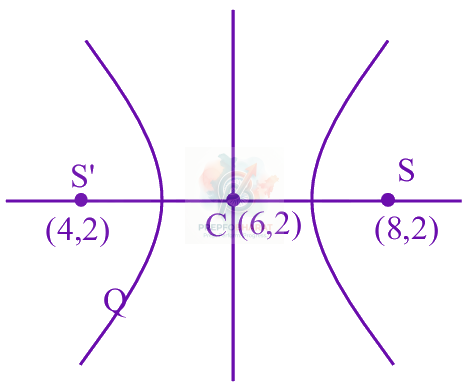
Let the circle $C$ touch the line $x-y+1=0$, have the centre on the positive x -axis, and cut off a chord of length $\frac{4}{\sqrt{13}}$ along the line $-3 x+2 y=1$. Let H be the hyperbola $\frac{x^2}{\alpha^2}-\frac{y^2}{\beta^2}=1$, whose one of the foci is the centre of $C$ and the length of the transverse axis is the diameter of $C$. Then $2 \alpha^2+3 \beta^2$ is equal to ______