JEE Main 2025 — Mathematics Coordinate Geometry
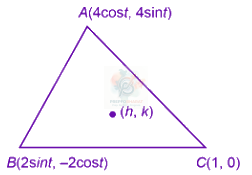
Let nCr−1=28,nCr=56{ }^{\mathrm{n}} \mathrm{C}_{\mathrm{r}-1}=28,{ }^{\mathrm{n}} \mathrm{C}_{\mathrm{r}}=56nCr−1=28,nCr=56 and nCr+1=70{ }^{\mathrm{n}} \mathrm{C}_{\mathrm{r}+1}=70nCr+1=70. Let A(4cost,4sint),B(2sint,−2cost)\mathrm{A}(4 \cos t, 4 \sin t), \mathrm{B}(2 \sin t,-2 \cos \mathrm{t})A(4cost,4sint),B(2sint,−2cost) and C(3r−n,r2−n−1)C\left(3 r-n, r^2-n-1\right)C(3r−n,r2−n−1) be the vertices of a triangle ABCA B CABC, where ttt is a parameter. If (3x−1)2+(3y)2(3 x-1)^2+(3 y)^2(3x−1)2+(3y)2 =α=\alpha=α, is the locus of the centroid of triangle ABC , then α\alphaα equals
Held on 28 Jan 2025 · Verified 6 Jul 2026.
6
18
8
20
Sign in to track your attempts and accuracy.
nCr−1=28nCr=56nCr+1=70nCr−1nCr=2856⇒rn−r+1=12nCrnCr+1=5670⇒r+1n−r=7056}n=8=3\left.\begin{array}{l}{ }^n C_{r-1}=28 \\ { }^n C_r=56 \\ { }^n C_{r+1}=70 \\ \begin{array}{l}{ }^n C_{r-1} \\ { }^n C_r\end{array}=\frac{28}{56} \Rightarrow \frac{r}{n-r+1}=\frac{1}{2} \\ \frac{{ }^n C_r}{{ }^n C_{r+1}}=\frac{56}{70} \Rightarrow \frac{r+1}{n-r}=\frac{70}{56}\end{array}\right\} n=8=3nCr−1=28nCr=56nCr+1=70nCr−1nCr=5628⇒n−r+1r=21nCr+1nCr=7056⇒n−rr+1=5670⎭⎬⎫n=8=3
h=4cost+2sint+13k=4sint−2cost3h=\frac{4 \cos t+2 \sin t+1}{3} \quad k=\frac{4 \sin t-2 \cos t}{3}h=34cost+2sint+1k=34sint−2cost 3h−1=4cost+2sint3 h-1=4 \cos t+2 \sin t3h−1=4cost+2sint 3k−1=4sint−2cost3 k-1=4 \sin t-2 \cos t3k−1=4sint−2cost $\begin{aligned}& (1)^2+(2)^2 \& (3 h-1)^2+(3 k)^2=20\end{aligned}Locusofcentroid:Locus of centroid:Locusofcentroid:(3 x-1)^2+(3 y)^2=20\Rightarrow \alpha=20$
Sign in to keep a private note on this question. Nothing you write is ever public.
Let $A,B$ be points on the two half-lines $x-\sqrt{3}|y|=\alpha$, $\alpha>0$ at a distance of $\alpha$ from their point of intersection $P$. The line segment $AB$ meets the angle bisector of the given half-lines at the point $Q$. If $PQ=\dfrac{9}{2}$ and $R$ is the radius of the circumcircle of $\triangle PAB$, then $\dfrac{\alpha^2}{R}$ is equal to ______
If a straight line drawn through the point of intersection of the lines $4x+3y-1=0$ and $3x+4y-1=0$, meets the co-ordinate axes at the points P and Q, then the locus of the mid point of PQ is:
Let $C$ be a circle having centre in the first quadrant and touching the $x$-axis at a distance of $3$ units from the origin. If the circle $C$ has an intercept of length $6\sqrt{3}$ on $y$-axis, then the length of the chord of the circle $C$ on the line $x - y = 3$ is :
Let O be the origin, and P and Q be two points on the rectangular hyperbola $xy = 12$ such that the mid point of the line segment PQ is $\left(\dfrac{1}{2}, -\dfrac{1}{2}\right)$. Then the area of the triangle OPQ equals:
Let the vertex $A$ of a triangle $ABC$ be $(1, 2)$, and the mid-point of the side $AB$ be $(5, -1)$. If the centroid of this triangle is $(3, 4)$ and its circumcenter is $(\alpha, \beta)$, then $21(\alpha + \beta)$ is equal to:
1966 questions
1411 questions
485 questions
389 questions
224 questions
Work through every JEE Main Coordinate Geometry PYQ, year by year.