JEE Main 2021 — Coordinate Geometry
Mathematics Coordinate Geometry questions from JEE Main 2021.
Other Years
52 Coordinate Geometry Questions from 2021
If the curve ${x}^{2}+2{y}^{2}=2$ intersects the line $x+y=1$ at two points $P$ and $Q$, then the angle subtended by the line segment $PQ$ at the origin is
The equation of the circle with centre (1, -2) and radius 3 is:
A hyperbola passes through the foci of the ellipse $\frac{{x}^{2}}{25}+\frac{{y}^{2}}{16}=1$ and its transverse and conjugate axes coincide with major and minor axes of the ellipse, respectively. If the product of their eccentricities is one, then the equation of the hyperbola is:
Consider a triangle having vertices $A(-2,3),B(1,9)$ and $C(3,8).$ If a line $L$ passing through the circum-centre of triangle $ABC,$ bisects line $BC,$ and intersects $y$-axis at point $(0,\frac{\alpha }{2}),$ then the value of real number $\alpha$ is _______.
The point $P(a,b)$ undergoes the following three transformations successively: $(a)$ reflection about the line $y=x.$ $(b)$ translation through $2$ units along the positive direction of $x-$ axis. $(c)$ rotation through angle $\frac{\pi }{4}$ about the origin in the anti-clockwise direction. If the co-ordinates of the final position of the point $P$ are $(-\frac{1}{\sqrt{2}},\frac{7}{\sqrt{2}})$, then the value of $2a+b$ is equal to:
Two tangents are drawn from the point $P(-1,1)$ to the circle ${x}^{2}+{y}^{2}-2x-6y+6=0.$ If these tangents touch the circle at points $A$ and $B,$ and if $D$ is a point on the circle such that length of the segments $AB$ and $AD$ are equal, then the area of the triangle $ABD$ is equal to:
If the locus of the mid-point of the line segment from the point $(3,2)$ to a point on the circle, ${x}^{2}+{y}^{2}=1$ is a circle of radius $r$, then $r$ is equal to
The locus of the point of intersection of the lines $(\sqrt{3})kx+ky-4\sqrt{3}=0$ and $\sqrt{3}x-y-4(\sqrt{3})k=0$ is a conic, whose eccentricity is
A ray of light through $(2,1)$ is reflected at a point $P$ on the $y-$ axis and then passes through the point $(5,3).$ If this reflected ray is the directrix of an ellipse with eccentricity $\frac{1}{3}$ and the distance of the nearer focus from this directrix is $\frac{8}{\sqrt{53}},$ then the equation of the other directrix can be:
Let $A(a,0),B(b,2b+1)$ and $C(0,b),b\neq 0,|b|\neq 1$, be points such that the area of triangle $ABC$ is $1$ sq. unit, then the sum of all possible values of $a$ is:
Let $\mathrm{tan}\alpha ,\mathrm{tan}\beta$ and $\mathrm{tan}\gamma ;\alpha ,\beta ,\gamma \neq \frac{(2n-1)\pi }{2},n\in N$ be the slopes of the three line segments $OA,OB$ and $OC,$ respectively, where $O$ is origin. If circumcentre of $\Delta ABC$ coincides with origin and its orthocentre lies on $y$-axis, then the value of ${(\frac{\mathrm{cos}3\alpha +\mathrm{cos}3\beta +\mathrm{cos}3\gamma }{\mathrm{cos}\alpha \cdot \mathrm{cos}\beta \cdot \mathrm{cos}\gamma })}^{2}$ is equal to :
Let ${r}_{1}$ and ${r}_{2}$ be the radii of the largest and smallest circles, respectively, which pass through the point $(-4,1)$ and having their centres on the circumference of the circle ${x}^{2}+{y}^{2}+2x+4y-4=0$. If $\frac{{r}_{1}}{{r}_{2}}=a+b\sqrt{2},$ then $a+b$ is equal to:
The minimum distance between any two points ${P}_{1}$ and ${P}_{2}$ while considering point ${P}_{1}$ on one circle and point ${P}_{2}$ on the other circle for the given circles' equations ${x}^{2}+{y}^{2}-10x-10y+41=0$ ${x}^{2}+{y}^{2}-24x-10y+160=0$ is ________
Let $A={(x,y)\in R\times R\mid 2{x}^{2}+2{y}^{2}-2x-2y=1}$ $B={(x,y)\in R\times R\mid 4{x}^{2}+4{y}^{2}-16y+7=0}$ and $C={(x,y)\in R\times R\mid {x}^{2}+{y}^{2}-4x-2y+5\leq {r}^{2}}$. Then the minimum value of $|r|$ such that $A\cup B\subseteq C$ is equal to
If the curves, $\frac{{x}^{2}}{a}+\frac{{y}^{2}}{b}=1$ and $\frac{{x}^{2}}{c}+\frac{{y}^{2}}{d}=1$ intersect each other at an angle of ${90}^{^{\circ}},$ then which of the following relations is TRUE?
Choose the incorrect statement about the two circles whose equations are given below: ${x}^{2}+{y}^{2}-10x-10y+41=0$ and ${x}^{2}+{y}^{2}-16x-10y+80=0$
The intersection of three lines $x-y=0,x+2y=3$ and $2x+y=6$ is a/an
The line $2x-y+1=0$ is a tangent to the circle at the point $(2,5)$ and the centre of the circle lies on $x-2y=4.$ Then, the radius of the circle is:
Two sides of a parallelogram are along the lines $4x+5y=0$ and $7x+2y=0.$ If the equation of one of the diagonals of the parallelogram is $11x+7y=9,$ then other diagonal passes through the point:
Let $P$ be a variable point on the parabola $y=4{x}^{2}+1.$ Then, the locus of the mid-point of the point $P$ and the foot of the perpendicular drawn from the point $P$ to the line $y=x$ is:
For the four circles $M,N,O$ and $P,$ following four equations are given: Circle $M:{x}^{2}+{y}^{2}=1$ Circle $N:{x}^{2}+{y}^{2}-2x=0$ Circle $O:{x}^{2}+{y}^{2}-2x-2y+1=0$ Circle $P:{x}^{2}+{y}^{2}-2y=0$ If the centre of circle $M$ is joined with centre of the circle $N,$ further centre of circle $N$ is joined with centre of the circle $O,$ centre of circle $O$ is joined with the centre of circle $P$ and lastly, centre of circle $P$ is joined with centre of circle $M,$ then these lines form the sides of a
Let $P$ and $Q$ be two distinct points on a circle which has center at $C(2,3)$ and which passes through origin $O.$ If $OC$ is perpendicular to both the line segments $CP$ and $CQ,$ then the set ${P,Q}$ is equal to
Let ${E}_{1}:\frac{{x}^{2}}{{a}^{2}}+\frac{{y}^{2}}{{b}^{2}}=1,a>b.$ Let ${E}_{2}$ be another ellipse such that it touches the end points of major axis of ${E}_{1}$ and the foci of ${E}_{2}$ are the end points of minor axis of ${E}_{1}.$ If ${E}_{1}$ and ${E}_{2}$ have same eccentricities, then its value is:
The length of the latus rectum of a parabola, whose vertex and focus are on the positive $x$-axis at a distance $R$ and $S(>R)$ respectively from the origin, is :
If one of the diameters of the circle ${x}^{2}+{y}^{2}-2x-6y+6=0$ is a chord of another circle $C''$, whose center is at $(2,1)$, then its radius is_____.
The locus of mid-points of the line segments joining $(-3,-5)$ and the points on the ellipse $\frac{{x}^{2}}{4}+\frac{{y}^{2}}{9}=1$ is :
Let the equation ${x}^{2}+{y}^{2}+px+(1-p)y+5=0$ represent circles of varying radius $r\in (0,5].$ Then the number of elements in the set $S=${$q:q={p}^{2}$ and $q$ is an integer} is ___________
The equation of one of the straight lines which passes through the point $(1,3)$ and makes an angles ${\mathrm{tan}}^{-1}(\sqrt{2})$ with the straight line, $y+1=3\sqrt{2}x$ is
Let $A$ be a fixed point $(0,6)$ and $B$ be a moving point $(2t,0).$ Let $M$ be the mid-point of $AB$ and the perpendicular bisector of $AB$ meets the $y-$axis at $C.$ The locus of the mid-point $P$ of $\mathrm{MC}$ is
In a triangle $PQR,$ the co-ordinates of the points $P$ and $Q$ are $(-2,4)$ and $(4,-2)$ respectively. If the equation of the perpendicular bisector of $PR$ is $2x-y+2=0,$ then the centre of the circumcircle of the $\Delta PQR$ is:
A square $ABCD$ has all its vertices on the curve ${x}^{2}{y}^{2}=1.$ The midpoints of its sides also lie on the same curve. Then, the square of area of $ABCD$ is
Let an ellipse $E:\frac{{x}^{2}}{{a}^{2}}+\frac{{y}^{2}}{{b}^{2}}=1,{a}^{2}>{b}^{2}$, passes through $(\sqrt{\frac{3}{2}},1)$ and has eccentricity $\frac{1}{\sqrt{3}}$. If a circle, centered at focus $F(\alpha ,0),\alpha >0$, of $E$ and radius $\frac{2}{\sqrt{3}}$, intersects $E$ at two points $P$ and $Q$, then $P{Q}^{2}$ is equal to :
Let $A(-1,1),B(3,4)$ and $C(2,0)$ be given three points. A line $y=mx,m>0$ , intersects lines $AC$ and $BC$ at point $P$ and $Q$ respectively. Let ${A}_{1}$ and ${A}_{2}$ be the areas of $\Delta ABC$ and $\Delta PQC$ respectively, such that ${A}_{1}=3{A}_{2}$, then the value of $m$ is equal to :
In the circle given below, let $OA=1$ unit, $OB=13$ unit and $PQ\perp OB$. Then, the area of the triangle $PQB$ (in square units) is :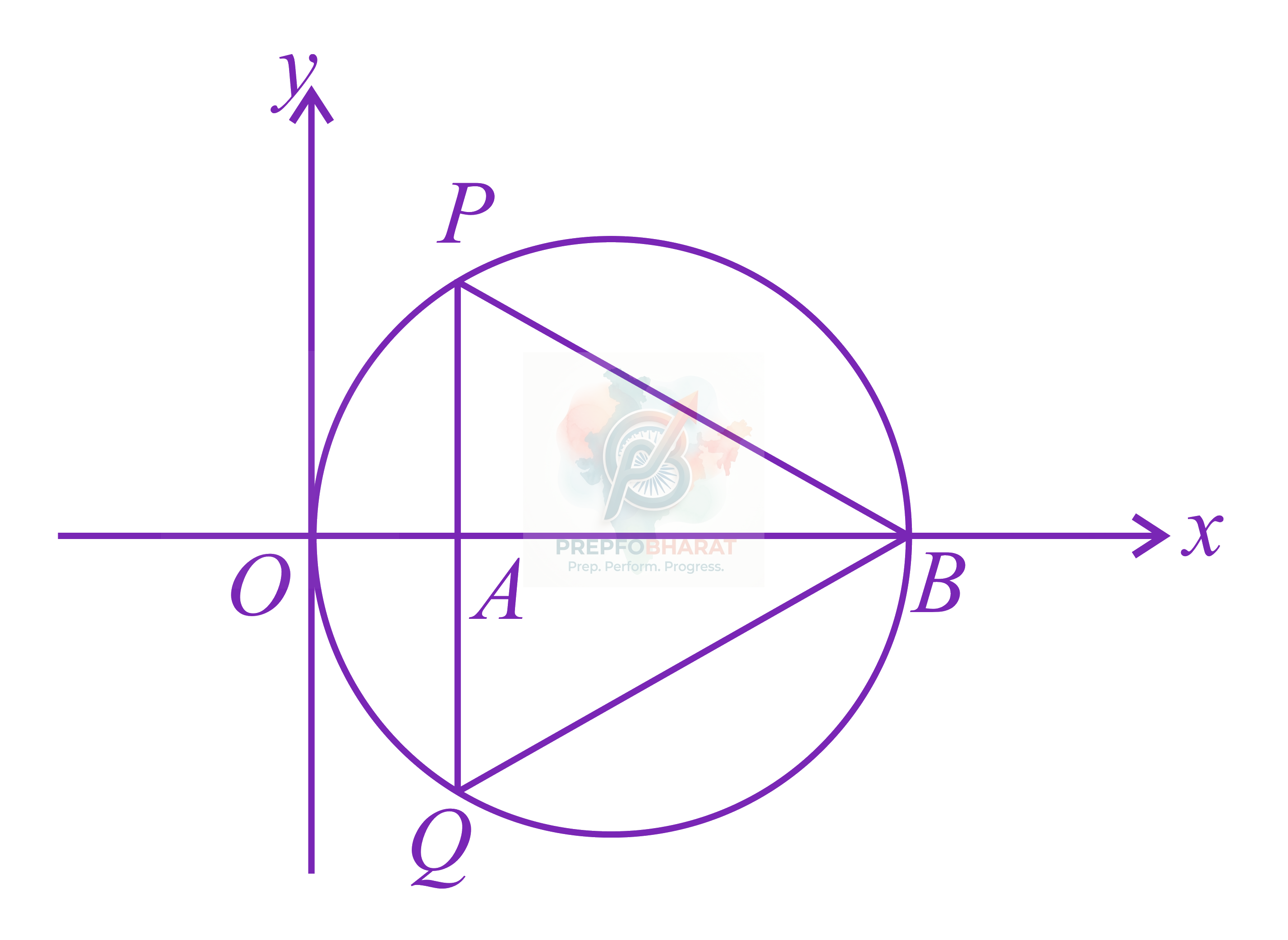
Let ${S}_{1}:{x}^{2}+{y}^{2}=9$ and ${S}_{2}:(x-2{)}^{2}+{y}^{2}=1$. Then the locus of center of a variable circle $S$ which touches ${S}_{1}$ internally and ${S}_{2}$ externally always passes through the points :
Let $A(1,4)$ and $B(1,-5)$ be two points. Let $P$ be a point on the circle ${((x-1))}^{2}+{(y-1)}^{2}=1$, such that ${(PA)}^{2}+{(PB)}^{2}$ have maximum value, then the points, $P,A$ and $B$ lie on
Let $B$ be the centre of the circle ${x}^{2}+{y}^{2}-2x+4y+1=0.$ Let the tangents at two points $P$ and $Q$ on the circle intersect at the point $A(3,1).$ Then $8(\frac{\mathrm{area}\Delta \mathrm{APQ}}{\mathrm{area}\Delta \mathrm{BPQ}})$ is equal to .
Let the lengths of intercepts on $x$ -axis and $y$ -axis made by the circle ${x}^{2}+{y}^{2}+ax+2ay+c=0,$ $(a<0)$ be $2\sqrt{2}$ and $2\sqrt{5}$, respectively. Then the shortest distance from origin to a tangent to this circle which is perpendicular to the line $x+2y=0,$ is equal to :
If $p$ and $q$ are the lengths of the perpendiculars from the origin on the lines, $xcosec\alpha -y\mathrm{sec}\alpha =k\mathrm{cot}2\alpha$ and $x\mathrm{sin}\alpha +y\mathrm{cos}\alpha =k\mathrm{sin}2\alpha$ respectively, then ${k}^{2}$ is equal to :
The locus of a point, which moves such that the sum of squares of its distances from the points $(0,0),(1,0),(0,1)(1,1)$ is $18$ units, is a circle of diameter $d.$ Then ${d}^{2}$ is equal to
Let the centroid of an equilateral triangle $ABC$ be at the origin. Let one of the sides of the equilateral triangle be along the straight line $x+y=3$. If $R$ and $r$ be the radius of circumcircle and incircle respectively of $\Delta ABC$, then $(R+r)$ is equal to :
If the points of intersection of the ellipse $\frac{{x}^{2}}{16}+\frac{{y}^{2}}{{b}^{2}}=1$ and the circle ${x}^{2}+{y}^{2}=4b,b>4$ lie on the curve ${y}^{2}=3{x}^{2}$, then $b$ is equal to :
The locus of the mid-point of the line segment joining the focus of the parabola ${y}^{2}=4ax$ to a moving point of the parabola, is another parabola whose directrix is:
Let the points of intersections of the lines $x-y+1=0,x-2y+3=0$ and $2x-5y+11=0$ are the mid points of the sides of a triangle $\mathrm{ABC}.$ Then the area of the triangle $\mathrm{ABC}$ is
Let $A$ be the set of all points $(\alpha ,\beta )$ such that the area of triangle formed by the points $(5,6),$ $(3,2)$ and $(\alpha ,\beta )$ is $12$ square units. Then the least possible length of a line segment joining the origin to a point in $A,$ is :
Choose the correct statement about two circles whose equations are given below: ${x}^{2}+{y}^{2}-10x-10y+41=0$ ${x}^{2}+{y}^{2}-22x-10y+137=0$
Let a point $P$ be such that its distance from the point $(5,0)$ is thrice the distance of $P$ from the point $(-5,0).$ If the locus of the point $P$ is a circle of radius $r,$ then $4{r}^{2}$ (in the nearest integer) is equal to __________.
Consider a circle $C$ which touches the $y-$ axis at $(0,6)$ and cuts off an intercept $6\sqrt{5}$ on the $x-$ axis. Then the radius of the circle $C$ is equal to :
Let the circle $S:36{x}^{2}+36{y}^{2}-108x+120y+C=0$ be such that it neither intersects nor touches the co-ordinate axes. If the point of intersection of the lines, $x-2y=4$ and $2x-y=5$ lies inside the circle $S,$ then:
If the variable line $3x+4y=\alpha$ lies between the two circles $(x-1{)}^{2}+(y-1{)}^{2}=1$ and $(x-9{)}^{2}+(y-1{)}^{2}=4,$ without intercepting a chord on either circle, then the sum of all the integral values of $\alpha$ is
Consider a hyperbola $H:{x}^{2}-2{y}^{2}=4$. Let the tangent at a point $P(4,\sqrt{6})$ meet the $x$-axis at $Q$ and latus rectum at $R({x}_{1},{y}_{1}),{x}_{1}>0$. If $F$ is a focus of $H$ which is nearer to the point $P$, then the area of $\Delta QFR$ (in sq. units) is equal to
The locus of the centroid of the triangle formed by any point $P$ on the hyperbola $16{x}^{2}-9{y}^{2}+32x+36y-164=0$ and its foci is