Let E_1: x^2 a^2+ y^2 b^2=1,a>b. Let E_2 be another ellipse such that it touches the end points of major axis of E_1 and the foci of E_2 are the end…
JEE Main 2021 — Mathematics Coordinate Geometry
2021mcqmedium
Let E1:a2x2+b2y2=1,a>b. Let E2 be another ellipse such that it touches the end points of major axis of E1 and the foci of E2 are the end points of minor axis of E1. If E1 and E2 have same eccentricities, then its value is:
Official previous-year question
Held on 22 Jul 2021 · Verified 6 Jul 2026.
Options
A
2−1+5
B
2−1+8
C
2−1+3
D
2−1+6
Did you get this right?
Sign in to track your attempts and accuracy.
Solution
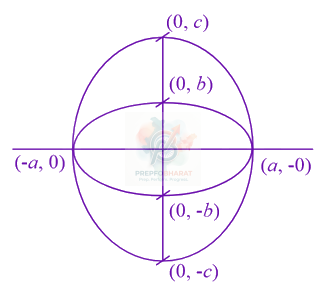
Given ellipse is E1:a2x2+b2y2=1,a>b and E2 is another ellipse which touches the end points of the major axis of E1 and foci of E2 are at the minor axis of E1, thus the two ellipses are given by the following diagram.
Since, the ellipse E2 touches the major axis of the ellipse E1, hence, the minor axis of the ellipse E2 is a1=a.
Now, let the major axis of the ellipse E2 is b1=c and it is obvious from the diagram and the given conditions that b1>a1.
We know that the eccentricity of an ellipse A2x2+B2y2=1,A>B is 1−A2B2.
Thus, for the ellipse E1, we have e=1−a2b2 and for the ellipse E2, we have e1=1−c2a2.
Given, e=e1
1−a2b2=1−c2a2
⇒1−a2b2=1−c2a2
⇒a2b2=c2a2
⇒c2=b2a4
⇒c=ba2...(i)
Also, given that the foci of E2 are the end points of the minor axis of E1, thus b=ce
⇒c=eb...(ii)
From the above two equations, we get eb=ba2
⇒e=a2b2
Now, using the definition of eccentricity, we get e=a2b2=1−e2
⇒e2+e−1=0
Now, applying the Sridharacharya's formula for the roots of a quadratic equation, i.e. if ax2+bx+c=0,a=0, then x=2a−b±b2−4ac, we get
e=2×1−1±12−4×1×(−1)
⇒e=2−1±1+4
⇒e=2−1±5
But, eccentricity can never be negative, hence e=2−1+5.
Your note
Sign in to keep a private note on this question. Nothing you write is ever public.