JEE Main 2026 — Modern Physics
Physics Modern Physics questions from JEE Main 2026.
Other Years
61 Modern Physics Questions from 2026
The following diagram shows a Zener diode as a voltage regulator. The Zener diode is rated at $V_{z}=5 \mathrm{~V}$ and the desired current in load is 5 mA. The unregulated voltage source can supply upto 25 V. Considering the Zener diode can withstand four times of the load current, the value of resistor $R_{S}$ (shown in circuit) should be $\_\_\_\_$ $\Omega$. 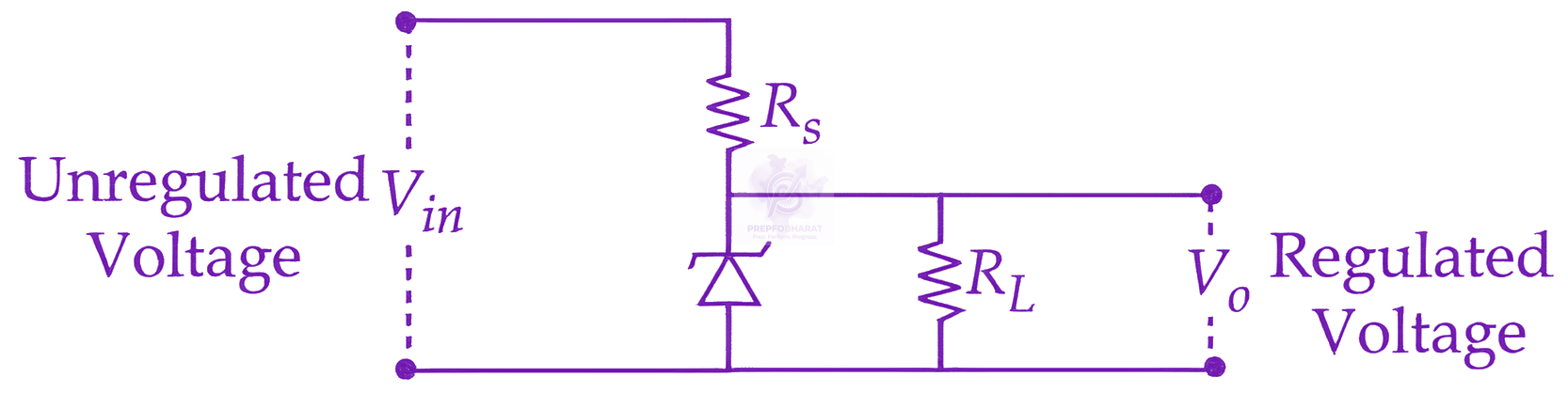
In a semiconductor p-n diode, the doping concentrations on p-side and n-side are $10^{15}\text{ atoms/cm}^3$ and $10^{18}\text{ atoms/cm}^3$, respectively. Which one of the following statements is true ?
Given below are two statements: one is labelled as Assertion (A) and the other is labelled as Reason (R). Assertion (A): The electromagnetic wave exerts pressure on the surface on which they are allowed to fall. Reason (R): There is no mass associated with the electromagnetic waves. In the light of the above statements, choose the correct answer from the options given below :
An electron of mass $m$ is moving in an electric field $\vec{E} = -2E_0\hat{i}$ ($E_0 =$ constant $> 0$), with an initial velocity $\vec{V} = v_0\hat{i}$ ($v_0 =$ constant $> 0$). If $\lambda_0 = \dfrac{h}{4mv_0}$, its de Broglie wavelength at time $t$ is __________. ($e =$ charge of electron)
In hydrogen atom spectrum, $(R \rightarrow$ Rydberg's constant $)$ A. the maximum wavelength of the radiation of Lyman series is $\frac{4}{3 R}$ B. the Balmer series lies in the visible region of the spectrum C. the minimum wavelength of the radiation of Paschen series is $\frac{9}{R}$ D. the minimum wavelength of Lyman series is $\frac{5}{4 R}$ Choose the correct answer from the options given below :
When a light of a given wavelength falls on a metallic surface the stopping potential for photoelectrons is 3.2 V. If a second light having wavelength twice of first light is used, the stopping potential drops to 0.7 V. The wavelength of first light is $\_\_\_\_$ m. $\left(\mathrm{h}=6.63 \times 10^{-34} \mathrm{~J}. \mathrm{s}, \mathrm{e}=1.6 \times 10^{-19} \mathrm{C}, \mathrm{c}=3 \times 10^{8} \mathrm{~m} / \mathrm{s}\right)$
A nucleus has mass number $\alpha$ and radius $R_{\alpha}$. Another nucleus has mass number $\beta$ and radius $R_{\beta}$. If $\beta=8 \alpha$ then $R_{\alpha} / R_{\beta}$ is:
For the given circuit (shown in part (A)) the time dependent input voltage $v_{in}(t)$ and corresponding output $v_o(t)$ are shown in part (B) and part (C), respectively. Identify the components that are used in the circuit between points X and Y. 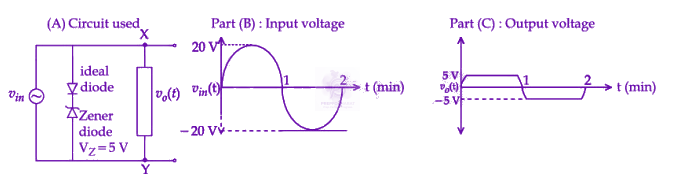
The energy released if hydrogen atoms are combined to form $^{4}_{2}\text{He}$ is __________ MeV. (Take binding energies per nucleon of $^{2}_{1}\text{H}$ and $^{4}_{2}\text{He}$ as $1.1$ MeV and $7.2$ MeV, respectively)
The graph shows variation of stopping potential $V_o$ with the frequency $\nu$ of the incident radiation for three photosensitive metals $X_1$, $X_2$ and $X_3$. Which metal will give out electrons with greater kinetic energy, for the same wavelength of incident radiation? 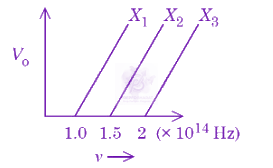
Identify the correct truth table of the given logic circuit. 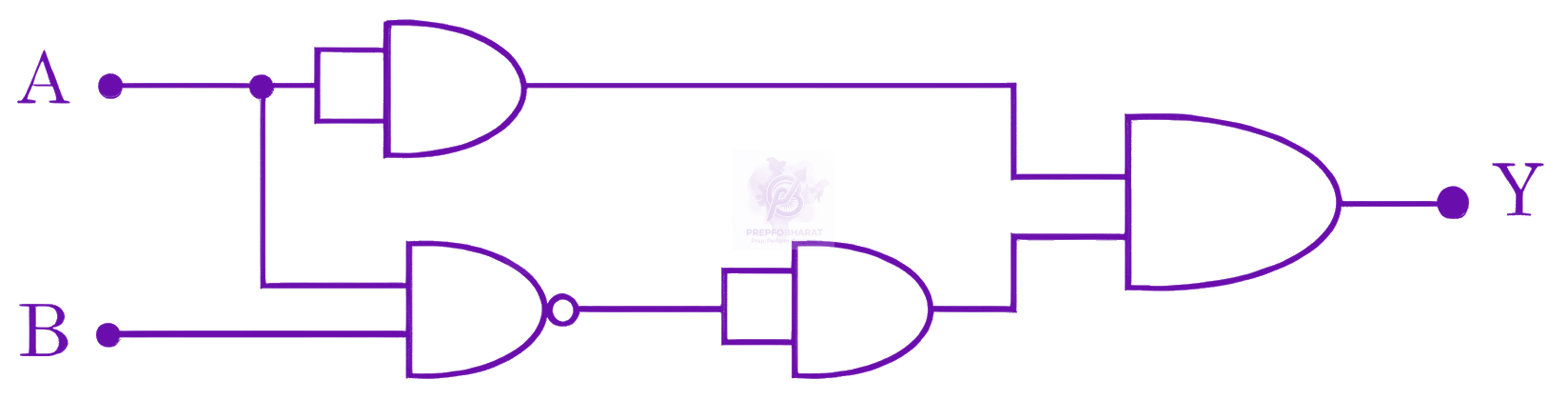
The energy of an electron in an orbit of the Bohr's atom is $-0.04 E_{0} \mathrm{eV}$ where $E_{0}$ is the ground state energy. If $L$ is the angular momentum of the electron in this orbit and $h$ is the Planck's constant, then $\frac{2 \pi L}{h}$ is $\_\_\_\_$ :
Light is incident on a metallic plate having work function $110 \times 10^{-20} \mathrm{~J}$. If the produced photoelectrons have zero kinetic energy then the angular frequency of the incident light is $\_\_\_\_$ rad/s. $\left(\mathrm{h}=6.63 \times 10^{-34} \mathrm{~J}. \mathrm{s}\right)$.
For a certain metal, when monochromatic light of wavelength $\lambda$ is incident, the stopping potential for photoelectrons is $3V_0$. When the same metal is illuminated by light of wavelength $2\lambda$, then the stopping potential becomes $V_0$. The threshold wavelength for photoelectric emission for the given metal is $\alpha\lambda$. The value of $\alpha$ is _______.
Given below are two statements: Statement I: For all elements, greater the mass of the nucleus, greater is the binding energy per nucleon. Statement II: For all elements, nuclei with less binding energy per nucleon transforms to nuclei with greater binding energy per nucleon. In the light of the above statements, choose the correct answer from the options given below
The smallest wavelength of Lyman series is 91 nm. The difference between the largest wavelengths of Paschen and Balmer series is nearly $\_\_\_\_$ nm .
The output $Y$ for the given inputs $A$ and $B$ to the circuit is: 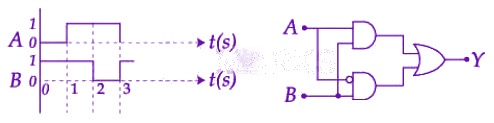
Assuming in forward bias condition there is a voltage drop of 0.7 V across a silicon diode, the current through diode $D_{1}$ in the circuit is $\_\_\_\_$ mA. (Assume all diodes in the given circuit are identical) 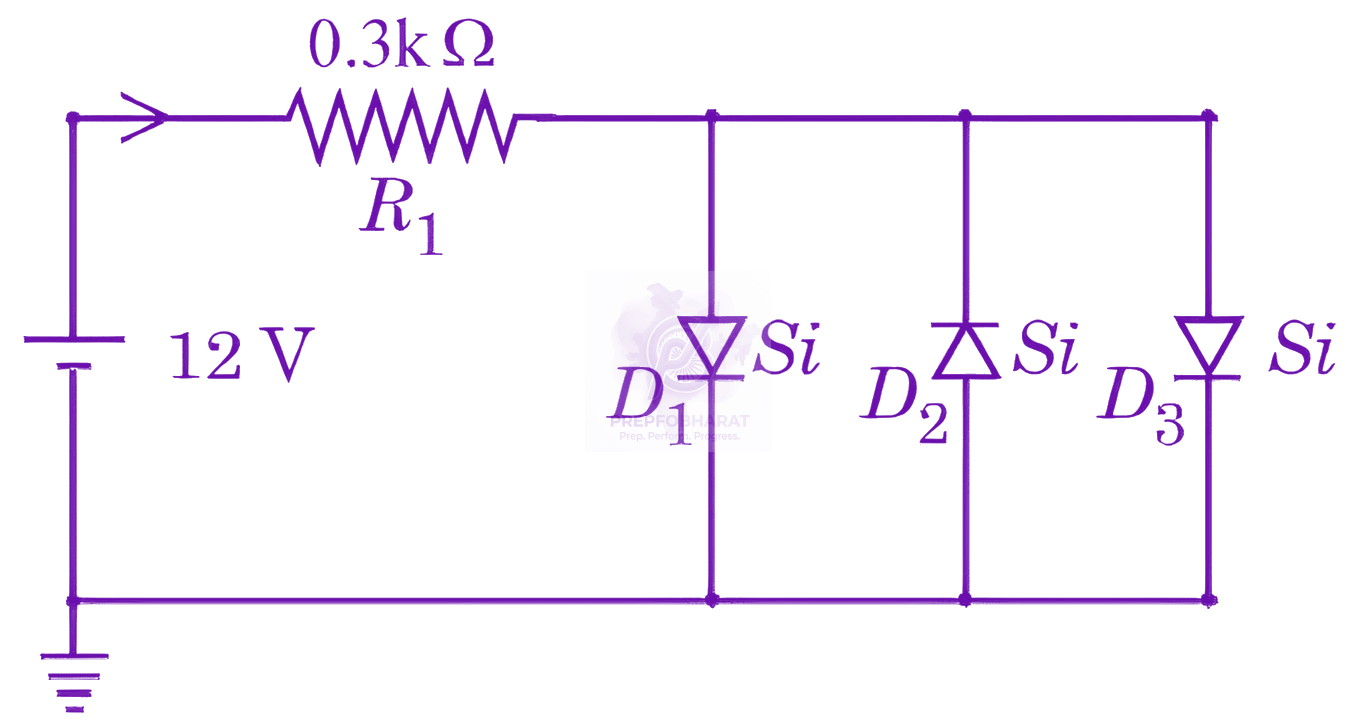
For the given logic gate circuit, which of the following is the correct truth table? 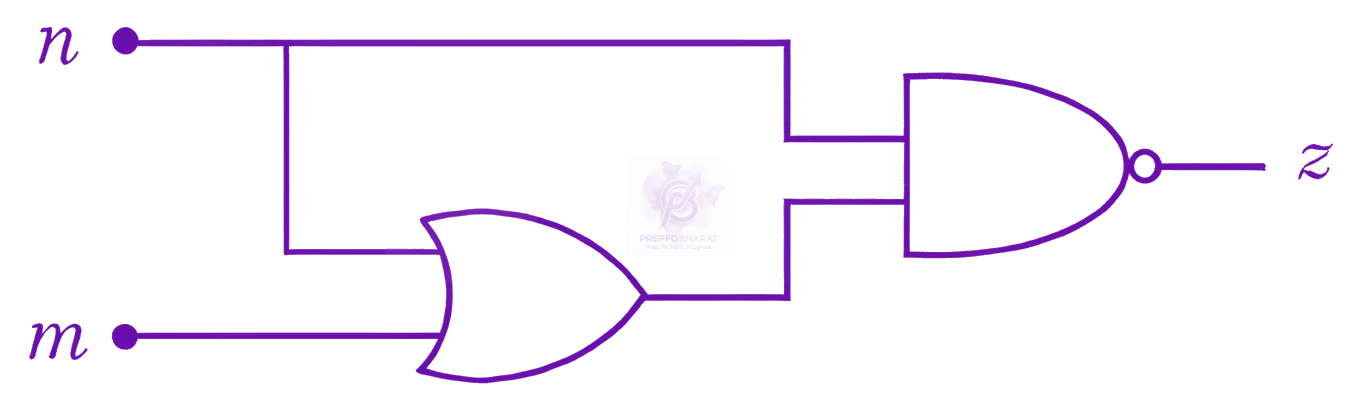
A voltage regulating circuit consisting of Zener diode, having break-down voltage of 10 V and maximum power dissipation of 0.4 W, is operated at 15 V. The approximate value of protective resistance in this circuit is $\_\_\_\_$ $\Omega$.
A particle having electric charge $3 \times 10^{-19} \mathrm{C}$ and mass $6 \times 10^{-27} \mathrm{~kg}$ is accelerated by applying an electric potential of 1.21 V. Wavelength of the matter wave associated with the particle is $\alpha \times 10^{-12} \mathrm{~m}$. The value of $\alpha$ is $\_\_\_\_$ - (Take Planck's constant $=6.6 \times 10^{-34} \mathrm{~J}. \mathrm{s}$)
Match the LIST-I with LIST-II <table class="pyq-table"><tbody><tr><th>List-I</th><th>List-II</th></tr><tr><td>A. Planck's constant</td><td>I. $ML^2T^{-2}$</td></tr><tr><td>B. Stopping potential</td><td>II. $T^{-1}$</td></tr><tr><td>C. Work function</td><td>III. $ML^2T^{-1}$</td></tr><tr><td>D. Threshold frequency</td><td>IV. $ML^2T^{-3}A^{-1}$</td></tr></tbody></table> Choose the correct answer from the options given below:
The de Broglie wavelength associated with an electron accelerated through a potential difference V is $\lambda_e$ and the de Broglie wavelength associated with a proton accelerated through the same potential difference is $\lambda_p$. If their corresponding masses are $m_e$ and $m_p$, respectively, then the ratio of their de Broglie wavelengths $\left(\dfrac{\lambda_e}{\lambda_p}\right)$ is ______.
A diode has Zener voltage of $10$ V and maximum power dissipation of $0.5$ W, then the minimum resistance to be used in series with this diode for safety when it is connected to a $25$ V power supply is ______ $\Omega$.
Given below are two statements: one is labelled as Assertion A and the other is labelled as Reason R Assertion A: A diode under reverse-biased condition provides very small current which is nearly independent of voltage until a critical limit at which the current increases drastically. Reason R: Below the critical voltage limit, only majority charge carriers flow which increases drastically above critical voltage. Choose the correct answer from the options given below
Two electrons are moving in orbits of two hydrogen like atoms with speeds $3 \times 10^{5} \mathrm{~m} / \mathrm{s}$ and $2.5 \times 10^{5} \mathrm{~m} / \mathrm{s}$ respectively. If the radii of these orbits are nearly same then the possible order of energy states are $\_\_\_\_$ respectively.
If an alpha particle with energy 7.7 MeV is bombarded on a thin gold foil, the closest distance from nucleus it can reach is $\_\_\_\_$ m. (Atomic number of gold $=79$ and $\frac{1}{4 \pi \epsilon_{\mathrm{o}}}=9 \times 10^{9}$ in SI units)
Refer to the logic circuit given below. For two inputs $(A=1, B=1)$ and $(A=0, B=1)$, output $(Y)$ will be __________. 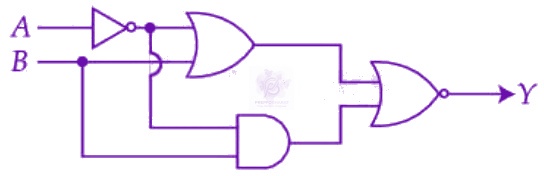
Which of the following pair of nuclei are isobars of the element?
The given circuit works as : 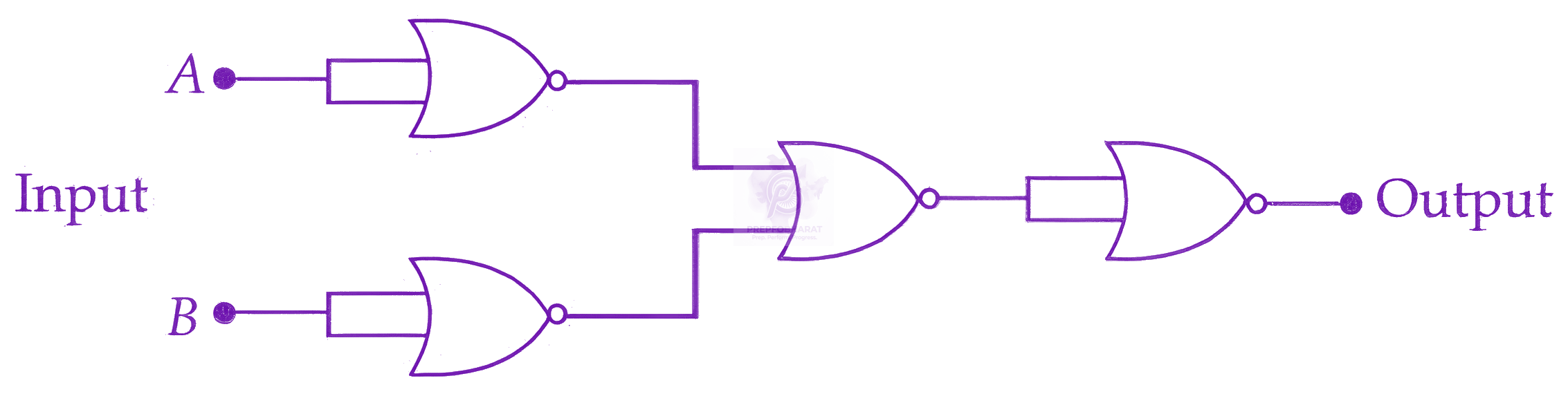
The de Broglie wavelength of an oxygen molecule at $27^{\circ} \mathrm{C}$ is $x \times 10^{-12} \mathrm{~m}$. The value of $x$ is (take Planck's constant $=6.63 \times 10^{-34} \mathrm{~J}. \mathrm{s}$, Boltzmann constant $=1.38 \times 10^{-23} \mathrm{~J} / \mathrm{K}$, mass of oxygen molecule $=5.31 \times 10^{-26} \mathrm{~kg}$)
The energy released when $\dfrac{7}{17.13}$ kg of $^{7}_{3}\text{Li}$ is converted into $^{4}_{2}\text{He}$ by proton bombardment is $\alpha \times 10^{32}$ eV. The value of $\alpha$ is _______. (Nearest integer) (Mass of $^{7}_{3}\text{Li} = 7.0183$ u, mass of $^{4}_{2}\text{He} = 4.004$ u, mass of proton $= 1.008$ u and $1$ u $= 931$ MeV/c$^2$ and Avogadro number $= 6.0 \times 10^{23}$)
The ratio of de Broglie wavelength of a deutron with kinetic energy $E$ to that of an alpha particle with kinetic energy $2 E$, is $n: 1$. The value of $n$ is $\_\_\_\_$. (Assume mass of proton $=$ mass of neutron) :
Two p-n junction diodes $D_{1}$ and $D_{2}$ are connected as shown in figure. $A$ and $B$ are input signals and $C$ is the output. The given circuit will function as a $\_\_\_\_$. 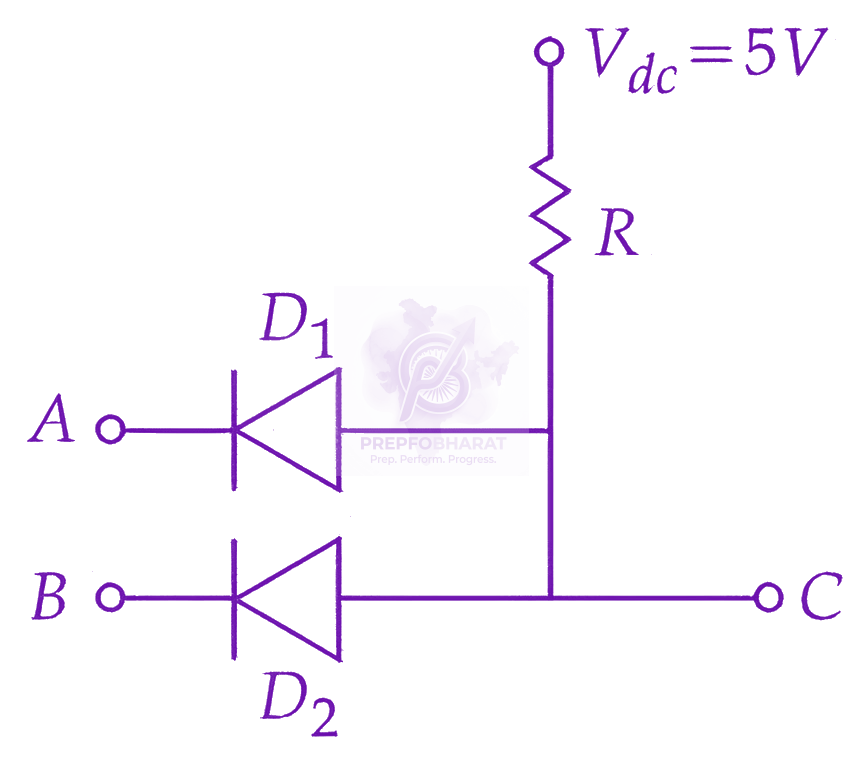
The ratio of momentum of the photons of the $1^{st}$ and $2^{nd}$ line of Balmer series of Hydrogen atoms is $\alpha/\beta$. The possible values of $\alpha$ and $\beta$ are:-
Light source having wavelength $331$ nm is used to generate photo-electrons whose stopping potential is $0.2$ V. The work function of the used metal in the experiment is $\alpha \times 10^{-19}$ J. The value of $\alpha$ is _____. ($h = 6.62 \times 10^{-34}$ J s, $e = 1.6 \times 10^{-19}$ C and $c = 3 \times 10^8$ m/s)
The minimum frequency of photon required to break a particle of mass 15.348 amu into $4 \alpha$ particles is $\_\_\_\_$ kHz. [mass of He nucleus = $4.002 \mathrm{amu}, 1 \mathrm{amu}=1.66 \times 10^{-27} \mathrm{~kg}, \mathrm{~h}=6.6 \times 10^{-34} \mathrm{~J}. \mathrm{s}$ and $\mathrm{c}=3 \times 10^{8} \mathrm{~m} / \mathrm{s}$ ]
$7.9 \mathrm{MeV} \alpha$-particle scatters from a target material of atomic number 79. From the given data the estimated diameter of nuclei of the target material is (approximately) $\_\_\_\_$ m. $\left[\frac{1}{4 \pi \epsilon_{\mathrm{o}}}=9 \times 10^{9} \mathrm{Nm}^{2} / \mathrm{C}^{2}\right.$ and electron charge $\left.=1.6 \times 10^{-19} \mathrm{C}\right]$
Two nuclei of mass number $3$ combine with another nucleus of mass number $4$ to yield a nucleus of mass number $10$. If the binding energy per nucleon for the mass numbers $3$, $4$ and $10$ are $5.6$ MeV, $7.4$ MeV and $6.1$ MeV, respectively, then in the process, $\Delta Mc^2 = $ _____ MeV.
In Rutherford's alpha-particle scattering experiment, only a few alpha particles rebound back because A. The size of gold nucleus is very small as compared to the size of gold atom. B. Alpha particle and gold nucleus have equal charge. C. The impact parameter is minimum for a few alpha particles. D. A few alpha particles have very high kinetic energy. E. Only a few alpha particles undergo head-on collision with the nuclei. Choose the correct answer from the options given below:
For the given logic circuit, which of the following inputs combination will make both LED$-1$ and LED$-2$ to glow? 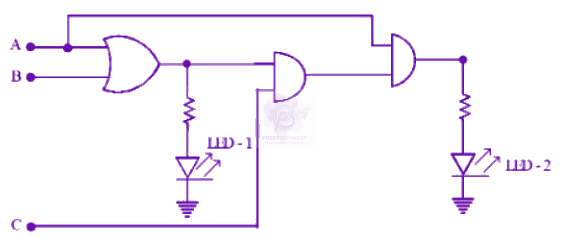
An atom ${ }_{3}^{8} X$ is bombarded by shower of fundamental particles and in 10 s this atom absorbed 10 electrons, 10 protons and 9 neutrons. The percentage growth in the surface area of the nucleons is recorded by:
Number of photons of equal energy emitted per second by a 6 mW laser source operating at 663 nm is $\_\_\_\_$. (Given : $\mathrm{h}=6.63 \times 10^{-34} \mathrm{~J}. \mathrm{s}$ and $\mathrm{c}=3 \times 10^{8} \mathrm{~m} / \mathrm{s}$)
The binding energy for the following nuclear reactions are expressed in MeV. ${ }_{2} \mathrm{He}^{3}+{ }_{0} \mathrm{n}^{1} \rightarrow{ }_{2} \mathrm{He}^{4}+20 \mathrm{MeV}$ ${ }_{2} \mathrm{He}^{4}+{ }_{0} \mathrm{n}^{1} \rightarrow{ }_{2} \mathrm{He}^{5}-0.9 \mathrm{MeV}$ If $\mathrm{X}_{3}, \mathrm{X}_{4}, \mathrm{X}_{5}$ denote the stability of ${ }_{2} \mathrm{He}^{3},{ }_{2} \mathrm{He}^{4}$ and ${ }_{2} \mathrm{He}^{5}$, respectively, then the correct order is :
Angular momentum of an electron in a hydrogen atom is $\dfrac{3h}{\pi}$, then the energy of the electron is _______ eV.
The binding energy per nucleon of $^{209}_{83}Bi$ is _______ MeV. $[\text{Take } m(^{209}_{83}Bi) = 208.980388 \, u, \, m_p = 1.007825 \, u, \, m_n = 1.008665 \, u, \, 1 \, u = 931 \, \text{MeV}/c^2]$
The de Broglie wavelength for an electron accelerated through the potential difference of $V_1$ volt is $\lambda_1$. When the potential difference is changed to $V_2$ volt, the associated de Broglie wavelength is increased by $50\%$. If $(V_1/V_2) = (9/\alpha)$, then the value of $\alpha$ is __________.
The work function of a metal is 4.2 eV. The threshold wavelength for photoelectric emission is approximately:
Two radioactive substances A and B of mass numbers $200$ and $212$ respectively, shows spontaneous $\alpha$-decay with same $Q$ value of $1$ MeV. The ratio of energies of $\alpha$-rays produced by A and B is ________.
The average energy released per fission for the nucleus of ${ }_{92}^{235} \mathrm{U}$ is 190 MeV. When all the atoms of 47 g pure ${ }_{92}^{235} \mathrm{U}$ undergo fission process, the energy released is $\alpha \times 10^{23} \mathrm{MeV}$. The value of $\alpha$ is $\_\_\_\_$. (Avogadro Number $=6 \times 10^{23}$ per mole)
In the hydrogen atom, the electron makes a transition from the higher orbit ($i$) to a lower orbit ($f$). The ratio of the radius of the orbits in given by $r_i : r_f = 16 : 4$. The wavelength of photon emitted due to this transition is _____ nm. (Given Rydberg constant $= 1.0973 \times 10^7$ /m)
Assuming the experimental mass of ${}^{12}_{6}C$ as $12\text{ u}$, the mass defect of ${}^{12}_{6}C$ atom is _______ $\text{MeV}/c^2$. (Mass of proton $= 1.00727\text{ u}$, mass of neutron $= 1.00866\text{ u}$, $1\text{ u} = 931.5\text{ MeV}/c^2$ and $c$ is the speed of the light in vacuum).
A light wave described by $E=60\left[\sin \left(3 \times 10^{15}\right) t+\sin \left(12 \times 10^{15}\right) t\right]$ (in SI units) falls on a metal surface of work function 2.8 eV. The maximum kinetic energy of ejected photoelectron is (approximately) $\_\_\_\_$ eV. $\left(h=6.6 \times 10^{-34} \mathrm{~J}\right.$. s. and $\left.e=1.6 \times 10^{-19} \mathrm{C}\right)$
Find the correct combination of $\mathrm{A}, \mathrm{B}, \mathrm{C}$ and D inputs which can cause the LED to glow. 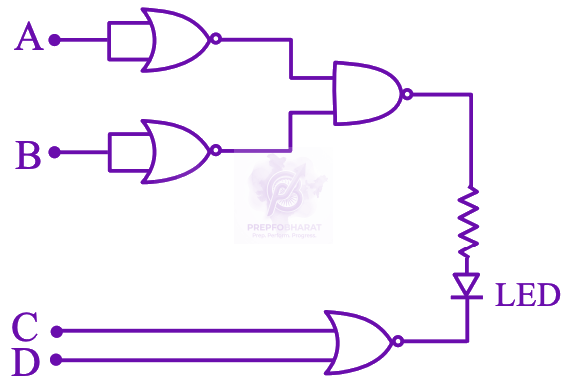
Using Bohr's model, calculate the ratio of the magnetic fields generated due to the motion of the electrons in the $2^{\text{nd}}$ and $4^{\text{th}}$ orbits of hydrogen atom _______.
$K_1$ and $K_2$ be the maximum kinetic energies of photoelectrons emitted from a surface of a given material for the light of wavelength $\lambda_1$ and $\lambda_2$, respectively. If $\lambda_1=2\lambda_2$ then the work function of material is given by:
If $X$ and $Y$ are the inputs, the given circuit works as _______. 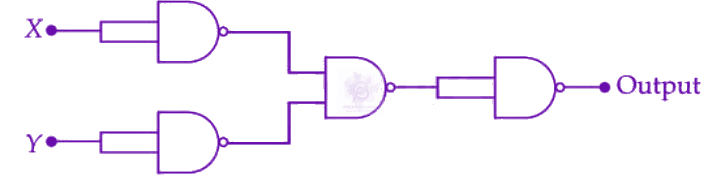
The correct truth table for the given input data of the following logic gate is : Inputs 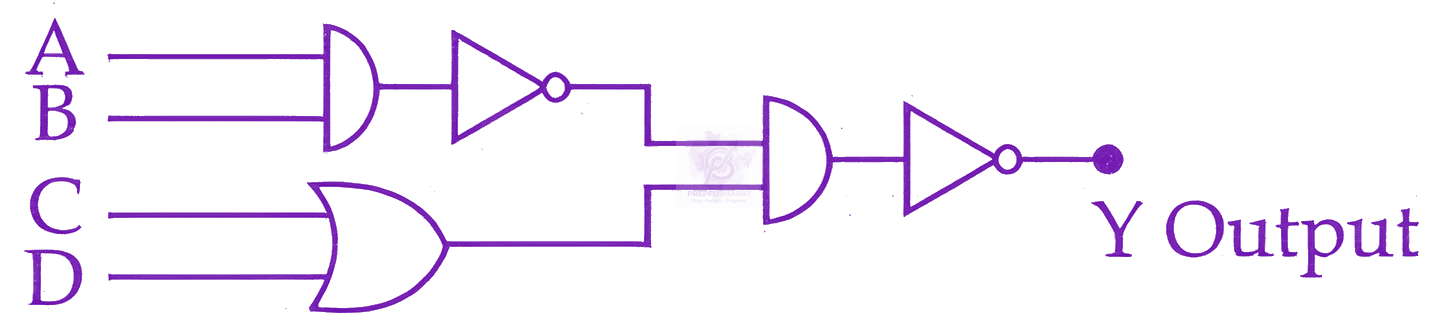
An electron is travelling with a velocity $v$ in free space and when it enters a medium, its velocity is reduced by $20\%$. The de Broglie wavelength of electron in the medium is $\alpha\lambda_0$, where $\lambda_0$ is its de Broglie wavelength in free space. The value of $\alpha$ is _______.
The maximum rated power of the LED is $2$ mW and it is used in the circuit with input voltage of $5$ V as shown in the figure below. The current through resistance $R_S$ is $0.5$ mA. The minimum value of the resistance of $R_S$, to ensure that the LED is not damaged is _______ k$\Omega$. 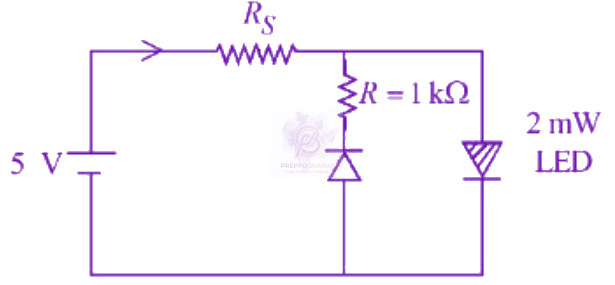
Two $4$ bits binary numbers, $A = 1101$ and $B = 1010$ are given in the inputs of a logic circuit shown in figure below. The output $(Y)$ will be: 