JEE Main 2017 — Modern Physics
Physics Modern Physics questions from JEE Main 2017.
Other Years
10 Modern Physics Questions from 2017
Two deuterons undergo nuclear fusion to form a Helium nucleus. The energy released in this process is (given binding energy per nucleon for deuteron$=\text{1.1}\mathrm{MeV}$ and for helium$=\text{7.0}\mathrm{MeV}$)
A laser light of wavelength $660 \mathrm{nm}$ is used to weld Retina detachment. If a laser pulse of width $60 \mathrm{ms}$ and power $0.5\mathrm{kW}$ is used, the approximate number of photons in the pulse are (Take Planck's Constant, $h=6.62\times {10}^{-34} Js)$
Imagine that a reactor converts all the given mass into energy and that it operates at a power level of ${10}^{9}\mathrm{Watt}$ . The mass of the fuel consumed $\mathrm{per}\mathrm{hour}$, in the reactor, will be: (velocity of light, $c$ is $3\times {10}^{8 }m{s}^{-1}$)
The conductivity of a semiconductor sample having electron concentration of $5\times {10}^{18}\mathrm{electrons}{m}^{-3}$, hole concentration of $5\times {10}^{19}\mathrm{holes}{m}^{-3}$, electron mobility of $2.0 {m}^{2} {V}^{-1} {s}^{-1}$ and hole mobility of $0.01{m}^{2} {V}^{-1} {s}^{-1}$ is (Take charge of an electron as $1.6\times {10}^{-19}C$ )
The acceleration of an electron in the first orbit of the hydrogen atom ($n=1$) is :
The maximum velocity of the photoelectrons emitted from the surface is $v$ when light of frequency $n$ falls on a metal surface. If the incident frequency is increased to $3n$, the maximum velocity of the ejected photoelectrons will be:
A particle $A$ of mass $m$ and initial velocity $v$ collides with a particle $B$ of mass $\frac{m}{2}$ which is at rest. The collision is head on, and elastic. The ratio of the de-Broglie wavelengths ${\lambda }_{A}$ to ${\lambda }_{B}$ after the collision is:
The $V-I$ characteristic of a diode is shown in the figure. The ratio of forward to reverse bias resistance is: 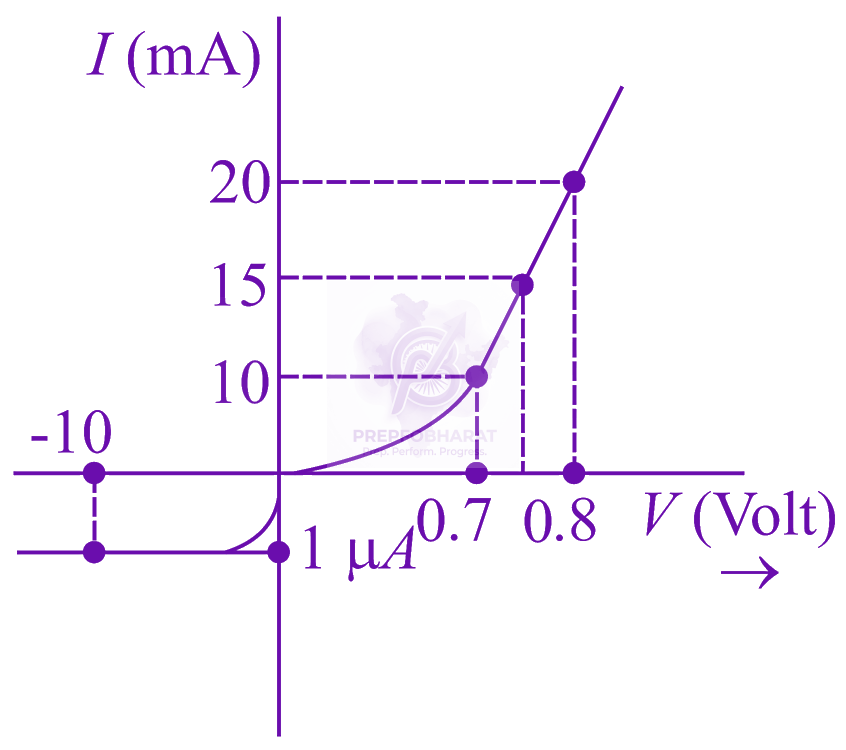
According to Bohr's theory, the time averaged magnetic field at the centre (i.e., nucleus) of a hydrogen atom due to the motion of electrons in the ${n}^{th}$ orbit is proportional to: ($n=$ principal quantum number)
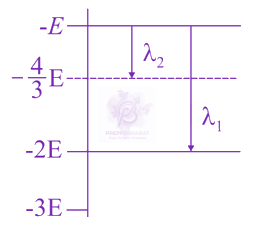
Some energy levels of a molecule are shown in the figure. The ratio of the wavelengths $r=\frac{{\lambda }_{1}}{{\lambda }_{2}}$, is given by: