JEE Main 2021 — Modern Physics
Physics Modern Physics questions from JEE Main 2021.
Other Years
86 Modern Physics Questions from 2021
The output of the given combination gates represents: 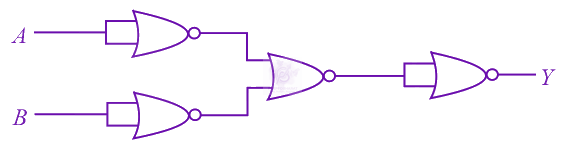
The binding energy per nucleon is maximum for:
The stopping potential in the context of photoelectric effect depends on the following property of incident electromagnetic radiation:
For the given circuit, the power across zener diode is _____ $\mathrm{mW}$. 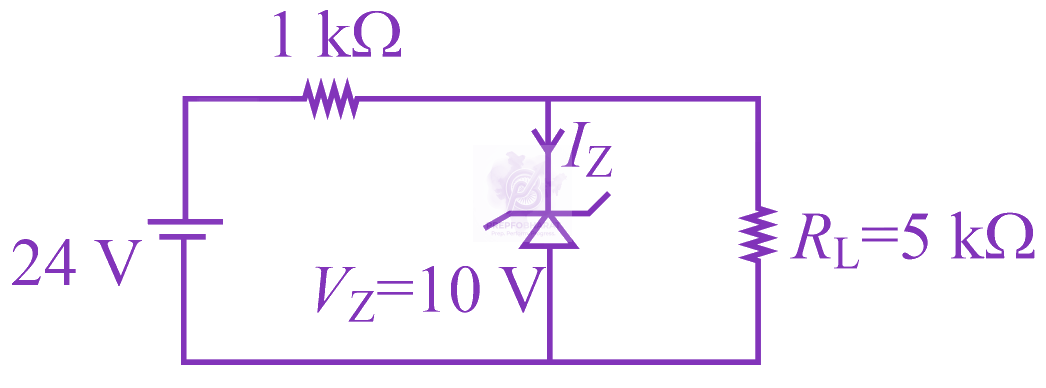
Draw the output signal $Y$ in the given combination of gates. 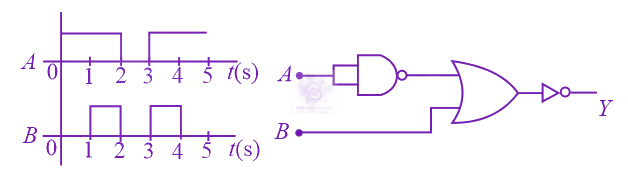
An electron of mass ${m}_{e}$ and a proton of mass ${m}_{p}=1836{m}_{e}$ are moving with the same speed. The ratio of their de Broglie wavelength $\frac{{\lambda }_{electron}}{{\lambda }_{proton}}$ will be :
Given below are two statements: Statement I : $p-n$ junction diodes can be used to function as a transistor, simply by connecting two diodes, back to back, which acts as the base terminal Statement II: In the study of transistors, the amplification factor $\beta$ indicates ratio of the collector current to the base current. In the light of the above statements, choose the correct answer from the options given below.
The temperature of an ideal gas in three dimensions is $300K.$ The corresponding de-Broglie wavelength of the electron approximately at $300K$ is: $[{m}_{e}=$mass of electron $=9\times {10}^{-31}\mathrm{kg}$, $h=$Planck constant $=6.6\times {10}^{-34}Js$, ${k}_{B}=$Boltzmann constant$=1.38\times {10}^{-23}J{K}^{-1}]$
From the given data, the amount of energy required to break the nucleus of aluminium $\mathrm{Al}1327$ is __________$x\times {10}^{-3}J$ Mass of neutron $=1.00866u$ Mass of proton $=1.00726u$ Mass of Aluminium nucleus $=27.18846u$ (Assume $1u$ corresponds to $xJ$ of energy) (Round off to the nearest integer)
Two identical photocathodes receive the light of frequencies ${f}_{1}$ and ${f}_{2}$ respectively. If the velocities of the photo-electrons coming out are ${v}_{1}$ and ${v}_{2}$ respectively, then
A monochromatic neon lamp with wavelength of $670.5\mathrm{nm}$ illuminates a photo-sensitive material which has a stopping voltage of $0.48V$. What will be the stopping voltage if the source light is changed with another source of wavelength of $474.6\mathrm{nm}$ ?
An electron of mass ${m}_{e}$ and a proton of mass ${m}_{P}$ are accelerated through the same potential difference. The ratio of the de-Broglie wavelength associated with the electron to that with the proton is
A particle of mass $4M$ at rest disintegrates into two particles of mass $M$ and $3M$, respectively, having non zero velocities. The ratio of de-Broglie wavelength of particle of mass $M$ to that of mass $3M$ will be:
A nucleus with mass number $184$ initially at rest emits an $\alpha -$particle. If the $Q$ value of the reaction is $5.5\mathrm{MeV},$ calculate the kinetic energy of the $\alpha -$ particle.
A particle of mass $9.1\times {10}^{-31}\mathrm{kg}$ travels in a medium with a speed of ${10}^{6}m{s}^{-1}$ and a photon of radiation of linear momentum ${10}^{-27}\mathrm{kg}m{s}^{-1}$ travels in a vacuum. The wavelength of the photon is ____ times the wavelength of the particle.
A particle of mass $m$ moves in a circular orbit in a central potential field $U(r)={U}_{0}{r}^{4}.$ If Bohr's quantization conditions are applied, radii of possible orbitals ${r}_{n}$ vary with ${n}^{\frac{1}{\alpha }}$, where $\alpha$ is _______ .
The wavelength of the photon emitted by a hydrogen atom when an electron makes a transition from $n=2$ to $n=1$ state is:
In the given figure, the energy levels of hydrogen atom have been shown along with some transitions marked $A,B,C,D$ and $E$. The transitions $A,B$ and $C$ respectively represent 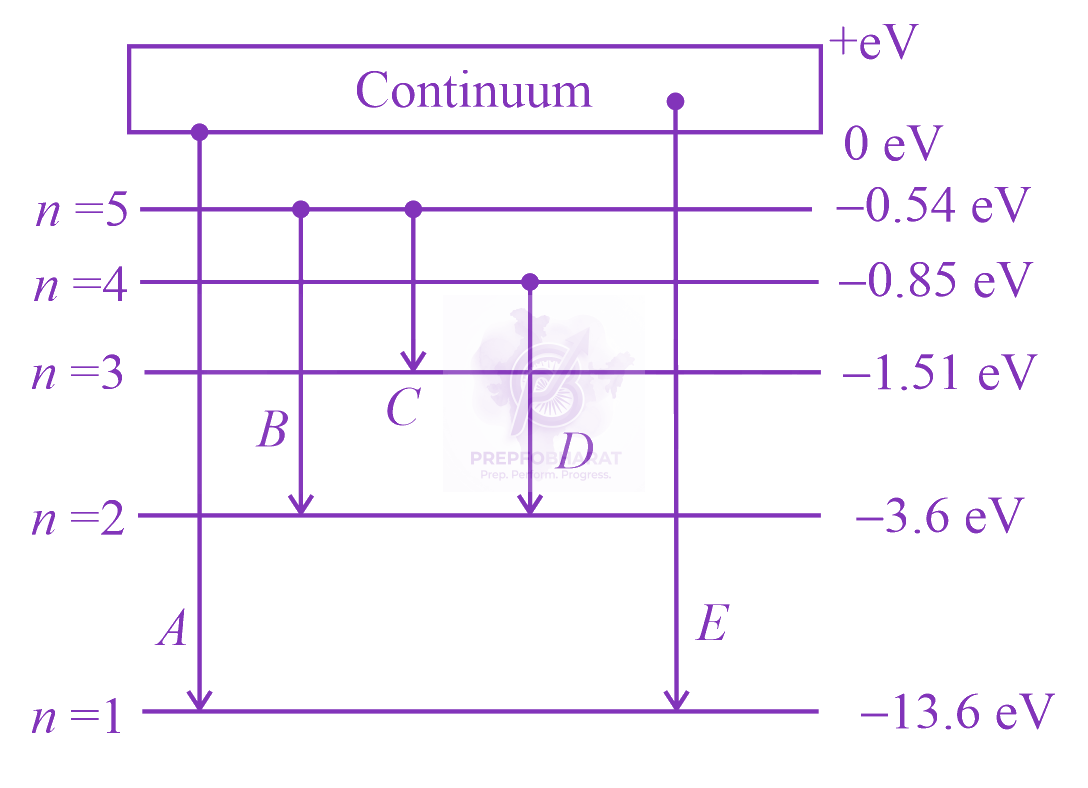
An electron moving with speed $v$ and a photon moving with speed $c$, have the same D-Broglie wavelength. The ratio of the kinetic energy of the electron to that of a photon is:
A moving proton and electron have the same de-Broglie wavelength. If $K$ and $P$ denote the $K.E.$ and momentum respectively. Then choose the correct option :
The recoil speed of a hydrogen atom after it emits a photon in going from $n=5$ state to $n=5$ state will be
Identify the logic operation carried out. 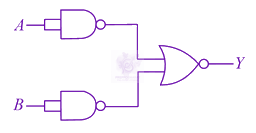
The stopping potential for electrons emitted from a photosensitive surface illuminated by light of wavelength $491\mathrm{nm}$ is $0.710V.$ When the incident wavelength is changed to a new value, the stopping potential is $1.43V.$ The new wavelength is :
Consider a situation in which reverse biased current of a particular $P-N$ junction increases when it is exposed to a light of wavelength $\leq 621\mathrm{nm}.$ During this process, enhancement in carrier concentration takes place due to generation of hole-electron pairs. The value of band gap is nearly.
If ${V}_{A}$ and ${V}_{B}$ are the input voltages (either $5V$ or $0V$) and ${V}_{0}$ is the output voltage then the two gates represented in the following circuits $(A)$ and $(B)$ are : 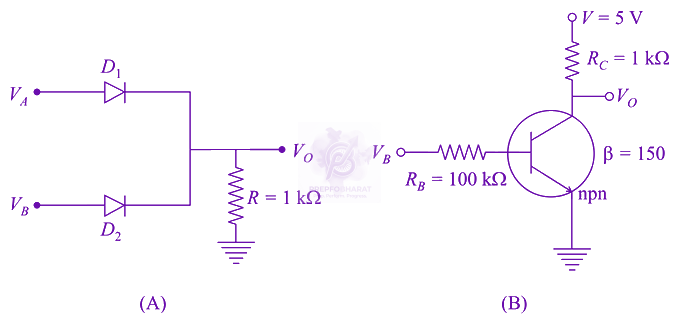
Consider two separate ideal gases of electrons and protons having same number of particles. The temperature of both the gases are same. The ratio of the uncertainty in determining the position of an electron to that of a proton is proportional to:
In connection with the circuit drawn below, the value of current flowing through $2k\Omega$ resistor is______$\times {10}^{-4}A.$ 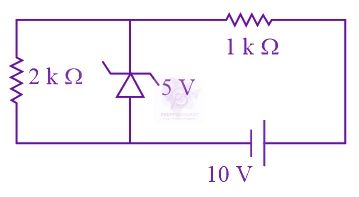
For extrinsic semiconductors; when doping level is increased;
The de Broglie wavelength of a proton and $\alpha$-particle are equal. The ratio of their velocities is
The first three spectral lines of $H$-atom in the Balmer series are given ${\lambda }_{1},{\lambda }_{2},{\lambda }_{3}$ considering the Bohr atomic model, the wave lengths of first and third spectral lines $(\frac{{\lambda }_{1}}{{\lambda }_{3}})$ are related by a factor of approximately $x$ $\times {10}^{-1}$. The value of $x$, to the nearest integer, is ________.
For the forward biased diode characteristics shown in the figure, the dynamic resistance at ${I}_{D}=3\mathrm{mA}$ will be ________$\Omega .$ 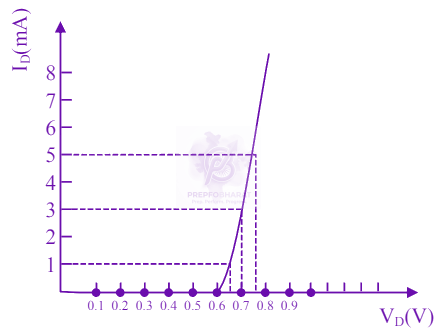
An electron having de-Broglie wavelength $\lambda$ is incident on a target in a $X$-ray tube. Cut-off wavelength of emitted $X$-ray is:
In a given circuit diagram, a $5V$ zener diode along with a series resistance is connected across a $50V$ power supply. The minimum value of the resistance required, if the maximum zener current is $90\mathrm{mA}$ will be $\text{Ω.}$ 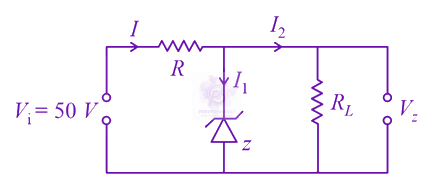
The de-Broglie wavelength associated with an electron and a proton were calculated by accelerating them through same potential of $100V$. What should nearly be the ratio of their wavelengths $?$ $({m}_{p}=1.00727u,{m}_{e}=0.00055u)$
Which one of the following will be the output of the given circuit? 
Statement I: By doping silicon semiconductors with pentavalent material, the electrons density increases. Statement II: The $n-$type of semiconductor has a net negative charge. In the above statements, choose the most appropriate answer from the options given below:
A light beam of wavelength $500\mathrm{nm}$ is incident on a metal having work function of $1.25\mathrm{eV}$, placed in a magnetic field of intensity $B$. The electrons emitted perpendicular to the magnetic field $B$, with maximum kinetic energy are bent into a circular arc of radius $30\mathrm{cm}$. The value of $B$ is ________$\times {10}^{-7}T$. Given $hc=20\times {10}^{-26}Jm$, the mass of the electron$=9\times {10}^{-31}\mathrm{kg}$.
A particular hydrogen like ion emits radiation of frequency $2.92\times {10}^{15}\mathrm{Hz}$ when it makes transition from $n=3$ to $n=1$. The frequency in $\mathrm{Hz}$ of radiation emitted in transition from $n=2$ to $n=1$ will be:
Choose the correct waveform that can represent the voltage across $R$ of the following circuit, assuming the diode is ideal one: 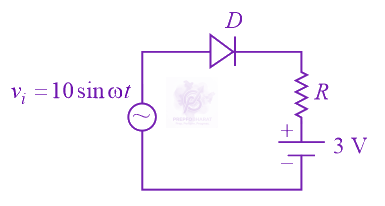
Which level of the single ionized carbon has the same energy as the ground state energy of hydrogen atom?
$X$ different wavelength may be observed in the spectrum from a hydrogen sample if the atoms are excited to states with principal quantum number $n=6$? The value of $X$ is
In a photoelectric experiment, increasing the intensity of incident light:
LED is constructed from $Ga-As-P$ semiconducting material. The energy gap of this LED is $1.9\mathrm{eV}$. Calculate the wavelength of light emitted and its colour. $h=6.63\times {10}^{-34}J-s$ and $c=3\times {10}^{8}m{s}^{-1}$
According to Bohr atom model, in which of the following transitions will the frequency be maximum?
In a photoelectric experiment, ultraviolet light of wavelength $280\mathrm{nm}$ is used with lithium cathode having work function $\phi =2.5\mathrm{eV}$. If the wavelength of incident light is switched to $400\mathrm{nm}$, find out the change in the stopping potential. $(h=6.63\times {10}^{-34}Js,c=3\times {10}^{8}{ms}^{-1})$
For the circuit shown below, calculate the value of ${I}_{z}:$ 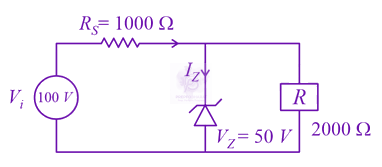
What should be the order of arrangement of de-Broglie wavelength of electron $({\lambda }_{e})$, an $\alpha$-particle $({\lambda }_{\alpha })$ and proton $({\lambda }_{p})$ given that all have the same kinetic energy ?
A circuit is arranged as shown in figure. The output voltage ${V}_{o}$ is equal to __________ $V.$ 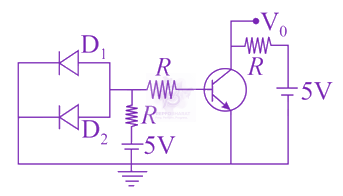
A particle is travelling $4$ times as fast as an electron. Assuming the ratio of de-Broglie wavelength of a particle to that of electron is $2:1,$ the mass of the particle is :-
An oil drop of the radius $2\mathrm{mm}$ with a density $3g$ ${\mathrm{cm}}^{-3}$ is held stationary under a constant electric field $3.55\times {10}^{5}V{m}^{-1}$ in the Millikan's oil drop experiment. What is the number of excess electrons that the oil drop will possess? $(\text{consider}g=9.81m{s}^{-2})$.
In the given figure, each diode has a forward bias resistance of $30\Omega$ and infinite resistance in reverse bias. The current ${I}_{1}$ will be : 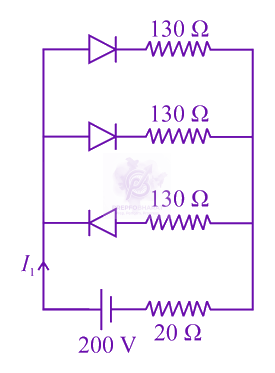
The decay of a proton to neutron is :
A zener diode of power rating $2W$ is to be used as a voltage regulator. If the zener diode has a breakdown of $10V$ and it has to regulate voltage fluctuated between $6V$ and $14V$, the value of ${R}_{s}$ for safe operation should be _____ $\Omega$ . 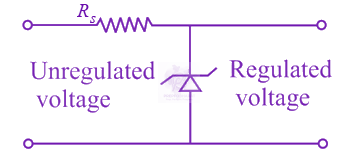
The de-Broglie wavelength of a particle having kinetic energy $E$ is $\lambda .$ How much extra energy must be given to this particle so that the de-Broglie wavelength reduces to $75%$ of the initial value?
A certain metallic surface is illuminated by monochromatic radiation of wavelength $\lambda$. The stopping potential for photoelectric current for this radiation is $3{V}_{0}.$ If the same surface is illuminated with a radiation of wavelength $2\lambda ,$ the stopping potential is ${V}_{0}.$ The threshold wavelength of this surface for photoelectric effect is___________$\lambda .$
A $5V$ battery is connected across the points $X$ and $Y$. Assume ${D}_{1}$ and ${D}_{2}$ to be normal silicon diodes. Find the current supplied by the battery if the $+ve$ terminal of the battery is connected to point $X$. 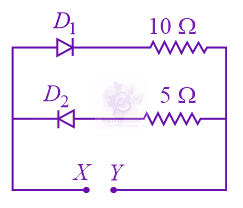
Consider the following statements: $A$. Atoms of each element emit characteristics spectrum. $B.$ According to Bohr's Postulate, an electron in a hydrogen atom revolves in a certain stationary orbit. $C.$ The density of nuclear matter depends on the size of the nucleus. $D.$ A free neutron is stable but a free proton decay is possible. $E.$ Radioactivity is an indication of the instability of nuclei. Choose the correct answer from the options given below.
The zener diode has a ${V}_{z}=30V$. The current passing through the diode for the following circuit is___$\mathrm{mA}.$ 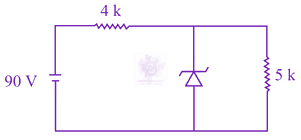
In the following logic circuit the sequence of the inputs $A,B$ are $(0,0),(0,1),(1,0)$ and $(1,1).$ The output $Y$ for this sequence will be : 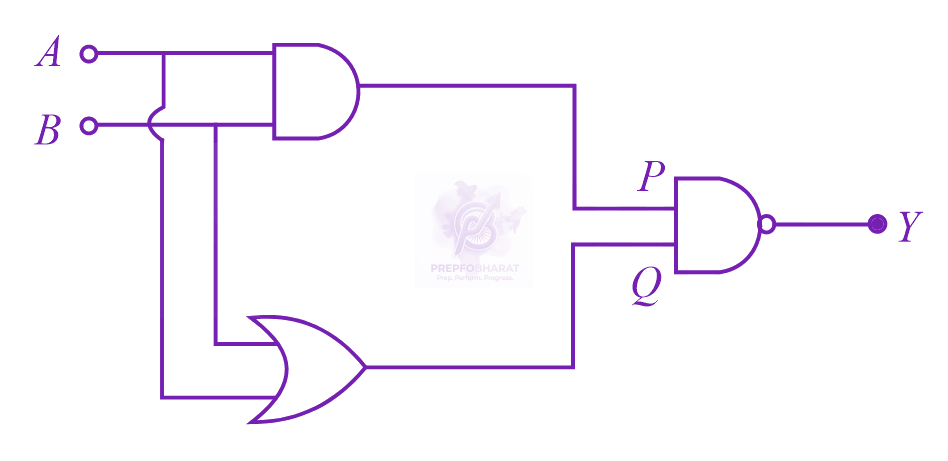
The truth table for the following logic circuit is : 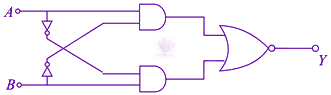
Identify the logic operation carried out by the given circuit: 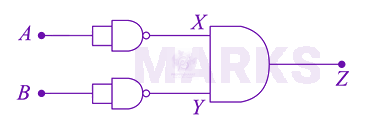
The radiation corresponding to $3\rightarrow 2$ transition of a hydrogen atom falls on a gold surface to generate photoelectrons. These electrons are passed through a magnetic field of $5\times {10}^{-4}T$. Assume that the radius of the largest circular path followed by these electrons is $7\mathrm{mm}$, the work function of the metal is: (Mass of electron $=9.1\times {10}^{-31}\mathrm{kg}$)
Statement I : To get a steady DC output from the pulsating voltage received from a full wave rectifier we can connect a capacitor across the output parallel to the load ${R}_{L}.$ Statement II : To get a steady DC output from the pulsating voltage received from a full wave rectifier we can connect an inductor in series with ${R}_{L}.$ In the light of the above statements, choose the most appropriate answer from the options given below :
The circuit contains two diodes each with a forward resistance of $50\Omega$ and with infinite reverse resistance. If the battery voltage is $6V$, the current through the $120\Omega$ resistance is _______ $\mathrm{mA}$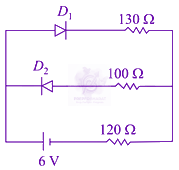
If an electron is moving in the ${n}^{\text{th }}$ orbit of the hydrogen atom, then its velocity $({v}_{n})$ for the ${n}^{\text{th }}$ orbit is given as:
The following logic gate is equivalent to : 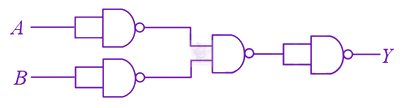
If ${\lambda }_{1}$ and ${\lambda }_{2}$ are the wavelengths of the third member of Lyman and first member of the Paschen series respectively, then the value of ${\lambda }_{1}:{\lambda }_{2}$ is :
An electron of mass $m$ and a photon have same energy $E.$ The ratio of wavelength of electron to that of photon is : ($c$ being the velocity of light)
The atomic hydrogen emits a line spectrum consisting of various series. Which series of hydrogen atomic spectra is lying in the visible region?
Imagine that the electron in a hydrogen atom is replaced by a muon $(\mu ).$ The mass of muon particle is $207$ times that of an electron and charge is equal to the charge of an electron. The ionization potential of this hydrogen atom will be:-
When radiation of wavelength $\lambda$ is incident on a metallic surface, the stopping potential of ejected photoelectrons is $4.8V$. If the same surface is illuminated by radiation of double the previous wavelength, then the stopping potential becomes $1.6V$. The threshold wavelength of the metal is:
Given below are two statements: Statement $I:$ Two photons having equal linear momenta have equal wavelengths. Statement $\mathrm{II}:$ If the wavelength of the photon is decreased, then the momentum and energy of a photon will also decrease. In the light of the above statements, choose the correct answer from the options given below.
The ${K}_{\alpha }$ X-ray of molybdenum has wavelength $0.071\mathrm{nm}$. If the energy of a molybdenum atom with a $K$ electron knocked out is $27.5\mathrm{keV}$, the energy of this atom when an $L$ electron is knocked out will be $\mathrm{keV}$. (Round off to the nearest integer ) $[h=4.14\times {10}^{-15}\mathrm{eV}s,c=3\times {10}^{8}{ms}^{-1}]$
In a semiconductor, the number density of intrinsic charge carriers at $27^{\circ}C$ is $1.5\times {10}^{16}{m}^{-3}$. If the semiconductor is doped with an impurity atom, the hole density increases to $4.5\times {10}^{22}{m}^{-3}$. The electron density in the doped semiconductor is _______$\times {10}^{9}{m}^{-3}$
A free electron of $2.6\mathrm{eV}$ energy collides with a ${H}^{+}$ ion. This results in the formation of a hydrogen atom in the first excited state and a photon is released. Find the frequency of the emitted photon. $(h=6.6\times {10}^{-34}Js)$
In the logic circuit shown in the figure, if input $A$ and $B$ are $0$ to $1$ respectively, the output at $Y$ would be $x$. The value of $x$ is _________. 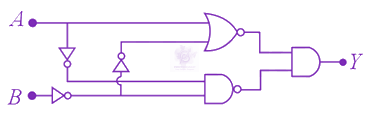
Four NOR gates are connected as shown in figure. The truth table for the given figure is : 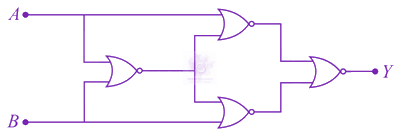
Find the truth table for the function $Y$ of $A$ and $B$ represented in the following figure. 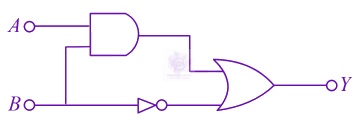
Two stream of photons, possessing energies equal to twice and ten times the work function of metal are incident on the metal surface successively. The value of ratio of maximum velocities of the photoelectrons emitted in the two respective cases is $x:3$ The value of $x$ is
An electron and proton are separated by a large distance. The electron starts approaching the proton with energy $3\mathrm{eV}$. The proton captures the electrons and forms a hydrogen atom in second excited state. The resulting photon is incident on a photosensitive metal of threshold wavelength $4000A$ What is the maximum kinetic energy of the emitted photoelectron?
Zener breakdown occurs in a $p-n$ junction having $p$and $n$ both:
A zener diode having zener voltage $8V$ and power dissipation rating of $0.5W$ is connected across a potential divider arranged with maximum potential drop across zener diode is as shown in the diagram. The value of protective resistance ${R}_{p}$ is _____$\Omega .$ 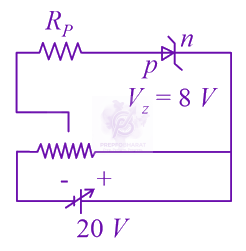
An $\alpha$ particle and a proton are accelerated from rest by a potential difference of $200V$. After this, their de Broglie wavelengths are ${\lambda }_{\alpha }$ and ${\lambda }_{p}$ respectively. The ratio $\frac{{\lambda }_{p}}{{\lambda }_{\alpha }}$ is :
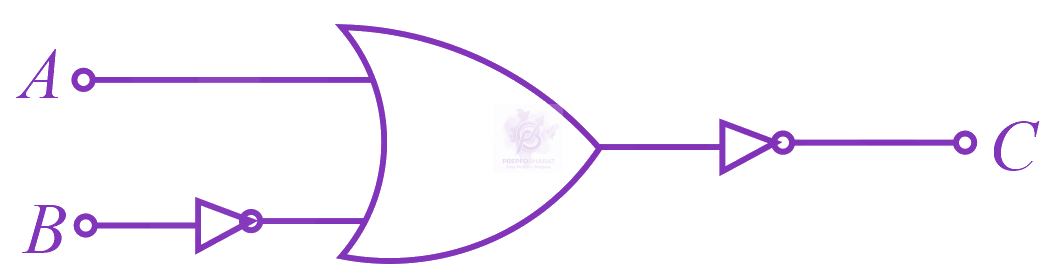 The logic circuit shown above is equivalent to :
In Bohr's atomic model, the electron is assumed to revolve in a circular orbit of radius $0.5\overset{\circ }{A}.$ If the speed of electron is $2.2\times {10}^{6}m{s}^{-1}.$ Then the current associated with the electron will be__________ $\times {10}^{-2}\mathrm{mA}.$ [Take $\pi$ as $\frac{22}{7}]$
The value of power dissipated across the zener diode $({V}_{z}=15V)$ connected in the circuit as shown in the figure is $x\times {10}^{-1}W$. 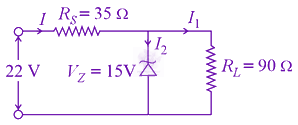 The value of $x$ to the nearest integer is _______.