JEE Main 2020 — Modern Physics
Physics Modern Physics questions from JEE Main 2020.
Other Years
38 Modern Physics Questions from 2020
Particle $A$ of mass ${\text{m}}_{\text{A}}=\frac{\text{m}}{2}$ moving along the $\text{x}$ -axis with velocity ${\text{v}}_{0}$ collides elastically with another particle $\text{B}$ at rest having mass ${\text{m}}_{\text{B}}=\frac{\text{m}}{3}$. If both the particles move along the $\text{x}$ -axis after the collision, the change $\Delta \lambda$ in the wavelength of the particle $\text{A}$, in terms of its de-Broglie wavelength $({\lambda }_{0})$ before the collision is:
A particle moving with kinetic energy $E$ has de Broglie wavelength $\lambda$ . If energy $\Delta E$ is added to its energy, the wavelength become $\frac{\lambda }{2}$ . Value of $\Delta E,$ is:
When the wavelength of radiation falling on a metal is changed from $500\mathrm{nm}\mathrm{to}200\mathrm{nm}$, the maximum kinetic energy of the photoelectrons becomes three times larger. The work function of the metal is close to:
The first member of the Balmer series of hydrogen atom has a wavelength of $6561\overset{\circ }{A}$. The wavelength of the second member of the Balmer series (in nm) is_____________
When photon of energy $4.0eV$ strikes the surface of a metal $A,$ the ejected photoelectrons have maximum kinetic energy ${T}_{A}eV$ and de-Broglie wavelength ${\lambda }_{A}.$ The maximum kinetic energy of photoelectrons liberated from another metal $B$ by photon of energy $4.50eV$ is ${T}_{B}=({T}_{A}-1.5)eV.$ If the de-Broglie wavelength of these photoelectrons ${\lambda }_{B}=2{\lambda }_{A},$ then the work function of metal $B$ is:
Which of the following gives a reversible operation?
With increasing biasing voltage of a photo diode, the photocurrent magnitude:
In a hydrogen atom the electron makes a transition from ${(n+1)}^{\mathrm{th}}$ level to the ${n}^{\mathrm{th}}$ level. If $n>>1$, the frequency of radiation emitted is proportional to :
In the line spectra of hydrogen atom, difference between the largest and the shortest wavelengths of the Lyman series is $305\overset{\circ }{A}$. The corresponding difference for the Paschan series in $\overset{\circ }{A}$ is:________
A beam of electromagnetic radiation of intensity $6.4\times { 10}^{ -5} \text{W}/ { \text{cm}}^{2}$ is comprised of wavelength, $\lambda =310nm$ . It falls normally on a metal (work function $\phi =2eV$ ) of surface area of $1{cm}^{2}$ . If one in ${10}^{3}$ photons ejects an election, total number of electrons ejected in $1s$ is ${10}^{x}$ . $(hc=1240eVnm,1eV=1.6\times {10}^{-19}J),$ then $x$ is ___________
Identify the operation performed by the circuit given below : 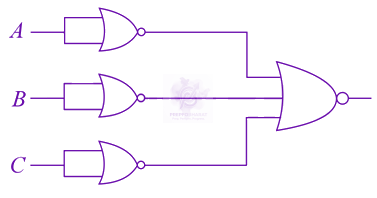
An electron of mass $m$ and magnitude of charge $e$ at rest, gets accelerated by a constant electric field $E$. The rate of change of de-Broglie wavelength of this electron at a time $t$ is (ignore relativistic effects)
Given figure shows few data points in a photo-electric effect experiment for a certain metal. The minimum energy for ejection of electrons from its surface is: (Planck's constant $h=6.62\times {10}^{–34}\text{ J.s}$) 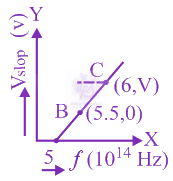
The current $i$ in the network is 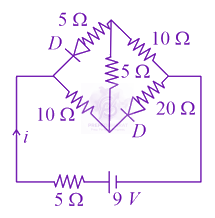
You are given that $\mathrm{Li}37=7.0160u,$Mass of Mass of $\mathrm{He}24=4.0026u$ and Mass of $\mathrm{He}11=1.0079H$ When $20g$ of $\mathrm{Li}37$ is converted into ${}_{2}^{4}$ He by proton capture, the energy liberated, (in $\mathrm{kWh}$ ), is : [Mass of nucleon $=1\mathrm{GeV}/{c}^{2}$]
In the given circuit, value of $Y$ is: 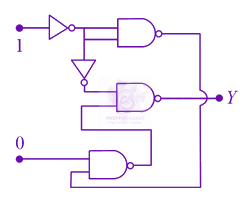
A particle is moving $5$ times as fast as an electron. The ratio of the de-Broglie wavelength of the particle to that of the electron is $1.878\times {10}^{–4}$. The mass of the particle is close to :
Take the breakdown voltage of the zener diode used in the given circuit as $6\text{V}$. For the input voltage shown in the figure below, the time variation of the output voltage is: (Graphs drawn are schematic and not to the scale) 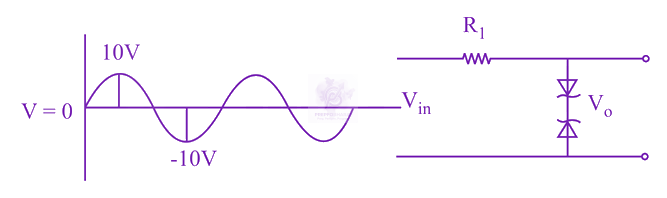
The energy required to ionise a hydrogen like ion in its ground state is $9$ Rydbergs. What is the wavelength of the radiation emitted when the electron in this ion jumps from the second excited stale to the ground state?
In the following, digital circuit, what will be the output a '$Z$', when the input $(A,B)$ are $(1,0),(0,0),(1,1),(0,1)$ 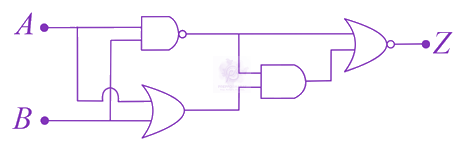
The surface of a metal is illuminated alternately with photons of energies ${E}_{1}=4\mathrm{eV}$ and ${E}_{2}=2.5\mathrm{eV}$ respectively. The ratio of maximum speeds of the photoelectrons emitted in the two cases is $2.$ The work function of the metal in $(\mathrm{eV})$ is..........
An electron (of mass $m$ ) and a photon have the same energy $E$ in the range of a few $eV$. The ratio of the de-Broglie wavelength associated with the electron and the wavelength of the photon is ( $c=$ speed of light in vacuum)
Given the masses of various atomic particles ${m}_{P}=1,0072 u$, ${m}_{n}=1,0087 u$, ${m}_{e}=0.000548 u$, ${m}_{\bar{v}}=0$, ${m}_{d}=2.0141 u$, where $p=$proton, $n\equiv$neutron, $e\equiv$electron, $\bar{v}\equiv$antineutrino and $\bar{d}\equiv$deuteron. Which of the following process is allowed by momentum and energy conservation :
An electron, a doubly ionized helium ion ($He^{++}$) and proton are having the same kinetic energy. The relation between their respective de-Broglie wavelength ${\lambda }_{{e}^{*}}{\lambda }_{{\mathrm{He}}^{++}}$ and ${\lambda }_{p}$ is :
Identify the correct output signal $Y$ in the given combination of gates (as shown $n$) for the given inputs $AandB$ 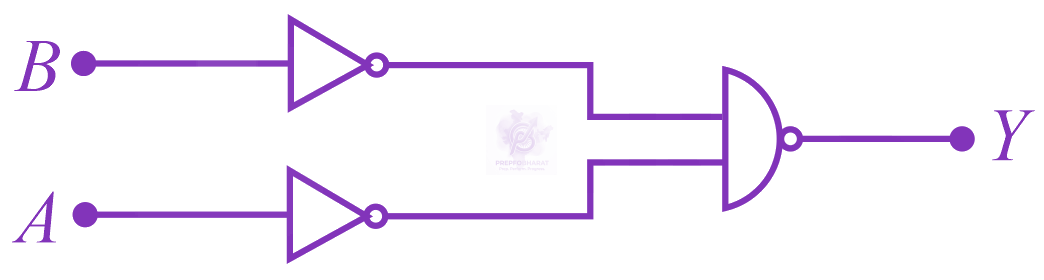 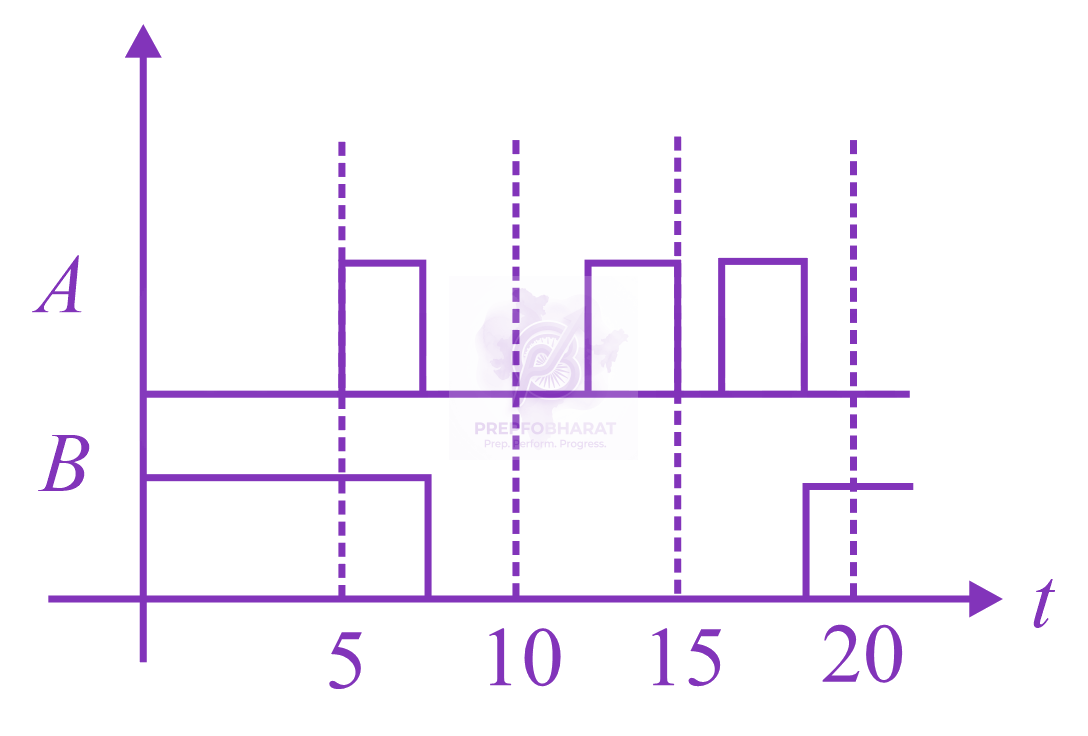
In the circuit shown below, is working as a $8Vdc$ regulated voltage source. When $12V$ is used as an input, the power dissipated (in $mW$ ) in each diode is (Considering both zener diodes are identical) 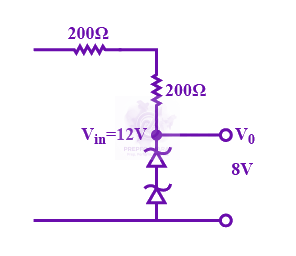
The de Broglie wavelength of an electron accelerated through a potential difference of 100 V is approximately:
An electron (mass $m$ ) with initial velocity $\vec{v}={v}_{0}\hat{i}+{v}_{0}\hat{j}$ is in an electric filed $\vec{E}=-{E}_{0}\hat{k}.$ If ${\lambda }_{0}$ is initial de-Broglie wavelength of electron, its de-Broglie wave length at time $t$ is given by:
Boolean relation at the output stage- $Y$ for the following circuit is: 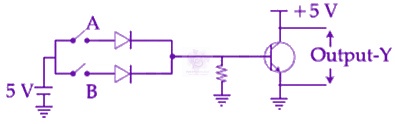
If a semiconductor photo diode can detect a photon with a maximum wavelength of $400\mathrm{nm}$, then its band gap energy is: Planck's constant $h=6.63\times {10}^{-34}J.s$ Speed of light $c=3\times {10}^{8}m{s}^{-1}$
Find the Binding energy per nucleon for $\mathrm{Sn}50120$. Mass of proton ${m}_{p}=1.00783U$, mass of neutron ${m}_{n}=1.00867U$ and mass of tin nucleus ${m}_{\mathrm{sn}}=119.902199U$. (take $1U=931MeV$)
Both the diodes used in the circuit shown are assumed to be ideal and have negligible resistance when these are forward biased. Built in potential in each diode is $0.7V$. For the input voltages shown in the figure, the voltage (in Volts) at point A is ________ 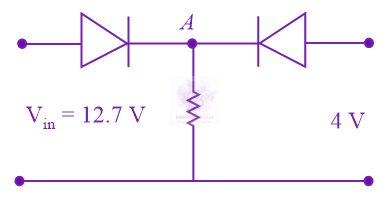
The radius $R$ of a nucleus of mass number $A$ can be estimated by the formula $R=(1.3\times {10}^{-15}){A}^{1/3}m$. It follows that the mass density of n nucleus is of the order of: $({M}_{prot}\cong {M}_{\text{neut }}\simeq 1.67\times {10}^{-27}\mathrm{kg})$
In a photoelectric effect experiment, the graph of stopping potential $V$ versus reciprocal of wavelength obtained is shown in the figure. As the intensity of incident radiation is increased : 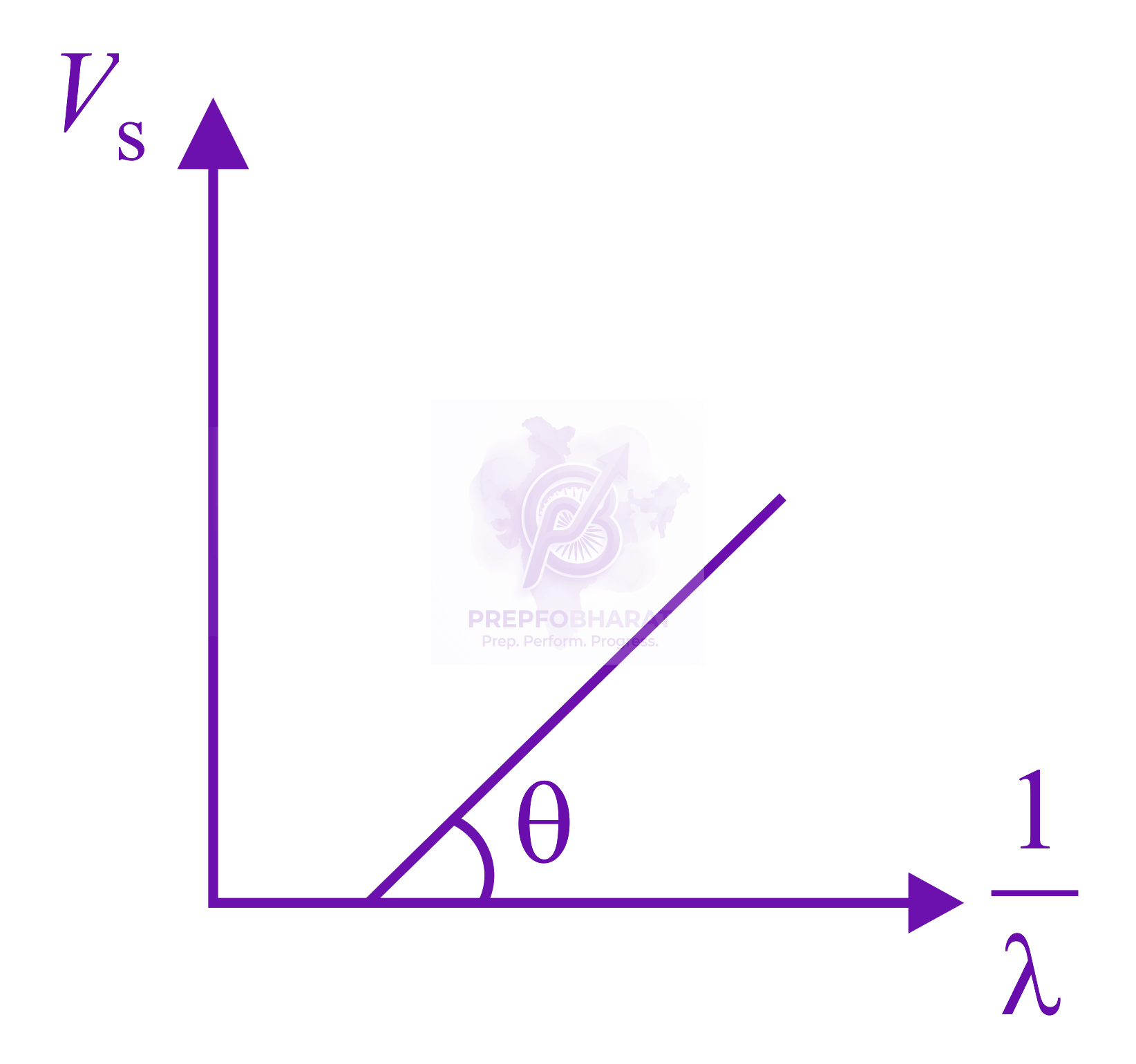
When a diode is forward biased, it has a voltage drop of $0.5V$ . the safe limit of current through the diode is $10\mathrm{mA}$. If a battery of emf $1.5V$ is used in the circuit, the value of minimum resistance to be connected in series with the diode so that the current does not exceed the safe limit is :
Two Zener diodes ($A$ and $B$) having breakdown voltages of $6V$ and $4V$ respectively, are connected as shown in the circuit below. The output voltage ${V}_{0}$ variation with input voltage linearly increasing with time, is given by (${V}_{input}=0Vatt=0$)
The time period of revolution of electron in its ground state orbit in a hydrogen atom is $1.6\times {10}^{-16}s.$ The frequency of revolution of the electron in its first excited state (in ${s}^{-1}$ ) is:
When radiation of wavelength $A$ is used to illuminate a metallic surface, the stopping potential is $V$. When the same surface is illuminated with radiation of wavelength $3A$, the stopping potential is $\frac{V}{4}$. If the threshold wavelength for the metallic surface is $n\lambda$ then value of $n$ will be :