JEE Main 2018 — Modern Physics
Physics Modern Physics questions from JEE Main 2018.
Other Years
14 Modern Physics Questions from 2018
An electron from various excited states of hydrogen atom emit radiation to come to the ground state. Let ${\lambda }_{n}, {\lambda }_{g}$ be the de Broglie wavelength of the electron in the ${n}^{th}$ state and the ground state respectively. Let ${\wedge }_{n}$ be the wavelength of the emitted photon in the transition from the ${n}^{th}$ state to the ground state. For large n, (A, B are constants)
Both the nucleus and the atom of some element are in their respective first excited states. They get de-excited by emitting photons of wavelengths ${\lambda }_{N}, {\lambda }_{A}$ respectively. The ratio $\frac{{\lambda }_{N}}{{\lambda }_{A}}$ is closest to:
The energy required to remove the electron from a singly ionized Helium atom is $2.2$ times the energy required to remove an electron from helium atom. The total energy required to ionize the Helium atom completely is close to
The de-Broglie wavelength $({\lambda }_{B})$ associated with the electron orbiting in the second excited state of hydrogen atom is related to that in the ground state $({\lambda }_{G})$ by:
The energy required to remove the electron from a singly ionized Helium atom is $2.2$ times the energy required to remove an electron from Helium atom. The total energy required to ionize the Helium atom completely is:
Two electrons are moving with non-relativistic speeds perpendicular to each other. If corresponding de brogile wavelengths are ${\lambda }_{1}$ and ${\lambda }_{2}$, their de brogile wavelength in the frame of reference attached to their centre of mass is:
Truth table for the given circuit will be 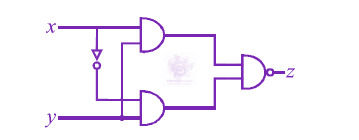
Two electrons are moving with non-relativistic speeds perpendicular to each other. If corresponding de Broglie wavelengths are $\lambda_1$ and $\lambda_2$, their de Broglie wavelength in the frame of reference attached to their centre of mass is:
If the de Broglie wavelengths associated with a proton and an $\alpha$-particle are equal, then the ratio of velocities of the proton and the $\alpha$-particle will be:
The reading of the ammeter for a silicon diode in the given circuit is: 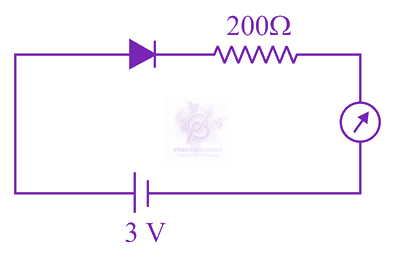
In the given circuit the current through zener diode is: 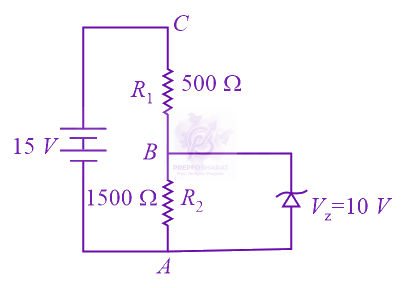
An unstable heavy nucleus at rest breaks into two nuclei which move away with velocities in the ratio of $8: 27$. The ratio of the radii of the nuclei (assumed to be spherical ) is:
If the series limit frequency of the Lyman series is ${V}_{L},$ then the series limit frequency of the Pfund series is:
Muon $\left(\mu^{-1}\right)$ is negatively charged $(|\mathrm{q}|=|\mathrm{e}|)$ with a mass $\mathrm{m}_\mu=200 \mathrm{~m}_{\mathrm{e}}$, where $\mathrm{m}_{\mathrm{e}}$ is the mass of the electron and e is the electronic charge. If $\mu^{-1}$ is bound to a proton to form a hydrogen like atom, identify the correct statements (A) Radius of the muonic orbit is 200 times smaller than that of the electron (B) the speed of the $\mu^{-1}$ in the $n$th orbit is $\frac{1}{200}$ times that of the election in the nth orbit (C) The lonization energy of muonic atom is 200 times more than that of an hydrogen atom (D) The momentum of the muon in the nth orbit is 200 times more than that of the electron