JEE Main 2024 — Modern Physics
Physics Modern Physics questions from JEE Main 2024.
Other Years
85 Modern Physics Questions from 2024
If the total energy transferred to a surface in time $t$ is $6.48\times {10}^{5}J$, then the magnitude of the total momentum delivered to this surface for complete absorption will be :
The radius of a nucleus of mass number $64$ is $4.8$ fermi. Then the mass number of another nucleus having radius of $4$ fermi is $\frac{1000}{x},$ where $x$ is _________.
In photoelectric experiment energy of $2.48 \mathrm{eV}$ irradiates a photo sensitive material. The stopping potential was measured to be $0.5 \mathrm{~V}$. Work function of the photo sensitive material is :
A proton and an electron are associated with same de-Broglie wavelength. The ratio of their kinetic energies is: (Assume h=6.63 $\times 10^{-34} \mathrm{~J} \mathrm{~s}, \mathrm{~m}_{\mathrm{e}}=9.0 \times 10^{-31} \mathrm{~kg}$ and $\mathrm{m}_{\mathrm{p}}=1836$ times $\mathrm{m}_{\mathrm{e}}$ )
Which of the following phenomena does not explain by wave nature of light. A. reflection B. diffraction C. photoelectric effect D. interference E. polarization Choose the most appropriate answer from the options given below:
In Franck-Hertz experiment, the first dip in the current-voltage graph for hydrogen is observed at 10.2 V. The wavelength of light emitted by hydrogen atom when excited to the first excitation level is _________ $\mathrm{nm}$. (Given $\mathrm{hc}=1245 \mathrm{eV} \mathrm{nm}, \mathrm{e}=1.6 \times 10^{-19} \mathrm{C}$ ).
The energy equivalent of $1 \mathrm{~g}$ of substance is :
In the given circuit, the voltage across load resistance $({R}_{L})$ is: 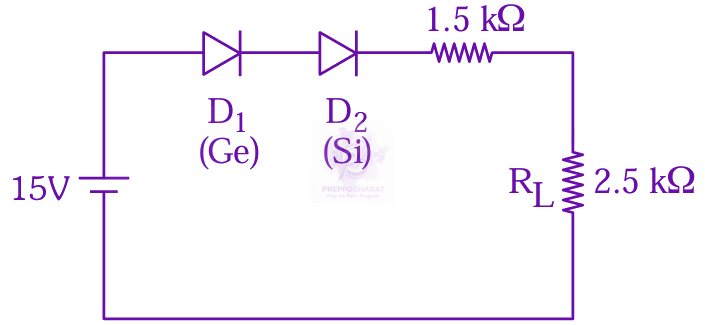
Which figure shows the correct variation of applied potential difference (V) with photoelectric current (I) at two different intensities of light $\left(\mathrm{I}_1 < \mathrm{I}_2\right)$ of same wavelengths :
Identify the logic gate given in the circuit: 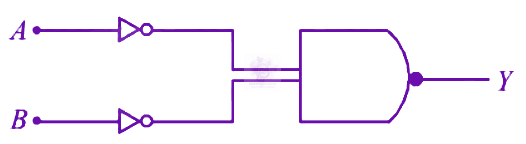
The disintegration energy $Q$ for the nuclear fission of ${ }^{235} \mathrm{U} \rightarrow{ }^{140} \mathrm{Ce}+{ }^{94} \mathrm{Zr}+n$ is ______ $\mathrm{MeV}$. Given atomic masses of ${ }^{235} \mathrm{U}: 235.0439 u ;{ }^{140} \mathrm{Ce}: 139.9054 u$, ${ }^{94} \mathrm{Zr}: 93.9063 u ; n: 1.0086 u \text {, }$ Value of $c^2=931 \mathrm{MeV} / \mathrm{u}$
A potential divider circuit is connected with a dc source of $20 \mathrm{~V}$, a light emitting diode of glow in voltage $1.8 \mathrm{~V}$ and a zener diode of breakdown voltage of $3.2 \mathrm{~V}$. The length (PR) of the resistive wire is $20 \mathrm{~cm}$. The minimum length of PQ to just glow the LED is _____$\mathrm{cm}$ 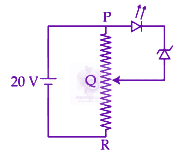
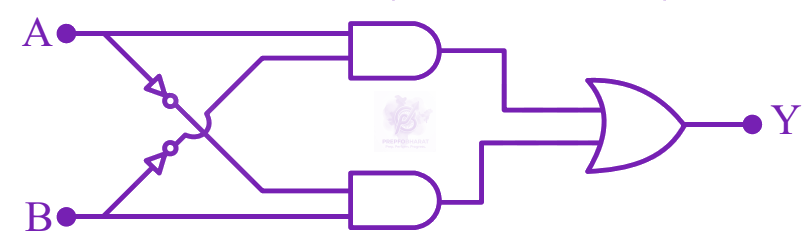
The correct truth table for the following logic circuit is : 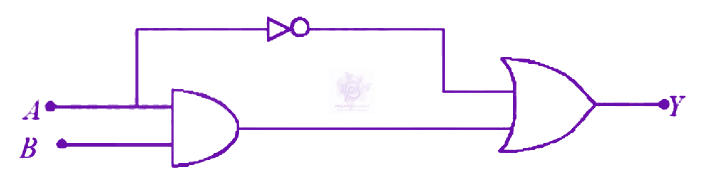
A nucleus has mass number ${A}_{1}$ and volume ${V}_{1}$. Another nucleus has mass number ${A}_{2}$ and volume ${V}_{2}$. If relation between mass number is ${A}_{2}=4{A}_{1}$, then $\frac{{V}_{2}}{{V}_{1}}=$ _______.
A star has $100 \%$ helium composition. It starts to convert three ${ }^4 \mathrm{He}$ into one ${ }^{12} \mathrm{C}$ via triple alpha process as ${ }^4 \mathrm{He}+{ }^4 \mathrm{He}+{ }^4 \mathrm{He} \rightarrow{ }^{12} \mathrm{C}+\mathrm{Q}$. The mass of the star is $2.0 \times 10^{32} \mathrm{~kg}$ and it generates energy at the rate of $5.808 \times 10^{30} \mathrm{~W}$. The rate of converting these ${ }^4 \mathrm{He}$ to ${ }^{12} \mathrm{C}$ is $\mathrm{n} \times 10^{42} \mathrm{~s}^{-1}$, where $\mathrm{n}$ is _________ [ Take, mass of ${ }^4 \mathrm{He}=4.0026 \mathrm{u}$, mass of ${ }^{12} \mathrm{C}=12 \mathrm{u}$ ]
Average force exerted on a non-reflecting surface at normal incidence is $2.4 \times 10^{-4} \mathrm{~N}$. If $360 \mathrm{~W} / \mathrm{cm}^2$ is the light energy flux during span of 1 hour 30 minutes, Then the area of the surface is:
If Rydberg's constant is $R$, the longest wavelength of radiation in Paschen series will be $\frac{\alpha }{7R}$, where $\alpha =$______.
Binding energy of a certain nucleus is $18 \times 10^8 \mathrm{~J}$. How much is the difference between total mass of all the nucleons and nuclear mass of the given nucleus:
Given below are two statements: one is labelled as Assertion $\mathbf{A}$ and the other is labelled as Reason R. Assertion A: Number of photons increases with increase in frequency of light. Reason R: Maximum kinetic energy of emitted electrons increases with the frequency of incident radiation. In the light of the above statements, choose the most appropriate answer from the options given below:
Radius of a certain orbit of hydrogen atom is $8.48 Ã…$. If energy of electron in this orbit is $E / x$. then $x=$ _____ (Given $\mathrm{a}_0=0.529 Ã…, E=$ energy of electron in ground state).
The de Broglie wavelengths of a proton and an $\alpha$ particle are $\lambda$ and $2\lambda$ respectively. The ratio of the velocities of proton and $\alpha$ particle will be :
In a nuclear fission process, a high mass nuclide $(A\approx 236)$ with binding energy $7.6\mathrm{MeV}/$Nucleon dissociated into two middle mass nuclides $(A\approx 118)$, having binding energy of $8.6\mathrm{MeV}/$Nucleon. The energy released in the process would be _______ $\mathrm{MeV}$.
Hydrogen atom is bombarded with electrons accelerated through a potential different of $V$, which causes excitation of hydrogen atoms. If the experiment is being formed at $T=0K$. The minimum potential difference needed to observe any Balmer series lines in the emission spectra will be $\frac{\alpha }{10}V$, where $\alpha =$_________.(Write the value to the nearest integer)
In the given circuit, the breakdown voltage of the Zener diode is $3.0V$. What is the value of ${I}_{z}$ ? 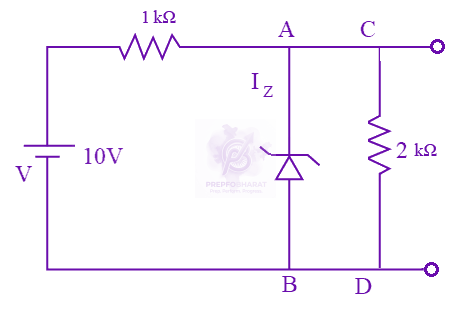
The explosive in a Hydrogen bomb is a mixture of $H21,H31$ and $\mathrm{Li}63$ in some condensed form. The chain reaction is given by $\mathrm{Li}63+n10\rightarrow \mathrm{He}42+H31$; $H21+H31\rightarrow \mathrm{He}42+n10$ During the explosion the energy released is approximately [Given : $M(\mathrm{Li})=6.01690\mathrm{amu},M(H21)=2.01471\mathrm{amu},M(\mathrm{He}42)=4.00388\mathrm{amu}$ and $1\mathrm{amu}=931.5\mathrm{MeV}$]
Which of the following nuclear fragments corresponding to nuclear fission between neutron $\left({ }_0^1 \mathrm{n}\right)$ and uranium isotope $\left({ }_{92}^{235} \mathrm{U}\right)$ is correct :
The angular momentum of an electron in a hydrogen atom is proportional to : (Where $r$ is the radius of orbit of electron)
A hydrogen atom in ground state is given an energy of $10.2 \mathrm{eV}$. How many spectral lines will be emitted due to transition of electrons?
An electron rotates in a circle around a nucleus having positive charge Ze. Correct relation between total energy (E) of electron to its potential energy (U) is :
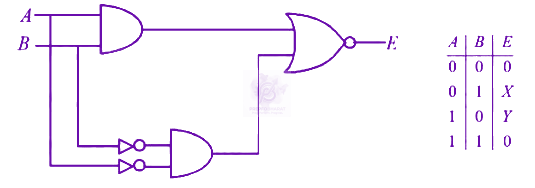 In the truth table of the above circuit the value of $\mathrm{X}$ and $\mathrm{Y}$ are :
Which of the diode circuit shows correct biasing used for the measurement of dynamic resistance of p-n junction diode :
If the wavelength of the first member of Lyman series of hydrogen is $\lambda$. The wavelength of the second member will be
The mass number of nucleus having radius equal to half of the radius of nucleus with mass number $192$ is:
A proton and an electron have the same de Broglie wavelength. If $\mathrm{K}_{\mathrm{p}}$ and $\mathrm{K}_{\mathrm{e}}$ be the kinetic energies of proton and electron respectively, then choose the correct relation :
The radius of third stationary orbit of electron for Bohr's atom is $R$. The radius of fourth stationary orbit will be:
The atomic mass of $C126$ is $12.000000u$ and that of $C136$ is $13.003354u$. The required energy to remove a neutron from $C136$, if mass of neutron is $1.008665u$, will be:
A particular hydrogen - like ion emits the radiation of frequency $3\times {10}^{15}\mathrm{Hz}$ when it makes transition from $n=2$ to $n=1.$ The frequency of radiation emitted in transition from $n=3$ to $n=1$ is $\frac{x}{9}\times {10}^{15}\mathrm{Hz},$ when $x=$ _____.
An electron of hydrogen atom on an excited state is having energy ${E}_{n}=-0.85\mathrm{eV}$. The maximum number of allowed transitions to lower energy level is _______.
The acceptor level of a p-type semiconductor is $6 \mathrm{eV}$. The maximum wavelength of light which can create a hole would be : Given $\mathrm{hc}=1242 \mathrm{eV} \mathrm{nm}$.
The threshold frequency of a metal with work function $6.63\mathrm{eV}$ is :
The truth table for this given circuit is: 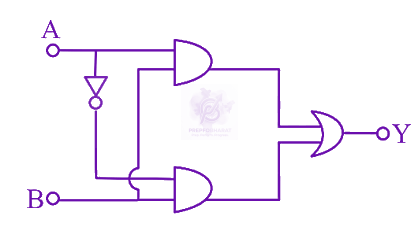
In a photoelectric effect experiment a light of frequency $1.5$ times the threshold frequency is made to fall on the surface of photosensitive material. Now if the frequency is halved and intensity is doubled, the number of photo electrons emitted will be:
If three helium nuclei combine to form a carbon nucleus then the energy released in this reaction is _____$\times 10^{-2} \mathrm{MeV}$. (Given $1 \mathrm{u}=931 \mathrm{MeV} / \mathrm{c}^2$, atomic mass of helium $=4.002603 \mathrm{u}$ )
In a hypothetical fission reaction ${ }_{92} X^{236} \rightarrow{ }_{56} Y^{141}+{ }_{36} Z^{92}+3 R$ The identity of emitted particles ( $\mathrm{R})$ is :
The minimum energy required by a hydrogen atom in ground state to emit radiation in Balmer series is nearly :
Two sources of light emit with a power of $200W$. The ratio of number of photons of visible light emitted by each source having wavelengths $300\mathrm{nm}$ and $500\mathrm{nm}$ respectively, will be :
An electron revolving in ${n}^{\text{th }}$ Bohr orbit has magnetic moment ${\mu }_{n}$. If ${\mu }_{n}\propto {n}^{x}$, the value of $x$ is:
The output $(Y)$ of logic circuit given below is 0 only when : 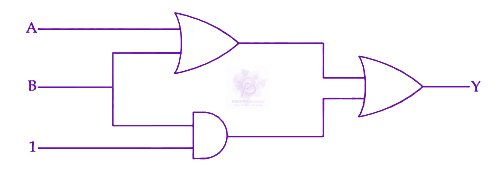
Which of the following circuits is reverse - biased ?
The ratio of the shortest wavelength of Balmer series to the shortest wavelength of Lyman series for hydrogen atom is :
A nucleus at rest disintegrates into two smaller nuclei with their masses in the ratio of $2: 1$. After disintegration they will move :
When UV light of wavelength $300 \mathrm{~nm}$ is incident on the metal surface having work function $2.13 \mathrm{eV}$, electron emission takes place. The stopping potential is: (Given hc $=1240 \mathrm{eV} \mathrm{nm}$ )
A hydrogen atom changes its state from $n=3$ to $n=2$. Due to recoil, the percentage change in the wave length of emitted light is approximately $1 \times 10^{-n}$. The value of $n$ is_____. [Given $\mathrm{Rhc}=13.6 \mathrm{eV}, \mathrm{hc}=1242 \mathrm{eV} \mathrm{nm}, \mathrm{h}=6.6 \times 10^{-34} \mathrm{~J} \mathrm{~s}$ mass of the hydrogenatom $=1.6 \times 10^{-27} \mathrm{~kg}$ ]
The shortest wavelength of the spectral lines in the Lyman series of hydrogen spectrum is $915 Ã…$. The longest wavelength of spectral lines in the Balmer series will be _____ $Ã…$.
In an alpha particle scattering experiment distance of closest approach for the $\alpha$ particle is $4.5 \times 10^{-14} \mathrm{~m}$. If target nucleus has atomic number 80 , then maximum velocity of $\alpha$ - particle is _______ $\times 10^5 \mathrm{~m} / \mathrm{s}$ approximately. $\left(\frac{1}{4 \pi \epsilon_0}=9 \times 10^9\right.$ SI unit, mass of $\alpha$ particle $\left.=6.72 \times 10^{-27} \mathrm{~kg}\right)$
The longest wavelength associated with Paschen series is : (Given $\mathrm{R}_{\mathrm{H}}=1.097 \times 10^7 \mathrm{SI}$ unit)
When a metal surface is illuminated by light of wavelength $\lambda$, the stopping potential is $8V$. When the same surface is illuminated by light of wavelength $3\lambda$, stopping potential is $2V$. The threshold wavelength for this surface is :
Monochromatic light of frequency $6\times {10}^{14}\mathrm{Hz}$ is produced by a laser. The power emitted is $2\times {10}^{-3}W.$ How many photons per second on an average, are emitted by the source? (Given $h=6.63\times {10}^{-34}Js$)
For the photoelectric effect, the maximum kinetic energy $({E}_{k})$ of the photoelectrons is plotted against the frequency $(v)$ of the incident photons as shown in figure. The slope of the graph gives 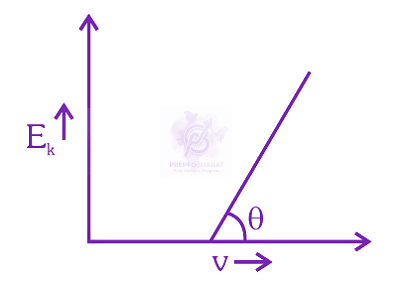
The ratio of the magnitude of the kinetic energy to the potential energy of an electron in the ${5}^{\text{th }}$ excited state of a hydrogen atom is :
From the statements given below : (A) The angular momentum of an electron in ${n}^{th}$ orbit is an integral multiple of $h$. (B) Nuclear forces do not obey inverse square law. (C) Nuclear forces are spin dependent. (D) Nuclear forces are central and charge independent. (E) Stability of nucleus is inversely proportional to the value of packing fraction. Choose the correct answer from the options given below :
A Zener diode of breakdown voltage $10V$ is used as a voltage regulator as shown in the figure. The current through the Zener diode is 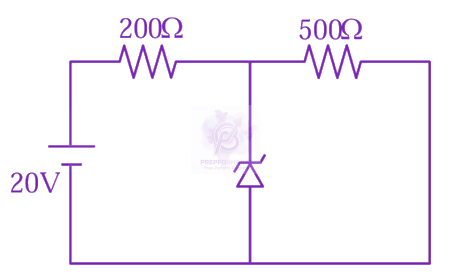
Which of the following statement is not true about stopping potential $\left(\mathrm{V}_0\right)$ ?
The $I-V$ characteristics of an electronic device shown in the figure. The device is: 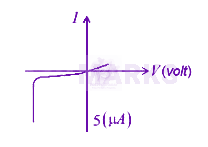
A proton, an electron and an alpha particle have the same energies. Their de-Broglie wavelengths will be compared as :
Given below are two statements : 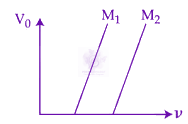 Statement I : Figure shows the variation of stopping potential with frequency $(v)$ for the two photosensitive materials $\mathrm{M}_1$ and $\mathrm{M}_2$. The slope gives value of $\frac{\mathrm{h}}{\mathrm{e}}$, where $\mathrm{h}$ is Planck's constant, $\mathrm{e}$ is the charge of electron. Statement II : $\mathrm{M}_2$ will emit photoelectrons of greater kinetic energy for the incident radiation having same frequency. In the light of the above statements, choose the most appropriate answer from the options given below.
A light emitting diode (LED) is fabricated using GaAs semiconducting material whose band gap is $1.42 \mathrm{eV}$. The wavelength of light emitted from the LED is :
UV light of $4.13 \mathrm{eV}$ is incident on a photosensitive metal surface having work function $3.13 \mathrm{eV}$. The maximum kinetic energy of ejected photoelectrons will be:
Following gates section is connected in a complete suitable circuit. 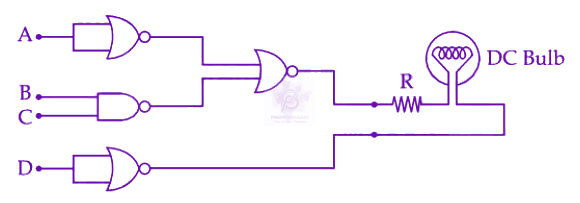 $\text { For which of the following combination, bulb will glow (ON) : }$
If $M_o$ is the mass of isotope ${ }_5^{12} B, M_P$ and $M_n$ are the masses of proton and neutron, then nuclear binding energy of isotope is :
The energy released in the fusion of $2 \mathrm{~kg}$ of hydrogen deep in the sun is $E_H$ and the energy released in the fission of $2 \mathrm{~kg}$ of ${ }^{235} \mathrm{U}$ is $E_U$. The ratio $\frac{E_H}{E_U}$ is approximately: (Consider the fusion reaction as $4 \mid H+2 \mathrm{e}^{-} \rightarrow{ }_2^4 \mathrm{He}+2 v+6 \gamma+26.7 \mathrm{MeV}$, energy released in the fission reaction of ${ }^{235} \mathrm{U}$ is $200 \mathrm{MeV}$ per fission nucleus and $\mathrm{N}_{\mathrm{A}}=$ $\left.6.023 \times 10^{23}\right)$
Identify the logic operation performed by the given circuit. 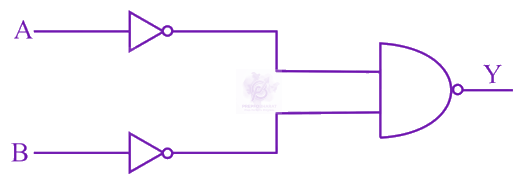
In the given circuit if the power rating of Zener diode is $10\mathrm{mW}$, the value of series resistance ${R}_{s}$ to regulate the input unregulated supply is: 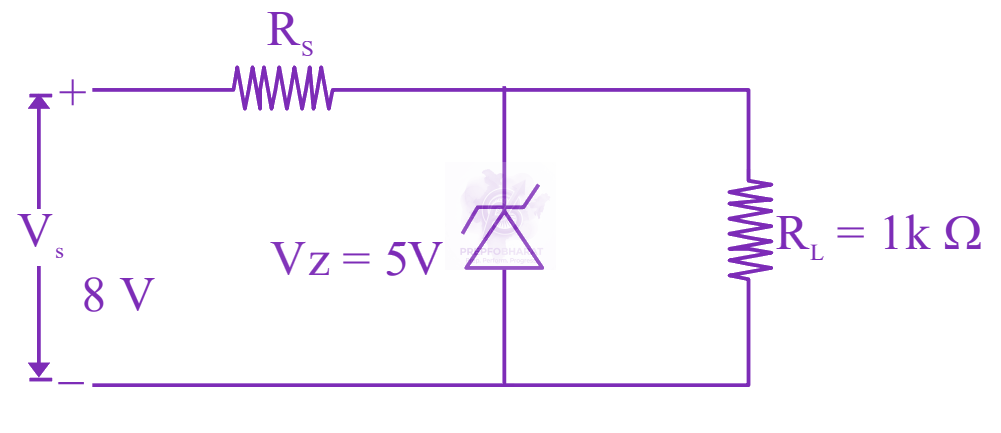
The value of net resistance of the network as shown in the given figure is : 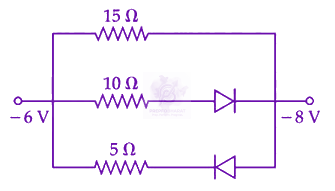
Conductivity of a photodiode starts changing only if the wavelength of incident light is less than $660\mathrm{nm}.$ The band gap of photodiode is found to be $(\frac{X}{8})\mathrm{eV}.$ The value of $X$ is: (Given $h=6.6\times {10}^{-34}Js,e=1.6\times {10}^{-19}C$)
The output of the given circuit diagram is 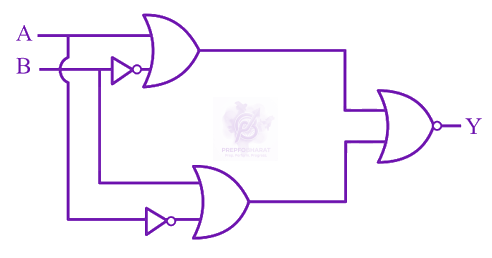
The work function of a substance is $3.0\mathrm{eV}$. The longest wavelength of light that can cause the emission of photoelectrons from this substance is approximately:
According to Bohr's theory, the moment of momentum of an electron revolving in $4^{\text {th }}$ orbit of hydrogen atom is:
In a nuclear fission reaction of an isotope of mass $M$, three similar daughter nuclei of same mass are formed. The speed of a daughter nuclei in terms of mass defect $\Delta M$ will be :
The de-Broglie wavelength of an electron is the same as that of a photon. If velocity of electron is $25%$ of the velocity of light, then the ratio of K.E. of electron and K.E. of photon will be:
The output $\mathrm{Y}$ of following circuit for given inputs is : 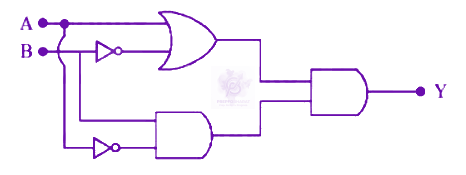
The mass defect in a particular reaction is $0.4g$. The amount of energy liberated is $n\times {10}^{7}\mathrm{kW}h$, where $n=$ _____. (speed of light $=3\times {10}^{8}m{s}^{-1}$)
When a hydrogen atom going from $n=2$ to $n=1$ emits a photon, its recoil speed is $\frac{x}{5}m{s}^{-1}$. Where $x=$_______. (Use: mass of hydrogen atom $=1.6\times {10}^{-27}\mathrm{kg}$, charge of electron $e=1.6\times {10}^{-19}C)$
Given below are two statements: Statement I: Most of the mass of the atom and all its positive charge are concentrated in a tiny nucleus and the electrons revolve around it, is Rutherford's model. Statement II: An atom is a spherical cloud of positive charges with electrons embedded in it, is a special case of Rutherford's model. In the light of the above statements, choose the most appropriate from the options given below.
The truth table of the given circuit diagram is :