(Theory) Photoelectric effect prove particle nature of light.
Which of the following phenomena does not explain by wave nature of light. A. reflection B. diffraction C. photoelectric effect D. interference E.…
JEE Main 2024 — Physics Modern Physics
2024mcqmedium
Which of the following phenomena does not explain by wave nature of light. A. reflection B. diffraction C. photoelectric effect D. interference E. polarization Choose the most appropriate answer from the options given below:
Official previous-year question
Held on 6 Apr 2024 · Verified 6 Jul 2026.
Options
- A
E only
- B
B, D only
- C
C only
- D
A, C only
Did you get this right?
Sign in to track your attempts and accuracy.
Your note
Sign in to keep a private note on this question. Nothing you write is ever public.
JEE Main Modern Physics in other years
More JEE Main Modern Physics questions
An electron of mass $m$ is moving in an electric field $\vec{E} = -2E_0\hat{i}$ ($E_0 =$ constant $> 0$), with an initial velocity $\vec{V} = v_0\hat{i}$ ($v_0 =$ constant $> 0$). If $\lambda_0 = \dfrac{h}{4mv_0}$, its de Broglie wavelength at time $t$ is __________. ($e =$ charge of electron)
2026medium
In a semiconductor p-n diode, the doping concentrations on p-side and n-side are $10^{15}\text{ atoms/cm}^3$ and $10^{18}\text{ atoms/cm}^3$, respectively. Which one of the following statements is true ?
2026easy
The following diagram shows a Zener diode as a voltage regulator. The Zener diode is rated at $V_{z}=5 \mathrm{~V}$ and the desired current in load is 5 mA. The unregulated voltage source can supply upto 25 V. Considering the Zener diode can withstand four times of the load current, the value of resistor $R_{S}$ (shown in circuit) should be $\_\_\_\_$ $\Omega$. 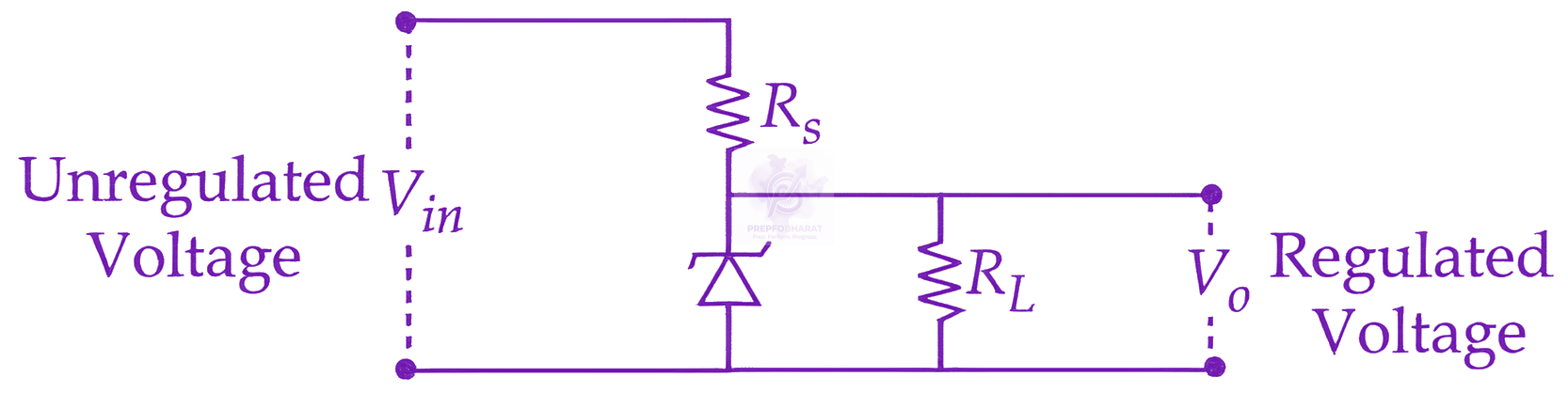
2026medium
Given below are two statements: one is labelled as Assertion (A) and the other is labelled as Reason (R). Assertion (A): The electromagnetic wave exerts pressure on the surface on which they are allowed to fall. Reason (R): There is no mass associated with the electromagnetic waves. In the light of the above statements, choose the correct answer from the options given below :
2026medium
In hydrogen atom spectrum, $(R \rightarrow$ Rydberg's constant $)$ A. the maximum wavelength of the radiation of Lyman series is $\frac{4}{3 R}$ B. the Balmer series lies in the visible region of the spectrum C. the minimum wavelength of the radiation of Paschen series is $\frac{9}{R}$ D. the minimum wavelength of Lyman series is $\frac{5}{4 R}$ Choose the correct answer from the options given below :
2026medium
Other Physics topics for JEE Main
Keep practicing Modern Physics
Work through every JEE Main Modern Physics PYQ, year by year.