JEE Main 2014 — Modern Physics
Physics Modern Physics questions from JEE Main 2014.
Other Years
11 Modern Physics Questions from 2014
A beam of light has two wavelengths of $4972 Å$ and $6216 Å$ with a total intensity of $3.6 \times 10^{-3}$ $\mathrm{Wm}^{-2}$ equally distributed among the two wavelengths. The beam falls normally on an area of $1 \mathrm{~cm}^2$ of a clean metallic surface of work function $2.3 \mathrm{eV}$. Assume that there is no loss of light by reflection and that each capable photon ejects one electron. The number of photoelectrons liberated in $2 \mathrm{~s}$ is approximately:
For which of the following particles will it be most difficult to experimentally verify the de-Broglie relationship?
Hydrogen ($_{1}$H$^{1}$), Deuterium ($_{1}$H$^{2}$), singly ionised Helium ($_{2}$He$^{4}$)$^{+}$ and doubly ionised lithium ($_{3}$Li$^{6}$)$^{++}$ all have one electron around the nucleus. Consider an electron transition from $n=2$ to $n=1$. If the wave lengths of emitted radiation are ${\lambda }_{1} \text{, } {\lambda }_{2} \text{, } {\lambda }_{3}$ and ${\lambda }_{4}$ respectively then approximately which one of the following is correct ?
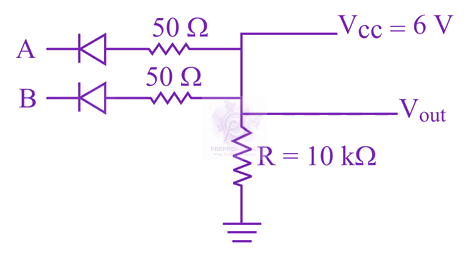 Given, $A$ and $B$ are input terminals Logic $1$ is$>5V$ Logic $0$ is$<1V$ Which logic gate operation, the following circuit does? Note: This question was awarded a bonus. $C$ option changed.
For LED's to emit light in visible region of electromagnetic light, it should have energy band gap in the range of:
A Zener diode is connected to a battery and a load as show below: 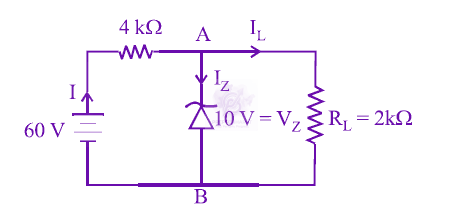 The currents, $\mathrm{I}, \mathrm{I}_{\mathrm{Z}}$ and $\mathrm{I}_{\mathrm{L}}$ are respectively.
The radiation corresponding to $3 \rightarrow 2$ transition of hydrogen atom falls on a metal surface to produce photoelectrons. These electrons are made to enter a magnetic field of $3 \times 1 {0}^{ - 4 } T$. If the radius of the largest circular path followed by these electrons is 10.0 mm, the work function of the metal is close to :
Identify the gate and match $A,B,Y$ in the bracket to check. 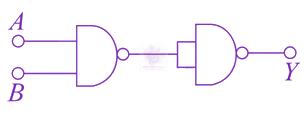
If the binding energy of the electron in a hydrogen atom is $13.6\mathrm{eV}$, the energy required to remove the electron from the first excited state of ${\mathrm{Li}}^{++}$ is :
The forward biased diode connection is :
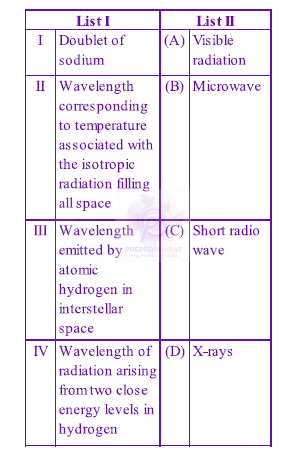
Match the List-I (Phenomenon associated with electromagnetic radiation) with List-II (Part of electromagnetic spectrum) and select the correct code from the choices given below this lists: