JEE Main 2023 — Modern Physics
Physics Modern Physics questions from JEE Main 2023.
Other Years
79 Modern Physics Questions from 2023
The work function of a metal is 4.2 eV. The threshold wavelength is (hc = 1240 eV·nm):
In Bohrs model the ratio of the kinetic energy to the total energy of the electron in nth orbit is:
An $\alpha$ particle, a proton and an electron have the same kinetic energy. Which one of the following is correct in case of their de-Broglie wavelength:
An atom absorbs a photon of wavelength $500\mathrm{nm}$ and emits another photon of wavelength $600\mathrm{nm}$. The net energy absorbed by the atom in this process is $n\times {10}^{-4}\mathrm{eV}$. The value of$n$is [Assume the atom to be stationary during the absorption and emission process] (Take $h=6.6\times {10}^{-34}Js$ and c=3\times 108 m s-1 ).
Given below are two statements : Statement I : Stopping potential in photoelectric effect does not depend on the power of the light source. Statement II : For a given metal, the maximum kinetic energy of the photoelectron depends on the wavelength of the incident light. In the light of above statements, choose the most appropriate answer from the options given below.
The energy levels of an hydrogen atom are shown below. The transition corresponding to emission of shortest wavelength is 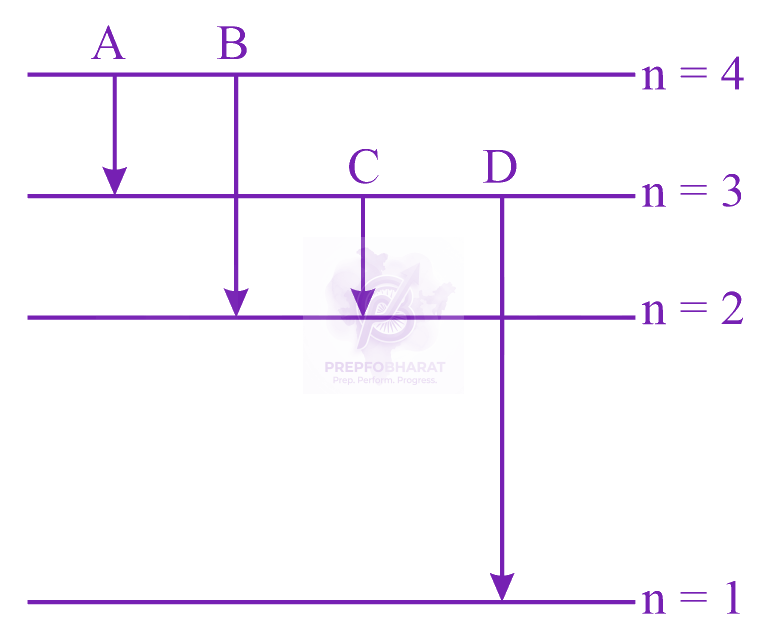
The threshold wavelength for photoelectric emission from a material is $5500\overset{\circ }{A}$. Photoelectrons will be emitted, when this material is illuminated with monochromatic radiation from a A. $75W$ infra-red lamp B. $10W$ infra-red lamp C. $75W$ ultra-violet lamp D. $10W$ ultra-violet lamp Choose the correct answer from the options given below :
The logic gate equivalent to the given circuit diagram is : 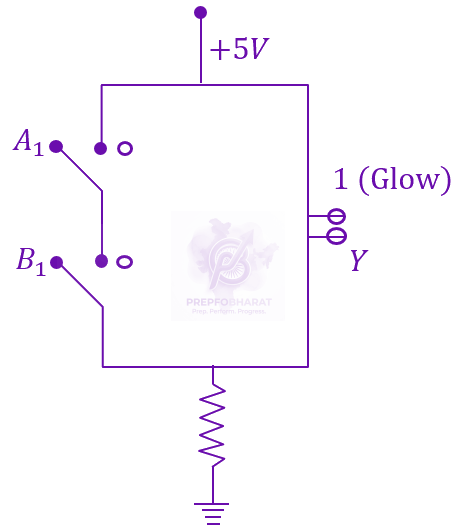
The energy released per fission of nucleus of $X240$ is $200\mathrm{MeV}$. The energy released if all the atoms in $120g$ of pure $X240$ undergo fission is _____$\times {10}^{25}\mathrm{MeV}$. (Given ${N}_{A}=6\times {10}^{23}$)
A photon is emitted in transition from $n=4\mathrm{to}n=1$ level in hydrogen atom. The corresponding wavelength for this transition is (given, $h=4\times {10}^{-15}\mathrm{eV}s$)
A proton moving with one tenth of velocity of light has a certain de Broglie wavelength of $\lambda$. An alpha particle having certain kinetic energy has the same de-Brogle wavelength $\lambda$. The ratio of kinetic energy of proton and that of alpha particle is :
If $917Å$ be the lowest wavelength of Lyman series then the lowest wavelength of Balmer series will be $Å$.
If the binding energy of ground state electron in a hydrogen atom is $13.6\mathrm{eV}$, then, the energy required to remove the electron from the second excited state of $\mathrm{Li}{}^{2+}$ will be: $x\times {10}^{-1}\mathrm{eV}$. The value of $x$ is _____.
Given below are two statements : one is labelled as Assertion A and the other is labelled as Reason R Assertion A: Photodiodes are used in forward bias usually for measuring the light intensity. Reason R: For a $p-n$ junction diode, at applied voltage $V$ the current in the forward bias is more than the current in the reverse bias for $|{V}_{z}|>\pm V\geq |{V}_{0}|$ where ${V}_{0}$ is the threshold voltage and ${V}_{z}$ is the breakdown voltage. In the light of the above statements, choose the correct answer from the options given below
A zener diode of power rating $1.6W$ is to be used as voltage regulator. If the zener diode has a breakdown of $8V$ and it has to regulate voltage fluctuating between $3V$ and $10V$ The value of resistance ${R}_{s}$ for safe operation of diode will be 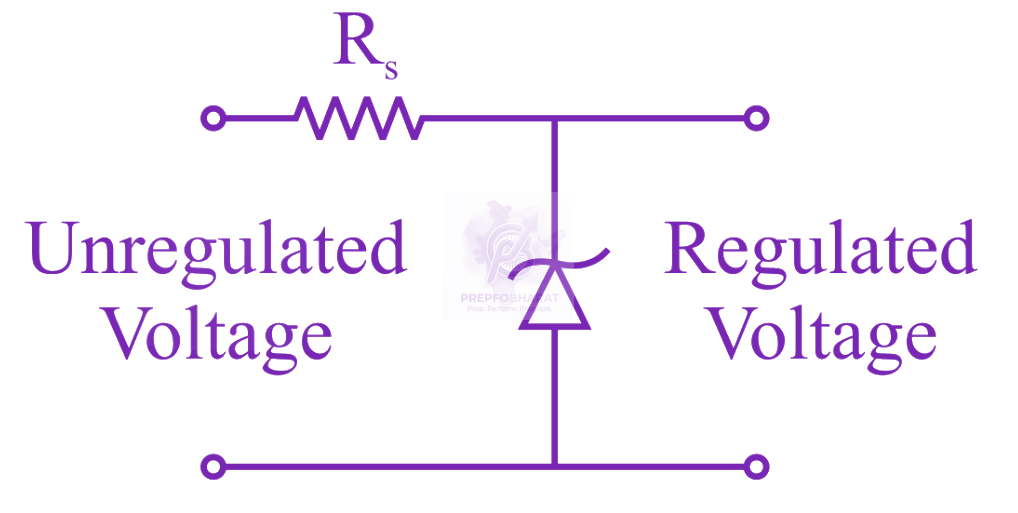
A light of energy $12.75\mathrm{eV}$ is incident on a hydrogen atom in its ground state. The atom absorbs the radiation and reaches to one of its excited states. The angular momentum of the atom in the excited state is $\frac{x}{\pi }\times {10}^{-17}\mathrm{eVs}$. The value of $x$ is ______ (use $h=4.14\times {10}^{–15}\mathrm{eVs},c=3\times {10}^{8}m{s}^{–1}$)
The resistivity $(\rho )$ of semiconductor varies with temperature. Which of the following curve represents the correct behaviour?
Given below are two statements: one is labelled as Assertion A and the other is labelled as Reason R Assertion A : The binding energy per nucleon is practically independent of the atomic number for nuclei of mass number in the range $30$ to $170$. Reason R : Nuclear force is short ranged. In the light of the above statements, choose the correct answer from the options given below
Given below are two statements: one is labelled as Assertion A and the other is labelled as Reason R Assertion A: Diffusion current in a $p-n$ junction is greater than the drift current in magnitude if the junction is forward biased. Reason R: Diffusion current in a $p-n$ junction is form the $n$-side to the $p$-side if the junction is forward biased. In the light of the above statements, choose the most appropriate answer from the options given below.
The ratio of the density of oxygen nucleus $(O816)$ and helium nucleus $(\mathrm{He}24)$ is
Name the logic gate equivalent to the diagram attached 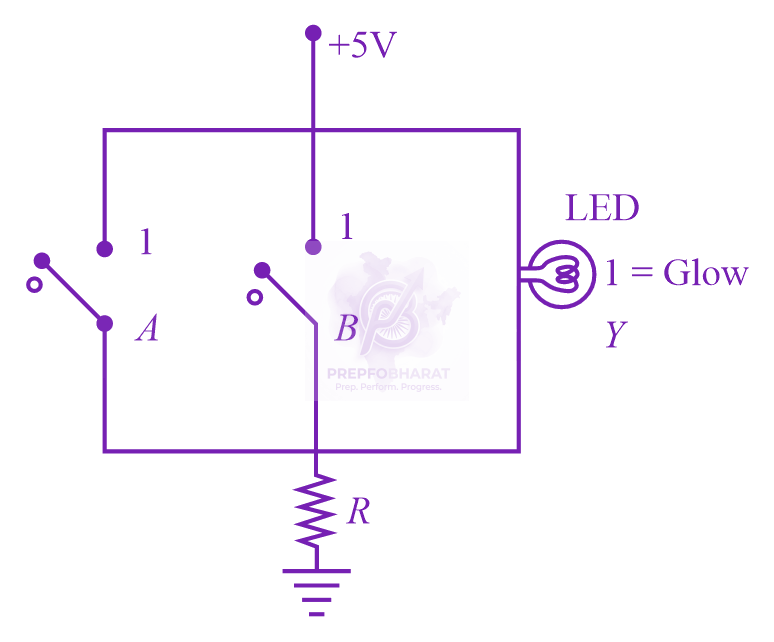
Choose the correct statement about Zener diode:
The de Broglie wavelength of an electron having kinetic energy $E$ is $\lambda$. If the kinetic energy of electron becomes $\frac{E}{4}$, then its de-Broglie wavelength will be:
The ratio of wavelength of spectral lines ${H}_{\alpha }$ and ${H}_{\beta }$ in the Balmer series is $\frac{x}{20}$. The value of $x$ is _____.
A point source of $100W$ emits light with $5%$ efficiency. At a distance of $5m$ from the source, the intensity produced by the electric field component is:
The radius of electron's second stationary orbit in Bohr's atom is $R$. The radius of ${3}^{rd}$ orbit will be
$92238A\rightarrow 90234B+D24+Q$ In the given nuclear reaction, the approximate amount of energy released will be: [Given, mass of $92238A=238.05079\times 931.5\mathrm{MeV}{c}^{-2}$, mass of $B90234=234.04363\times 931.5\mathrm{MeV}{c}^{-2}$, mass of $D24=4.00260\times 931.5\mathrm{Me}V{c}^{-2}$ ]
If each diode has a forward bias resistance of $25\Omega$ in the below circuit, 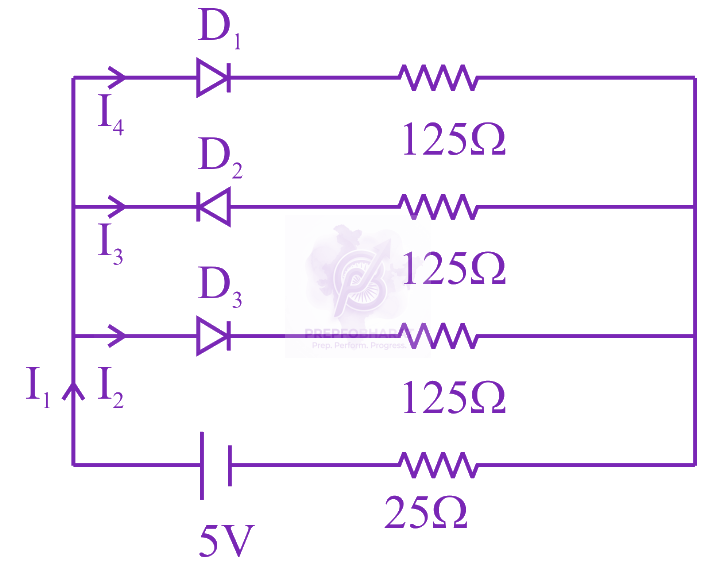 Which of the following options is correct?
The output $Y$ for the inputs $A$ and $B$ of circuit is given by 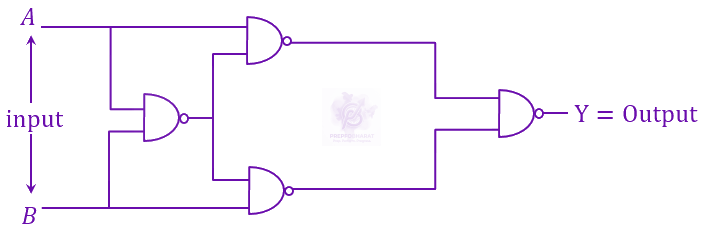 Truth table of the shown circuit is :
Proton $(P)$ and electron $(e)$ will have same de-Broglie wavelength when the ratio of their momentum is (assume, ${m}_{p}=1849$ ${m}_{e}$)
Given below are two statements : one is labelled as Assertion A and the other is labelled as Reason R Assertion A : The nuclear density of nuclides $B510,L36i,F2656e,N1020e\text{and}B83209i$ can be arranged as ${\rho }_{Bi}^{N}>{\rho }_{Fe}^{N}>{\rho }_{Ne}^{N}>{\rho }_{B}^{N}>{\rho }_{Li}^{N}$ Reason R : The radius $R$ of nucleus is related to its mass number $A$ as $R={R}_{0}{A}^{\frac{1}{3}}$, where ${R}_{0}$ is a constant. In the light of the above statement, choose the correct answer from the options given below :
From the photoelectric effect experiment, following observations are made. Identify which of these are correct A. The stopping potential depends only on the work function of the metal. B. The saturation current increases as the intensity of incident light increases. C. The maximum kinetic energy of a photo electron depends on the intensity of the incident light. D. Photoelectric effect can be explained using wave theory of light. Choose the correct answer from the options given below:
The kinetic energy of an electron, $\alpha -$particle and a proton are given as $4K,2K$ and $K$ respectively. The de-Broglie wavelength associated with electron $({\lambda }_{e}),\alpha -$particle $({\lambda }_{\alpha })$ and the proton $({\lambda }_{p})$ are as follows:
The variation of stopping potential $({V}_{0})$ as a function of the frequency $(\nu )$ of the incident light for a metal is shown in figure. The work function of the surface is 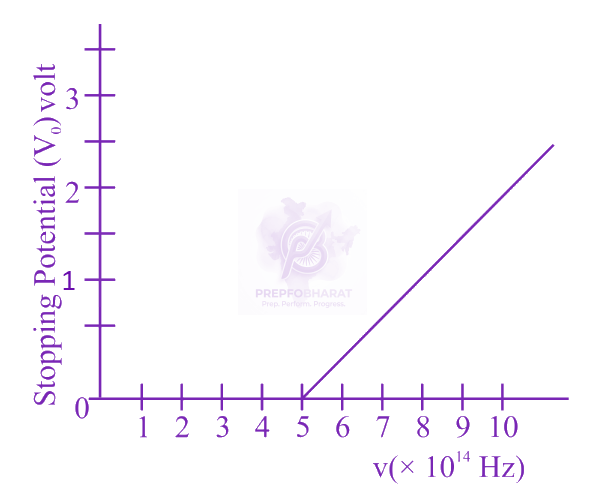
For a nucleus $XZA$ having mass number A and atomic number $Z$ A. The surface energy per nucleon$({b}_{s})=–{a}_{1}{A}^{\frac{2}{3}}.$ B. The Coulomb contribution to the binding energy ${b}_{c}=-{a}_{2}\frac{Z(Z-1)}{{A}^{\frac{4}{3}}}$. C. The volume energy ${b}_{v}={a}_{3}A$ D. Decrease in the binding energy is proportional to surface area. E. While estimating the surface energy, it is assumed that each nucleon interacts with 12 nucleons. (${a}_{1},{a}_{2}$ and ${a}_{3}$ are constants) Choose the most appropriate answer from the options given below:
An electron accelerated through a potential difference ${V}_{1}$ has a de-Broglie wavelength of $\lambda$. When the potential is changed to ${V}_{2}$, its de-Broglie wavelength increases by $50%$. The value of $(\frac{{V}_{1}}{{V}_{2}})$ is equal to :
If a source of electromagnetic radiation having power $15\mathrm{kW}$ produces ${10}^{16}$ photons per second, the radiation belongs to a part of spectrum is : (Take Planck constant $h=6\times {10}^{-34}Js)$
The ratio of de-Broglie wavelength of an $\alpha$-particle and a proton accelerated from rest by the same potential is $\frac{1}{\sqrt{m}}$ , the value of $m$ is:
The radius of ${2}^{\mathrm{nd}}$ orbit of ${\mathrm{He}}^{+}$ of Bohr's model is ${r}_{1}$ and that of fourth orbit of ${\mathrm{Be}}^{3+}$ is represented as ${r}_{2}.$ Now the ratio $\frac{{r}_{2}}{{r}_{1}}$ is $x:1.$ The value of $x$ is _____.
Given below are two statements: one is labelled as Assertion A and the other is labelled as Reason R. Assertion A: Photodiodes are preferably operated in reverse bias condition for light intensity measurement. Reason R: The current in the forward bias is more than the current in the reverse bias for a $p-n$ junction diode. In the light of the above statement, choose the correct answer from the options given below :
The logic performed by the circuit shown in figure is equivalent to 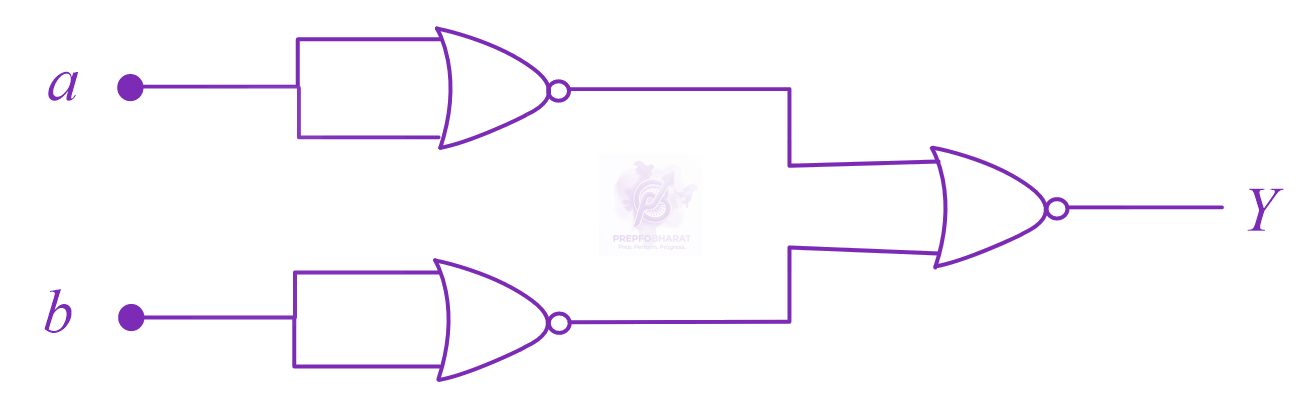
The output from a NAND gate having inputs A and B given below will be, 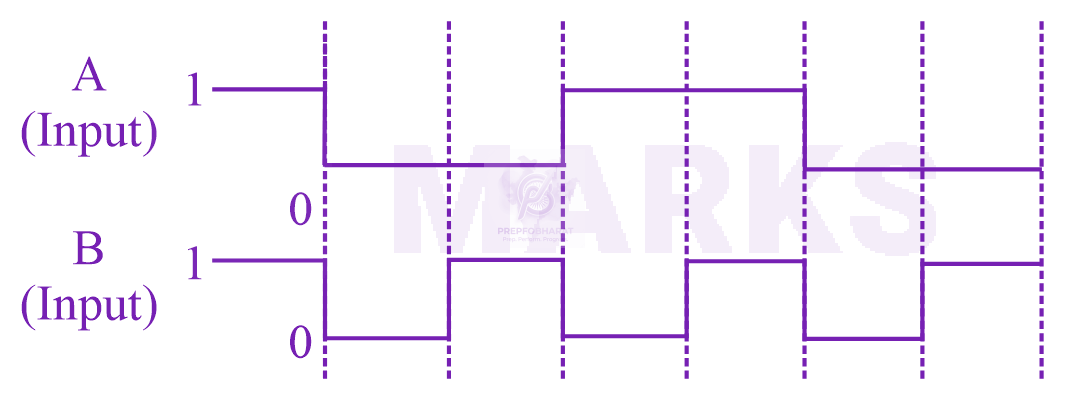
A monochromatic light is incident on a hydrogen sample in ground state. Hydrogen atoms absorb a fraction of light and subsequently emit radiation of six different wavelengths. The frequency of incident light is $x\times {10}^{15}\mathrm{Hz}$. The value of x is ________ (Given $h=4.25\times {10}^{-15}\mathrm{eVs}$)
The angular momentum for the electron in Bohr’s orbit is $L$. If the electron is assumed to revolve in second orbit of hydrogen atom, then the change in angular momentum will be
A point source of light is placed at the centre of curvature of a hemispherical surface. The source emits a power of $24W$. The radius of curvature of hemisphere is $10\mathrm{cm}$ and the inner surface is completely reflecting. The force on the hemisphere due to the light falling on it is ______ $\times {10}^{-8}N$.
The mass of proton, neutron and helium nucleus are respectively $1.0073u,1.0087u\mathrm{and}4.0015u$. The binding energy of helium nucleus is:
The threshold frequency of metal is ${f}_{0}$. When the light of frequency $2{f}_{0}$ is incident on the metal plate, the maximum velocity of photoelectron is ${v}_{1}$. When the frequency of incident radiation is increased to $5{f}_{0}$. the maximum velocity of photoelectrons emitted is ${v}_{2}$. The ratio of ${v}_{1}$ to ${v}_{2}$ is:
A free neutron decays into a proton but a free proton does not decay into neutron. This is because
Which of the following statement is not correct in the case of light emitting diodes? A. It is a heavily doped p-n junction. B. It emits light only when it is forward biased. C. It emits light only when it is reverse biased. D. The energy of the light emitted is equal to or slightly less than the energy gap of the semiconductor used. Choose the correct answer from the options given below :
If the two metals $A$ and $B$ are exposed to radiation of wavelength $350\mathrm{nm}$. The work functions of metals $A$ and $B$ are $4.8\mathrm{eV}\text{and}2.2\mathrm{eV}$. Then choose the correct option
A $12.5\mathrm{eV}$ electron beam is used to bombard gaseous hydrogen at room temperature. The number of spectral lines emitted will be:
The work functions of Aluminium and Gold are $4.1\mathrm{eV}$ and $5.1\mathrm{eV}$ respectively. The ratio of the slope of the stopping potential versus frequency plot for Gold to that of Aluminium is
A metallic surface is illuminated with radiation of wavelength $\lambda$, the stopping potential is ${V}_{0}$. If the same surface is illuminated with radiation of wavelength $2\lambda$, the stopping potential becomes $\frac{{V}_{0}}{4}$. The threshold wavelength for this metallic surface will be
In photoelectric effect A. The photocurrent is proportional to the intensity of the incident radiation. B. Maximum kinetic energy with which photoelectrons are emitted depends on the intensity of incident light. C. Max K.E. with which photoelectrons are emitted depends on the frequency of incident light. D. The emission of photoelectrons require a minimum threshold intensity of incident radiation. E. Max K.E. of the photoelectrons is independent of the frequency of the incident light. Choose the correct answer from the options given below:
The energy levels of an atom is shown is figure. 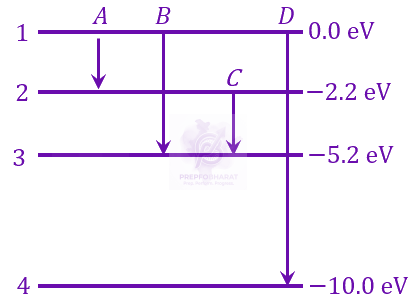 Which one of these transitions will result in the emission of a photon of wavelength $124.1\mathrm{nm}$? Given ($h=6.62\times {10}^{–34}Js$)
The ratio of the de-Broglie wavelengths of proton and electron having same kinetic energy: (Assume ${m}_{p}={m}_{e}\times 1849$)
Statement I : When a Si sample is doped with Boron, it becomes P type and when doped by Arsenic it becomes N-type semi conductor such that P-type has excess holes and N-type has excess electrons. Statement II : When such P-type and N-type semi-conductors, are fused to make a junction, a current will automatically flow which can be detected with an externally connected ammeter. In the light of above statements, choose the most appropriate answer from the options given below.
A proton and an $\alpha$-particle are accelerated from rest by $2V$ and $4V$ potentials, respectively. The ratio of their de-Broglie wavelength is :
The wavelength of the radiation emitted is ${\lambda }_{0}$ when an electron jumps from the second excited state to the first excited state of hydrogen atom. If the electron jumps from the third excited state to the second orbit of the hydrogen atom, the wavelength of the radiation emitted will be $\frac{20}{x}{\lambda }_{0}$. The value of $x$ is________.
The energy of ${\mathrm{He}}^{+}$ ion in its first state is, (The ground state energy for the Hydrogen atom$-13.6\mathrm{eV}$):
An electron of a hydrogen like atom, having $Z=4$, jumps from ${4}^{th}$ energy state to ${2}^{nd}$ energy state, The energy released in this process, will be: (Given $Rch=13.6eV$) Where $R=$ Rydberg constant $c=$Speed of light in vacuum $h=$ Planck's constant
For the given logic gates combination, the correct truth table will be 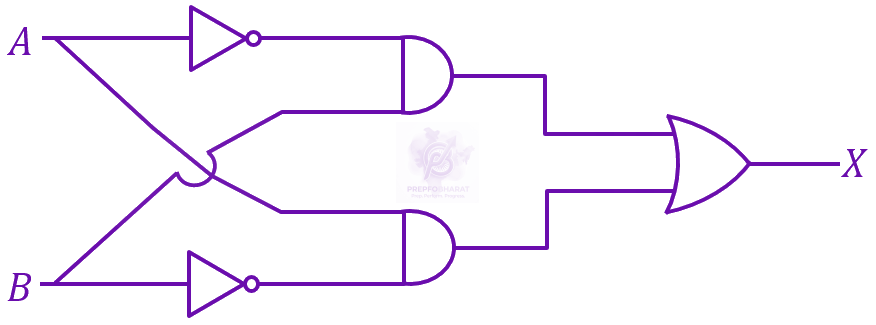
The logic operations performed by the given digital circuit is equivalent to: 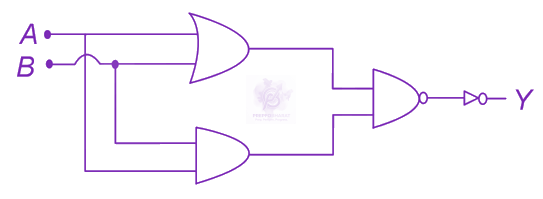
Electron beam used in an electron microscope, when accelerated by a voltage of $20\mathrm{kV}$ has a de-Broglie wavelength of ${\lambda }_{0}$. If the voltage is increased to $40\mathrm{kV}$ then the de-Broglie wavelength associated with the electron beam would be:
The output waveform of the given logical circuit for the following inputs $A$ and $B$ as shown below, is 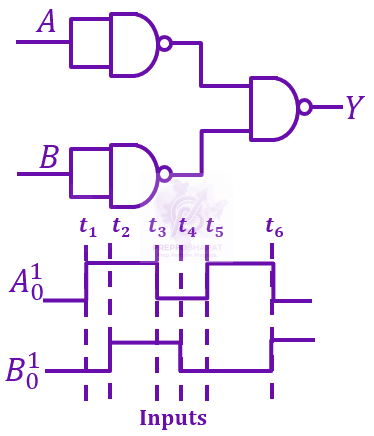
The difference between threshold wavelengths for two metal surfaces $A$ and $B$ having work function ${\phi }_{A}=9\mathrm{eV}$ and ${\phi }_{B}=4.5\mathrm{eV}$ in $\mathrm{nm}$ is: {Given, $hc=1242\mathrm{eV}\mathrm{nm}$}
A small object at rest, absorbs a light pulse of power $20\mathrm{mW}$ and duration $300\mathrm{ns}$. Assuming speed of light as $3\times {10}^{8}m{s}^{-1}$. The momentum of the object becomes equal to :
For the following circuit and given inputs $A$ and $B,$ choose the correct option for output $‘Y’$ 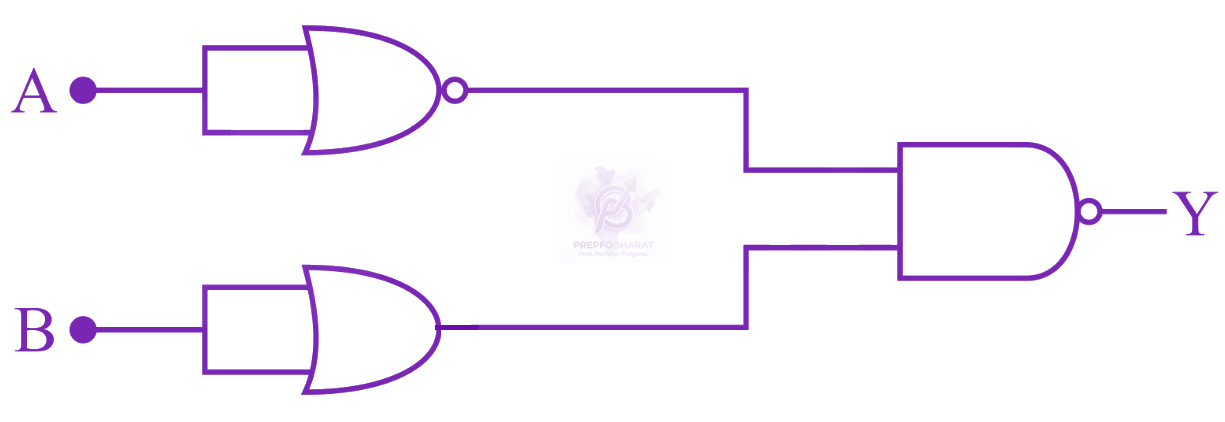 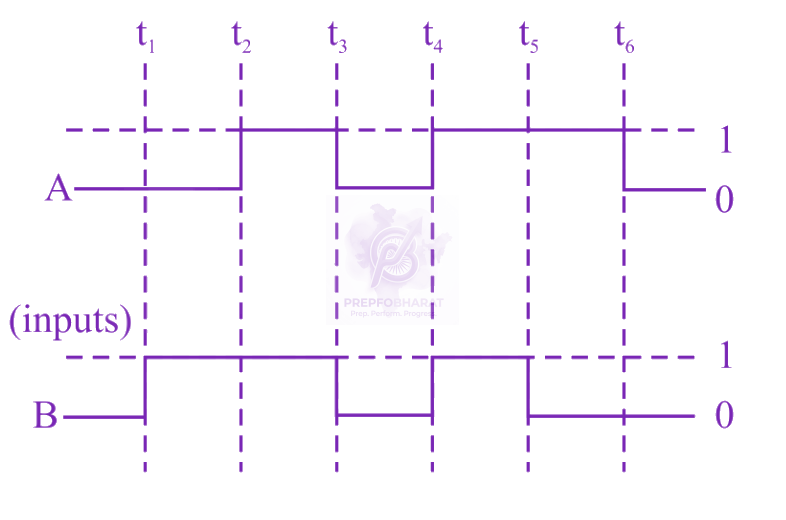
The radius of fifth orbit of ${\mathrm{Li}}^{++}$ is$_______\times {10}^{-12}m.$ Take: radius of hydrogen atom$=0.51\overset{\circ }{A}$
Nucleus a having $Z=17$ and equal number of protons and neutrons has $1.2\mathrm{MeV}$ binding energy per nucleon. Another nucleus $B$ of $Z=12$ has total $26$ nucleons and $1.8\mathrm{MeV}$ binding energy per nucleons. The difference of binding energy of $B$ and $A$ will be ______ $\mathrm{MeV}$.
The de Broglie wavelength of a molecule in a gas at room temperature $(300K)$ is ${\lambda }_{1}$. If the temperature of the gas is increased to $600K$, then the de Broglie wavelength of the same gas molecule becomes
Speed of an electron in Bohr’s ${7}^{\mathrm{th}}$ orbit for Hydrogen atom is $3.6\times {10}^{6}m{s}^{-1}$. The corresponding speed of the electron in ${3}^{\mathrm{rd}}$ orbit, in $m{s}^{-1}$ is :
For hydrogen atom, ${\lambda }_{1}$ and ${\lambda }_{2}$ are the wavelengths corresponding to the transitions $1$ and $2$ respectively as shown in figure. The ratio of ${\lambda }_{1}$ and ${\lambda }_{2}$ is $\frac{x}{32}$. The value of $x$ is ______. 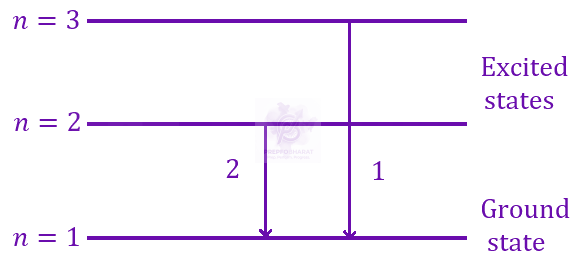
A nucleus with mass number $242$ and binding energy per nucleon as $7.6\mathrm{MeV}$ breaks into two fragment each with mass number $121$. If each fragment nucleus has binding energy per nucleon as $8.1\mathrm{MeV},$ the total gain in binding energy is $_______\mathrm{MeV}$.
Match the List I with List II <table class="pyq-table"><tbody><tr><td></td><td>List I</td><td></td><td>List II</td></tr><tr><td>A</td><td>Intrinsic Semiconductor</td><td>I</td><td>Fermi-level near valence band</td></tr><tr><td>B</td><td>n-type semiconductor</td><td>II</td><td>Fermi-level at middle of valence and conduction band</td></tr><tr><td>C</td><td>p-type semiconductor</td><td>III</td><td>Fermi-level near conduction band</td></tr><tr><td>D</td><td>Metals</td><td>IV</td><td>Fermi-level inside conduction band</td></tr></tbody></table>Choose the correct answer from the options given below:
For the logic circuit shown, the output waveform at $Y$ is 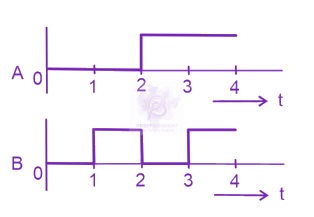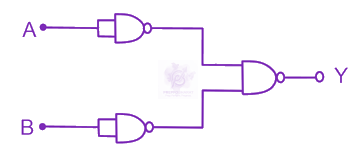
The effect of increase in temperature on the number of electrons in conduction band $({n}_{e})$ and resistance of a semiconductor will be as:
As per given figure $A,B$ and $C$ are the first, second and third excited energy levels of hydrogen atom respectively. If the ratio of the two wavelengths$(i.e.\frac{{\lambda }_{1}}{{\lambda }_{2}})$ is $\frac{7}{4n}$, then the value of $n$ will be 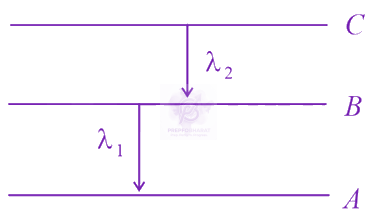
Assume that protons and neutrons have equal masses. Mass of a nucleon is $1.6\times {10}^{-27}\mathrm{kg}$ and radius of nucleus is $1.5\times {10}^{-15}{A}^{\frac{1}{3}}m$. The approximate ratio of the nuclear density and water density is $n\times {10}^{13}$. The value of $n$ is _____.