JEE Main 2025 — Modern Physics
Physics Modern Physics questions from JEE Main 2025.
Other Years
58 Modern Physics Questions from 2025
A radioactive nucleus $n_2$ has 3 times the decay constant as compared to the decay constant of another radioactive nucleus $n_1$. If initial number of both nuclei are the same, what is the ratio of number of nuclei of $n_2$ to the number of nuclei of $n_1$, after one half-life of $n_1$ ?
The energy $E$ and momentum $p$ of a moving body of mass $m$ are related by some equation. Given that c represents the speed of light, identify the correct equation
The work function of a metal is 4.2 eV. What is the threshold wavelength for photoelectric emission? (hc = 1240 eV·nm)
A monochromatic light is incident on a metallic plate having work function $\phi$. An electron, emitted normally to the plate from a point $A$ with maximum kinetic energy, enters a constant magnetic field, perpendicular to the initial velocity of electron. The electron passes through a curve and hits back the plate at a point $B$. The distance between A and B is : (Given : The magnitude of charge of an electron is e and mass is $\mathrm{m}, \mathrm{h}$ is Planck's constant and c is velocity of light. Take the magnetic field exists throughout the path of electron)
In an experiment with photoelectric effect, the stopping potential,
Considering Bohr's atomic model for hydrogen atom : (A) the energy of H atom in ground state is same as energy of $\mathrm{He}^{+}$ion in its first excited state. (B) the energy of H atom in ground state is same as that for $\mathrm{Li}^{++}$ion in its second excited state. (C) the energy of H atom in its ground state is same as that of $\mathrm{He}^{+}$ion for its ground state. (D) the energy of $\mathrm{He}^{+}$ion in its first excited state is same as that for $\mathrm{Li}^{++}$ion in its ground state Choose the correct answer from the options given below :
In photoelectric effect, the stopping potential $\left(\mathrm{V}_0\right) \mathrm{v} / \mathrm{s}$ frequency $(\nu)$ curve is plotted. ( h is the Planck's constant and $\phi_0$ is work function of metal ) (A) $\mathrm{V}_0 \mathrm{v} / \mathrm{s} \nu$ is linear. (B) The slope of $\mathrm{V}_0 \mathrm{v} / \mathrm{s} \nu$ curve $=\frac{\phi_0}{\mathrm{~h}}$ (C) h constant is related to the slope of $\mathrm{V}_0 \mathrm{v} / \mathrm{s} \nu$ line. (D) The value of electric charge of electron is not required to determine $h$ using the $V_0 \mathrm{v} / \mathrm{s} \nu$ curve. (E) The work function can be estimated without knowing the value of $h$. Choose the correct answer from the options given below :
A small mirror of mass $m$ is suspended by a massless thread of length $l$. Then the small angle through which the thread will be deflected when a short pulse of laser of energy $E$ falls normal on the mirror ( $\mathrm{c}=$ speed of light in vacuum and $\mathrm{g}=$ acceleration due to gravity)
Given below are two statements : one is labelled as Assertion (A) and the other is labelled as Reason (R). Assertion (A) : Emission of electrons in photoelectric effect can be suppressed by applying a sufficiently negative electron potential to the photoemissive substance. Reason (R) : A negative electric potential, which stops the emission of electrons from the surface of a photoemissive substance, varies linearly with frequency of incident radiation. In the light of the above statements, choose the most appropriate answer from the options given below :
A photo-emissive substance is illuminated with a radiation of wavelength $\lambda_i$ so that it releases electrons with de-Broglie wavelength $\lambda_e$. The longest wavelength of radiation that can emit photoelectron is $\lambda_0$. Expression for de-Broglie wavelength is given by : ( $\mathrm{m}:$ mass of the electron, $\mathrm{h}:$ Planck's constant and $c$ : speed of light)
Refer to the circuit diagram given in the figure. which of the following observations are correct? A. Total resistance of circuit is $6 \Omega$ B. Current in Ammeter is 1 A C. Potential across $A B$ is 4 Volts. D. Potential across CD is 4 Volts E. Total resistance of the circuit is $8 \Omega$. Choose the correct answer from the options given below: 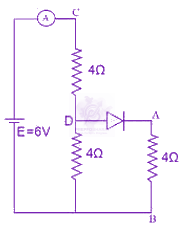
Given below are two statements: one is labelled as Assertion A and the other is labelled as Reason R. Assertion A: The Bohr model is applicable to hydrogen and hydrogen-like atoms only. Reason R : The formulation of Bohr model does not include repulsive force between electrons. In the light of the above statements, choose the correct answer from the options given below :
An electron in the ground state of the hydrogen atom has the orbital radius of $5.3 \times 10^{-11} \mathrm{~m}$ while that for the electron in third excited state is $8.48 \times 10^{-10} \mathrm{~m}$. The ratio of the de Broglie wavelengths of electron in the excited state to that in the ground state is
Given below are two statements: one is labelled as Assertion (A) and the other is labelled as Reason (R). Assertion (A) : The density of the copper $\left({ }_{29}^{64} \mathrm{Cu}\right)$ nucleus is greater than that of the carbon $\left({ }_6^{12} \mathrm{C}\right)$ nucleus. Reason (R): The nucleus of mass number A has a radius proportional to $\mathrm{A}^{1 / 3}$. In the light of the above statements, choose the most appropriate answer from the options given below :
For a nucleus of mass number $A$ and radius $R$, the mass density of nucleus can be represented as
Considering the Bohr model of hydrogen like atoms, the ratio of the ratio of the radius $5^{\text {th }}$ orbit of the electron in $\mathrm{Li}^{2+}$ and $\mathrm{He}^{+}$is
Given below are two statements: one is labelled as Assertion A and the other is labelled as Reason $\mathrm{R}$ Assertion A: In photoelectric effect, on increasing the intensity of incident light the stopping potential increases. Reason R : Increase in intensity of light increases the rate of photoelectrons emitted, provided the frequency of incident light is greater than threshold frequency. In the light of the above statements, choose the correct answer from the options given below
Match the LIST-I with LIST-II $\begin{array}{|l|l|l|l|}\hline & \text{LIST-I} & & \text{LIST-II} \\ \hline \text{A.} & \begin{array}{l} { }_0^1 \mathrm{n}+{ }_{92}^{235} \mathrm{U} \\ \rightarrow{ }_{54}^{140} \mathrm{Xe}+{ }_{38}^{94} \mathrm{Sr}+2{ }_0^1 \mathrm{n} \end{array} & \text{I.} & \begin{array}{l} \text{Chemical} \\ \text{reaction} \end{array} \\ \hline \text{B.} & 2 \mathrm{H}_2+\mathrm{O}_2 \rightarrow 2 \mathrm{H}_2 \mathrm{O} & \text{II.} & \begin{array}{l} \text{Fusion} \\ \text{with +ve} \\ \text{Q value} \end{array} \\ \hline \text{C.} & { }_1^2 \mathrm{H}+{ }_1^2 \mathrm{H} \rightarrow{ }_2^3 \mathrm{He}+{ }_0^1 \mathrm{n} & \text{III.} & \text{Fission} \\ \hline \text{D.} & { }_1^1 \mathrm{H}+{ }_1^3 \mathrm{H} \rightarrow{ }_1^2 \mathrm{H}+{ }_1^2 \mathrm{H} & \text{IV.} & \begin{array}{l} \text{Fusion} \\ \text{with -ve Q} \\ \text{value} \end{array} \\ \hline\end{array}$ Choose the correct answer from the options given below :
In photoelectric effect an em-wave is incident on a metal surface and electrons are ejected from the surface. If the work function of the metal is 2.14 eV and stopping potential is 2 V , what is the wavelength of the em-wave ? (Given hc $=1242 \mathrm{eVnm}$ where h is the Planck's constant and c is the speed of light in vaccum.)
The output voltage in the following circuit is (Consider ideal diode case) 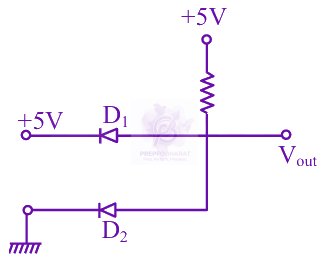
Assuming the validity of Bohr's atomic model for hydrogen like ions the radius of $\mathrm{Li}^{++}$ion in its ground state is given by $\frac{1}{X} a_0$, where $X=$ _______. (Where $\mathrm{a}_0$ is the first Bohr's radius.)
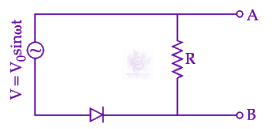 In the circuit shown here, assuming threshold voltage of diode is negligibly small, then voltage $V_{A B}$ is correctly represented by :
The work functions of cesium (Cs) and lithium (Li) metals are 1.9 eV and 2.5 eV , respectively. If we incident a light of wavelength 550 nm on these two metal surfaces, then photo-electric effect is possible for the case of
Which of the following circuits has the same outpur as that of the given circuit? 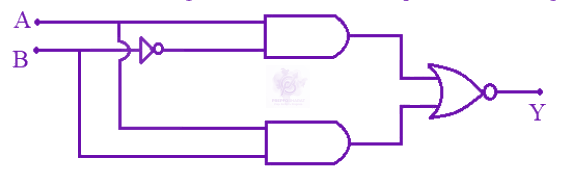
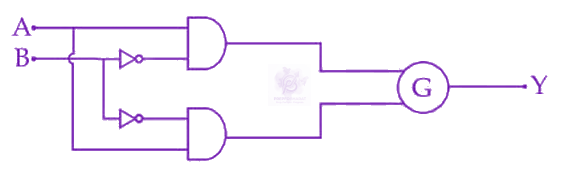 \begin{array}{c|c|c} A & B & Y \\\hline 0 & 0 & 1 \\0 & 1 & 1 \\1 & 0 & 0 \\1 & 1 & 1\end{array} To obtain the given truth table, following logic gate should be placed at G:
The work function of a metal is 3 eV. The color of the visible light that is required to cause emission of photoelectrons is
In the digital circuit shown in the figure, for the given inputs the P and Q values are : 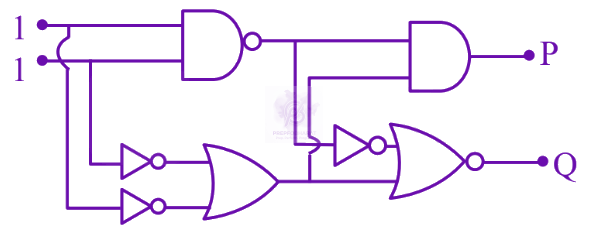
In a hydrogen like ion, the energy difference between the $2^{\text {nd }}$ excitation energy state and ground is 108.8 eV. The atomic number of the ion is
A radioactive material P first decays into Q and then Q decays to non-radioactive material R. Which of the following figure represents time dependent mass of $\mathrm{P}, \mathrm{Q}$ and R ?
The output of the circuit is low (zero) for :  (A) $\mathrm{X}=0, \mathrm{Y}=0$ (B) $X=0, Y=1$ (C) $X=1, Y=0$ (D) $\mathrm{X}=1, \mathrm{Y}=1$ Choose the correct answer from the options given below :
The Boolean expression $\mathrm{Y}=\mathrm{A} \overline{\mathrm{B}} \mathrm{C}+\overline{\mathrm{A}} \overline{\mathrm{C}}$ can be realised with which of the following gate configurations. A. One 3-input AND gate, 3 NOT gates and one 2input OR gate, One 2-input AND gate, B. One 3-input AND gate, 1 NOT gate, One 2input NOR gate and one 2-input OR gate C. 3-input OR gate, 3 NOT gates and one 2-input AND gate Choose the correct answer from the options given below
The de Broglie wavelength of a particle with mass m and velocity v is:
A zener diode with 5 V zener voltage is used to regulate an unregulated dc voltage input of 25 V. For a $400 \Omega$ resistor connected in series, the zener current is found to be 4 times load current. The load current $\left(I_L\right)$ and load resistance $\left(R_{\mathrm{L}}\right)$ are :
In the following circuit, the reading of the ammeter will be (Take Zener breakdown voltage $=4 \mathrm{~V})$ 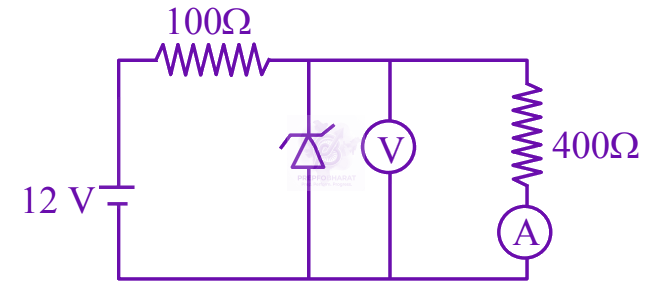
A sub-atomic particle of mass $10^{-30} \mathrm{~kg}$ is moving with a velocity $2.21 \times 10^6 \mathrm{~m} / \mathrm{s}$. Under the matter wave consideration, the particle will behave closely like $\qquad$ $\left(\mathrm{h}=6.63 \times 10^{-34} \mathrm{~J} . \mathrm{s}\right)$
Choose the correct logic circuit for the given truth table having inputs A and B. $\begin{array}{|c|c|c|} \hline \text{Inputs} & & \text{Output} \\ \hline A & B & Y \\ \hline 0 & 0 & 0 \\ \hline 0 & 1 & 0 \\ \hline 1 & 0 & 1 \\ \hline 1 & 1 & 1 \\ \hline \end{array}$
The truth table corresponding to the circuit given below is 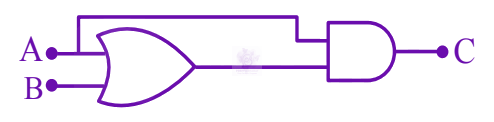
An electron in the hydrogen atom initially in the fourth excited state makes a transition to $\mathrm{n}^{\text {th }}$ energy state by emitting a photon of energy 2.86 eV. The integer value of $n$ will be ____.
Arrange the following in the ascending order of wavelength $(\lambda)$ : (A) Microwaves $\left(\lambda_1\right)$ (B) Ultraviolet rays $\left(\lambda_2\right)$ (C) Infrared rays $\left(\lambda_3\right)$ (D) X-rays $\left(\lambda_4\right)$ Choose the most appropriate answer from the options given below :
The number of spectral lines emitted by atomic hydrogen that is in the $4^{\text {th }}$ energy level, is
During the transition of electron from state A to state C of a Bohr atom, the wavelength of emitted radiation is $2000 Å$ and it becomes $6000 Å$ when the electron jumps from state B to state C. Then the wavelength of the radiation emitted during the transition of electrons from state A to state B is
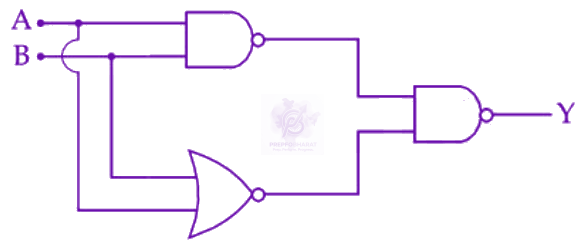 For the circuit shown above, equivalent GATE is :
Which of the following circuits represents a forward biased diode? 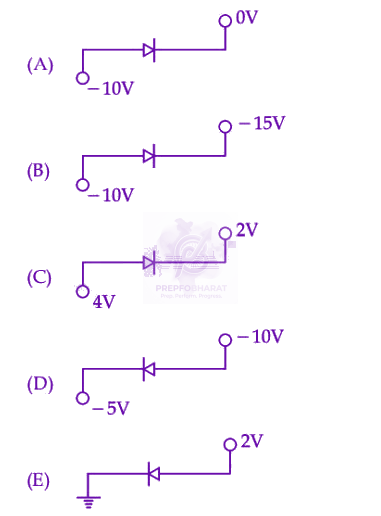 Choose the correct answer from the options given below :
For a hydrogen atom, the ratio of the largest wavelength of Lyman series to that of the Balmer series is.
Energy released when two deuterons $\left({ }_1 \mathrm{H}^2\right)$ fuse to form a helium nucleus $\left({ }_2 \mathrm{He}^4\right)$ is : (Given : Binding energy per nucleon of ${ }_1 \mathrm{H}^2=1.1 \mathrm{MeV}$ and binding energy per nucleon of ${ }_2 \mathrm{He}^4=7.0 \mathrm{MeV}$)
A light source of wavelength $\lambda$ illuminates a metal surface and electrons are ejected with maximum kinetic energy of 2 eV . If the same surface is illuminated by a light source of wavelength $\frac{\lambda}{2}$, then the maximum kinetic energy of ejected electrons will be (The work function of metal is 1 eV )
The truth table for the circuit given below is : 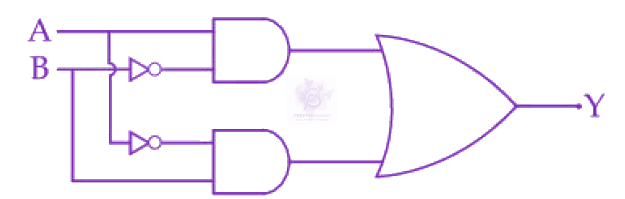
An electron with mass ' $m$ ' with an initial velocity $(\mathrm{t}=0) \overrightarrow{\mathrm{v}}=\mathrm{v}_0 \hat{\mathrm{i}} \quad\left(\mathrm{v}_0 \gt 0\right)$ enters a magnetic field $\vec{B}=B_0 \hat{j}$. If the initial de-Broglie wavelength at $\mathrm{t}=0$ is $\lambda_0$ then its value after time ' t ' would be :
Consider the following logic circuit. 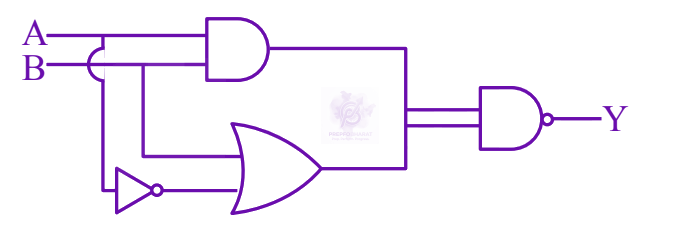 The output is $\mathrm{Y}=0$ when :
Given below are two statements. One is labelled as Assertion (A) and the other is labelled as Reason (R). Assertion (A) : The binding energy per nucleon is found to be practically independent of the atomic number A, for nuclei with mass numbers between 30 and 170. Reason (R): Nuclear force is long range. In the light of the above statements, choose the correct answer from the options given below :
The frequency of revolution of the electron in Bohr's orbit varies with $n$, the principal quantum number as
If \(\lambda\) and \(K\) are de Broglie wavelength and kinetic energy, respectively, of a particle with constant mass. The correct graphical representation for the particle will be
Choose the correct nuclear process from the below options [p: proton, n : neutron, $\mathrm{e}^{-}$: electron, $\mathrm{e}^{+}$: positron, $v:$ neutrino, $\bar{v}$ : antineutrino]
Consider the following statements: A. The junction area of solar cell is made very narrow compared to a photo diode. B. Solar cells are not connected with any external bias. C. LED is made of lightly doped p-n junction. D. Increase of forward current results in continuous increase of LED light intensity. E. LEDs have to be connected in forward bias for emission of light. Choose the correct answer from the options given below:
The radiation pressure exerted by a 450 W light source on a perfectly reflecting surface placed at 2 m away from it, is :
A proton of mass ' $m_{\mathrm{p}}$ ' has same energy as that of a photon of wavelength ' $\lambda$ '. If the proton is moving at non-relativistic speed, then ratio of its de Broglie wavelength to the wavelength of photon is.
Consider a n-type semiconductor in which $\mathrm{n}_{\mathrm{e}}$ and $\mathrm{n}_{\mathrm{h}}$ are number of electrons and holes, respectively. (A) Holes are minority carriers (B) The dopant is a pentavalent atom (C) $\mathrm{n}_{\mathrm{e}} \mathrm{n}_{\mathrm{h}} \neq \mathrm{n}_{\mathrm{i}}^2$ (where $n_i$ is number of electrons or holes in semiconductor when it is intrinsic form) (D) $\mathrm{n}_{\mathrm{e}} \mathrm{n}_{\mathrm{h}} \geq \mathrm{n}_{\mathrm{i}}^2$ (E) The holes are not generated due to the donors Choose the correct answer from the options given below :
An electron of mass ' m ' with an initial velocity $\overrightarrow{\mathrm{v}}=\mathrm{v}_0 \hat{i}\left(\mathrm{v}_0\gt0\right)$ enters an electric field $\overrightarrow{\mathrm{E}}=-\mathrm{E}_{\mathrm{o}} \hat{\mathrm{k}}$. If the initial de Broglie wavelength is $\lambda_0$, the value after time t would be